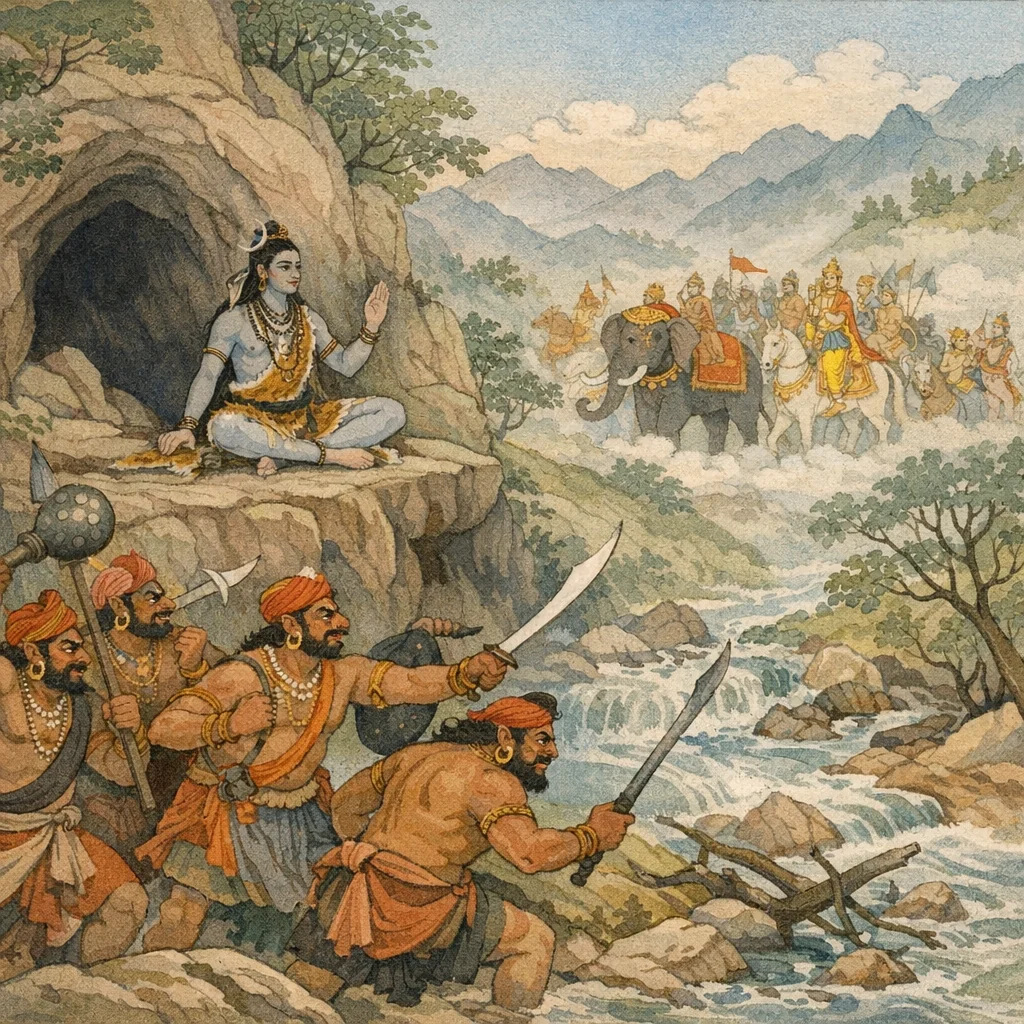
गिलासुर-आक्रमणम् तथा शिवसैन्य-समाह्वानम् — The Assault of Gila and Śiva’s Mobilization
Adhyāya 46, as narrated by Sanatkumāra, describes a decisive escalation: the daitya-king “Gila” rushes forward with his army, mace in hand, and violently breaches Maheśvara’s sacred stronghold at the cave-entrance (guhā-mukha). The daityas wield lightning-bright weapons, wreck gates and garden paths, and devastate plants, waters, and the beauty-order of the divine precinct—an act of boundaryless, lawless aggression (maryādā-hīna). In response, Hara (Śūlapāṇi/Kapardin/Pinākin) remembers and summons his own hosts; at once an immense, many-formed army gathers—devas (with Viṣṇu among the foremost), bhūtas, gaṇas, and liminal beings such as pretas and piśācas—along with chariots, elephants, horses, bulls, and battle formations. They arrive in reverence, appoint Vīraka as senāpati, and are dispatched by Maheśvara into war. The ensuing conflict is portrayed as yuga-end-like and without bounds, highlighting its cosmic scale and the moral polarity between desecration and the restoration of sacred order.
Shlokas
Verse 1
सनत्कुमार उवाच । तस्येंगितज्ञश्च स दैत्यराजो गदां गृहीत्वा त्वरितस्ससैन्यः । कृत्वाथ साऽग्रे गिलनामधेयं सुदारुणं देववरैरभेद्यम्
Sanatkumāra said: Knowing his intention, that king of the Daityas swiftly took up his mace and, together with his army, fashioned before him a most dreadful formation/weapon named “Gila,” which even the foremost of the gods could not break.
Verse 2
गुहामुखं प्राप्य महेश्वरस्य बिभेद शस्त्रैरशनिप्रकाशैः । अन्ये ततो वीरकमेव शस्त्रैरवाकिरञ्छैल सुतां तथान्ये
Reaching the mouth of Maheśvara’s cave, they struck and shattered it with weapons flashing like lightning. Then some warriors showered that heroic host with their arms, while others likewise rained weapons upon the Mountain-Daughter, Pārvatī.
Verse 3
द्वारं हि केचिद्रुचिरं बभंजुः पुष्पाणि पत्राणि विनाशयेयुः । फलानि मूलानि जलं च हृद्यमुद्यानमार्गानपि खंडयेयुः
Some of them smashed the beautiful gateway; others ruined the flowers and leaves. They destroyed the fruits and roots, even the pleasing water, and they also broke up the paths of the garden.
Verse 4
विलोडयेयुर्मुदिताश्च केचिच्छृंगाणि शैलस्य च भानुमंति । ततो हरस्सस्मृतवान्स्वसैन्यं समाह्वयन्कुपितः शूलपाणिः
Some of them, exulting, began to shake and churn the shining peaks of the mountain. Then Hara—remembering His own forces—angrily summoned His army, He who bears the trident in His hand.
Verse 5
भूतानि चान्यानि सुदारुणानि देवान्ससैन्यान्सह विष्णुमुख्यान् । आहूतमात्रानुगणास्ससैन्या रथैर्गजैर्वाजिवृषैश्च गोभिः
And other dread and ferocious beings too—along with the gods and their armies, with Viṣṇu and the foremost among them—came forth the moment they were summoned. Those attendant hosts arrived with their forces, furnished with chariots, elephants, horses, bulls, and even cattle.
Verse 6
उष्ट्रैः खरैः पक्षिवरैश्च सिंहैस्ते सर्वदेवाः सहभूतसंघैः । व्याघ्रैमृगैस्सूकरसारसैश्च समीनमत्स्यैश्शिशुमारमुख्यैः
All the gods, together with their companies of beings, came accompanied by camels, donkeys, noble birds, and lions—along with tigers, deer, boars, cranes, and hosts of aquatic creatures such as fishes, with porpoises and the like foremost among them.
Verse 7
अन्यैश्च नाना विधजीवसंघैर्विशीर्णदंशाः स्फुटितैस्स्मशानैः । भुजंगमैः प्रेतशतैः पिशाचैर्दिव्यैर्विमानैः कमलाकरैश्च
And along with many other multitudes of diverse beings—amid shattered and broken cremation-grounds, with fangs worn and ruined—there were serpents, hundreds of ghosts (preta), and piśācas; and there were also wondrous divine aerial chariots (vimānas) and lotus-filled lakes.
Verse 8
नदीनदैः पर्वतवाहनैश्च समागताः प्रांजलयः प्रणम्य । कपर्दिनं तस्थुरदीनसत्त्वास्सेनापतिं वीरकमेव कृत्वा
Gathering together with the rivers and their lords, and with the mountains and their bearers, they approached with joined palms and bowed. Then, steadfast and undaunted, they stood before Kapardin (Lord Śiva), appointing Vīraka alone as their commander-in-chief.
Verse 9
विसर्जयामास रणाय देवान्विश्रांतवाहानथ तत्पिनाकी । युद्धे स्थिरं लब्धजयं प्रधानं संप्रेषितास्ते तु महेश्वरेण
Then the Pināka-bearing Lord (Śiva) dispatched the gods to battle, after their mounts had been rested. Steady in warfare and already assured of victory, those foremost ones were thus sent forth by Maheśvara.
Verse 10
चक्रुर्युगांतप्रतिमं च युद्धं मर्य्यादहीनं सगिलेन सर्वे । दैत्येन्द्रसैन्येन सदैव घोरं क्रोधान्निगीर्णास्त्रिदशास्तु संख्ये
Then all of them together waged a battle like the cataclysm at the end of a yuga—without restraint and without limit. In that clash, the hosts of the Daitya-lord were ever dreadful, and the Tridaśas, amid the fight, seemed as though swallowed up by wrath.
Verse 11
तस्मिन्क्षणे युध्यमानाश्च सर्वे ब्रह्मेन्द्रविष्ण्वर्कशशांकमुख्याः । आसन्निगीर्णा विधसेन तेन सैन्ये निगीर्णेऽस्ति तु वीरको हि
In that very moment, as all fought—Brahmā, Indra, Viṣṇu, the Sun, the Moon, and the other foremost gods—they were on the verge of being swallowed up by that mighty host. As the army was thus engulfed, only the hero Vīraka remained.
Verse 12
विहाय संग्रामशिरोगुहां तां प्रविश्य शर्वं प्रणिपत्य मूर्ध्ना । प्रोवाच दुःखाभिहतः स्मरारिं सुवीरको वाग्ग्मिवरोऽथ वृत्तम्
Leaving the cavern called Saṅgrāmaśira, Suvīraka—the eloquent—entered and bowed his head in reverence to Śarva (Lord Śiva). Struck by grief, he spoke to Smarāri, the foe of Smara (Kāma), and reported the events exactly as they had occurred.
Verse 13
निगीर्णैते सैन्यं विधसदितिजेनाद्य भगवन्निगीर्णोऽसौ विष्णुस्त्रिभुवनगुरुर्दैत्यदलनः । निगीर्णौ चन्द्रार्कौद्रुहिणमघवानौ च वरदौ निगीर्णास्ते सर्वे यमवरुणवाताश्च धनदः
“O Lord, today an Asura who destroys the order of the Devas has swallowed up your army. Even Viṣṇu—the guru of the three worlds and crusher of the Daityas—has been swallowed. The Moon and the Sun have been swallowed; so too Brahmā and Indra, the gracious bestowers of boons. Indeed, all have been swallowed—Yama, Varuṇa, Vāyu, and Kubera (Dhanada) as well.”
Verse 14
स्थितोस्म्येकः प्रह्वः किमिह करणीयं भवतु मे अजेयो दैत्येन्द्रः प्रमुदितमना दैत्यसहितः
“I stand here alone, my head bowed in humility. What, indeed, should I do now? The lord of the Daityas is invincible, and with exultant mind he is accompanied by the hosts of asuras.”
Verse 15
अजेयं त्वां प्राप्तः प्रतिभयमना मारुतगतिस्स्वयं विष्णुर्देवः कनककशिपुं कश्यपसुतम् । नखैस्तीक्ष्णैर्भक्त्या तदपिभगवञ्छिष्टवशगः प्रवृत्तस्त्रैलोक्य विधमतु मलं व्यात्तवदनः
O Invincible Lord, Viṣṇu himself—swift as the wind and intent on dispelling fear—came upon Hiraṇyakaśipu, the son of Kaśyapa. With razor-sharp nails, and moved by bhakti, he too submitted to Your ordinance, O Bhagavān, and went forth with gaping mouth to crush the impurity that afflicted the three worlds.
Verse 16
वसिष्ठाद्यैश्शप्तो भुवनपतिभिस्सप्तमुनिभिस्तथाभूते भूयस्त्वमिति सुचिरं दैत्यसहितः
Cursed by Vasiṣṭha and the other sages, and likewise by the world-protecting lords and the Seven Ṛṣis, he remained in that condition for a long time, accompanied by the Daityas, thinking, “Again I shall rise (and return).”
Verse 17
ततस्तेनोक्तास्ते प्रणयवचनैरात्मनि हितैः कदास्माद्वै घोराद्भवति मम मोक्षो मुनिवराः । यतः क्रुद्धैरुक्तो विधसहरणाद्युद्धसमये ततो घोरैर्बाणैर्विदलितमुखे मुष्टिभिरलम्
Then, addressed by him with affectionate and well‑meaning words, they said: “O best of sages, when will mokṣa—liberation—come to me from this dreadful state? For in the time of battle, when the enraged one spoke of seizing the Creator Brahmā’s portion, my face was torn by terrible arrows—enough of these blows of fists!”
Verse 18
बदर्याख्यारण्ये ननु हरिगृहापुण्यवसतौ निसंस्तभ्यात्मानं विगतकलुषो यास्यसि परम् । ततस्तेषां वाक्यात्प्रतिदिनमसौ दैत्यगिलनः क्षुधार्तस्संग्रामाद्भ्रमति पुनरामोदमुदितः
“Indeed, in the forest called Badarī—an auspicious holy abode, the very ‘house’ of Hari (Viṣṇu)—steadying your inner self and becoming free of impurity, you shall attain the Supreme.” After those words, that demon‑devourer, tormented by hunger, again roamed about because of the battle—yet was gladdened, taking delight in his own fierce prowess.
Verse 19
तमस्वेदं घोरं जगदुदितयोस्सूर्यशशिनोर्यथाशुक्रस्तुभ्यं परमरिपुरत्यंतविकरः । हतान्देवैर्देत्यान्पुनरमृतविद्यास्तुतिपदैस्सवीर्यान्संदृष्टान्व्रणशतवियुक्तान्प्रकुरुते
This dreadful darkness is like the radiance of the sun and moon risen over the world; yet for you it is a supreme adversary, exceedingly fierce. The Daityas once slain by the Devas are being restored again by praise-formulas of the nectar-bearing knowledge, seen once more as vigorous, freed from hundreds of wounds.
Verse 20
वरं प्राणास्त्याज्यास्तव मम तु संग्रामसमये भवान्साक्षीभूतः क्षणमपि वृतः कार्यकरणे
Better that life itself be given up; but in the time of battle, you must not withdraw even for a moment. Remain as my witness and be engaged in accomplishing the task.
Verse 21
सनत्कुमार उवाच । इतीदं सत्पुत्रात्प्रमथपतिराकर्ण्य कुपितश्चिरं ध्यात्वा चक्रे त्रिभुवनपतिः प्रागनुपमम् । प्रगायत्सामाख्यं दिनकरकराकारवपुषा प्रहासात्तन्नाम्ना तदनु निहतं तेन च तमः
Sanatkumāra said: Hearing these words from that noble son, Pramathapati (Śiva, Lord of the Gaṇas) became wrathful. After long contemplation, the Lord of the three worlds brought forth something unprecedented. Singing a sāman-hymn, he manifested a form like the rays of the sun; and by his very laughter—bearing that newly uttered name—he thereafter struck down the darkness.
Verse 22
प्रकाशेस्मिंल्लोके पुनरपि महायुद्धमकरोद्रणे दैत्यैस्सार्द्धं विकृतवदनैर्वीरकमुनिः । शिलाचूर्णं भुक्त्वा प्रवरमुनिना यस्तु जनितस्स कृत्वा संग्रामं पुरमपि पुरा यश्च जितवान्
Then, in this manifest world, the heroic sage Vīraka once more waged a great battle on the field against the Dānavas, whose faces were grotesquely contorted. He who was brought forth by the foremost of sages—after consuming powdered stone—entered the fray and, in former times, even conquered their citadel.
Verse 23
महारुद्रस्सद्यः स खलु दितिजेनातिगिलितस्ततश्चासौ नन्दी निशितशरशूलासिसहितः । प्रधानो योधानां मुनिवरशतानामपि महान्निवासो विद्यानां शमदममहाधैर्यसहितः
Then Mahārudra was indeed swallowed up at once by the Dānava. Thereupon Nandī, bearing sharp arrows, a trident, and a sword, advanced—foremost among warriors, great even among hundreds of best sages, an abode of sacred knowledges, endowed with tranquility, self-restraint, and mighty steadfast courage.
Verse 24
निरीक्ष्यैवं पश्चाद्वृषभवरमारुह्य भगवान्कपर्द्दी युद्धार्थी विधसदितिजं सम्मुखमुखः । जपन्दिव्यं मन्त्रं निगलनविधानोद्गिलनकं स्थितस्सज्जं कृत्वा धनुरशनिकल्पानपि शरान्
Having thus observed, the blessed Lord Kapardī mounted the excellent bull and, intent on battle, faced the Daitya who stood opposite. Continuously reciting a divine mantra—one that could both swallow and cast forth the foe—he stood ready, with thunderbolt-like arrows set upon the bowstring.
Verse 25
ततौ निष्कांतोऽसौ विधसवदनाद्वीरकमुनिर्गृहीत्वा तत्सर्वे स्वबलमतुलं विष्णुसहितः । समुद्गीर्णास्सर्वे कमलजबलारीन्दुदिनपाः प्रहृष्टं तसैन्यं पुनरपि महायुद्धमकरोत्
Then the heroic sage Vīraka came forth from the mouth of Brahmā. Taking up that incomparable force—together with Viṣṇu—he rallied and gathered them all. Brahmā, Indra, the Moon, and the Sun also raised their battle-cries; and that delighted host once again waged a mighty war.
Verse 26
जिते तस्मिञ्छुक्रस्तदनु दितिजान्युद्धविहतान् यदा विद्यावीर्यात्पुनरपि सजीवान्प्रकुरुते । तदा बद्ध्वानीतः पशुरिव गणैभूतपतये निगीर्णस्तेनासौ त्रिपुररिपुणा दानवगुरुः
When they had been conquered, Śukra, by the power of mantra-knowledge, began to restore to life the Daityas fallen in battle. Then the gaṇas bound him and dragged him like an animal to Bhūtapati, Lord Śiva; and there the enemy of Tripura—Śiva—swallowed the guru of the Dānavas.
Verse 27
विनष्टे शुक्राख्यो सुररिपुनिवासस्तदखिलो जितो ध्वस्तो भग्नो भृशमपि सुरैश्चापि दलितम् । प्रभूतैर्भूतौघैर्दितिजकुणपग्रासरसिकैस्सरुंडैर्नृत्यद्भिर्निशितशरशक्त्युद्धृतकरैः
When Śukra—called the very refuge of the enemies of the gods—was destroyed, the entire Daitya stronghold was conquered, shattered, and utterly broken, grievously crushed by the Devas. Then vast hosts of Bhūtas surged forth, delighting in devouring the demons’ corpses, howling and dancing with hands raised, brandishing sharp arrows and spears.
Verse 28
प्रमत्तैर्वेतालैस्सुदृढकरतुंडैरपि खगैवृकैर्नानाभेदैश्शवकुणपपूर्णास्यकवलैः । विकीर्णे संग्रामे कनककशिपोर्वंशजनकश्चिरं युद्धं कृत्वा हरिहरमहेन्द्रैश्च विजितः
When the battle was thrown into chaos—amid frenzied vetālas, fierce birds with hard, powerful beaks, and wolves of many kinds, their mouths stuffed with morsels of corpses—then the progenitor of Hiraṇyakaśipu’s lineage fought for a long time, but was ultimately defeated by Hari (Viṣṇu), Hara (Śiva), and Mahendra (Indra).
Verse 29
प्रविष्टे पाताले गिरिजलधिरंध्राण्यपि तथा ततस्सैन्ये क्षीणे दितिजवृषभश्चांधकवरः । प्रकोपे देवानां कदनदवरो विश्वदलनो गदाघातैर्घोरैर्विदलितमदश्चापि हरिणा
When he had entered Pātāla—and even the mountain-caves and ocean-depths—then, as that army was worn down, Andhaka, foremost among the Daityas, the bull among demons, rose up. With the Devas inflamed in wrath, that chief maker of slaughter, the world-rending one, had his pride shattered too—split apart by Hari through dreadful blows of the mace.
Verse 30
न वै यस्सग्रामं त्यजति वरलब्धः किलः यत स्तदा ताडैर्घोरैस्त्रिदशपतिना पीडिततनुः । ततश्शस्त्रास्त्रौघैस्तरुगिरिजलैश्चाशु विबुधाञ्जिगायोच्चैर्गर्जन्प्रमथपतिमाहूय शनकैः
For he—fortified by the boon he had obtained—did not abandon the battlefield. Though his body was tormented by the dreadful blows of the lord of the gods, he swiftly overcame the celestials with torrents of weapons and astras, hurling trees, mountains, and waters; roaring aloud, he gradually summoned the Lord of the Pramathas (Śiva).
Verse 31
स्थितो युद्धं कुर्वन्रणपतितशस्त्रैर्बहुविधैः परिक्षीणैस्सर्वैस्तदनु गिरिजा रुद्रमतुदत् । तथा वृक्षैस्सर्पैरशनिनिवहैः शस्त्रप टलैर्विरूपैर्मायाभिः कपटरचनाशम्बरशतैः
Standing firm and continuing the battle, Rudra saw that all the many kinds of weapons that had fallen upon the battlefield were spent and ineffective. Thereafter Girijā assailed Rudra again—hurling trees, serpents, volleys of thunderbolts, showers of weapons, and even distorted magical illusions, fashioned through hundreds of deceptive stratagems.
Verse 32
विजेतुं शैलेशं कुहकमपरं तत्र कृतवान्महासत्त्वो वीरस्त्रिपुररिपुतुल्यश्च मतिमान् । न वध्यो देवानां वरशतमनोन्मादविवशः प्रभूतैश्शस्त्रास्त्रैस्सपदि दितिजो जर्जरतनुः
To conquer Śaileśa, that mighty hero devised yet another deception there—valiant, great-souled, intelligent, and comparable to the Slayer of Tripura. But the Dānava, driven mad by a hundred boons, could not be slain by the gods; though struck at once with many weapons and astras, his body only became battered and shattered.
Verse 33
तदीयाद्विष्यन्दात्क्षिति तलगतैरन्धकगणैरतिव्याप्तघोरं विकृतवदनं स्वात्मसदृशम् । दधत्कल्पांताग्निप्रतिमवपुषा भूतपतिना त्रिशूले नोद्भिन्नस्त्रिपुररिपुणा दारुणतरम्
From his body there streamed forth upon the earth hosts of Andhakas, spreading everywhere in a dreadful flood. Each bore a distorted, terrifying face and was like his very own self. Yet the Lord of the Bhūtas, whose form blazed like the fire at the end of the age, was not pierced even by the trident of Tripura’s foe (Śiva); indeed he became still more ferocious.
Verse 34
यदा सैन्यासैन्यं पशुपतिहतादन्यदभवद्व्रणोत्थैरत्युष्णैः पिशितनिसृतैर्बिन्दुभिरलम् । तदा विष्णुर्योगा त्प्रमथपतिमाहूय मतिमान् चकारोग्रं रूपं विकृतवदनं स्त्रैणमजितम्
When the opposing hosts, struck down by Paśupati, became altogether different—splattered everywhere with exceedingly hot drops flowing from flesh and from wounds—then the wise Viṣṇu, by the power of yoga, summoned the lord of the Pramathas and fashioned a fierce form: unconquered, with a distorted face, assuming a womanly guise.
Verse 35
करालं संशुष्कं बहुभुजलताक्रांतकुपितो विनिष्क्रांतः कर्णाद्रणशिरसि शंभोश्च भगवान्
Then the Blessed Lord—terrible to behold and parched with fury, enraged as he was seized and entwined by many arm-like coils—burst forth from the ear onto the battlefield, even before Śambhu (Śiva).
Verse 36
रणस्था सा देवी चरणयुगलालंकृतमही स्तुता देवैस्सर्वैस्मदनु भगवान् प्रेरितमतिः । क्षुधार्ता तत्सैन्यं दितिजनिसृतं तच्च रुधिरं पपौ सात्युष्णं तद्रणशिरसि सृक्कर्दममलम्
Standing in the midst of the battle, that Goddess—whose two feet adorned the earth—was praised by all the gods. Thereupon, her resolve, impelled by the Lord, became firm. Tormented by hunger, she drank the army that had issued from the Daityas, and she drank their blood as well—hot indeed—so that on the battlefield her mouth became smeared with the mud-like stain of gore.
Verse 37
ततस्त्वेको दैत्यस्तदपि युयुधे शुष्करुधिरस्तलाघातैर्घोरैशनिसदृशैर्जानुचरणैः । नखैर्वज्राकारैर्मुखभुजशिरोभिश्च गिरिशं स्मरन् क्षात्रं धर्मं स्वकुल विहितं शाश्वतमजम्
Then a certain Daitya—his blood dried—still fought on, striking with terrifying blows of his palms like thunder, using his knees and feet as weapons. With nails like vajras, and with his face, arms, and head as well, he assailed Girīśa, remembering the warrior’s duty—an eternal, birthless ordinance enjoined upon his own lineage.
Verse 38
रणे शांतः पश्चात्प्रमथपतिना भिन्नहृदयस्त्रिशूले सप्रोतो नभसि विधृतस्स्थाणुसदृशः । अधःकायश्शुष्कस्नपनकिरणैर्जीर्णतनुमाञ्जलासारेर्मेघैः पवनसहितैः क्लेदितवपुः
In the battle he grew still; then, struck from behind by the Lord of the Pramathas, his heart was pierced by the triśūla. Impaled upon that trident and held aloft in the sky, he stood motionless like a pillar. His lower body, dried by scorching yet purifying rays, seemed worn and withered; yet his frame was drenched by rain-bearing clouds driven on by the wind.
Verse 39
विशीर्णस्तिग्मांशोस्तुहिनशकलाकारशकलस्तथाभूतः प्राणांस्तदपि न जहौ दैत्य वृषभः । तदा तुष्टश्शंभुः परमकरुणावारिधिरसौ ददौ तस्मै प्रीत्या गणपतिपदं तेन विनुतः
Though shattered—like fragments of the scorching sun and like splinters as pieces of ice—yet the daitya Vṛṣabha did not relinquish his life-breath. Then Śambhu, that ocean of supreme compassion, being pleased, lovingly granted him the rank of Gaṇapati; and thereafter he praised the Lord.
Verse 40
ततो युद्धस्यांते भुवनपतयस्सार्थ रमणैस्तवैर्नानाभेदैः प्रमथपतिमभ्यर्च्य विधिवत् । हरिब्रह्माद्यास्ते परमनुतिभिस्स्तुष्टुवुरलं नतस्कंधाः प्रीता जयजय गिरं प्रोच्य सुखिताः
Then, when the battle had ended, the lords of the worlds—together with their consorts—worshipped the Lord of the Pramathas (Śiva) according to due rite, praising Him with hymns of many kinds. Hari, Brahmā, and the other gods, their shoulders bowed in reverence, extolled Him abundantly with supreme adorations; delighted, they uttered cries of “Victory, victory!” and became joyful.
Verse 41
हरस्तैस्तैस्सार्द्धं गिरिवरगुहायां प्रमुदितो विसृज्यैकानंशान् विविधबलिना पूज्यसुनगान् । चकाराज्ञां क्रीडां गिरिवर सुतां प्राप्य मुदितां तथा पुत्रं घोराद्विधसवदनान्मुक्तमनघम्
There, in the cave of the best of mountains, Hara rejoiced with those attendants. Having dispatched certain portions (of his power) and venerable divine beings endowed with varied strength, he issued his command. Then, delighted, he obtained the mountain-born goddess (Pārvatī) for his sportive play; and he also gained, free from all blemish, a son released from the dreadful, twofold-faced (peril).
Verse 46
इति श्रीशिवमहा पुराणे द्वितीयायां रुद्रसंहितायां पंचमे युद्धखण्डे अंधकवधोपाख्याने अन्धकयुद्धवर्णनं नाम षट्चत्वारिंशोऽध्यायः
Thus, in the Śrī Śiva Mahāpurāṇa—within the Second (section), the Rudra Saṃhitā, in the Fifth, the Yuddha Khaṇḍa—within the episode of Andhaka’s slaying, ends the forty-sixth chapter, entitled “The Description of the Battle with Andhaka.”
Frequently Asked Questions
The daitya-king’s (Gila-associated) assault on Maheśvara’s sacred precinct and Śiva’s immediate counter-mobilization of devas, gaṇas, and bhūtas culminating in a yuga-end-like battle.
The episode encodes boundary-violation as adharma and depicts Śiva’s sovereignty as the power to integrate even liminal forces (pretas/piśācas/bhūtas) into a single ordered agency restoring cosmic stability.
Śiva is signaled through epithets—Kapardin, Śūlapāṇi, Pinākin—emphasizing his martial authority and command-function; the collective manifestation of his śakti appears as the assembled gaṇa-bhūta host under Vīraka.