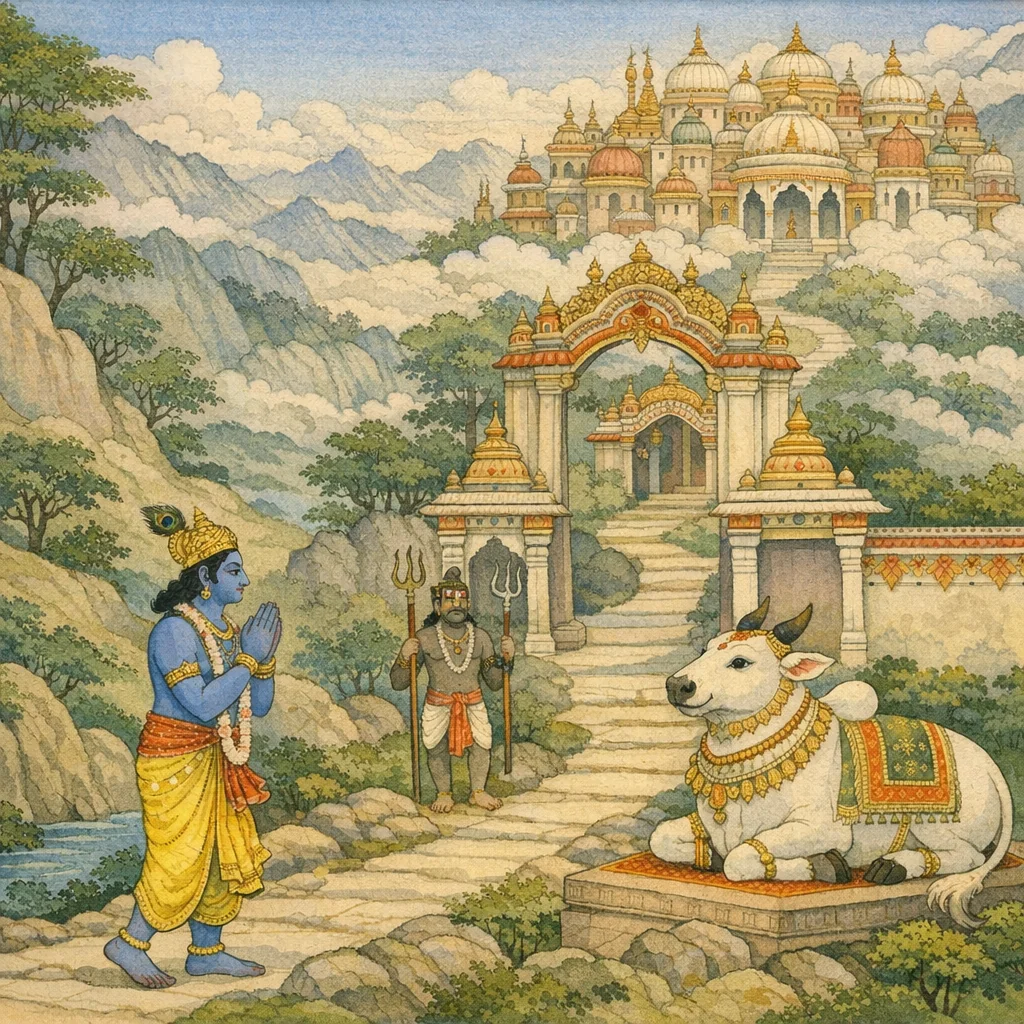
शिवलोकप्रवेशः (Entry into Śivaloka through successive gateways)
Adhyāya 30 describes entry into Śivaloka through successive gates, each crossed only by formal permission. Sanatkumāra recounts how the arriving deity (with Brahmā/Rameśvara mentioned) reaches the “mahādivya” Śivaloka, a non-material, supportless realm (nirādhāra, abhautika). Viṣṇu, filled with inner joy, beholds a jewel-bright world and comes to the first gateway guarded by gaṇas, then meets dvārapālas seated on jeweled thrones, clad in white and gem-adorned. Marked by Śaiva features—five faces, three eyes, weapons like the triśūla, sacred ash and rudrākṣa—they receive his bow, hear his request to behold the Lord, and grant ājñā to pass. This protocol repeats through many gates (fifteen are named), until the great gate where Nandin appears; after salutation and praise, Nandin authorizes entry, and Viṣṇu enters the inner precinct in delight. The chapter maps sacred space as a graded hierarchy of access, stressing protocol, devotional praise (stuti), and sanctioned entry as prerequisites for nearness to Śiva.
Shlokas
Verse 1
सनत्कुमार उवाच । गत्वा तदैव स विधिस्तदा व्यास रमेश्वरः । शिवलोकं महादिव्यं निराधारमभौतिकम्
Sanatkumāra said: Then, at once, that Ordainer—Brahmā—went there, O Vyāsa, to the supremely divine realm of Śiva, which is without material support and beyond physical substance.
Verse 2
साह्लादोभ्यन्तरं विष्णुर्जगाम मुदिताननः । नानारत्नपरिक्षिप्तं विलसंतं महोज्ज्वलम्
With his heart filled with delight, Lord Viṣṇu proceeded, his face radiant with joy, into that splendid inner chamber—shining with great brilliance and adorned all around with many kinds of jewels.
Verse 3
संप्राप्य प्रथमद्वारं विचित्रं गणसेवितम् । शोभितं परया लक्ष्म्या महोच्चमतिसुन्दरम्
Reaching the first gate—marvelous in design and attended by Śiva’s gaṇas—he saw it adorned with supreme splendor, exceedingly lofty and most beautiful.
Verse 4
ददर्श द्वारपालांश्च रत्नसिंहासनस्थितान् । शोभिताञ्श्वेतवस्त्रैश्च रत्नभूषणभूषितान्
He beheld the gatekeepers seated upon jeweled thrones—radiant in white garments and adorned with ornaments of precious gems.
Verse 5
पञ्चवक्त्रत्रिनयनान्गौरसुन्दरविग्रहान् । त्रिशूलादिधरान्वीरान्भस्मरुद्राक्षशोभितान्
He beheld heroic beings with five faces and three eyes, whose forms were radiant and beautiful—bearing tridents and other weapons, and resplendent with sacred ash (bhasma) and rudrākṣa beads.
Verse 6
सब्रह्मापि रमेशश्च तान् प्रणम्य विनम्रकः । कथयामास वृत्तान्तं प्रभुसंदर्शनार्थकम्
Then Rameśa—together with Brahmā—bowed to them in humility and recounted the events that would lead to the blessed darśana, the vision of the Lord.
Verse 7
तदाज्ञां च ददुस्तस्मै प्रविवेश तदाज्ञया । परं द्वारं महारम्यं विचित्रं परम प्रभम्
They granted him their permission; and, in obedience to that command, he entered through the supreme gateway—exceedingly delightful, wondrous, and radiant with the highest splendor.
Verse 8
प्रभूपकंठगत्यर्थं वृत्तांतं संन्यवेदयत् । तद्द्वारपाय चाज्ञप्तस्तेनान्यं प्रविवेश ह
Seeking audience with the Lord, he duly reported the entire account. Then, instructed by the gatekeeper, he entered by another appointed way.
Verse 9
एवं पंचदशद्वारान्प्रविश्य कमलोद्भवः । महाद्वारं गतस्तत्र नन्दिनं प्रददर्श ह
Thus Kamalodbhava (Brahmā), having passed through the fifteen gateways, came to the great main gate; there he beheld Nandin standing as the guardian of Śiva’s abode.
Verse 10
सम्यङ्नत्वा च तं स्तुत्वा पूर्ववत्तेन नन्दिना । आज्ञप्तश्च शनैर्विष्णुर्विवेशाभ्यंतरं मुदा
Having bowed properly to him and praised him, Viṣṇu—being instructed by Nandin as before—slowly entered within, joyfully.
Verse 11
ददर्श गत्वा तत्रोच्चैस्सभां शंभोस्समुत्प्रभाम् । तां पार्षदैः परिवृतां लसद्देहैस्सुभूषिताम्
Having gone there, he beheld aloft the radiant assembly-hall of Lord Śambhu, shining with splendid brilliance—surrounded by Śiva’s attendants and beautifully adorned by their luminous forms.
Verse 12
महेश्वरस्य रूपैश्च दिग्भुजैश्शुभकांतिभिः । पञ्चवक्त्रैस्त्रिनयनैश्शितिकंठमहोज्ज्वलैः
They beheld the forms of Maheśvara, radiant with auspicious splendor—his arms extending to all directions, bearing five faces and three eyes—blazing in great brilliance as the blue-throated Lord, Nīlakaṇṭha.
Verse 13
सद्रत्नयुक्तरुद्राक्षभस्माभरणभूषितैः । नवेन्दुमंडलाकारां चतुरस्रां मनोहराम्
Adorned with auspicious gems, with Rudrākṣa beads, with bhasma (sacred ash) and ornaments, it was charming—shaped like the orb of the new moon and fashioned in a delightful four-sided design.
Verse 14
मणीन्द्रहारनिर्माणहीरसारसुशोभिताम् । अमूल्यरत्नरचितां पद्मपत्रैश्च शोभिताम्
It shone splendidly, adorned with the finest essence of diamonds set into necklaces fit for the lord of jewels; fashioned from priceless gems, it was further beautified with lotus-petal motifs.
Verse 15
माणिक्यजालमालाभिर्नानाचित्रविचित्रिताम् । पद्मरागेन्द्ररचितामद्भुतां शंकरेच्छया
Adorned with networks of ruby garlands and embellished with many wondrous designs, it was an astonishing creation fashioned by the lord of Padmarāga gems—brought forth by Śaṅkara’s own will.
Verse 16
सोपानशतकैर्युक्तां स्यमंतकविनिर्मितैः । स्वर्णसूत्रग्रन्थियुक्तैश्चारुचन्दनपल्लवैः
It was furnished with hundreds of steps, fashioned by Syamantaka, and adorned with charming sprigs of sandalwood, tied in knots with golden threads.
Verse 17
इन्द्रनीलमणिस्तंभैर्वेष्टितां सुमनोहराम् । सुसंस्कृतां च सर्वत्र वासितां गंधवायुना
It was encircled by pillars of indranīla sapphire, exceedingly enchanting to behold—well-adorned in every part and perfumed everywhere by fragrant breezes.
Verse 18
सहस्रयोजनायामां सुपूर्णां बहुकिंकरैः । ददर्श शंकरं सांबं तत्र विष्णुस्सुरेश्वरः
There, Lord Viṣṇu—the lord of the gods—beheld Śaṅkara, the auspicious Lord, together with Ambā (Umā), in a region stretching a thousand yojanas, completely filled with many attendants.
Verse 19
वसंतं मध्यदेशे च यथेन्दुतारकावृतम् । अमूल्यरत्ननिर्माणचित्रसिंहासनस्थितम्
In the central region there appeared a splendid spring-like radiance, encircled by the moon and stars, and set upon a wondrous throne fashioned with inestimable gems and intricate workmanship.
Verse 20
किरीटिनं कुंडलिनं रत्नमालाविभूषितम् । भस्मोद्धूलितसर्वाङ्गं बिभ्रतं केलिपंकजम्
He was adorned with a crown and earrings, beautified by a garland of gems; his entire body was dusted with sacred bhasma ash, and he held a lotus—an emblem of sportive grace—in his hand.
Verse 21
पुरतो गीतनृत्यश्च पश्यंतं सस्मितं मुदा
Before him there was singing and dancing; and he watched it, smiling gently, with joy.
Verse 22
शांतं प्रसन्नमनसमुमाकांतं महोल्लसम् । देव्या प्रदत्त ताम्बूलं भुक्तवंतं सुवासितम्
He beheld Lord Śiva—tranquil, serene in mind, the beloved of Umā, and greatly radiant—who had accepted and chewed the fragrant tāmbūla (betel) offered by the Goddess.
Verse 23
गणैश्च परया भक्त्या सेवितं श्वेतचामरैः । स्तूयमानं च सिद्धैश्च भक्तिनम्रात्मकंधरैः
He was attended by the Gaṇas with supreme devotion, fanned with white chowries, and praised by the Siddhas—whose very bearing was humbled and softened by devotion.
Verse 24
गुणातीतं परेशानं त्रिदेवजनकं विभुम् । निर्विकल्पं निराकारं साकारं स्वेच्छया शिवम्
I contemplate Śiva—the Supreme Lord beyond the three guṇas, the sovereign God above all, the all-pervading source of the three deities; who is free from all conceptual distinctions and formless in His highest reality, yet who, by His own will, assumes a manifest form for the sake of grace and liberation.
Verse 25
अमायमजमाद्यञ्च मायाधीशं परात्परम् । प्रकृतेः पुरुषस्यापि परमं स्वप्रभुं सदा
He is free from delusion, unborn and beginningless; the Lord of Māyā, higher than the highest. Ever the supreme Self-Lord, He stands beyond both Prakṛti (Nature) and Puruṣa (the individual conscious being).
Verse 26
एवं विशिष्टं तं दृष्ट्वा परिपूर्णतमं समम् । विष्णुर्ब्रह्मा तुष्टुवतुः प्रणम्य सुकृतांजली
Seeing Him thus—supremely distinguished, most perfectly complete, and ever the same—Vishnu and Brahma bowed down, formed their hands in reverent añjali, and praised Him with devotion.
Verse 27
विष्णुविधी ऊचतुः । देवदेव महादेव परब्रह्माखिलेश्वर । त्रिगुणातीत निर्व्यग्र त्रिदेवजनक प्रभो
Vishnu and Brahma said: “O God of gods, O Mahadeva—Supreme Brahman and Lord of all! O Master, transcending the three guṇas and ever undisturbed—O origin of the three gods, O mighty Lord!”
Verse 28
वयं ते शरणापन्ना रक्षस्मान्दुखितान्विभो । शंखचूडार्दितान्क्लिष्टान्सन्नाथान्परमेश्वर
“We have taken refuge in You. Protect us, O all-pervading Lord, for we are afflicted with sorrow—harassed and tormented by Śaṅkhacūḍa. O Parameśvara, be our true protector and shelter.”
Verse 29
अयं योऽधिष्ठितो लोको गोलोक इति स स्मृतः । अधिष्ठाता तस्य विभुः कृष्णोऽयं त्वदधिष्ठितः
“This world that is presided over is remembered as Goloka. Its presiding Lord is the all-pervading Kṛṣṇa; and even he stands under Your governance (O Śiva), being established by You.”
Verse 30
इति श्रीशिव महापुराणे द्वितीयायां रुद्रसंहितायां पञ्चमे युद्धखंडे शंखचूडवधे देवदेवस्तुतिर्नाम त्रिंशोऽध्यायः
Thus, in the Śrī Śiva Mahāpurāṇa—within the Second section, the Rudra-saṃhitā, in the Fifth division called the Yuddha-khaṇḍa—during the account of Śaṅkhacūḍa’s slaying, ends the thirtieth chapter entitled “Devadeva-stuti,” the hymn of praise to the God of Gods.
Verse 31
तेन निस्सारिताः शंभो पीड्यमानाः समंततः । हृताधिकारस्त्रिदशा विचरंति महीतले
O Śambhu, driven out by him and oppressed on every side, the thirty gods—stripped of their divine authority—wander upon the face of the earth.
Verse 32
त्वां विना न स वध्यश्च सर्वेषां त्रिदिवौकसाम् । तं घातय महेशान लोकानां सुखमावह
Without You, O Maheshvara, that one cannot be slain by any of the dwellers of the three heavens. Therefore, O Great Lord, strike him down and bring well-being and happiness to the worlds.
Verse 33
त्वमेव निर्गुणस्सत्योऽनंतोऽनंतपराक्रमः । सगुणश्च सन्निवेशः प्रकृतेः पुरुषात्परः
You alone are the attributeless Reality—true, infinite, and of limitless might. Yet You also become manifest with attributes and form; You transcend both Prakṛti (Nature) and Puruṣa (the individual conscious principle), standing supreme beyond them.
Verse 34
रजसा सृष्टिसमये त्वं ब्रह्मा सृष्टिकृत्प्रभो । सत्त्वेन पालने विष्णुस्त्रिभुवावन कारकः
O Lord, at the time of creation, through rajas You become Brahmā, the maker of the world; and for its preservation, through sattva You become Viṣṇu, the protector of the three worlds.
Verse 35
तमसा प्रलये रुद्रो जगत्संहारकारकः । निस्त्रैगुण्ये शिवाख्यातस्तुर्य्यो ज्योतिः स्वरूपकः
At the time of dissolution, by the power of tamas, Rudra becomes the agent who withdraws and dissolves the universe. But in the state beyond the three guṇas, He is known as Śiva—the Fourth (turīya), whose very nature is pure Light (jyotis).
Verse 36
त्वं दीक्षया च गोलोके त्वं गवां परिपालकः । त्वद्गोशालामध्यगश्च कृष्णः क्रीडत्यहर्निशम्
By virtue of your consecration, you are fit to dwell in Goloka; you are the guardian of the cows. And Krishna, staying in the midst of your cowshed, plays there day and night.
Verse 37
त्वं सर्वकारणं स्वामी विधि विष्ण्वीश्वरः परम् । निर्विकारी सदा साक्षी परमात्मा परेश्वरः
You are the Lord, the cause of all causes—the supreme ruler even over Brahmā and Viṣṇu. Ever changeless, ever the Witness, You are the Supreme Self (Paramātman), the transcendent Lord of all.
Verse 38
दीनानाथसहायी च दीनानां प्रतिपालकः । दीनबंधुस्त्रिलोकेशश्शरणागतवत्सलः
He is the helper of the helpless, the protector of the afflicted, the true friend of the lowly; the Lord of the three worlds, ever tender toward those who seek refuge in Him.
Verse 39
अस्मानुद्धर गौरीश प्रसीद परमेश्वरः । त्वदधीना वयं नाथ यदिच्छसि तथा कुरु
O Lord of Gaurī, be gracious, O Supreme Lord—lift us up and deliver us. O Master (Nātha), we are wholly dependent upon You; do exactly as You will.
Verse 40
सनत्कुमार उवाच । इत्युक्त्वा तौ सुरौ व्यास हरिर्ब्रह्मा च वै तदा । विरेमतुः शिवं नत्वा करौ बद्ध्वा विनीतकौ
Sanatkumāra said: Having thus spoken, O Vyāsa, those two deities—Hari (Viṣṇu) and Brahmā—then desisted. Bowing to Śiva, they stood with folded hands, humbled and disciplined in their demeanor.
Frequently Asked Questions
The chapter depicts Viṣṇu’s (and the accompanying divine party’s) entry toward Śivaloka through successive guarded gateways, culminating in meeting Nandin at the great gate and receiving permission to enter the inner precinct.
They symbolize graded spiritual access: movement from outer perception to inner proximity requires humility (praṇāma), praise (stuti), right intention (darśanārtha), and grace-mediated authorization—an allegory for disciplined approach to the Absolute.
Śaiva guardians are described with pañcavaktra (five faces), trinayana (three eyes), weapons such as the triśūla, and ascetic-devotional emblems like bhasma (sacred ash) and rudrākṣa—signaling Śiva’s sovereign domain.