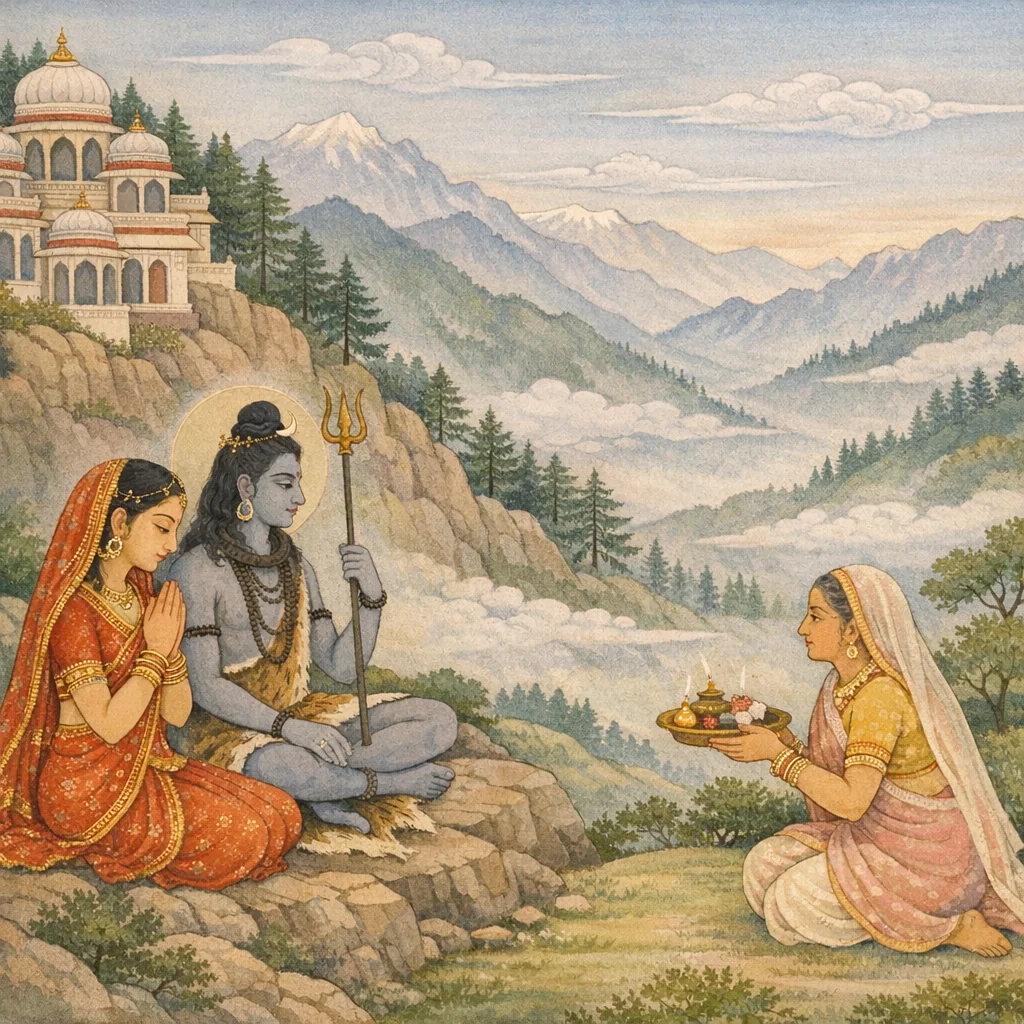
हिमाचलविवाहवर्णनम् — Description of Himācala’s (context for) Marriage / The Himālaya-Marriage Narrative (Chapter Opening)
The chapter opens with Nārada asking Brahmā how and why Satī—after relinquishing her body at her father Dakṣa’s yajña—comes to manifest again as Girisutā, the mountain’s daughter, and as Jagadambikā, Mother of the world. Brahmā presents the reply as a purifying account within Śiva’s sacred narrative. The discourse then places Satī with Hara upon Himācala in a playful divine mood, and introduces Menā, Himācala’s beloved, who recognizes the Goddess’s destined motherhood. After Satī is dishonored and abandoned at Dakṣa’s sacrifice, Menā is shown devoutly propitiating the Goddess in Śivaloka. Satī inwardly resolves to be born as Menā’s daughter; though she gives up the body, she preserves the continuity of her saṅkalpa (intent) to re-manifest. In due time, praised by the gods, Satī is born as Menā’s daughter, laying the foundation for Pārvatī’s later tapas and her re-attainment of Śiva as husband.
Shlokas
Verse 1
इति श्रीशिवमहापुराणे द्वितीयायां रुद्रसंहितायां तृतीये पार्वतीखण्डे हिमाचलविवाहवर्णनं नाम प्रथमोध्यायः
Thus, in the Śrī Śiva Mahāpurāṇa—within the Second section, the Rudrasaṃhitā—here begins the First Chapter of the Third division, the Pārvatī-khaṇḍa, entitled “The Description of Himācala’s Marriage.”
Verse 2
कथं कृत्वा तपोऽत्युग्रम्पतिमाप शिवं च सा । एतन्मे पृच्छते सम्यक्कथय त्वं विशेषतः
“By performing what kind of exceedingly intense tapas did she attain Śiva as her husband? I ask you this precisely—tell me the matter in full detail.”
Verse 3
ब्रह्मोवाच । शृणु त्वं मुनिशार्दूल शिवाचरितमुत्तमम् । पावनं परमं दिव्यं सर्वपापहरं शुभम्
Brahmā said: O tiger among sages, listen to the supreme sacred narrative of Śiva—most purifying, highest and divine, auspicious, and the remover of all sins.
Verse 4
यदा दाक्षायणी देवी हरेण सहिता मुदा । हिमाचले सुचिक्रीडे लीलया परमेश्वरी
When the Goddess Dākṣāyaṇī, the Supreme Lady, was joyfully united with Hara (Lord Śiva), she sported upon Himācala (the Himālaya) in pure and auspicious play, in divine līlā.
Verse 5
मत्सुतेयमिति ज्ञात्वा सिषेवे मातृवर्चसा । हिमाचलप्रिया मेना सर्वर्द्धिभिरनिर्भरा
Knowing, “She is truly my own daughter,” Menā—the beloved queen of Himācala—served and nurtured her with the radiant authority of a mother, dwelling in contentment, upheld by every kind of prosperity.
Verse 6
यदा दाक्षायणी रुष्टा नादृता स्वतनुं जहौ । पित्रा दक्षेण तद्यज्ञे संगता परमेश्वरी
When Dakṣāyaṇī (Satī), angered at not being shown due honor, abandoned her own body, it was at that sacrifice (yajña) where her father Dakṣa had convened the rites—there the Supreme Goddess, Śiva’s divine Consort, was present.
Verse 7
तदैव मेनका तां सा हिमाचलप्रिया मुने । शिवलोकस्थितां देवीमारिराधयिषुस्तदा
O sage, at that very time Menakā—beloved of Himācala—began, with devotion, to worship that Goddess who abides in Śiva’s world, seeking Her gracious favor.
Verse 8
तस्यामहं सुता स्यामित्यवधार्य सती हृदा । त्यक्तदेहा मनो दध्रे भवितुं हिमवत्सुता
Satī, having cast off her former body, fixed in her heart the resolve, “I shall become her daughter,” and set her mind on being born as Himavān’s daughter, so that the divine union with Śiva might be fulfilled again in purity and in accord with Dharma.
Verse 9
समयं प्राप्य सा देवी सर्वदेवस्तुता पुनः । सती त्यक्ततनुः प्रीत्या मेनकातनयाभवत्
When the destined time arrived, that Goddess—praised once more by all the gods—Satī, having cast off her former body, was joyfully born as Menakā’s daughter.
Verse 10
नाम्ना सा पार्वती देवी तपः कृत्वा सुदुस्सहम् । नारदस्योपदेशाद्वै पतिम्प्राप शिवं पुनः
Known by the name Pārvatī, the Goddess performed exceedingly arduous austerities (tapas); and indeed, by Nārada’s instruction, she once again attained Lord Śiva as her Husband.
Verse 11
नारद उवाच । ब्रह्मन्विधे महाप्राज्ञ वद मे वदतां वर । मेनकायास्समुत्पतिं विवाहं चरितं तथा
Nārada said: “O Brahmā, O Ordainer (Vidhē), O greatly wise one—best among speakers—tell me: the origin of Menakā, and also her marriage and the course of her life.”
Verse 12
धन्या हि मेनका देवी यस्यां जाता सुता सती । अतो मान्या च धन्या च सर्वेषां सा पतिव्रता
Blessed indeed is the goddess Menakā, in whom the daughter Satī was born. Therefore she is honored and truly fortunate by all, for she is a devoted wife (pativratā).
Verse 13
ब्रह्मोवाच । शृणु त्वं नारद मुने पार्वतीमातुरुद्भवम् । विवाहं चरितं चैव पावनं भक्तिवर्द्धनम्
Brahmā said: “Listen, O sage Nārada, to the sacred account of the Mother Pārvatī—her arising and the story of her marriage as well—an utterly purifying narration that increases devotion (bhakti) to Lord Śiva.”
Verse 14
अस्त्युत्तरस्यां दिशि वै गिरीशो हिमवान्महान् । पर्वतो हि मुनिश्रेष्ठ महातेजास्समृद्धिभाक्
Indeed, in the northern quarter stands the great lord of mountains—Himavān, the mighty Himalaya. O best of sages, that mountain is endowed with immense spiritual radiance and is a bearer of prosperity.
Verse 15
द्वैरूप्यं तस्य विख्यातं जंगमस्थिरभेदतः । वर्णयामि समासेन तस्य सूक्ष्मस्वरूपकम्
That Supreme Lord is renowned as having a twofold manifestation, distinguished as the moving and the unmoving. I shall describe, in brief, His subtle essential nature.
Verse 16
पूर्वापरौ तोयनिधी सुविगाह्य स्थितो हि यः । नानारत्नाकरो रम्यो मानदण्ड इव क्षितेः
He who, plunging into the eastern and western oceans, stands firm—beautiful and delightful, a mine of many jewels—like a measuring staff set upon the earth.
Verse 17
नानावृक्षसमाकीर्णो नानाशृंगसुचित्रितः । सिंहव्याघ्रादिपशुभिस्सेवितस्सुखिभिस्सदा
It was filled with many kinds of trees and beautifully adorned with diverse peaks; it was ever frequented by lions, tigers, and other beasts—who remained always peaceful and content there.
Verse 18
तुषारनिधिरत्युग्रो नानाश्चर्यविचित्रितः । देवर्षिसिद्धमुनिभिस्संश्रितः शिवसंप्रियः
That mighty, awe-inspiring treasury of snow—adorned with many wondrous marvels—is frequented by divine seers, Siddhas, and sages, and is exceedingly dear to Lord Śiva.
Verse 19
तपस्थानोऽतिपूतात्मा पावनश्च महात्मनाम् । तपस्सिद्धिप्रदोत्यंतं नानाधात्वाकरः शुभः
That sacred seat of austerity is supremely pure in essence and a purifier even of great souls. It grants the highest fulfilment of tapas and is auspicious—like a rich mine yielding many kinds of metals, that is, spiritual attainments.
Verse 20
स एव दिव्यरूपो हि रम्यः सर्वाङ्गसुन्दरः । विष्ण्वंशोऽविकृतः शैलराजराजस्सताम्प्रियः
He indeed was of a divine form—charming, with every limb beautiful. Born in the lineage of Viṣṇu and untainted by any distortion, he was a sovereign among mountain-kings and beloved of the virtuous.
Verse 21
कुलस्थित्यै च स गिरिर्धर्म्मवर्द्धनहेतवे । स्वविवाहं कर्त्तुमैच्छत्पितृदेवहितेच्छया
And that mountain-king (Himālaya), wishing to preserve the stability of his lineage and to promote dharma, desired to arrange the marriage (of his daughter), motivated by the welfare of the Pitṛs and the Devas.
Verse 22
तस्मिन्नवसरे देवाः स्वार्थमाचिन्त्य कृत्स्नशः । ऊचुः पितॄन्समागत्य दिव्यान्प्रीत्या मुनीश्वर
O best of sages, at that very time the gods, having fully considered their own objective, approached the divine Pitṛs and, with affectionate reverence, addressed them.
Verse 23
देवा ऊचुः । सर्वे शृणुत नो वाक्यं पितरः प्रीतमानसाः । कर्त्तव्यं तत्तथैवाशु देवकार्य्येप्सवो यदि
The Devas said: “O Fathers (Pitṛs), all of you, with pleased hearts, listen to our words. If you truly desire the accomplishment of the gods’ purpose, then do exactly that—quickly.”
Verse 24
मेना नाम सुता या वो ज्येष्ठा मङ्गलरूपिणी । ताम्विवाह्य च सुप्रीत्या हिमाख्येन महीभृता
Your eldest daughter, named Menā—auspicious in form—was lovingly married by the mountain-king called Himavān, with great delight.
Verse 25
एवं सर्वमहालाभः सर्वेषां च भविष्यति । युष्माकममराणां च दुःखहानिः पदे पदे
Thus, a great and auspicious gain shall come to all; and for you immortal gods as well, the removal of sorrow will occur at every step.
Verse 26
ब्रह्मोवाच । इत्याकर्ण्यापरवचः पितरस्ते विमृश्य च । स्मृत्वा शापं सुतानां च प्रोचुरोमिति तद्वचः
Brahmā said: Hearing those further words, your forefathers reflected upon them; and, remembering the curse concerning their sons, they responded by uttering that word, “Om.”
Verse 27
ददुर्मेनां सुविधिना हिमागाय निजात्मजाम् । समुत्सवो महानासीत्तद्विवाहे सुमङ्गले
Then Menā, following the proper rites, gave her own daughter to Himālaya. That auspicious wedding became a grand celebration.
Verse 28
हर्य्यादयाऽपि ते देवा मुनयश्चापरोखिलाः । आजग्मुस्तत्र संस्मृत्य वामदेवं भवं धिया
Then Hari and the other gods, along with all the various sages, came to that place—mentally remembering Bhava, the auspicious Lord Vāmadeva, with concentrated awareness.
Verse 29
उत्सवं कारयामासुर्दत्त्वा दानान्यनेकशः । सुप्रशस्य पितॄन्दिव्यान्प्रशशंसुर्हिमाचलम्
They arranged a grand festival, bestowing many gifts in abundance. Having duly extolled the divine Pitṛs (ancestral deities), they praised Himācala (the Himālaya), the sacred lord of mountains.
Verse 30
महामोदान्विता देवास्ते सर्वे समुनीश्वराः । संजग्मुः स्वस्वधामानि संस्मरन्तः शिवाशिवौ
Filled with great joy, all those gods—together with the lords of sages—departed to their own abodes, continually remembering Shiva and Shakti, Shiva’s auspicious Divine Consort.
Verse 31
कौतुकं बहु सम्प्राप्य सुविवाह्य प्रियां च ताम् । आजगाम स्वभवनं मुदमाप गिरीश्वरः
Having attained great festivity and auspicious joy, and having duly married off his beloved daughter, the Lord of Mountains (Himālaya) returned to his own abode, filled with gladness.
Verse 32
ब्रह्मोवाच मेनया हि हिमागस्य सुविवाहो मुनीश्वर । प्रोक्तो मे सुखदः प्रीत्या किम्भूयः श्रोतुमिच्छसि
Brahmā said: “O lord among sages, I have already described with affection the auspicious, joy-giving marriage of Menā with Himālaya. What more do you wish to hear?”
Frequently Asked Questions
Satī’s relinquishing of her body at Dakṣa’s sacrificial rite (Dakṣa-yajña) and the subsequent explanation of how she becomes Girisutā—reborn as Himavat and Menā’s daughter.
The chapter frames rebirth as continuity of Śakti’s intention and divine function: the Goddess remains Jagadambikā while adopting a new familial and geographic matrix to re-establish Śiva–Śakti union and cosmic order.
Satī as Dākṣāyaṇī (Dakṣa’s daughter) transitions toward Girisutā/Menakātanayā (Menā’s daughter), while Śiva appears as Hara/Parameśvara; Menā is emphasized as the devotional maternal agent in the rebirth narrative.