Śivarātri-vrata Udyāpana-vidhi (Completion Rite for the Śivarātri Observance)
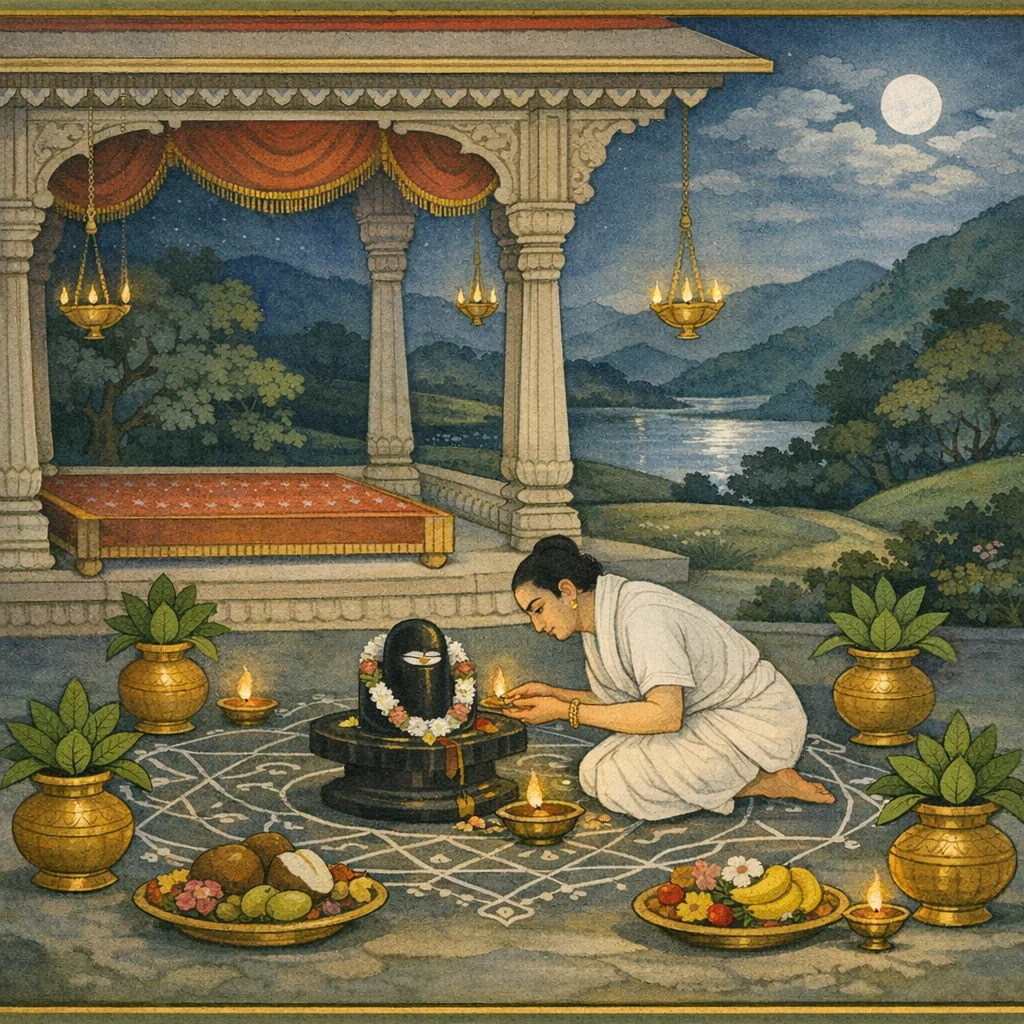
Adhyāya 39 sets forth the udyāpana-vidhi, the formal completion rite of the Śivarātri-vrata that brings direct satisfaction to Śaṅkara. Asked by the ṛṣis, Sūta explains the canonical completion: a fourteen-year observance (caturdaśābda), with trayodaśī kept as ekabhakta (one meal) and caturdaśī as upavāsa (fasting). On Śivarātri night the votary goes to a Śivālaya, performs pūjā as prescribed, establishes a consecrated maṇḍala called Gaurī-tilaka, and draws the auspicious bhadra-maṇḍala/sarvatobhadra within a prepared pavilion. Multiple ritual pots (kuṃbha) of Prajāpati-type designation, furnished with cloth, fruits, and dakṣiṇā, are arranged at the sides of the maṇḍala, with a central pot optionally of gold. The rite culminates in installing a small golden icon of Śambhu with Umā (one pala or half-pala), placing Śivā to the left, and worshipping through the night, expressing completeness through auspicious geometry, center–periphery order, and the union of Śiva and Śakti.
Shlokas
Verse 1
ऋषय उचुः । उद्यापनविधिं ब्रूहि शिवरात्रिव्रतस्य च । यत्कृत्वा शंकरस्साक्षात्प्रसन्नो भवति धुवम्
The sages said: “Tell us also the procedure for the udyāpana, the concluding observance of the Śivarātri vow—by performing which Śaṅkara Himself becomes certainly and directly pleased.”
Verse 2
सूत उवाच । श्रूयतामृषयो भक्त्या तदुद्यापनमादरात् । यस्यानुष्ठानतः पूर्णं व्रतं भवति तद्ध्रुवम्
Sūta said: “O sages, listen with devotion and earnest care to the udyāpana, the concluding rite of that observance; by performing it, the vow is certainly brought to full completion.”
Verse 3
चतुर्दशाब्दं कर्तव्यं शिवरात्रिव्रतं शुभम् । एकभक्तं त्रयोदश्यां चतुर्दश्यामुपोषणम्
The auspicious vow of Śivarātri should be observed for fourteen years. On the thirteenth (lunar day) one should take a single meal, and on the fourteenth one should keep a fast.
Verse 4
शिवरात्रिदिने प्राप्ते नित्यं संपाद्य वै विधिम् । शिवालयं ततो गत्वा पूजां कृत्वा यथाविधि
When the sacred day of Śivarātri arrives, one should duly complete the daily prescribed observances; then, going to Śiva’s temple, one should perform worship in the proper manner according to rule.
Verse 5
ततश्च कारयेद्दिव्यं मण्डलं तत्र यत्नतः । गौरीतिलकनाम्ना वै प्रसिद्धं भुवनत्रये
Then, with due care, one should have a divine maṇḍala prepared there. Indeed, it is renowned throughout the three worlds by the name “Gaurī-tilaka.”
Verse 6
तन्मध्ये लेखयेद्दिव्यं लिंगतो भद्रमण्डलम् । अथवा सर्वतोभद्रं मण्डपान्तः प्रकल्पयेत्
In its midst, one should draw a divine auspicious maṇḍala in relation to the Liṅga. Or else, within the pavilion (maṇḍapa) itself, one may arrange a sarvatobhadra—an auspicious formation beneficent in all directions.
Verse 7
कुंभास्तत्र प्रकर्तव्याः प्राजापत्यविसंज्ञया । सवस्त्रास्सफलास्तत्र दक्षिणासहिताः शुभाः
There, auspicious water-pots (kumbhas) should be arranged, designated as ‘Prājāpatya’; and there too, they should be offered along with cloth and fruits, together with an appropriate honorarium (dakṣiṇā), as a sacred and meritorious gift.
Verse 8
मण्डलस्य च पार्श्वे वै स्थापनीयाः प्रयत्नतः । मध्ये चैकश्च संस्थाप्यः सौवर्णो वापरो घटः
At the sides of the ritual maṇḍala, vessels should be carefully placed with due effort. And in the very center, one more ghaṭa (ritual pot) should be installed—either a golden one, or another suitable metal vessel.
Verse 9
तत्रोमासहितां शंभुमूर्तिन्निर्माय हाटकीम् । पलेन वा तदर्द्धेन यथाशक्त्याथवा व्रती
There, the observer of the vow should fashion a golden image of Lord Śambhu together with Umā—using a pala of gold, or half of that, or according to one’s capacity.
Verse 10
निधाय वामभागे तु शिवामूर्त्तिमतन्द्रितः । मदीयां दक्षिणे भागे कृत्वा रात्रौ प्रपूजयेत्
Without negligence, placing the image of Śivā (Pārvatī) on the left side and setting My image (Śiva) on the right, one should perform devoted worship throughout the night.
Verse 11
आचार्यं वरयेत्तत्र चर्त्विग्भिस्सहितं शुचिम् । अनुज्ञातश्च तैर्भक्त्या शिवपूजां समाचरेत्
There, one should choose a pure ācārya (preceptor), accompanied by the priests (ṛtviks). Having received their permission with devotion, one should then perform the worship of Śiva with bhakti.
Verse 12
रात्रौ जागरणं कुर्यात्पूजां यामोद्भवां चरन् । रात्रिमाक्रमयेत्सर्वां गीतनृत्यादिना व्रती
At night the vow-holder should keep vigil, performing worship that arises in each watch of the night. He should pass the entire night through with devotional acts such as sacred singing and dancing.
Verse 13
एवं सम्पूज्य विधिवत्संतोष्य प्रातरेव च । पुनः पूजां ततः कृत्वा होमं कुर्याद्यथाविधि
Thus, having duly performed the worship according to the prescribed rite and remaining content—early in the morning—one should again perform the pūjā; thereafter, according to rule, one should carry out the homa, the fire-offering.
Verse 14
यथाशक्ति विधानं च प्राजापत्यं समाचरेत् । ब्राह्मणान्भोजयेत्प्रीत्या दद्याद्दानानि भक्तितः
According to one’s capacity, one should duly perform the observance known as Prājāpatya. With glad-hearted reverence, one should feed the brāhmaṇas and, in devotion, bestow gifts in charity.
Verse 15
ऋत्विजश्च सपत्नीकान्वस्त्रालङ्कारभूषणैः । अलङ्कृत्य विधानेन दद्याद्दानं पृथक्पृथक्
According to the prescribed rite, he should honor the officiating priests (ṛtvij) together with their wives by adorning them with garments, ornaments, and jewelry; then he should duly give to each of them their respective gifts, separately.
Verse 16
गां सवत्सां विधानेन यथोपस्करसंयुताम् । उक्त्वाचार्याय वै दद्याच्छिवो मे प्रीयतामिति
According to the prescribed rite, one should offer to the ācārya a cow along with her calf, properly furnished with the requisite accessories, saying: “May Lord Śiva be pleased with me.”
Verse 17
तत्तस्सकुम्भां तन्मूर्तिं सवस्त्रां वृषभे स्थिताम् । सर्वालंकारसहितामाचार्याय निवेदयेत्
Thereafter, one should present to the ācārya that very icon—together with its ritual pot (kumbha)—clothed, established upon a bull, and adorned with every ornament.
Verse 18
ततः संप्रार्थयेद्देवं महेशानं महाप्रभुम् । कृतांजलिर्नतस्कन्धस्सुप्रीत्या गद्गदाक्षरः
Then, with palms joined and shoulders bowed in humility, one should earnestly pray to Maheśāna, the great and all-glorious Lord, speaking with deep devotion, the voice trembling with reverent emotion.
Verse 19
देवदेव महादेव शरणागतवत्सल । व्रतेनानेन देवेश कृपां कुरु ममोपरि
O God of gods, O Mahādeva, tender to those who seek refuge in You; O Lord of the devas, by this observance (vrata) bestow Your grace upon me.
Verse 20
मया भक्त्यनुसारेण व्रतमेतत्कृतं शिवा । न्यूनं सम्पूर्णतां यातु प्रसादात्तव शङ्कर
O auspicious Lord Śiva, I have undertaken this vow according to my capacity of devotion. O Śaṅkara, by Your grace, may whatever is deficient in it attain completeness.
Verse 21
अज्ञानाद्यदि वा ज्ञानाज्जपपूजादिकं मया । कृतं तदस्तु कृपया सफलं तव शङ्कर
O Śaṅkara, whether I have performed japa, pūjā, and other acts of worship out of ignorance or with true understanding—by Your compassion, may all that be made fruitful and fulfilled.
Verse 22
एवं पुष्पांजलिं दत्त्वा शिवाय परमात्मने । नमस्कारं ततः कुर्यात्प्रार्थनां पुनरेव च
Thus, having offered a handful of flowers to Śiva, the Supreme Self, one should then make a reverent salutation and again offer a prayer.
Verse 23
एवं व्रतं कृतं येन न्यूनं तस्य न विद्यते । मनोभीष्टां ततः सिद्धिं लभते नात्र संशयः
Whoever performs the vow in this manner suffers no deficiency in it. Thereafter, he attains the accomplishment of his heart’s desire—of this there is no doubt.
Verse 39
इति श्रीशिवमहापुराणे चतुर्थ्यां कोटित्त्वसंहितायां शिवरात्रिव्रतोद्यापनं नामैकोनचत्वारिंशोऽध्यायः
Thus ends the thirty-ninth chapter, entitled “The Completion Rite (Udyāpana) of the Śivarātri Vow,” in the fourth section of the Śrī Śiva Mahāpurāṇa, in the Koṭirudra Saṃhitā.
Frequently Asked Questions
It teaches the udyāpana-vidhi (completion rite) for the Śivarātri-vrata: a fourteen-year observance framework, the trayodaśī/caturdaśī food-fast rules, temple worship on Śivarātri, maṇḍala preparation (Gaurī-tilaka), installation of kuṃbhas with dakṣiṇā, and nocturnal worship of Umā-sahita Śambhu.
The rite encodes completeness through ordered space: the maṇḍala’s auspicious geometry (bhadra/sarvatobhadra) sacralizes the field, side-placed kuṃbhas stabilize the periphery (supporting powers/guardianship logic), and the central ghaṭa marks the axis of presence. Together they ritualize ‘pūrṇatā’—the vow becomes complete when the cosmos is symbolically re-centered on Śiva-Śakti.
The chapter highlights Umā-sahita Śambhu—Śiva installed and worshipped together with Umā/Śivā (placed on the left). This paired iconography emphasizes Śiva-Śakti inseparability as the proper theological form for concluding (udyāpana) a major vrata.