Kedāreśvara-pratiṣṭhā: Nara-Nārāyaṇa’s Worship and Śiva’s Abiding as Jyoti
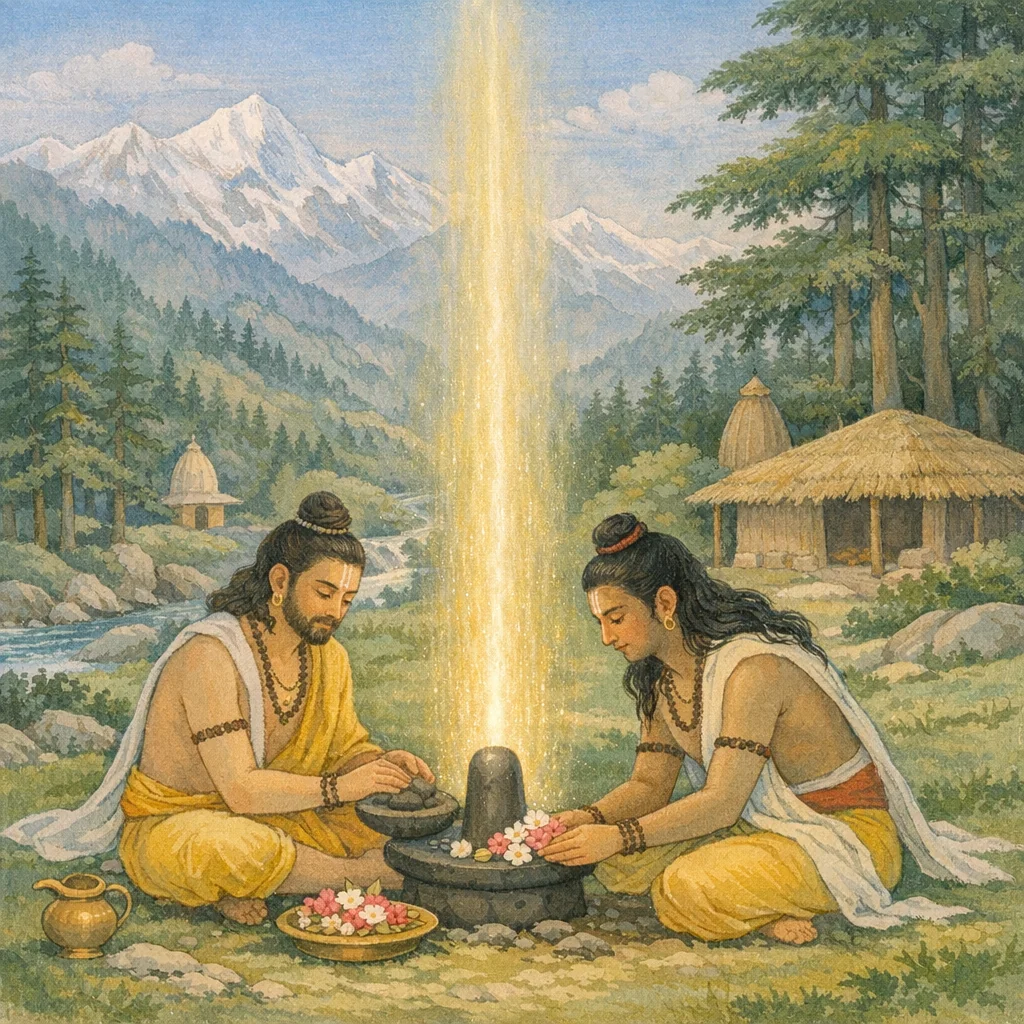
Framed by Sūta’s narration, this chapter describes Nara and Nārāyaṇa—incarnatory forms of Hari—performing long, sustained worship in Badaryāśrama within Bhārata-khaṇḍa. Their practice is pārtthiva-pūjā (earth/clay worship), and Śiva, moved by bhakta-adhīnatā (being governed by devotion), repeatedly manifests in the liṅga to receive their arcana. After a great span of worship, Śiva is deeply pleased and offers a boon; Nara–Nārāyaṇa ask that Śaṅkara remain in his own form for continued worship and the welfare of the world. Accordingly, Śiva abides in the Himalayan Kedāra region as a jyoti-rūpa (luminous) manifestation and is named Kedāreśvara. The text then proclaims the general fruit: through darśana and arcana, Kedāreśvara ever grants devotees their desired aims; devas and ancient ṛṣis worship there and obtain wished-for results from the gracious Maheśvara. The esoteric teaching is that ascetic bhakti becomes permanent sacred presence—place, icon, and grace mutually reinforcing as vehicles of Śiva-tattva.
Shlokas
Verse 1
सूत उवाच । नरनारायणाख्यौ याववतारौ हरेर्द्विजाः । तेपाते भारते खण्डे बदर्याश्रम एव हि
Sūta said: “O twice-born sages, the two incarnations of Hari known as Nara and Nārāyaṇa indeed performed austerities in the land of Bhārata, in the very hermitage of Badarī.”
Verse 2
ताभ्यां संप्रार्थितश्शंभुः पार्थिवे पूजनाय वै । आयाति नित्यं तल्लिंगे भक्ताधीनतया शिव
When earnestly entreated by those devotees, Śambhu indeed comes—day after day—into that earthen liṅga to receive worship, for Śiva, out of His gracious nature, becomes ‘dependent’ upon the devotion of His bhaktas.
Verse 3
एवं पूजयतोश्शंभुं तयोर्विष्ण्ववतारयोः । चिरकालो व्यतीताय शैवयोर्धर्मपुत्रयोः
Thus, as those two incarnations of Viṣṇu continued to worship Śambhu (Lord Śiva), a long time passed for those two righteous sons of dharma, devoted to Śiva.
Verse 4
एकस्मिन्समये तत्र प्रसन्नः परमेश्वरः । प्रत्युवाच प्रसन्नोस्मि वरो मे व्रियतामिति
At one time there, the Supreme Lord (Parameśvara) became gracious and replied: “I am pleased. Choose a boon from Me.”
Verse 5
इत्युक्ते च तदा । तेन नरो नारायणस्स्वयम् । ऊचतुर्वचनं तत्र लोकानां हितकाम्यया
When this was said, then Nara and Nārāyaṇa themselves spoke words there, desiring the welfare of all beings.
Verse 6
नरनारायणावूचतुः । यदि प्रसन्नो देवेश यदि देयो वरस्त्वया । स्थीयतां स्वेन रूपेण पूजार्थं शंकरस्स्वयम्
Nara and Nārāyaṇa said: “If you are pleased, O Lord of the gods, and if a boon is to be granted by you, then may Śaṅkara himself remain here in his own manifest form, for the sake of worship.”
Verse 7
सूत उवाच । इत्युक्तस्तु तदा ताभ्यां केदारे हिमसंश्रये । स्वयं च शंकरस्तस्थौ ज्योतीरूपो महेश्वरः
Sūta said: Thus addressed by the two of them, then at Kedāra—sheltered by the snows—Śaṅkara Himself stood revealed there as Maheśvara, in the form of radiant Light.
Verse 8
ताभ्यां च पूजितश्चैव सर्वदुःखभयापहः । लोकानामुपकारार्थं भक्तानां दर्शनाय वै
Worshipped by those two, the Lord—remover of all sorrow and fear—truly manifested for the welfare of the worlds and to grant His devotees the grace of divine sight (darśana).
Verse 9
स्वयं स्थितस्तदा शंभुः केदारेश्वरसंज्ञकः । भक्ताभीष्टप्रदो नित्यं दर्शनादर्चनादपि
Then Śambhu Himself abode there, renowned as Kedāreśvara, ever granting devotees their cherished aims—through mere darśana and also through worship.
Verse 10
देवाश्च पूजयंतीह ऋषयश्च पुरातनाः । मनोभीष्ट फलं तेते सुप्रसन्नान्महेश्वरात्
Here the gods and the ancient sages worship Him. From Mahēśvara—exceedingly pleased by that devotion—each obtained the very fruits desired in the heart.
Verse 11
भवस्य पूजनान्नित्यं बदर्याश्रमवासिनः । प्राप्नुवन्ति यतः सोऽसौ भक्ताभी ष्टप्रदः सदा
By the daily worship of Bhava (Lord Śiva), the residents of Badarī-āśrama continually attain their aims; for He indeed is ever the granter of devotees’ cherished desires.
Verse 12
तद्दिनं हि समारभ्य केदारेश्वर एव च । पूजितो येन भक्त्या वै दुःखं स्वप्नेऽति दुर्लभम्
From that very day onward, for the one who worships Kedāreśvara with true devotion, sorrow becomes exceedingly rare—even in dreams.
Verse 13
यो वै हि पाण्डवान्दृष्ट्वा माहिषं रूपमास्थितः । मायामास्थाय तत्रैव पलायनपरोऽभवत्
Indeed, on seeing the Pāṇḍavas, he assumed the form of a buffalo; resorting to illusion right there, he became intent only on fleeing.
Verse 14
धृतश्च पाण्डवैस्तत्र ह्यवाङ्मुखतया स्थितः । पुच्छ चैव धृतं तैस्तु प्रार्थितश्च पुनःपुनः
There the Pāṇḍavas restrained him, for he stood with his face turned downward. They held fast to his tail as well, and again and again they entreated him.
Verse 15
तद्रूपेण स्थितस्तत्र भक्तवत्सलनामभाक् । नयपाले शिरोभागो गतस्तद्रूपतः स्थितः
Abiding there in that very form, Śiva became renowned by the name “Bhaktavatsala,” the tender lover of His devotees. In that same form, a portion of His head also came to rest at Nayapāla and remained established there.
Verse 16
स वै व पूजनान्नित्यमाज्ञां चैवाप्यदात्तथा । पूजितश्च स्वयं शंभुस्तत्र तस्थौ वरानदात्
Thus he performed worship each day and in that very manner received the Lord’s command as well. When Śambhu Himself was duly worshipped, He remained there and granted boons.
Verse 17
पूजयित्वा गतास्ते तु पाण्डवा मुदितास्तदा । लब्ध्वा चित्तेप्सितं सर्वं विमुक्तास्सर्वदुःखतः
Having duly worshipped Śiva, those Pāṇḍavas then departed in joy. Having attained everything their hearts desired, they were freed from all sorrow.
Verse 18
तत्र नित्यं हस्साक्षात्क्षेत्रे केदारसंज्ञके । भारतीभिः प्रजाभिश्च तथेव परिपूज्यते
There, in the sacred field directly manifest as Kedāra-kṣetra, He (Lord Śiva) is worshipped every day with due reverence—by the Bhāratīs (learned devotees of Bhārata) and by the people as well.
Verse 19
इति श्रीशिवमहापुराणे चतुर्थ्यां कोटिरुद्रसंहितायां केदारेश्वरज्योतिर्लिगमा हात्म्यवर्णनं नामैकोनविंशोऽध्यायः
Thus, in the holy Śiva Mahāpurāṇa, in the Fourth section known as the Koṭirudra Saṃhitā, the nineteenth chapter entitled “The Narration of the Greatness of the Kedāreśvara Jyotirliṅga” concludes.
Verse 20
तथैव रूपं दृष्ट्वा च सर्वपापैः प्रमुच्यते । जीवन्मुक्तो भवेत्सोपि यो गतो बदरीवने
Likewise, by beholding that very divine form, one is released from all sins. Indeed, whoever goes to Badarīvana becomes a jīvanmukta—liberated even while living.
Verse 21
दृष्ट्वा रूपं नरस्यैव तथा नारायणस्य हि । केदारेश्वरशंभोश्च मुक्तभागी न संशयः
Having beheld the forms of Nara and also of Nārāyaṇa, and having had the vision of Kedāreśvara Śambhu, one becomes a rightful recipient of liberation—there is no doubt.
Verse 22
केदारेशस्य भक्ता ये मार्गस्थास्तस्य वै मृता । गतेऽपि मुक्ता भवंत्येव नात्र कार्य्या विचारणा
Those devotees of Lord Kedāreśa who, while journeying on the path to Him, die on the way—even without reaching the shrine—are indeed liberated. About this there is no need for doubt or further deliberation.
Verse 23
गत्वा तत्र प्रीतियुक्तः केदारेशं प्रपूज्य च । तत्रत्यमुदकं पीत्वा पुन र्जन्म न विन्दति
Going there with a heart filled with devotion and worshipping Kedāreśa, whoever drinks the sacred water of that place does not attain birth again.
Verse 24
खण्डेस्मिन्भारते विप्रा नरनारायणेश्वरः । केदारेशः प्रपूज्यश्च सर्वैर्जीवैस्सुभक्तितः
O brāhmaṇas, in this very Bhārata-khaṇḍa, the Lord known as Nara-Nārāyaṇeśvara—Kedāreśa—should be worshipped by all living beings with excellent devotion.
Verse 25
अस्य खण्डस्य स स्वामी सर्वेशोपि विशेषतः । सर्वकामप्रदश्शंभुः केदाराख्यो न संशय
He is the Lord of this sacred region—indeed, the Supreme Lord above all, in a special way. That Śambhu, who grants every worthy desire, is known as Kedāra; of this there is no doubt.
Verse 26
एतद्वचस्समाख्यातं यत्पृष्टमृषिसत्तमाः । श्रुत्वा पापं हरेत्सर्वं नात्र कार्या विचारणा
O best of sages, I have thus declared the teaching you asked about. Merely hearing it removes all sin—of this there is no need for any further doubt or deliberation.
Frequently Asked Questions
Nara-Nārāyaṇa perform prolonged pārthiva worship at Badaryāśrama; Śiva, pleased, offers a boon and is requested to remain for ongoing worship and lokahita. He abides in Kedāra as Kedāreśvara, accessible for darśana and pūjā.
The liṅga and ‘jyoti-rūpa’ together model transcendence-in-immanence: devotion stabilizes a luminous divine presence into a fixed sacred locus, making metaphysical Śiva-tattva ritually and geographically encounterable.
Śiva is highlighted as Kedāreśvara, described as abiding in Kedāra in a jyoti-rūpa mode and functioning as a constant bestower of devotees’ aims through darśana and arcana.