Sarga 29
सिद्धाश्रम-प्रसङ्गः (Siddhashrama and the Vāmana Narrative)
बालकाण्ड
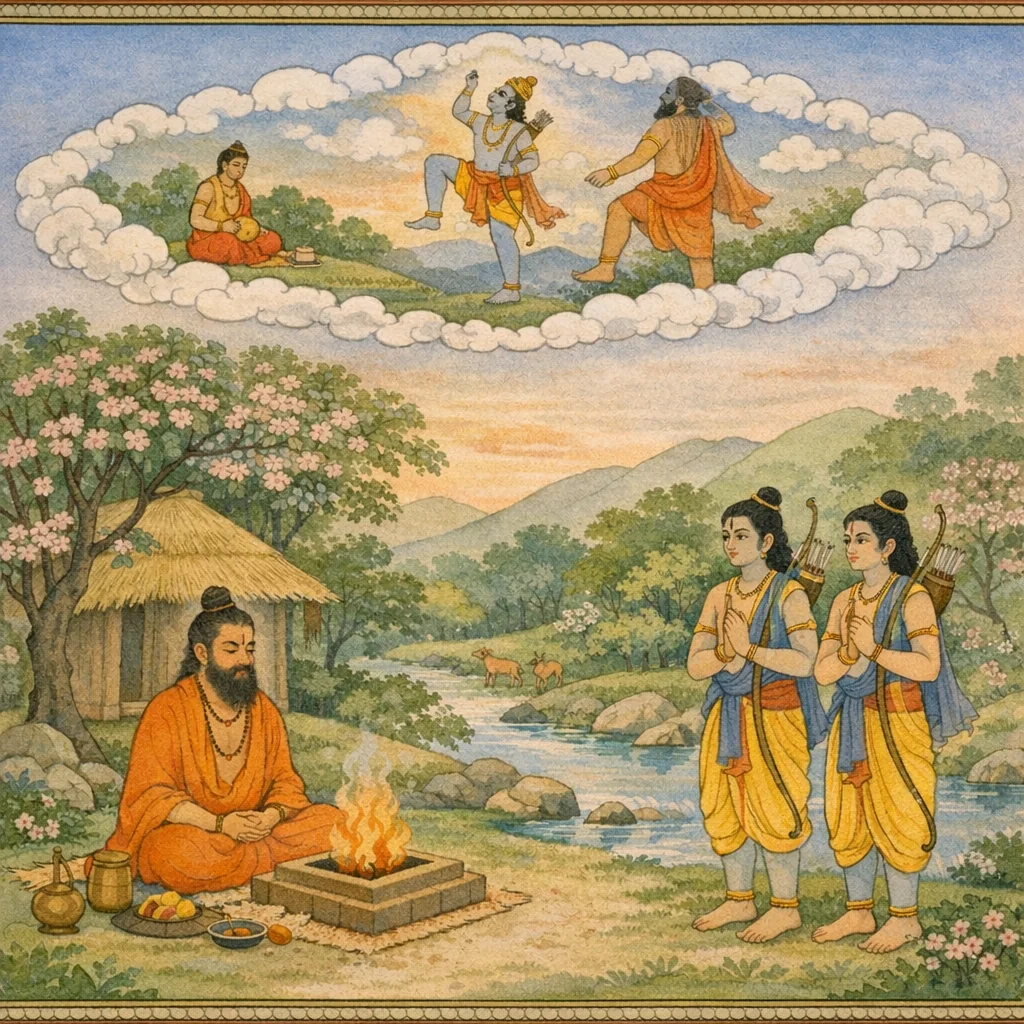
When Rama asks about “that forest,” Vishvamitra recounts the ancient history of Siddhashrama. The chapter establishes the hermitage’s sanctity, for it was here that Lord Vishnu performed yoga and austere tapas, consecrating the place. Thereafter Bali, son of Virochana, conquers the devas and rules the three worlds. The gods, led by Agni, approach Vishnu for the welfare of the celestials and beseech Him to assume, through the power of māyā-yoga, the form of Vāmana. Through the episode of Kashyapa and Aditi—Aditi’s thousand-year austerity, hymns to Vishnu, and the boon granted—the cause of the Vāmana avatāra is shown, as Vishnu agrees to be born as Aditi’s son. Vāmana overcomes Bali with three strides and restores the three worlds to Indra; thus the hermitage is praised as “the dispeller of toil.” Vishvamitra then proceeds to Siddhashrama with Rama and Lakshmana, where the resident sages honor them with worship. After the princes rest, they urge Vishvamitra to enter dīkṣā, and he does so with senses restrained. At dawn Rama and Lakshmana perform sandhyā worship, japa, agnihotra, and the prescribed rites, then bow to Vishvamitra, and the chapter concludes in the spirit of dharma as the protection of the hermitage.
Shlokas
Verse 1
अथ तस्याप्रमेयस्य तद्वनं परिपृच्छत:।विश्वामित्रो महातेजा व्याख्यातुमुपचक्रमे।।1.29.1।।
Then, as Rāma of immeasurable prowess inquired about that forest, the highly radiant Viśvāmitra began to explain its account.
Verse 2
इह राम महाबाहो विष्णुर्देववर: प्रभु:।वर्षाणि सुबहूनीह तथा युगशतानि च।।1.29.2।।तपश्चरणयोगार्थमुवास सुमहातपा:।
Here, O Rāma of mighty arms, Viṣṇu—the sovereign Lord, foremost among the gods—dwelt for countless years, even for hundreds of yugas, to practice yoga and perform austerities (tapas).
Verse 3
एष पूर्वाश्रमो राम वामनस्य महात्मन:।।1.29.3।।सिद्धाश्रम इति ख्यातस्सिद्धो ह्यत्र महातपा:।
“Enter upon the dīkṣā today itself, O foremost of sages—may good be yours. May this Siddhāśrama attain full success; may your word prove true.”
Verse 4
एतस्मिन्नेव काले तु राजा वैरोचनिर्बलि:।।1.29.4।।निर्जित्य दैवतगणान् सेन्द्रांश्च समरुद्गणान्। कारयामास तद्राज्यं त्रिषु लोकेषु विश्रुत:।।1.29.5।।
At that very time, King Bali, son of Virocana—having conquered the hosts of the gods, along with Indra and the Maruts—ruled that sovereignty, renowned across the three worlds.
Verse 5
एतस्मिन्नेव काले तु राजा वैरोचनिर्बलि:।।1.29.4।।निर्जित्य दैवतगणान् सेन्द्रांश्च समरुद्गणान्। कारयामास तद्राज्यं त्रिषु लोकेषु विश्रुत:।।1.29.5।।
At that very time, King Bali, son of Virocana—having conquered the hosts of the gods, along with Indra and the Maruts—ruled that sovereignty, renowned across the three worlds.
Verse 6
बलेस्तु यजमानस्य देवास्साग्निपुरोगमा:।समागम्य स्वयं चैव विष्णुमूचुरिहाश्रमे।।1.29.6।।
Now, while Bali was officiating as the sacrificer, the gods—led by Agni—gathered together and, in this hermitage, personally addressed Viṣṇu.
Verse 7
बलिर्वैरोचनिर्विष्णो यजते यज्ञमुत्तमम्।असमाप्ते क्रतौ तस्मिन् स्वकार्यमभिपद्यताम्।।1.29.7।।
“O Viṣṇu, Bali the son of Virocana is performing an excellent sacrifice; before that rite is completed, let our purpose be accomplished.”
Verse 8
ये चैनमभिवर्तन्ते याचितार इतस्तत:।यच्च यत्र यथावच्च सर्वं तेभ्य: प्रयच्छति।।1.29.8।।
And those who approach him as petitioners from here and there—whatever they ask, wherever it be, and in a proper manner—he grants it all to them.
Verse 9
स त्वं सुरहितार्थाय मायायोगमुपागत:।वामनत्वं गतो विष्णो कुरु कल्याणमुत्तमम्।।1.29.9।।
Therefore, O Viṣṇu, for the welfare of the gods, by your divine power (māyā-yoga) assume the form of the dwarf Vāmana and accomplish this highest auspicious work.
Verse 10
एतस्मिन्नन्तरे राम कश्यपोऽग्निसमप्रभ:।अदित्या सहितो राम दीप्यमान इवौजसा।।1.29.10।।देवीसहायो भगवान् दिव्यं वर्षसहस्रकम् ।व्रतं समाप्य वरदं तुष्टाव मधुसूदनम्।।1.29.11।।
“In the meantime, O Rāma, Kaśyapa—radiant like fire—together with Aditi, shone as though blazing with his own splendor,” said Viśvāmitra in his narration.
Verse 11
एतस्मिन्नन्तरे राम कश्यपोऽग्निसमप्रभ:।अदित्या सहितो राम दीप्यमान इवौजसा।।1.29.10।।देवीसहायो भगवान् दिव्यं वर्षसहस्रकम् ।व्रतं समाप्य वरदं तुष्टाव मधुसूदनम्।।1.29.11।।
“That blessed one, aided by the goddess (Aditi), having completed a vow for a thousand divine years, praised Madhusūdana—the granter of boons,” continued Viśvāmitra.
Verse 12
तपोमयं तपोराशिं तपोमूर्तिं तपात्मकम्।तपसा त्वां सुतप्तेन पश्यामि पुरुषोत्तमम्।।1.29.12।।
You are austerity itself—an amassed treasury of tapas, the very embodiment of tapas, whose very being is tapas. O Puruṣottama, by penance rigorously performed, I now behold you.
Verse 13
शरीरे तव पश्यामि जगत्सर्वमिदं प्रभो।त्वमनादिरनिर्देश्यस्त्वामहं शरणं गत:।।1.29.13।।
O Lord, within your body I behold this entire universe. You are beginningless and beyond description; to you I have come for refuge.
Verse 14
तमुवाच हरि: प्रीत: कश्यपं धूतकल्मषम्।वरं वरय भद्रं ते वरार्होऽसि मतो मम ।।1.29.14।।
Pleased, Hari spoke to Kāśyapa—whose impurities had been washed away: “Choose a boon. Blessings upon you; you are worthy of a boon and dear to me.”
Verse 15
तच्छ्रुत्वा वचनं तस्य मारीच: कश्यपोऽब्रवीत्।अदित्या देवतानां च मम चैवानुयाचत:।।1.29.15।।वरं वरद सुप्रीतो दातुमर्हसि सुव्रत।
Hearing his words, Kāśyapa—descendant of Marīci—replied: “O giver of boons, O steadfast in vow, be gracious and grant a boon—sought for Aditi, for the gods, and also for me.”
Verse 16
पुत्रत्वं गच्छ भगवन्नदित्या मम चानघ।।1.29.16।।भ्राता भव यवीयांस्त्वं शक्रस्यासुरसूदन ।शोकार्तानां तु देवानां साहाय्यं कर्तुमर्हसि।।1.29.17।।
O Blessed Lord, O stainless One—become a son to Aditi and to me. O slayer of the Asuras, become the younger brother of Śakra (Indra); you are worthy to aid the gods who are afflicted with sorrow.
Verse 17
पुत्रत्वं गच्छ भगवन्नदित्या मम चानघ।।1.29.16।।भ्राता भव यवीयांस्त्वं शक्रस्यासुरसूदन ।शोकार्तानां तु देवानां साहाय्यं कर्तुमर्हसि।।1.29.17।।
O Blessed Lord, O stainless One—become a son to Aditi and to me. O slayer of the Asuras, become the younger brother of Śakra (Indra); you are worthy to aid the gods who are afflicted with sorrow.
Verse 18
अयं सिद्धाश्रमो नाम प्रसादा त्ते भविष्यति।सिद्धे कर्मणि देवेश उत्तिष्ठ भगवन्नित:।।1.29.18।।
By your grace this place shall be known as Siddhāśrama. O Lord of the gods—my observance is fulfilled; O Blessed One, now arise and depart from here.
Verse 19
अथ विष्णुर्महातेजा अदित्यां समजायत।वामनं रूपमास्थाय वैरोचनिमुपागमत्।।1.29.19।।
Then the greatly radiant Viṣṇu was born of Aditi; assuming the form of Vāmana, he approached Bali, the son of Virocana.
Verse 20
त्रीन् क्रमानथ भिक्षित्वा प्रतिगृह्य च मानद:।आक्रम्य लोकान् लोकात्मा सर्वभूतहिते रत:।।1.29.20।।महेन्द्राय पुन: प्रादान्नियम्य बलिमोजसा।त्रैलोक्यं स महातेजाश्चक्रे शक्रवशं पुन:।।1.29.21।।
Thereafter, the restorer of honour—the very inner Self of the worlds, devoted to the welfare of all beings—begged for three strides; and, having received them, he encompassed the worlds with those strides. Then, restraining Bali by his power, that greatly radiant One returned the three worlds to Mahendra (Indra), placing them once more under Śakra’s rule.
Verse 21
त्रीन् क्रमानथ भिक्षित्वा प्रतिगृह्य च मानद:।आक्रम्य लोकान् लोकात्मा सर्वभूतहिते रत:।।1.29.20।।महेन्द्राय पुन: प्रादान्नियम्य बलिमोजसा।त्रैलोक्यं स महातेजाश्चक्रे शक्रवशं पुन:।।1.29.21।।
Thereafter, the restorer of honour—the very inner Self of the worlds, devoted to the welfare of all beings—begged for three strides; and, having received them, he encompassed the worlds with those strides. Then, restraining Bali by his power, that greatly radiant One returned the three worlds to Mahendra (Indra), placing them once more under Śakra’s rule.
Verse 22
तेनैष पूर्वमाक्रान्त आश्रमश्श्रमनाशन:।मयापि भक्तय तस्यैष वामनस्योपभुज्यते।।1.29.22।।
This hermitage—banisher of fatigue—was formerly occupied by him (Vāmana); and now, through devotion to that Vāmana, it is enjoyed and maintained by me as well.
Verse 23
एतमाश्रममायान्ति राक्षसा विघ्नकारिण:।अत्रैव पुरुषव्याघ्र हन्तव्या दुष्टचारिण:।।1.29.23।।
Rakṣasas who create obstacles come to this very hermitage. Here itself, O tiger among men, those wicked-doers must be slain.
Verse 24
अद्य गच्छामहे राम सिद्धाश्रममनुत्तमम्।तदाश्रमपदं तात तवाप्येतद्यथा मम।।1.29.24।।
Today, O Rāma, let us go to the unsurpassed Siddhāśrama. O child, regard this hermitage as yours too—just as it is mine.
Verse 25
प्रविशन्नाश्रमपदं व्यरोचत महामुनि:।शशीव गतनीहार: पुनर्वसुसमन्वित:।।1.29.25।।
As the great sage entered the hermitage, he shone—like the moon, freed from mist, accompanied by the Punarvasu star.
Verse 26
तं दृष्ट्वा मुनयस्सर्वे सिद्धाश्रमनिवासिन:।उत्पत्त्योत्पत्त्य सहसा विश्वामित्रमपूजयन्।।1.29.26।।
Seeing him, all the sages dwelling in Siddhāśrama sprang up at once and reverently honoured Viśvāmitra.
Verse 27
यथार्हं चक्रिरे पूजां विश्वामित्राय धीमते।तथैव राजपुत्राभ्यामकुर्वन्नतिथिक्रियाम्।।1.29.27।।
They offered fitting honours to the wise Viśvāmitra, and in the same manner extended hospitality to the two princes.
Verse 28
मुहूर्तमथ विश्रान्तौ राजपुत्रावरिन्दमौ।प्राञ्जली मुनिशार्दूलमूचतू रघुनन्दनौ।।1.29.28।।
After resting for a short while, the two princes—subduers of enemies, the delight of Raghu’s line—addressed the tiger among sages (Viśvāmitra) with folded hands.
Verse 29
अद्यैव दीक्षां प्रविश भद्रं ते मुनिपुङ्गव।सिद्धाश्रमोऽयं सिद्धस्स्यात् सत्यमस्तु वचस्तव।।1.29.29।।
“Enter upon the dīkṣā today itself, O foremost of sages—may good be yours. May this Siddhāśrama attain full success; may your word prove true.”
Verse 30
एवमुक्तो महातेजा विश्वामित्रो महान् ऋषि: ।प्रविवेश तदा दीक्षां नियतो नियतेन्द्रिय:।।1.29.30।।
Thus addressed, the great sage Viśvāmitra—radiant in spiritual power, disciplined in vow, and with senses restrained—then entered upon the rite of consecratory initiation (dīkṣā).
Verse 31
कुमारावपि तां रात्रिमुषित्वा सुसमाहितौ।प्रभातकाले चोत्थाय पूर्वां सन्ध्यामुपास्य च।।1.29.31।।स्पृष्टोदकौ शुची जप्यं समाप्य नियमेन च ।हुताग्निहोत्रमासीनं विश्वामित्रमवन्दताम् ।।1.29.32।।
The two princes too, having spent that night in calm and steady composure, rose at daybreak and duly performed the morning sandhyā observance.
Frequently Asked Questions
The chapter frames a protective dharma-action: Siddhashrama is threatened by विघ्नकारिणः राक्षसाः, and Rama is implicitly tasked to neutralize the disruptors so that ascetic rites and initiation (दीक्षा) can proceed without obstruction.
Legitimate authority is shown as tapas-validated and welfare-oriented: Vishnu’s ‘three strides’ restore cosmic balance, while the ashram narrative teaches that spiritual practice (yajña/tapas) requires disciplined guardianship aligned with the common good.
Siddhashrama is the central landmark—described as a श्रमनाशन आश्रम linked to Vāmana’s prior presence; culturally, the text highlights dīkṣā, sandhyā-upāsanā, japa, and agnihotra as the ritual ecology of an ashram.