Sarga 27
अस्त्रप्रदानम् — Bestowal of Divine Astras to Rama
बालकाण्ड
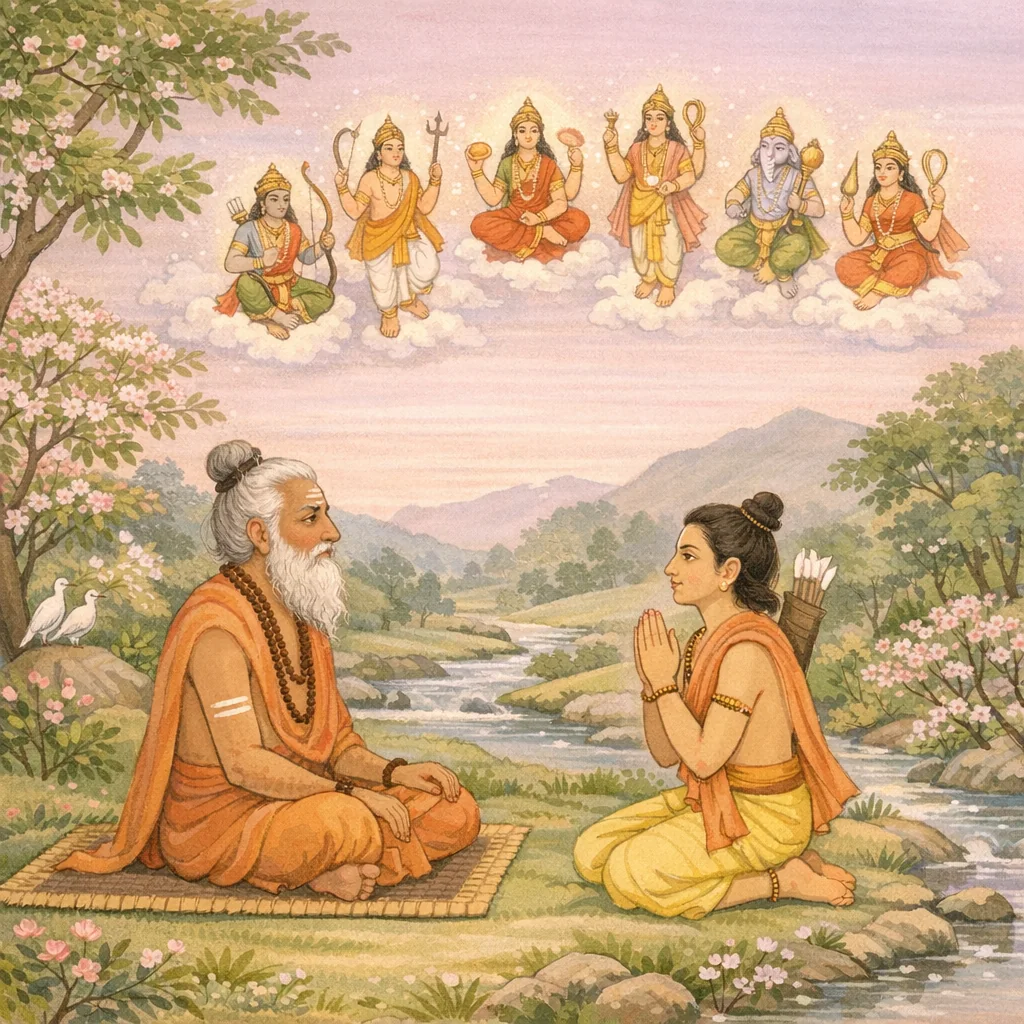
After the night’s rest, Viśvāmitra, pleased with Rāma, declares that out of affection and approval he will bestow upon him a complete arsenal of divine astras (divya-astras). The sarga unfolds as a formal transmission: the sage’s auspicious blessing, followed by a catalog-like naming of astras and allied implements—chakras, pāśas, gadās, thunderbolts, and other famed weapons. Having purified himself and facing east, the rishi ritually delivers the supreme (anuttama) collections of mantras, thereby installing their power. The presiding forces of the astras then manifest and present themselves as obedient attendants to Rāma. Rāma receives them and immediately internalizes their command, ordering them to remain “in his mind,” signifying disciplined restraint and controlled recall rather than impulsive use. Thus the chapter frames power as subordinate to dharma: weapon-knowledge is rightful only when transmitted by ascetic authority, consecrated through mantra, and governed by mastery of the mind. It ends with Rāma’s reverent salutation to Viśvāmitra and readiness to continue the journey.
Shlokas
Verse 1
अथ तां रजनीमुष्य विश्वामित्रो महायशाः।प्रहस्य राघवं वाक्यमुवाच मधुराक्षरम्।।।।
Then, after staying through that night, the illustrious Viśvāmitra—smiling—spoke to Rāghava in gentle, sweet words.
Verse 2
परितुष्टोऽस्मि भद्रं ते राजपुत्र महायशः।प्रीत्या परमया युक्तो ददाम्यस्त्राणि सर्वशः।।।।
O prince of great renown, I am wholly satisfied with you; may auspiciousness be yours. Filled with the highest affection, I bestow upon you the complete array of divine weapons.
Verse 3
देवासुरगणान्वापि सगन्धर्वोरगानपि।यैरमित्रान् प्रसह्याजौ वशीकृत्य जयिष्यसि।।।।तानि दिव्यानि भद्रं ते ददाम्यस्त्राणि सर्वशः ।
By these you shall overcome your foes in battle, subduing them by force—even if they be hosts of Devas or Asuras, and also Gandharvas and Nāgas. Those celestial weapons—may it be well with you—I now bestow upon you in full.
Verse 4
दण्डचक्रं महद्दिव्यं तव दास्यामि राघव।।।।धर्मचक्रं ततो वीर कालचक्रं तथैव च।विष्णुचक्रं तथात्युग्रमैन्द्रमस्त्रं तथैव च।।।।वज्रमस्त्रं नरश्रेष्ठ शैवं शूलवरं तथा।अस्त्रं ब्रह्मशिरश्चैव ऐषीकमपि राघव।।।।ददामि ते महाबाहो ब्राह्ममस्त्रमनुत्तमम्।
Rāghava, I shall bestow upon you the great, celestial Disc of Punishment. Then, O hero, I grant you the Disc of Dharma, the Disc of Time, and the exceedingly fierce Disc of Viṣṇu—along with Indra’s missile. O best of men, I also give you the Vajra-weapon, Śiva’s supreme trident, the Brahmaśiras weapon, and the Aiṣīka weapon as well, O Rāghava. Mighty-armed one, I grant you the unsurpassed Brahmā-weapon too.
Verse 5
दण्डचक्रं महद्दिव्यं तव दास्यामि राघव।।1.27.4।।धर्मचक्रं ततो वीर कालचक्रं तथैव च।विष्णुचक्रं तथात्युग्रमैन्द्रमस्त्रं तथैव च।।1.27.5।।वज्रमस्त्रं नरश्रेष्ठ शैवं शूलवरं तथा।अस्त्रं ब्रह्मशिरश्चैव ऐषीकमपि राघव।।1.27.6।। ददामि ते महाबाहो ब्राह्ममस्त्रमनुत्तमम्।
Then, O hero, I grant you the Disc of Dharma and the Disc of Time; and also the exceedingly fierce Disc of Viṣṇu—together with Indra’s missile as well.
Verse 6
दण्डचक्रं महद्दिव्यं तव दास्यामि राघव।।1.27.4।।धर्मचक्रं ततो वीर कालचक्रं तथैव च।विष्णुचक्रं तथात्युग्रमैन्द्रमस्त्रं तथैव च।।1.27.5।।वज्रमस्त्रं नरश्रेष्ठ शैवं शूलवरं तथा।अस्त्रं ब्रह्मशिरश्चैव ऐषीकमपि राघव।।1.27.6।। ददामि ते महाबाहो ब्राह्ममस्त्रमनुत्तमम्।
O best of men, I grant you the Vajra-weapon, and also Śiva’s supreme trident; and further the Brahmaśiras weapon and the Aiṣīka weapon as well, O Rāghava.
Verse 7
गदे द्वे चैव काकुत्स्थ मोदकी शिखरी उभे।।।।प्रदीप्ते नरशार्दूल प्रयच्छामि नृपात्मज।
O Kākutstha, tiger among men, O prince—I also bestow upon you two blazing maces, named Modakī and Śikharī.
Verse 8
धर्मपाशमहं राम कालपाशं तथैव च।।।।पाशं वारुणमस्त्रं च ददाम्यहमनुत्तमम्।
Rāma, I grant you the noose of Dharma, and likewise the noose of Time; and also Varuṇa’s noose-weapon, unsurpassed in might.
Verse 9
अशनी द्वे प्रयच्छामि शुष्कार्द्रे रघुनन्दन।।।।ददामि चास्त्रं पैनाकमस्त्रं नारायणं तथा।
O delight of the Raghu line, I bestow on you two thunderbolts—Śuṣka and Ārdra, the ‘dry’ and the ‘wet’. I also grant you the Paināka weapon and the Nārāyaṇa weapon.
Verse 10
आग्नेयमस्त्रं दयितं शिखरं नाम नामतः।।।।वायव्यं प्रथनं नाम ददामि च तवानघ ।
O blameless one, I grant you the Agneya weapon, dear to me, called Śikhara by name; and also the Vāyavya weapon called Prathana.
Verse 11
अस्त्रं हयशिरो नाम क्रौञ्चमस्त्रं तथैव च।शक्तिद्वयं च काकुत्स्थ ददामि तव राघव।।।।
O Rāghava, O scion of Kakutstha, I grant you the weapon called Hayaśira, and likewise the Krauñca weapon, and also a pair of śaktis (spears of power).
Verse 12
कङ्कालं मुसलं घोरं कापालमथ कङ्कणम्।धारयन्त्यसुरा यानि ददाम्येतानि सर्वशः।।।।
I grant you in full these dreadful weapons—Kaṅkāla, Musala, Kāpāla, and Kaṅkaṇa—such as the asuras are known to wield.
Verse 13
वैद्याधरं महास्त्रं च नन्दनं नाम नामतः।असिरत्नं महाबाहो ददामि च नृपात्मज।।।।
O mighty-armed prince, I also grant you the great Vaidyādhara weapon called Nandana by name, and an excellent sword-gem—a peerless blade.
Verse 14
गान्धर्वमस्त्रं दयितं मानवं नाम नामतः।प्रस्वापनप्रशमने दद्मि सौरं च राघव।।।।
O Rāghava, I grant you the beloved Gāndharva weapon called Mānava by name—effective for inducing sleep and for dispelling it—and also the Saura weapon.
Verse 15
दर्पणं शोषणं चैव सन्तापनविलापने।मदनं चैव दुर्धर्षं कन्दर्पदयितं तथा।।।।पैशाचमस्त्रं दयितं मोहनं नाम नामतः।प्रतीच्छ नरशार्दूल राजपुत्र महायशः।।।।
Receive, O tiger among men—O illustrious prince—these: Darpaṇa and Śoṣaṇa; Santāpana and Vilāpana; and also Madana, the unassailable one dear to Kandarpa; and the beloved Paiśāca weapon called Mohana by name.
Verse 16
दर्पणं शोषणं चैव सन्तापनविलापने।मदनं चैव दुर्धर्षं कन्दर्पदयितं तथा।।1.27.15।।पैशाचमस्त्रं दयितं मोहनं नाम नामतः।प्रतीच्छ नरशार्दूल राजपुत्र महायशः।।1.27.16।।
O tiger among men, illustrious prince—receive the Paiśāca weapon, beloved and called Mohana by name, together with the astras just enumerated.
Verse 17
तामसं नरशार्दूल सौमनं च महाबल।संवर्धं चैव दुर्धर्षं मौसलं च नृपात्मज।।।।सत्यमस्त्रं महाबाहो तथा मायाधरं परम्।घोरं तेजः प्रभं नाम परतेजोऽपकर्षणम्।।।।सौम्यास्त्रं शिशिरं नाम त्वष्टुरस्त्रं सुदामनम्।दारुणं च भगस्यापि शितेषु मथ मानवम्।।।।
O tiger among men, mighty prince: receive the Tāmasa and Saumana weapons; the irresistible Saṃvardha and the Mausala. And, O mighty-armed one, receive the Satya-astra and the supreme Māyādhara; the dreadful weapon named Tejaḥprabha, which draws away an opponent’s power. Receive also the gentle weapon called Śiśira; Tvaṣṭṛ’s astra Sudāman; Bhaga’s fierce Śiteṣu; and the Mānava-astra as well.
Verse 18
तामसं नरशार्दूल सौमनं च महाबल।संवर्धं चैव दुर्धर्षं मौसलं च नृपात्मज।।1.27.17।।सत्यमस्त्रं महाबाहो तथा मायाधरं परम्।घोरं तेजः प्रभं नाम परतेजोऽपकर्षणम्।।1.27.18।।सौम्यास्त्रं शिशिरं नाम त्वष्टुरस्त्रं सुदामनम्।दारुणं च भगस्यापि शितेषु मथ मानवम्।।1.27.19।।
And, O mighty-armed one, receive also the Satya-astra and the supreme Māyādhara-astra; and the dreadful weapon named Tejaḥprabha, which draws away the adversary’s power.
Verse 19
तामसं नरशार्दूल सौमनं च महाबल।संवर्धं चैव दुर्धर्षं मौसलं च नृपात्मज।।1.27.17।।सत्यमस्त्रं महाबाहो तथा मायाधरं परम्।घोरं तेजः प्रभं नाम परतेजोऽपकर्षणम्।।1.27.18।।सौम्यास्त्रं शिशिरं नाम त्वष्टुरस्त्रं सुदामनम्।दारुणं च भगस्यापि शितेषु मथ मानवम्।।1.27.19।।
Receive the gentle weapon called Śiśira; and Tvaṣṭṛ’s astra, Sudāman; and also Bhaga’s dreadful Śiteṣu (the sharp-arrowed weapon), and the Mānavāstra.
Verse 20
एतान् राम महाबाहो कामरूपान् महाबलान् ।गृहाण परमोदारान् क्षिप्रमेव नृपात्मज।।।।
O Rāma, mighty-armed prince: receive at once these most exalted and powerful astras, able to assume whatever form is willed.
Verse 21
स्थितस्तु प्राङ्मुखो भूत्वा शुचिर्मुनिवरस्तदा।ददौ रामाय सुप्रीतो मन्त्रग्राममनुत्तमम्।।।।
Then the foremost of sages, purified and facing east, well pleased, bestowed upon Rāma the unsurpassed corpus of mantras.
Verse 22
सर्वसङ्ग्रहणं येषां दैवतैरपि दुर्लभम्।तान्यस्त्राणि तदा विप्रो राघवाय न्यवेदयत्।।।।
Those weapons whose full acquisition is difficult even for the gods—those astras the sage then presented and made known to Rāghava.
Verse 23
जपतस्तु मुनेस्तस्य विश्वामित्रस्य धीमतः।उपतस्थुर्महार्हाणि सर्वाण्यस्त्राणि राघवम्।।।।
As the wise sage Viśvāmitra recited their mantras, all the venerable astras appeared and stood ready in attendance upon Rāghava.
Verse 24
ऊचुश्च मुदितास्सर्वे रामं प्राञ्जलयस्तदा।इमे स्म परमोदाराः किङ्करास्तव राघव।।।।
Then all of them, rejoicing with folded hands, spoke to Rāma: “We, the most exalted, are here as your servants, O Rāghava.”
Verse 25
प्रतिगृह्य च काकुत्स्थः समालभ्य च पाणिना।मानसा मे भविष्यध्वमिति तानभ्यचोदयत्।।।।
Having received them, the scion of Kakutstha touched them with his hand and commanded them: “Dwell in my mind”—thus did he instruct them.
Verse 26
ततः प्रीतमना रामो विश्वामित्रं महामुनिम्।अभिवाद्य महातेजा गमनायोपचक्रमे।।।।
Then Rāma, his heart filled with joy, saluted the great sage Viśvāmitra; and the radiant hero made ready to depart.
Frequently Asked Questions
The pivotal action is the authorized bestowal of immense martial power to a young prince, framed ethically through ritual purity, east-facing transmission, and the requirement that astras remain under mental discipline—power is granted, but bounded by dharma and restraint.
The sarga teaches that śakti (capability) becomes legitimate only when yoked to right authority and self-control: mantra installs power, but mastery is shown by internal command (‘live in my mind’) rather than display or aggression.
A ritual-cultural landmark is emphasized rather than a place-name: Viśvāmitra’s purification and prāṅmukha (east-facing) stance, reflecting Vedic ritual orientation and the cultural grammar by which knowledge-transfers are sanctified.