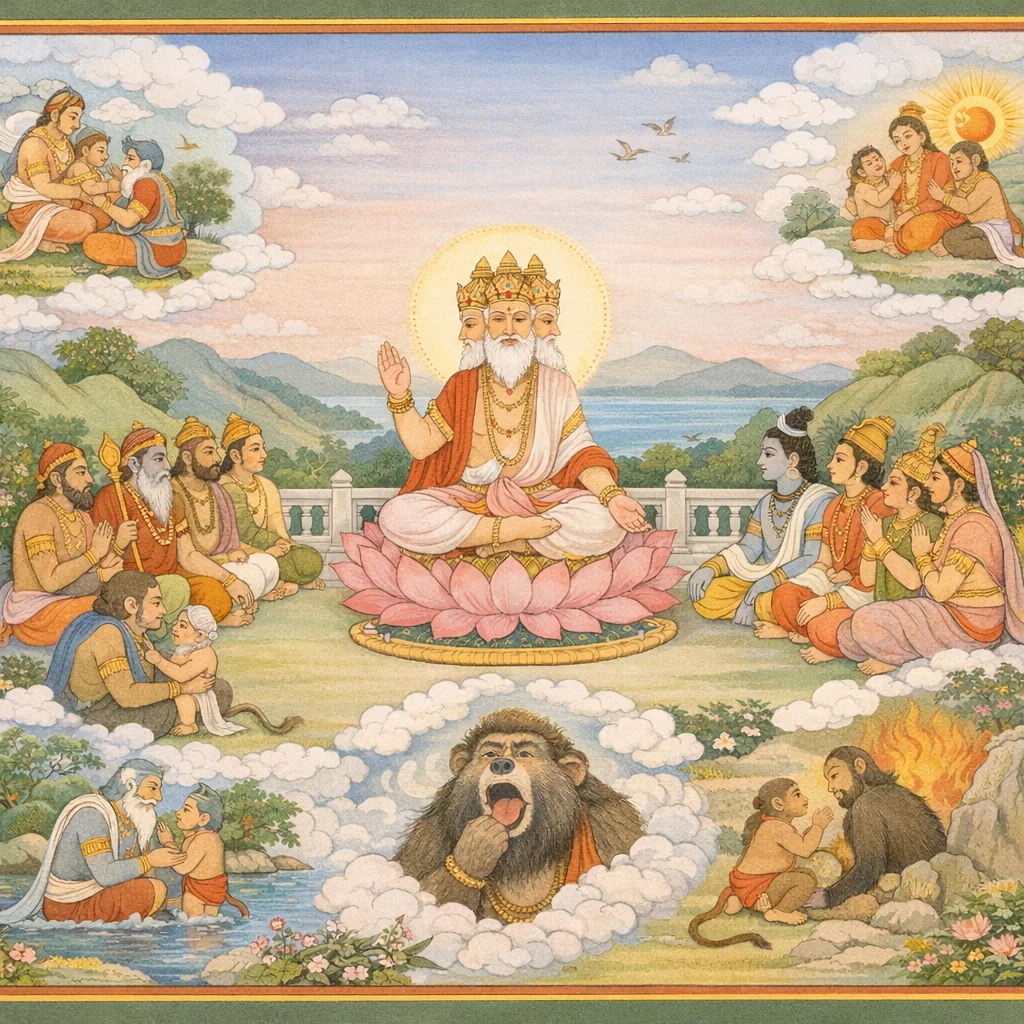
Sarga 17
सप्तदशः सर्गः — देवसंवादः तथा वानर-ऋक्ष-उत्पत्तिः (Divine Council and the Generation of Vanara Allies)
बालकाण्ड
Sarga 17 sets forth the epic’s sacred strategy: when Viṣṇu resolves to be born as Daśaratha’s son and manifest as Rāma, Brahmā addresses the assembled devas and commands them to bring forth mighty companions for Viṣṇu/Rāma—beings endowed with kāmarūpatva (voluntary shape-changing), extraordinary speed, keen intelligence, and martial skill. The sarga then names the principal births among the vanara leaders: Indra fathers Vāli; Sūrya fathers Sugrīva; Vāyu fathers Hanumān; Agni fathers Nīla; Viśvakarmā fathers Nala; Bṛhaspati fathers Tārā; Varuṇa fathers Suṣeṇa; Parjanya fathers Śarabha; and the Aśvins beget Mainda and Dvivida. Brahmā also recalls the earlier creation of Jāmbavān, who emerges from Brahmā’s face during a yawn, preserving an archaic cosmogonic motif. From these individual progenitors the account expands to mass procreation: devas, ṛṣis, gandharvas, yakṣas, nāgas, siddhas, vidyādharas, and others, through apsaras, nāga-kanyās, and gandharvī women, generate vast forest-dwelling forces. Their powers are described—rock and tree weapons, claws and teeth, mountain-shaking strength, and ocean-leaping speed—and Vāli is established as protector of bears, gopuccha-vanaras, and monkeys, all created expressly to aid Rāma in the future conflict with Daśagrīva (Rāvaṇa).
Shlokas
Verse 1
पुत्रत्वं तु गते विष्णौ राज्ञस्तस्य सुमहात्मन:।उवाच देवतास्सर्वास्स्वयम्भूर्भगवानिदम्।।।।
When Viṣṇu had resolved to be born as the son of that great-souled king, the Self-born Lord (Brahmā) addressed all the gods with these words.
Verse 2
सत्यसन्धस्य वीरस्य सर्वेषान्नो हितैषिण:।विष्णोस्सहायान्बलिनस्सृजध्वं कामरूपिण:।।।।
Create strong companions for Viṣṇu—steadfast in truth, heroic, and intent on the welfare of all—companions who can assume forms at will.
Verse 3
मायाविदश्च शूरांश्च वायुवेगसमाञ्जवे।नयज्ञान्बुद्धिसम्पन्नान्विष्णुतुल्यपराक्रमान्।।।।असंहार्यानुपायज्ञान् दिव्यसंहननान्वितान्।सर्वास्त्रगुणसम्पन्नानमृतप्राशनानिव।।।।अप्सरस्सु च मुख्यासु गन्धर्वाणां तनूषु च ।सृजध्वं हरिरूपेण पुत्रांस्तुल्यपराक्रमान्।।।।
“Create, in monkey form, sons of equal prowess—skilled in stratagems, brave, swift as the wind; wise in policy and endowed with intelligence; equal to Viṣṇu in valor; unwavering in effort; versed in the means of success; possessed of divine physiques; accomplished in the arts of weapons, as if nourished on amṛta. Let them be born from the bodies of the foremost apsarases and gandharva-women.”
Verse 4
मायाविदश्च शूरांश्च वायुवेगसमाञ्जवे।नयज्ञान्बुद्धिसम्पन्नान्विष्णुतुल्यपराक्रमान्।।1.17.3।।असंहार्यानुपायज्ञान् दिव्यसंहननान्वितान्।सर्वास्त्रगुणसम्पन्नानमृतप्राशनानिव।।1.17.4।।अप्सरस्सु च मुख्यासु गन्धर्वाणां तनूषु च ।सृजध्वं हरिरूपेण पुत्रांस्तुल्यपराक्रमान्।।1.17.5।।
“Create, in monkey form, sons of equal prowess—skilled in stratagems, brave, swift as the wind; wise in policy and endowed with intelligence; equal to Viṣṇu in valor; unwavering in effort; versed in the means of success; possessed of divine physiques; accomplished in the arts of weapons, as if nourished on amṛta. Let them be born from the bodies of the foremost apsarases and gandharva-women.”
Verse 5
मायाविदश्च शूरांश्च वायुवेगसमाञ्जवे।नयज्ञान्बुद्धिसम्पन्नान्विष्णुतुल्यपराक्रमान्।।1.17.3।।असंहार्यानुपायज्ञान् दिव्यसंहननान्वितान्।सर्वास्त्रगुणसम्पन्नानमृतप्राशनानिव।।1.17.4।।अप्सरस्सु च मुख्यासु गन्धर्वाणां तनूषु च ।सृजध्वं हरिरूपेण पुत्रांस्तुल्यपराक्रमान्।।1.17.5।।
“Create, in monkey form, sons of equal prowess—skilled in stratagems, brave, swift as the wind; wise in policy and endowed with intelligence; equal to Viṣṇu in valor; unwavering in effort; versed in the means of success; possessed of divine physiques; accomplished in the arts of weapons, as if nourished on amṛta. Let them be born from the bodies of the foremost apsarases and gandharva-women.”
Verse 6
पूर्वमेव मया सृष्टो जाम्बवानृक्षपुङ्गव:।जृम्भमाणस्य सहसा मम वक्त्रादजायत।।।।
Earlier I created Jāmbavān, the foremost of bears; as I yawned, he suddenly sprang forth from my mouth.
Verse 7
ते तथोक्ता भगवता तत्प्रतिश्रुत्य शासनम्।जनयामासुरेवं ते पुत्रान्वानररूपिण:।।।।
Thus instructed by the Blessed Lord, and having assented to his command, they accordingly begot sons, assuming the form of monkeys.
Verse 8
ऋषयश्च महात्मानस्सिद्धविद्याधरोरगा:।चारणाश्च सुतान्वीरान्ससृजुर्वनचारिण:।।।।
Great-souled ṛṣis, siddhas, vidyādharas, uragas, and cāraṇas too brought forth heroic sons, who became wanderers of the forest.
Verse 9
वानरेन्द्रं महेन्द्राभमिन्द्रो वालिनमूर्जितम्।सुग्रीवं जनयामास तपनस्तपतां वर:।।।।
Indra begot Vāli, the king of monkeys, mighty in body and like Mount Mahendra; and Sūrya, best among the radiant, begot Sugrīva.
Verse 10
बृहस्पतिस्त्वजनयत्तारं नाम महाहरिम्।सर्ववानरमुख्यानां बुद्धिमन्तमनुत्तमम्।।।।
Bṛhaspati begot the great monkey named Tārā—supremely intelligent, unsurpassed among all the leaders of the Vānaras.
Verse 11
धनदस्य सुतश्श्रीमान् वानरो गन्धमादन:।विश्वकर्मात्वजनयन्नलं नाम महाहरिम्।।।।
Dhanada’s (Kubera’s) illustrious son was the monkey Gandhamādana; and Viśvakarmā begot the great monkey named Nala.
Verse 12
पावकस्य सुतश्श्रीमान् नीलोऽग्निसदृशप्रभ:।तेजसा यशसा वीर्यादत्यरिच्यत वानरान्।।।।
Nīla, the illustrious son of Pāvaka (Agni), radiant like fire itself, surpassed the other Vānaras in energy, fame, and valor.
Verse 13
रूपद्रविणसम्पन्नावश्विनौ रूपसम्मतौ।मैन्दं च द्विविदं चैव जनयामासतुस्स्वयम्।।।।
The Aśvins—endowed with beauty and wealth, and revered for their comeliness—personally begot Mainda and Dvivida.
Verse 14
वरुणो जनयामास सुषेणं वानरर्षभम्।शरभं जनयामास पर्जन्यस्तु महाबलम्।।।।
Varuṇa begot Suṣeṇa, a bull among the Vānaras; and Parjanya begot Śarabha, possessed of great strength.
Verse 15
मारुतस्यात्मजश्श्रीमान्हनुमान्नाम वीर्यवान् ।वज्रसंहननोपेतो वैनतेयसमो जवे।।।।
Māruta (Vāyu) begot a son named Hanumān—illustrious and mighty—whose frame was diamond-hard, and whose speed equaled that of Vainateya (Garuḍa).
Verse 16
ते सृष्टा बहुसाहस्रा दशग्रीववधे रता:।अप्रमेयबला वीरा विक्रान्ता: कामरूपिण:।।।।
Thus were created many thousands—heroes intent on the slaying of Daśagrīva—of immeasurable strength, bold in battle, and able to assume forms at will.
Verse 17
मेरुमन्दरसङ्काशा वपुष्मन्तो महाबला:।ऋक्षवानरगोपुच्छा: क्षिप्रमेवाभिजज्ञिरे।।।।
Mighty beings swiftly came into existence—bodied like Meru and Mandara—of great strength: bears, monkeys, and those with cow-like tails.
Verse 18
यस्य देवस्य यद्रूपं वेषो यश्च पराक्रम:।अजायत समस्तेन तस्य तस्य सुत: पृथक्।।।।
Whatever form, attire, and prowess belonged to any god, the son of each was born separately, bearing those very traits in their fullness.
Verse 19
गोलाङ्गूलीषु चोत्पन्ना: केचित्सम्मतविक्रमा:।ऋक्षीषु च तथा जाता वानरा: किन्नरीषु च।।।।
Some monkeys, famed for their valor, were born from tailed she-monkeys; likewise others were born from she-bears, and also from female Kinnaras.
Verse 20
देवा महर्षिगन्धर्वास्तार्क्ष्या यक्षा यशस्विन:।नागा: किम्पुरुषाश्चैव सिद्धविद्याधरोरगा:।।।।बहवो जनयामासुर्हृष्टास्तत्र सहस्रश:।वानरान्सुमहाकायान्सर्वान्वै वनचारिण:।।।।अप्सरस्सु च मुख्यासु तथा विद्याधरीषु च।नागकन्यासु च तथा गन्धर्वीणां तनूषु च ।।।।
Devas, great seers, Gandharvas, Garuḍas, glory-famed Yakṣas, Nāgas, Kimpuruṣas, Siddhas, Vidyādharas, and Uragas—many of them, delighted, generated by the thousand enormous Vānaras, all forest-roamers, through the foremost Apsarases, through female Vidyādharas, through daughters of the Nāgas, and through the bodies of female Gandharvas.
Verse 21
देवा महर्षिगन्धर्वास्तार्क्ष्या यक्षा यशस्विन:।नागा: किम्पुरुषाश्चैव सिद्धविद्याधरोरगा:।।1.17.20।। बहवो जनयामासुर्हृष्टास्तत्र सहस्रश:।वानरान्सुमहाकायान्सर्वान्वै वनचारिण:।।1.17.21।।अप्सरस्सु च मुख्यासु तथा विद्याधरीषु च।नागकन्यासु च तथा गन्धर्वीणां तनूषु च ।।1.17.22।।
Endowed with strength and the power to assume forms at will, they roamed as they pleased; in pride and prowess they were like lions and tigers.
Verse 22
देवा महर्षिगन्धर्वास्तार्क्ष्या यक्षा यशस्विन:।नागा: किम्पुरुषाश्चैव सिद्धविद्याधरोरगा:।।1.17.20।। बहवो जनयामासुर्हृष्टास्तत्र सहस्रश:।वानरान्सुमहाकायान्सर्वान्वै वनचारिण:।।1.17.21।।अप्सरस्सु च मुख्यासु तथा विद्याधरीषु च।नागकन्यासु च तथा गन्धर्वीणां तनूषु च ।।1.17.22।।
All of them could strike with rocks; all could fight using trees; all bore claws and teeth as weapons; and all were skilled in every kind of weapon.
Verse 23
कामरूपबलोपेता यथाकामं विचारिण:।सिंहशार्दूलसदृशा दर्पेण च बलेन च।।।।
Endowed with strength and the power to assume forms at will, they roamed as they pleased; in pride and prowess they were like lions and tigers.
Verse 24
शिलाप्रहरणास्सर्वे सर्वे पादपयोधिन:।।।।नखदंष्ट्रायुधास्सर्वे सर्वे सर्वास्त्रकोविदा:।
All of them could strike with rocks; all could fight using trees; all bore claws and teeth as weapons; and all were skilled in every kind of weapon.
Verse 25
विचालयेयुश्शैलेन्द्रान्भेदयेयुस्स्थिरान्द्रुमान्।क्षोभयेयुश्च वेगेन समुद्रं सरितां पतिम्।।।।
They could shake mighty mountains, split firm trees, and with their speed churn even the ocean, lord of rivers.
Verse 26
दारयेयु: क्षितिं पद्भ्यामाप्लवेयुर्महार्णवम्।नभ:स्थलम् विशेयुश्च गृह्णीयुरपि तोयदान्।।।।
With their feet they could cleave the earth, leap across the great ocean, enter the realm of the sky, and even seize the rain-bearing clouds.
Verse 27
गृह्णीयुरपि मातङ्गान्मत्तान्प्रव्रजतो वने।नर्दमानाश्च नादेन पातयेयुर्विहङ्गमान्।।।।
They could even seize rutting elephants roaming in the forest; and, roaring with their cry, they could make birds in flight fall down.
Verse 28
ईदृशानां प्रसूतानि हरीणां कामरूपिणाम्।शतं शतसहस्राणि यूथपानां महात्मनाम्।।।।
Thus were born vast hosts of monkeys able to assume forms at will—hundreds and hundreds of thousands of eminent troop-commanders.
Verse 29
ते प्रधानेषु यूथेषु हरीणां हरियूथपा:।बभूवुर्यूथपश्रेष्ठा वीरांश्चाजनयन् हरीन्।।।।
Among the foremost monkey clans, those commanders became the finest of troop-leaders, and they brought forth heroic monkeys.
Verse 30
अन्ये ऋक्षवत: प्रस्थानवतस्थु स्सहस्रश:।अन्ये नानाविधान्शैलान्भेजिरे काननानि च।।।।
Some, in their thousands, dwelt on mountain plateaus where bears abounded; others took to diverse mountains and forests as their homes.
Verse 31
सूर्यपुत्रं च सुग्रीवं शक्रपुत्रं च वालिनम्।भ्रातरावुपतस्थुस्ते सर्व एव हरीश्वरा:।।।।नलं नीलं हनूमन्तमन्यांश्च हरियूथपान्। 3
All those monkey-lords gathered in attendance upon the two brothers—Sugrīva, son of the Sun, and Vālī, son of Śakra—along with Nala, Nīla, Hanūmān, and other troop-commanders.
Verse 32
ते तार्क्ष्यबलसम्पन्नास्सर्वे युद्धविशारदा:।विचरन्तोऽर्दयन्दर्पात्सिंहव्याघ्रमहोरगान्।।।।
Endowed with the strength of Tārkṣya (Garuḍa) and skilled in warfare, they ranged about and, in their pride, harried lions, tigers, and great serpents.
Verse 33
तांश्च सर्वान्महाबाहुर्वाली विपुलविक्रम:।जुगोप भुजवीर्येण ऋक्षगोपुच्छवानरान्।।।।
And Vālī—mighty-armed and of vast prowess—protected them all with the strength of his arms: the bears, the gopucchas, and the monkeys.
Verse 34
तैरियं पृथिवी शूरैस्सपर्वतवनार्णवा।कीर्णा विविधसंस्थानैर्नानाव्यञ्जनलक्षणै:।।।।
By those valiant beings—of many builds and diverse distinguishing marks—this earth, with its mountains, forests, and seas, came to be filled.
Verse 35
तैर्मेघबृन्दाचलकूटकल्पै:महाबलैर्वानरयूथपालै:।बभूव भूर्भीमशरीररूपैस्समावृता रामसहायहेतो:।।।।
For the sake of aiding Rāma, the earth was covered by mighty commanders of monkey troops—huge as cloud-masses and mountain-peaks, and formidable in body and appearance.
Verse 36
All of them struck with rocks, and all fought wielding trees. All bore claws and sharp teeth as their natural weapons, yet all were skilled in every kind of missile and weapon.
Frequently Asked Questions
The pivotal action is Brahmā’s directive to the devas to create capable helpers for Viṣṇu/Rāma—framing collective responsibility as an ethical response to cosmic disorder, where power is generated not for conquest but for restoring dharma through disciplined assistance.
The sarga teaches that righteous outcomes depend on coordinated agency: divine intent (Viṣṇu’s incarnation) is paired with prepared support systems (vanara/ṛkṣa forces), emphasizing that dharma is upheld through cooperation, competence, and purpose-bound strength.
Landmarks function as similes and scope-markers—Meru, Mandara, and Mahendra (mountains) and Samudra (the ocean/lord of rivers)—to convey the allies’ magnitude and to map the epic’s world as a terrain requiring extraordinary mobility and force.