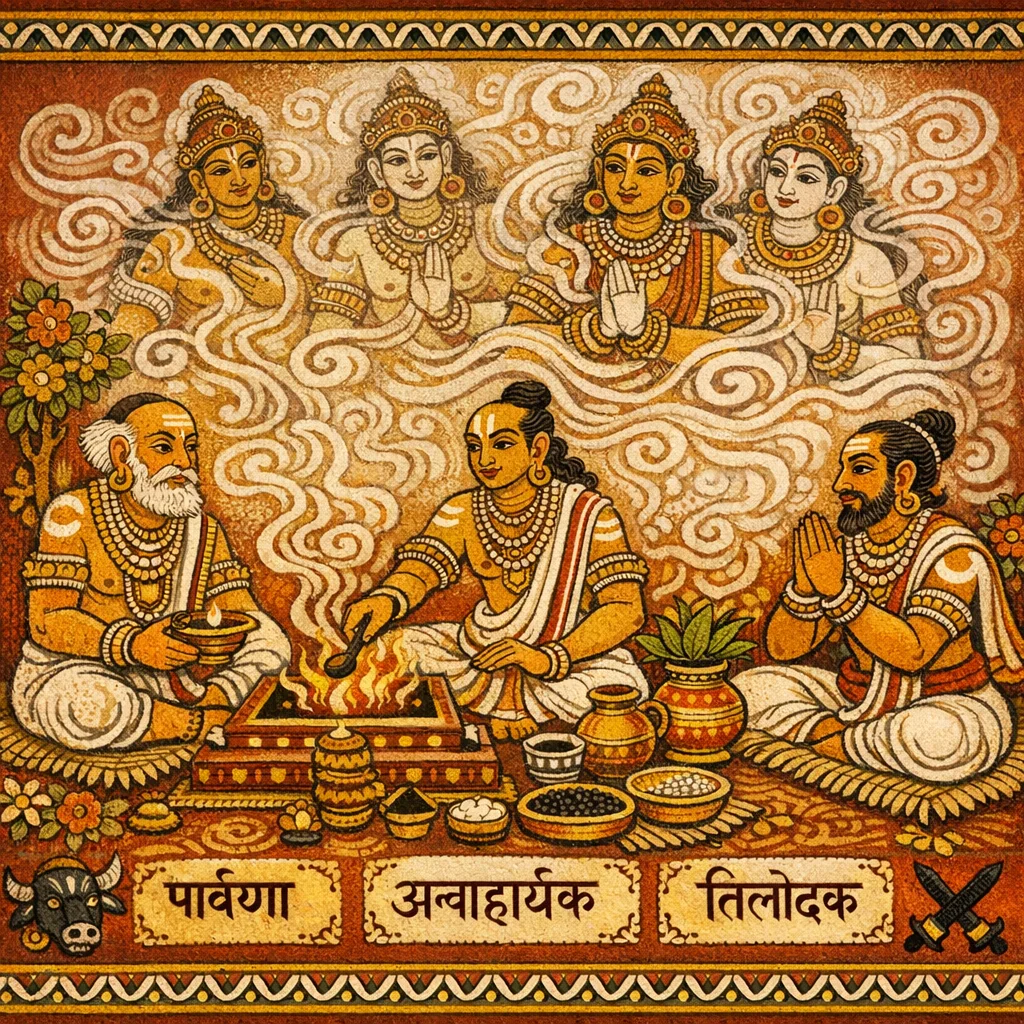
Adhyaya 16: Śrāddha Procedure: Types, Eligible Guests, Exclusions, and the Pārvaṇa–Anvāhāryaka Rite
श्राद्धविधिः (पार्वणान्वाहार्यक-नियमाः)
Speaker: Sūta, Vaivasvata Manu, Lord Matsya (Keśava/Madhusūdana addressed)
Sūta relates that Manu, having heard the earlier teachings, asks Keśava/Matsya about the proper timing of śrāddha, its varieties, whom to invite, whom to exclude, and how the offering reaches the Pitṛs. Matsya replies by (1) classifying śrāddha as nitya, naimittika, and kāmya; (2) defining the Pārvaṇa rite performed on parva days and stating who is qualified to receive the śrāddha meal; (3) listing censured persons and behaviors to be avoided, especially during śrāddha; (4) explaining invitation etiquette and that the Pitṛs are present, accompanying the invited brāhmaṇas; and (5) setting out a step-by-step fire-based ritual—preparing the site and implements, arranging seats, specifying the number of brāhmaṇas for deva and pitṛ portions, cooking caru, rules for sacred thread and posture, offering six piṇḍas and sesame-water, invocation and dismissal, satisfaction and vikirana, dismissal with pradakṣiṇā, concluding petitions, disposal of the piṇḍas, and post-rite observances—ending with notes on auspicious timing (certain solar signs, kṛṣṇa-pakṣa, and gifts after sapiṇḍīkaraṇa).
Key Concepts
Shlokas in Adhyaya 16
Verse 1
*सूत उवाच श्रुत्वैतत् सर्वम् अखिलं मनुः पप्रच्छ केशवम् श्राद्धकालं च विविधं श्राद्धभेदं तथैव च //
Sūta said: Having heard all of this in full, Manu questioned Keśava about the various proper times for performing śrāddha rites, and likewise about the different kinds of śrāddha.
Verse 2
श्राद्धेषु भोजनीया ये ये च वर्ज्या द्विजातयः कस्मिन्वासरभागे वा पितृभ्यः श्राद्धमाचरेत् //
At śrāddhas, which twice-born persons are fit to be fed, and which are to be avoided? And at what division of the day should one perform the śrāddha for the Pitṛs (ancestors)?
Verse 3
कस्मिन्दत्तं कथं याति श्राद्धं तु मधुसूदन विधिना केन कर्तव्यं कथं प्रीणाति तत्पितॄन् //
O Madhusūdana, when a śrāddha offering is given, to whom does it truly go, and by what means does it reach them? By which prescribed procedure should it be performed, and in what way does it gratify the Pitṛs, the ancestral fathers?
Verse 4
*मत्स्य उवाच कुर्यादहरहः श्राद्धम् अन्नाद्येनोदकेन वा पयोमूलफलैर् वापि पितृभ्यः प्रीतिमावहन् //
Lord Matsya said: One should perform śrāddha every day—using cooked food and other offerings, or even with water alone, or with milk, roots, and fruits—thereby bringing satisfaction to the Pitṛs, the ancestral spirits.
Verse 5
नित्यं नैमित्तिकं काम्यं त्रिविधं श्राद्धमुच्यते नित्यं तावत्प्रवक्ष्यामि अर्घ्यावाहनवर्जितम् //
Śrāddha is said to be of three kinds—daily (nitya), occasional (naimittika), and desire-motivated (kāmya). First I shall explain the daily śrāddha, performed without the arghya offering and without formal invocation (āvāhana).
Verse 6
अदैवं तद्विजानीयात् पार्वणं पर्वसु स्मृतम् पार्वणं त्रिविधं प्रोक्तं शृणु तावन्महीपते //
Know this as ‘a-daiva’—not offered to the gods. The rite called ‘pārvaṇa’ is remembered as that which is performed on parva (junction) days. The pārvaṇa is declared to be of three kinds—listen, O king.
Verse 7
पार्वणे ये नियोज्यास्तु ताञ्शृणुष्व नराधिप पञ्चाग्निः स्नातकश्चैव त्रिसुपर्णः षडङ्गवित् //
O king, listen to those who may be appointed for the Parvaṇa (śrāddha) rite: one who maintains the five sacred fires (pañcāgni), a duly graduated Vedic student (snātaka), one versed in the Trisuparṇa Vedic recitation, and one who knows the six Vedāṅgas (ṣaḍaṅga).
Verse 8
श्रोत्रियः श्रोत्रियसुतो विधिवाक्यविशारदः सर्वज्ञो वेदविन्मन्त्री ज्ञातवंशः कुलान्वितः //
He should be a śrotriya (a Brahmin trained in the Veda and grounded in tradition), born of a śrotriya, skilled in authoritative injunctions of ritual and law, broadly learned, a knower of the Vedas and fit to serve as a minister—of known lineage and well-established family.
Verse 9
पुराणवेत्ता धर्मज्ञः स्वाध्यायजपतत्परः शिवभक्तः पितृपरः सूर्यभक्तो ऽथ वैष्णवः //
He is a knower of the Purāṇas and a knower of dharma; devoted to svādhyāya (Vedic self-study) and japa (repetition of sacred mantras); a devotee of Śiva, devoted to the Pitṛs (ancestral rites), a devotee of the Sun—and also a Vaiṣṇava (devotee of Viṣṇu).
Verse 10
ब्रह्मण्यो योगविच्छान्तो विजितात्मा च शीलवान् भोजयेच्चापि दौहित्रं यत्नतः स्वसुहृद्गुरून् //
One devoted to Brahmins and to Brahman (the sacred order), tranquil through the discipline of yoga, self-controlled, and of good character should also, with due care, provide a meal—especially for his daughter’s son—and diligently feed his own friends and his teachers (gurus).
Verse 11
विट्पीतं मातुलं बन्धुम् ऋत्विगाचार्यसोमपान् यश्च व्याकुरुते वाक्यं यश्च मीमांसते ऽध्वरम् //
One should properly recognize and honor the maternal uncle and other kinsmen, those who have shared one’s food, the officiating priests (ṛtvij) and teachers (ācārya), and those entitled to Soma-drink; as well as the person who explains the Vedic utterance and the one who investigates and determines the procedure of the sacrifice (adhvara).
Verse 12
सामस्वरविधिज्ञश्च पङ्क्तिपावनपावनः सामगो ब्रह्मचारी च वेदयुक्तो ऽथ ब्रह्मवित् //
He knows the rules and tonal patterns of the Sāma-chant; he purifies the paṅkti (the dining-row) and is himself pure; a singer of the Sāmans, a celibate student (brahmacārin), disciplined in the Veda—and indeed a knower of Brahman.
Verse 13
यत्रैते भुञ्जते श्राद्धे तदेव परमार्थवत् एते भोज्याः प्रयत्नेन वर्जनीयान्निबोध मे //
Wherever these persons partake of the śrāddha meal, that act is regarded as truly fruitful. Therefore know from me: some are to be fed with careful attention, and some are to be avoided with deliberate effort.
Verse 14
पतितो ऽभिशस्तः क्लीबः पिशुनव्यङ्गरोगिणः कुनखी श्यावदन्तश्च कुण्डगोलाश्वपालकाः //
“The fallen from right conduct (patita), the publicly accused or condemned (abhiśasta), the impotent (klība), the slanderer (piśuna), those afflicted with deformity or disease (vyaṅga-rogin), one with diseased nails (kunakhī), one with blackened teeth (śyāvadanta), and those such as the kuṇḍa, gola, and keepers of horses—these are counted among the censured classes.”
Verse 15
परिवित्तिर्नियुक्तात्मा प्रमत्तोन्मत्तदारुणाः बैडाली बकवृत्तिश्च दम्भी देवलकादयः //
A man who marries before his elder brother (parivitti), one whose mind is bought over and who acts under another’s compulsion (niyuktātman), those who are heedless, mad, and cruel; the cat-like deceiver (baiḍālī), the crane-like hypocrite (bakavṛtti), the ostentatious pretender (dambhī), and those who live by temple-service for hire (devalaka) and the like—these are censured as base modes of conduct and livelihood.
Verse 16
कृतघ्नान्नास्तिकांस् तद्वन् म्लेच्छदेशनिवासिनः त्रिशङ्कुर् बर्बरद्राववीतद्रविडकोङ्कणान् //
Likewise, he (Triśaṅku) drove away the ungrateful (kṛtaghna) and the unbelievers (nāstika), as well as those dwelling in mleccha lands—including the Barbaras, Drāva-vītas, Draviḍas, and Koṅkaṇas.
Verse 17
वर्जयेल्लिङ्गिनः सर्वाञ् श्राद्धकाले विशेषतः पूर्वेद्युरपरेद्युर्वा विनीतात्मा निमन्त्रयेत् //
At the time of the Śrāddha—especially—one should exclude all liṅgins, those marked by sectarian externals. With a disciplined mind, one should invite the proper guests either on the previous day or on the following day.
Verse 18
निमन्त्रितान्हि पितर उपतिष्ठन्ति तान्द्विजान् वायुभूता नु गच्छन्ति तथासीनानुपासते //
For when duly invited, the Pitṛs (ancestors) attend upon those brāhmaṇas; assuming a wind-like form, they follow them and, as the brāhmaṇas sit, remain nearby, reverently waiting upon them.
Verse 19
दक्षिणं जानुमालभ्य त्वं मया तु निमन्त्रितः एवं निमन्त्र्य नियमं श्रावयेत्पितृबान्धवान् //
Touching the right knee (as a respectful entreaty), one should say: “You have indeed been invited by me.” Having thus invited them, one should then make the rule of observance heard by the paternal relatives.
Verse 20
अक्रोधनैः शौचपरैः सततं ब्रह्मचारिभिः भवितव्यं भवद्भिश्च मया च श्राद्धकारिणा //
Those who perform the śrāddha should always be free from anger, devoted to purity, and steadfast in continence (brahmacarya); thus should you be, and thus should I too be, as one undertaking the ancestral rite.
Verse 21
पितृयज्ञं विनिर्वर्त्य तर्पणाख्यं तु यो ऽग्निमान् पिण्डान्वाहार्यकं कुर्याच् छ्राद्धमिन्दुक्षये सदा //
Having duly completed the Pitṛ-yajña—namely the rite called tarpaṇa—one who maintains the sacred fire should always perform the Śrāddha with piṇḍa-offerings and the anvāhārya-oblation at the waning of the moon (the new-moon period).
Verse 22
गोमयेनोपलिप्ते तु दक्षिणप्रवणे स्थले श्राद्धं समाचरेद्भक्त्या गोष्ठे वा जलसंनिधौ //
One should perform the Śrāddha with devotion in a place plastered with cow-dung, on ground sloping to the south—either in a cowshed or near a body of water.
Verse 23
अग्निमान्निर्वपेत्पित्र्यं चरुं च सममुष्टिभिः पितृभ्यो निर्वपामीति सर्वं दक्षिणतो न्यसेत् //
Having kindled the sacred fire, he should offer the ancestral cooked oblation (caru) to the Pitṛs in equal handful-measures, reciting, “I offer to the Pitṛs.” He should then place everything to the south, the direction of the Pitṛs.
Verse 24
अभिघार्यं ततः कुर्यान् निर्वापत्रयमग्रतः ते ऽपि तस्यायताः कार्याश् चतुरङ्गुलविस्तृताः //
Then he should prepare the abhighārya, the consecrated sprinkling or unction. In front of it he should make three nirvāpa, the deposited offering-places or portions. These too should be formed elongated in the same manner, each with a breadth of four aṅgulas (four finger-widths).
Verse 25
दर्वीत्रयं तु कुर्वीत खादिरं रजतान्वितम् रत्निमात्रं परिश्लक्ष्णं हस्ताकाराग्रमुत्तमम् //
He should make a set of three ladles (darvī), fashioned from khadira wood and fitted with silver. Each should be a ratni (a span) in length, smoothly finished, and with an excellent tip shaped like a hand.
Verse 26
उदपात्रं च कांस्यं च मेक्षणं च समित्कुशान् तिलाः पात्राणि सद्वासो गन्धधूपानुलेपनम् //
One should provide: an offering water-vessel, a kāṃsya (bronze) utensil, a ladle for libations (meṣaṇa), fuel-sticks and kuśa grass, sesame seeds, vessels, good garments, and also fragrance, incense, and unguents for anointing—these as prescribed ritual gifts.
Verse 27
आहरेदपसव्यं तु सर्वं दक्षिणतः शनैः एवमासाद्य तत्सर्वं भवनस्याग्रतो भुवि //
One should then bring everything in the reverse (counterclockwise) direction, slowly, keeping to the right (southern) side; and having thus brought all of it, one should place it on the ground in front of the house.
Verse 28
गोमयेनोपलिप्तायां गोमूत्रेण तु मण्डलम् अक्षताभिः सपुष्पाभिस् तदभ्यर्च्यापसव्यवत् //
After smearing the ritual ground with cow-dung, one should delineate the maṇḍala with cow-urine; then one should worship that maṇḍala with unbroken rice grains (akṣata) and with flowers, performing the rite in the prescribed apasavya manner.
Verse 29
विप्राणां क्षालयेत् पादाव् अभिनन्द्य पुनः पुनः आसनेषूपकॢप्तेषु दर्भवत्सु विधानवत् //
Having respectfully greeted the brāhmaṇas again and again, one should wash their feet, and then seat them properly on the prepared seats furnished with darbha-grass, in accordance with the prescribed rite.
Verse 30
उपस्पृष्टोदकान्विप्रान् उपवेश्यानुमन्त्रयेत् द्वौ दैवे पितृकृत्ये त्रीन् एकैकमुभयत्र च //
After having the brāhmaṇas touch consecrated water for purification, he should seat them and then recite the appropriate invitatory formulas. For the rite meant for the Devas he should employ two brāhmaṇas, for the ancestral rite (pitṛkṛtya/śrāddha) three, and in a combined rite one for each side.
Verse 31
भोजयेदीश्वरो ऽपीह न कुर्याद्विस्तरं बुधः दैवपूर्वं नियोज्याथ विप्रानर्घ्यादिना बुधः //
Even a powerful lord should, in this matter, simply provide the meal and not make an ostentatious display. Having first performed the offerings to the gods, the wise man should then seat and attend to the brāhmaṇas, honoring them with arghya and the customary rites of welcome.
Verse 32
अग्नौ कुर्यादनुज्ञातो विप्रैर् विप्रो यथाविधि स्वगृह्योक्तविधानेन कांस्ये कृत्वा चरुं ततः //
When permitted by the brāhmaṇas, the brāhmaṇa should perform the rite in the sacred fire in the proper manner; then, following the procedure taught in his own Gṛhya tradition, he should prepare the caru (sacrificial porridge) in a bronze vessel.
Verse 33
अग्नीषोमयमाभ्यां तु कुर्यादाप्यायनं बुधः दक्षिणाग्नौ प्रतीते वा य एकाग्निर्द्विजोत्तमः //
A wise man should perform the rite of replenishment (āpyāyana) with invocations to Agni, Soma, and Yama. Or, if the southern fire (dakṣiṇāgni) has gone out, then the best of twice-born—who maintains a single sacred fire—should perform it accordingly.
Verse 34
यज्ञोपवीती निर्वर्त्य ततः पर्युक्षणादिकम् प्राचीनावीतिना कार्यम् अतः सर्वं विजानता //
Having arranged the sacred thread in the yajñopavīta position, one should then perform acts such as sprinkling (paryukṣaṇa) and the rest; but these are to be done with the thread in the prācīnāvīta position—so understands the one who knows the entire procedure.
Verse 35
षट् च तस्माद्धविःशेषात् पिण्डान्कृत्वा ततोदकम् दद्यादुदकपात्रैस् तु सतिलं सव्यपाणिना //
Then, from that remaining oblation (havis), he should prepare six piṇḍas (rice-balls). After that, he should offer water—using vessels meant for water—mixed with sesame seeds, pouring it with the left hand.
Verse 36
जान्व् आच्य सव्यं यत्नेन दर्भयुक्तो विमत्सरः विधाय लेखा यत्नेन निर्वापेष्ववनेजनम् //
With care, he should bend the left knee, remaining free from malice and equipped with darbha grass. Then, having carefully drawn the prescribed lines, he should perform the washing/purificatory rinsing at the places of offering (nirvāpa).
Verse 37
दक्षिणाभिमुखः कुर्यात् करे दर्वीं निधाय वै निधाय पिण्डम् एकैकं सर्वदर्भेष्वनुक्रमात् //
Facing south, he should perform the rite, holding the ladle (darvī) in his hand, and then place each piṇḍa (rice-ball offering) one by one, in due sequence, upon all the darbha-grass arrangements.
Verse 38
निनयेदथ दर्भेषु नामगोत्रानुकीर्तनैः तेषु दर्भेषु तं हस्तं विमृज्याल्लेपभागिनाम् //
Then, while reciting the names and the gotras (lineages), he should place his hand upon the darbha grass; and upon those darbhas he should wipe his hand—the hand that has come into contact with the remnants or coating of the offering.
Verse 39
तथैव च ततः कुर्यात् पुनः प्रत्यवनेजनम् षडप्यृतून्नमस्कृत्य गन्धधूपार्हणादिभिः //
And likewise, thereafter one should again perform the rite of rinsing or purificatory sprinkling; having bowed to all the six seasons, one should honor them with offerings such as fragrance, incense, and other acts of worship.
Verse 40
एवमावाह्य तत्सर्वं वेदमन्त्रैर्यथोदितैः एकाग्नेरेक एव स्यान् निर्वापो दर्विका तथा //
Thus, having invoked all of that as prescribed with Vedic mantras, one should maintain a single sacred fire; and there should be only one act of offering (nirvāpa), performed using the ladle (darvikā) as well.
Verse 41
ततः कृत्वान्तरे दद्यात् पत्नीभ्यो ऽन्नं कुशेषु सः तद्वत्पिण्डादिके कुर्याद् आवाहनविसर्जनम् //
Then, after observing the proper interval between the offerings, he should place portions of food for the wives of the invoked ancestors upon the kuśa grass. Likewise, with regard to the piṇḍa offerings and the rest, he should perform the rites of invocation (āvāhana) and dismissal (visarjana).
Verse 42
ततो गृहीत्वा पिण्डेभ्यो मात्राः सर्वाः क्रमेण तु तानेव विप्रान्प्रथमं प्राशयेद्यत्नतो नरः //
Then, taking in due order all the measured portions from the piṇḍas, the man should carefully have those very Brahmins partake of them first.
Verse 43
यस्मादन्नाद्धृता मात्रा भक्षयन्ति द्विजातयः अन्वाहार्यकम् इत्युक्तं तस्मात्तच्चन्द्रसंक्षये //
Because the twice-born (dvija) partake of a measured portion taken from the cooked food, it is therefore called “anvāhāryaka”; hence this rite is performed during the waning of the moon.
Verse 44
पूर्वं दत्त्वा तु तद्धस्ते सपवित्रं तिलोदकम् तत्पिण्डाग्रं प्रयच्छेत स्वधैषामस्त्विति ब्रुवन् //
First, placing sesame-water (tilodaka) together with the pavitra (sacred ring/grass) into his hand, one should then offer the foremost portion of the piṇḍa (rice-ball), saying, “Let this be for them—svadhā.”
Verse 45
वर्णयन्भोजयेदन्नं मिष्टं पूतं च सर्वदा वर्जयेत्क्रोधपरतां स्मरन्नारायणं हरिम् //
Speaking pleasantly, one should always eat food that is sweet and pure; one should avoid being given over to anger, remembering Nārāyaṇa—Hari.
Verse 46
तृप्ताञ्ज्ञात्वा ततः कुर्याद् विकिरन्सार्ववर्णिकम् सोदकं चान्नमुद्धृत्य सलिलं प्रक्षिपेद्भुवि //
Having ascertained that they are satisfied, one should then perform the scattering-offering (vikiraṇa) meant for all social classes (varṇa); and, lifting up the food together with water, one should pour the water onto the ground.
Verse 47
आचान्तेषु पुनर्दद्याज् जलपुष्पाक्षतोदकम् स्वस्तिवाचनकं सर्वं पिण्डोपरि समाहरेत् //
After they have performed ācamana (ritual sipping of water), one should again offer water together with flowers and unbroken grains (akṣata); and one should gather and place all the auspicious recitations (svasti-formulas) over the piṇḍa (rice-ball offering).
Verse 48
देवाद्यन्तं प्रकुर्वीत श्राद्धनाशो ऽन्यथा भवेत् विसृज्य ब्राह्मणांस्तद्वत् तेषां कृत्वा प्रदक्षिणम् //
One should perform the śrāddha beginning with offerings to the gods and bringing it to its proper conclusion; otherwise the śrāddha becomes futile. Having duly dismissed the brāhmaṇas according to rule, one should then circumambulate them respectfully (pradakṣiṇa).
Verse 49
दक्षिणां दिशमाकाङ्क्षन् पितॄन् याचेत मानवः दातारो नो ऽभिवर्धन्तां वेदाः संततिरेव च //
Facing the southern quarter, a man should supplicate the Pitṛs (ancestral fathers): “May our benefactors increase; and may the Vedas—and our lineage—indeed flourish.”
Verse 50
श्रद्धा च नो मा व्यगमद् बहु देयं च नो ऽस्त्विति अन्नं च नो बहु भवेद् अतिथींश्च लभेमहि //
May śraddhā (faithful reverence) never depart from us; may we have much to give in charity; may we possess abundant food; and may we obtain guests to honor.
Verse 51
याचितारश्च नः सन्तु मा च याचिष्म कंचन एतदस्त्विति तत्प्रोक्तम् अन्वाहार्यं तु पार्वणम् //
“May there be those who ask of us, yet may we not ask of anyone.” With these words it is enjoined that the Anvāhārya (supplementary oblation) is to be performed in the Pārvaṇa rite.
Verse 52
यथेन्दुसंक्षये तद्वद् अन्यत्रापि निगद्यते पिण्डांस्तु गोजविप्रेभ्यो दद्यादग्नौ जले ऽपि वा //
As is prescribed at the waning of the moon, so too it is stated elsewhere: one should offer the piṇḍa-balls—either to cows, to goats, or to brāhmaṇas; or else one may consign them into fire or into water.
Verse 53
विप्राग्रतो वा विकिरेद् वयोभिर् अभिवाशयेत् पत्नी तु मध्यमं पिण्डं प्राशयेद् विनयान्विता //
He should either scatter the offering in front of the Brahmins, or respectfully invite the elders to partake. Then the wife, endowed with humility and proper conduct, should cause the middle piṇḍa (rice-ball offering) to be eaten.
Verse 54
आधत्त पितरो गर्भम् अत्र संतानवर्धनम् तावदुच्छेषणं तिष्ठेद् यावद्विप्रा विसर्जिताः //
Here the Pitṛs (ancestral spirits) bestow conception and increase of progeny. Therefore, one should keep the remaining food (the leavings of the rite/meal) in place until the Brahmins have been formally dismissed.
Verse 55
वैश्वदेवं ततः कुर्यान् निवृत्ते पितृकर्मणि इष्टैः सह ततः शान्तो भुञ्जीत पितृसेवितम् //
When the rite for the Ancestors (pitṛ-karman) has been completed, one should then perform the Vaiśvadeva offering. Thereafter, being composed, one should eat together with one’s dear ones the food that has been offered in service to the Pitṛs.
Verse 56
पुनर् भोजनमध्वानं यानमायासमैथुनम् श्राद्धकृच्छ्राद्धभुक्चैव सर्वमेतद्विवर्जयेत् //
One should avoid all of the following: eating again (a second meal), long travel, riding or vehicular movement, exhausting exertion, sexual intercourse, undertaking a Śrāddha-related austerity (kṛcchra), and eating the food offered in a Śrāddha.
Verse 57
स्वाध्यायकलहं चैव दिवास्वप्नं च सर्वदा अनेन विधिना श्राद्धं निरुद्वास्येह निर्वपेत् //
One should always avoid quarrelling during Vedic study (svādhyāya) and sleeping in the daytime; following this procedure, one should here perform the śrāddha offering without driving anyone away (and without causing disturbance).
Verse 58
कन्याकुम्भवृषस्थे ऽर्के कृष्णपक्षेषु सर्वदा यत्र यत्र प्रदातव्यं सपिण्डीकरणात् परम् तत्रानेन विधानेन देयम् अग्निमता सदा //
Whenever the Sun is in Virgo, Aquarius, or Taurus, and always during the dark fortnight (kṛṣṇa-pakṣa), whatever offering is to be made after the rite of sapiṇḍīkaraṇa (joining the departed to the ancestral line) should invariably be given according to this prescribed procedure—by one who maintains the sacred fire.
Frequently Asked Questions
It teaches the correct śrāddha framework—its types, the Pārvaṇa–Anvāhāryaka procedure, and the ethical/ritual conditions for efficacy: invite qualified brāhmaṇas, avoid censured persons and hypocrisy, prepare the south-oriented ritual space, perform tarpaṇa and piṇḍa offerings with proper thread positions and apasavya actions, conclude with satisfaction checks, dismissal rites, prayers for lineage and prosperity, and observe post-rite restraints.
Primarily Dharma (ritual-dharma and purity discipline) with an implicit genealogy/lineage focus through Pitṛ worship, sapiṇḍīkaraṇa reference, and prayers for santati (progeny/continuity). Vāstu/architecture is not the chapter’s focus, though it includes spatial rules (southward slope, cow-dung plastering, maṇḍala marking) relevant to ritual space design.
Those praised include śrotriya brāhmaṇas grounded in Vedic tradition and conduct: maintainers of sacred fires, snātakas, Trisuparṇa reciters, ṣaḍaṅga-vids, purāṇa- and dharma-knowers, disciplined in svādhyāya and japa, self-controlled and of good character—along with respected relations/elders such as maternal kin, teachers, officiants, and qualified explainers/investigators of ritual procedure.
The text lists patita (fallen), abhiśasta (publicly accused/condemned), kṛtaghna (ungrateful), nāstika (unbeliever), deceitful/hypocritical types (baiḍālī, bakavṛtti), dāmbhika (ostentatious), devalaka (temple-service for hire), and various censured conditions/livelihoods; it also says to exclude liṅgins (those marked by sectarian externals) especially at śrāddha.
It states that when brāhmaṇas are duly invited, the Pitṛs attend upon them, becoming wind-like in form, following them and remaining near as the brāhmaṇas sit—implying that correct invitation and hospitality serve as the channel for ancestral participation.
Notable markers include: south-oriented setup on cow-dung plastered ground; apasavya (counterclockwise) handling; seating on darbha; specific counts of brāhmaṇas (two for deva, three for pitṛ, one each in combined); preparation of pitṛ-caru and six piṇḍas; sesame-water offerings with the left hand; prācīnāvīta usage for key actions; invocation/dismissal; feeding measured portions to brāhmaṇas (anvāhāryaka); vikirana; concluding svasti recitations over piṇḍa; disposal options for piṇḍas; and concluding petitions for prosperity, Vedic flourishing, and lineage.