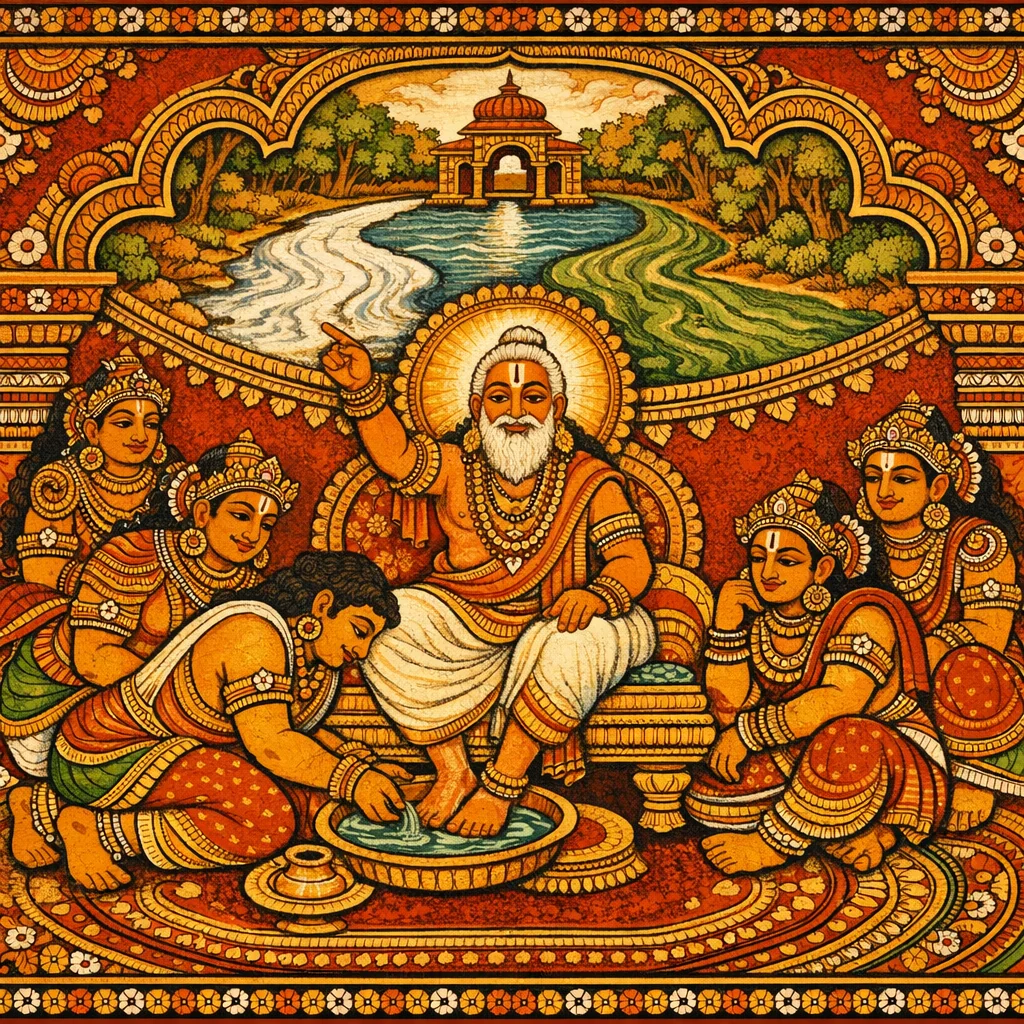
Adhyaya 103: Prayaga Mahatmya Begins: Yudhishthira’s Remorse, Markandeya’s Counsel, and the Call to Prayaga
प्रयागमाहात्म्यप्रकरणम् (युधिष्ठिरशोक-मार्कण्डेयसंवादः)
Speaker: नन्दिकेश्वर (Nandikeśvara), युधिष्ठिर (Yudhiṣṭhira), मार्कण्डेय (Mārkaṇḍeya)
Nandikeśvara resumes the praise of Prayāga as Mārkaṇḍeya once related it to Yudhiṣṭhira. After the Bhārata war, Yudhiṣṭhira is crushed by grief and moral dread over the vast slaughter, wondering whom to seek for guidance and how to swiftly cast off the stain of great sins and attain Viṣṇuloka. Mārkaṇḍeya arrives in Hāstinapura, is ritually honored by the king, and asks why he weeps. Yudhiṣṭhira confesses his anxious brooding over what was done for the sake of the kingdom. Mārkaṇḍeya teaches that the wise see no sin in fighting a righteous battle as the kṣatriya’s duty, and urges the king not to torment himself. Asked for a sin-destroying practice, he answers briefly: going to Prayāga is the foremost means to remove all sins.
Key Concepts
Shlokas in Adhyaya 103
Verse 1
*नन्दिकेश्वर उवाच अतः परं प्रवक्ष्यामि प्रयागस्योपवर्णनम् मार्कण्डेयेन कथितं यत्पुरा पाण्डुसूनवे //
Nandikeśvara said: “Now, hereafter, I shall relate the description and praise of Prayāga—just as it was formerly narrated by Mārkaṇḍeya to the son of Pāṇḍu.”
Verse 2
भारते तु यदा वृत्ते प्राप्तराज्ये पृथासुते एतस्मिन्नन्तरे राजा कुन्तीपुत्रो युधिष्ठिरः //
When the events of the Bhārata had taken place and Pṛthā’s son had obtained the kingdom, in that interval King Yudhiṣṭhira—the son of Kuntī—ruled.
Verse 3
भ्रातृशोकेन संतप्तश् चिन्तयन्स पुनः पुनः आसीत्सुयोधनो राजा एकादशचमूपतिः //
Scorched by grief for his brothers, King Suyodhana kept thinking again and again; he stood there as the commander over eleven divisions of the army.
Verse 4
अस्मान्संताप्य बहुशः सर्वे ते निधनं गताः वासुदेवं समाश्रित्य पञ्च शेषास्तु पाण्डवाः //
Having repeatedly caused us great anguish, all of them met their end; but the five Pāṇḍavas remained—taking refuge in Vāsudeva.
Verse 5
हत्वा भीष्मं च द्रोणं च कर्णं चैव महाबलम् दुर्योधनं च राजानं पुत्रभ्रातृसमन्वितम् //
Having slain Bhīṣma, Droṇa, and the mighty Karṇa, and also King Duryodhana—together with his sons and brothers—(they proceeded further).
Verse 6
राजानो निहताः सर्वे ये चान्ये शूरमानिनः किं नो राज्येन गोविन्द किं भोगैर्जीवितेन वा //
All the kings have been slain—along with others who fancied themselves heroes. O Govinda, what use is a kingdom to us now? What use are pleasures, or even life itself?
Verse 7
धिक् कष्टमिति संचित्य राजा वैक्लव्यभागतः निर्विचेष्टो निरुत्साहः किंचित् तिष्ठत्यधोमुखः //
Thinking to himself, “Fie—what misery this is!”, the king, overtaken by helpless despondency, stood for a while with his face cast down—motionless and devoid of all spirit.
Verse 8
लब्धसंज्ञो यदा राजा चिन्तयन्स पुनः पुनः कतरो विनियोगो वा नियमं तीर्थमेव च //
When the king regained awareness, he reflected again and again: “Which application of this rite is proper? What restraint should be observed? And which sacred ford (tīrtha) indeed should be chosen?”
Verse 9
येनाहं शीघ्रम् आमुञ्चे महापातकिकिल्बिषात् यत्र स्थित्वा नरो याति विष्णुलोकमनुत्तमम् //
By what means may I be quickly freed from the taint of great sins; and by abiding in what does a man attain the unsurpassed realm of Viṣṇu (Viṣṇuloka)?
Verse 10
कथं पृच्छामि वै कृष्णं येनेदं कारितो ऽस्म्यहम् धृतराष्ट्रं कथं पृच्छे यस्य पुत्रशतं हतम् //
How can I even question Kṛṣṇa—by whom I have been made to bring this about? And how can I question Dhṛtarāṣṭra, whose hundred sons have been slain?
Verse 11
व्यासं कथमहं पृच्छे यस्य गोत्रक्षयः कृतः एवं वैक्लव्यमापन्नो धर्मराजो युधिष्ठिरः रुदन्ति पाण्डवाः सर्वे भ्रातृशोकपरिप्लुताः //
“How can I question Vyāsa—he by whom the destruction of the lineages has been brought about?” Thus, overcome with helpless distress, King Yudhiṣṭhira, the upholder of dharma, lamented; and all the Pāṇḍavas wept, submerged in sorrow for their brother.
Verse 12
ये च तत्र महात्मानः समेताः पाण्डवाः स्मृताः कुन्ती च द्रौपदी चैव ये च तत्र समागताः भूमौ निपतिताः सर्वे रुदन्तस्तु समन्ततः //
And there, those great-souled ones—the Pāṇḍavas who had assembled—along with Kuntī and Draupadī and all others who had gathered there, all fell down upon the ground, weeping on every side.
Verse 13
वाराणस्यां मार्कण्डेयस् तेन ज्ञातो युधिष्ठिरः यथा वैक्लव्यमापन्नो रुदमानस्तु दुःखितः //
In Vārāṇasī, Mārkaṇḍeya was recognized by him—by Yudhiṣṭhira—who, overcome by helpless distress, was sorrowful and weeping.
Verse 14
अचिरेणैव कालेन मार्कण्डेयो महातपाः सम्प्राप्तो हास्तिनपुरं राजद्वारे ह्यतिष्ठत //
Before long, the great ascetic Mārkaṇḍeya arrived at Hāstinapura and stood waiting at the king’s gate.
Verse 15
द्वारपालो ऽपि तं दृष्ट्वा राज्ञः कथितवान्द्रुतम् त्वां द्रष्टुकामो मार्कण्डेयो द्वारि तिष्ठत्यसौ मुनिः त्वरितो धर्मपुत्रस्तु द्वारमागादतः परम् //
Seeing him, the gatekeeper quickly informed the king: “The great sage Mārkaṇḍeya, desiring to see you, is standing at the gate.” Then the righteous king’s son hurried at once to the gateway.
Verse 16
*युधिष्ठिर उवाच स्वागतं ते महाभाग स्वागतं ते महामुने अद्य मे सफलं जन्म अद्य मे तारितं कुलम् //
Yudhiṣṭhira said: “Welcome to you, O greatly fortunate one; welcome to you, O great sage. Today my birth has borne fruit; today my lineage has been redeemed.”
Verse 17
अद्य मे पितरस्तुष्टास् त्वयि दृष्टे महामुने अद्याहं पूतदेहो ऽस्मि यत्त्वया सह दर्शनम् //
Today my forefathers are satisfied, O great sage, for I have seen you. Today even my body is purified, since I have received the blessed darśana of you in person.
Verse 18
*नन्दिकेश्वर उवाच सिंहासने समास्थाप्य पादशौचार्चनादिभिः युधिष्ठिरो महात्मा वै पूजयामास तं मुनिम् //
Nandikeśvara said: Having seated him upon a throne and honoring him with rites such as washing his feet and offering due worship, the great-souled Yudhiṣṭhira paid reverence to that sage.
Verse 19
ततः स तुष्टो मार्कण्डः पूजितश्चाह तं नृपम् आख्याहि त्वरितं राजन् किमर्थं रुदितं त्वया केन वा विक्लवीभूतः का बाधा ते किमप्रियम् //
Then the sage Mārkaṇḍa, pleased and duly honored, said to the king: “Tell me at once, O King—why have you wept? By what have you been thrown into distress? What affliction troubles you, and what is it that is displeasing to you?”
Verse 20
*युधिष्ठिर उवाच अस्माकं चैव यद्वृत्तं राज्यस्यार्थे महामुने एतत्सर्वं विदित्वा तु चिन्तावशमुपागतः //
Yudhiṣṭhira said: “O great sage, having learned all that has occurred concerning our affairs for the sake of the kingdom, I have fallen under the sway of anxious reflection.”
Verse 21
*मार्कण्डेय उवाच शृणु राजन्महाबाहो क्षत्रधर्मव्यवस्थितम् नैव दृष्टं रणे पापं युध्यमानस्य धीमतः //
Mārkaṇḍeya said: “Listen, O king of mighty arms, to the established code of Kṣatriya duty. For the wise man who fights in battle, no sin is seen (incurred) in war.”
Verse 22
किं पुना राजधर्मेण क्षत्रियस्य विशेषतः तदेवं हृदयं कृत्वा तस्मात्पापं न चिन्तयेत् //
How much more so in the case of royal duty—especially for a kṣatriya! Having thus made one’s heart steadfast, one should therefore not brood over sin in the rightful performance of one’s duty.
Verse 23
ततो युधिष्ठिरो राजा प्रणम्य शिरसा मुनिम् पप्रच्छ विनयोपेतः सर्वपातकनाशनम् //
Then King Yudhiṣṭhira, bowing his head to the sage, respectfully asked about that which destroys all sins.
Verse 24
*युधिष्ठिर उवाच पृच्छामि त्वां महाप्राज्ञ नित्यं त्रैलोक्यदर्शिनम् कथय त्वं समासेन येन मुच्येत किल्बिषात् //
Yudhiṣṭhira said: “O greatly wise one, who ever beholds the three worlds, I ask you—tell me briefly that by which one may be freed from sin.”
Verse 25
*मार्कण्डेय उवाच शृणु राजन्महाबाहो सर्वपातकनाशनम् प्रयागगमनं श्रेष्ठं नराणां पुण्यकर्मणाम् //
Mārkaṇḍeya said: Listen, O king of mighty arms—going to Prayāga is the foremost act, the destroyer of all sins, for men devoted to meritorious deeds.
Frequently Asked Questions
The chapter teaches that righteous warfare performed as kṣatriya duty does not incur sin for the wise, yet for those burdened by remorse and seeking swift purification, the foremost practical remedy is Prayāga-gamana (pilgrimage to Prayāga), which is said to destroy all sins and support attainment of Viṣṇu’s supreme realm.
This adhyaya is primarily Dharma-focused: it treats Rajadharma/Kshatriya-dharma in the aftermath of the Mahabharata war and introduces Tirtha-Mahatmya by recommending Prayaga pilgrimage as a means of expiation and spiritual ascent. Vastu and genealogical catalogues are not the focus in these verses.