Adhyaya 2: Intermediate Dissolution (Antarakṣaya), Matsya’s Rescue of Manu, and the Opening Outline of Creation Topics
अन्तरक्षयप्रलयवर्णनं तथा सृष्ट्यादिविषयसङ्ग्रहः
Speaker: Sūta, Vaivasvata Manu, Lord Matsya (Janārdana/Keśava/Madhusūdana)
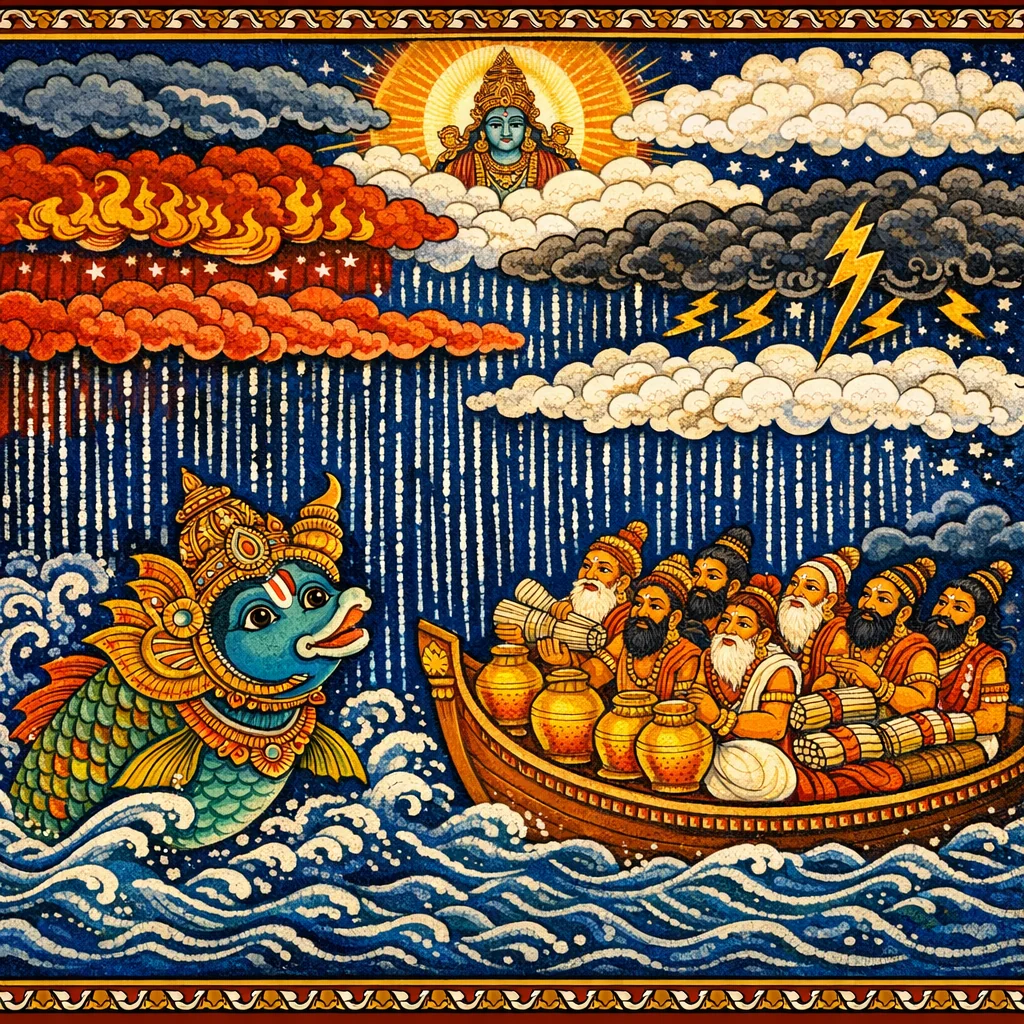
Sūta recounts Manu’s questions to Madhusūdana about when the intermediate dissolution (antarakṣaya) occurs, how beings are to be safeguarded, and how reunion will come in the future. Matsya explains the course of pralaya: a long drought and famine, the sun’s heat growing fierce, many fires that burn the worlds, and then seven dissolution-clouds pouring rain until the oceans merge into a single cosmic sea. Matsya commands Manu to take the Veda-boat, gather the seed-forms of all life, and bind the vessel to Matsya’s horn with a serpent as rope; Manu practices yoga and waits for the foretold time, when the horned Matsya appears and the embarkation takes place. After the flood, Sūta announces the Purāṇa’s scope—creation and dissolution, dynasties and manvantaras, and teachings on dharma. Matsya then begins cosmogony: darkness at the end of mahāpralaya, Nārāyaṇa’s self-manifestation, the creation of waters, the cosmic egg, Brahmā/Sūrya, and the ordering of heaven and earth, directions, mountains, clouds, rivers, and oceans.
Key Concepts
Shlokas in Adhyaya 2
Verse 1
*सूत उवाच एवमुक्तो मनुस्तेन पप्रच्छ मधुसूदनम् भगवन्कियद्भिर्वर्षैर् भविष्यत्यन्तरक्षयः //
Sūta said: Thus addressed by him, Manu questioned Madhusūdana: “O Blessed Lord, after how many years will the intermediate dissolution (antarākṣaya) occur?”
Verse 2
सत्त्वानि च कथं नाथ रक्षिष्ये मधुसूदन त्वया सह पुनर्योगः कथं वा भविता मम //
“O Lord, O Madhusūdana—how shall I protect these living beings? And how, indeed, will my reunion with you come about again?”
Verse 3
*मत्स्य उवाच अद्यप्रभृत्यनावृष्टिर् भविष्यति महीतले यावद्वर्षशतं साग्रं दुर्भिक्षम् अशुभावहम् //
Matsya said: “From today onward there will be no rainfall upon the earth; for a full hundred years and more, a dire famine—bringing inauspiciousness—will arise.”
Verse 4
ततो ऽल्पसत्त्वक्षयदा रश्मयः सप्त दारुणाः सप्तसप्तेर्भविष्यन्ति प्रतप्ताङ्गारवर्षिणः //
Then there will arise seven terrible rays from the Sun—sevenfold—bringing ruin to the scant vitality of beings, raining down burning embers like red-hot charcoal.
Verse 5
और्वानलो ऽपि विकृतिं गमिष्यति युगक्षये विषाग्निश्चापि पातालात् संकर्षणमुखच्युतः भवस्यापि ललाटोत्थस् तृतीयनयनानलः //
At the end of the age, even the Aurva fire will undergo a fearful transformation. And the poisonous fire too, released from Pātāla from the mouth of Saṅkarṣaṇa; as well as the fire of Bhava (Śiva) that springs from his forehead—the blaze of the third eye.
Verse 6
त्रिजगन्निर्दहन् क्षोभं समेष्यति महामुने एवं दग्धा मही सर्वा यदा स्याद्भस्मसंनिभा //
O great sage, the upheaval that burns the three worlds will subside; and when the whole earth has thus been scorched, it will appear as though reduced to ash.
Verse 7
आकाशमूष्मणा तप्तं भविष्यति परंतप ततः सदेवनक्षत्रं जगद्यास्यति संक्षयम् //
O scorcher of foes, the sky will be heated by fierce heat; then this entire world—together with the gods and the stars—will pass into destruction.
Verse 8
संवर्तो भीमनादश्च द्रोणश्चण्डो बलाहकः विद्युत्पताकः शोणस्तु सप्तैते लयवारिदाः //
Saṃvarta, Bhīmanāda, Droṇa, Caṇḍa, Balāhaka, Vidyutpatāka, and Śoṇa—these seven are the waters, the rain-bearing clouds of dissolution, who pour forth the deluge at the time of pralaya, the cosmic withdrawal.
Verse 9
अग्निप्रस्वेदसम्भूताः प्लावयिष्यन्ति मेदिनीम् समुद्राः क्षोभमागत्य चैकत्वेन व्यवस्थिताः //
Born from the fiery perspiration of the cosmic heat, the oceans—rising in agitation—will inundate the earth; and, having surged together, will stand as one single expanse.
Verse 10
एतदेकार्णवं सर्वं करिष्यन्ति जगत्त्रयम् वेदनावमिमां गृह्य सत्त्वबीजानि सर्वशः //
They will turn this entire threefold world into a single ocean. Therefore, taking this boat of the Veda, gather up on every side the seed-forms of living beings.
Verse 11
आरोप्य रज्जुयोगेन मत्प्रदत्तेन सुव्रत संयम्य नावं मच्छृङ्गे मत्स्यभावाभिरक्षितः //
O man of excellent vows, having fastened the boat with the rope-arrangement given by me, secure it to my horn; thus, guarded by my very nature as Matsya the Fish, you will be protected.
Verse 12
एकः स्थास्यसि देवेषु दग्धेष्वपि परंतप सोमसूर्यावहं ब्रह्मा चतुर्लोकसमन्वितः //
O scorcher of foes, even when the gods are burned up, you alone will remain. Brahmā too—together with the four worlds—will be borne along, along with the Moon and the Sun.
Verse 13
नर्मदा च नदी पुण्या मार्कण्डेयो महानृषिः भवो वेदाः पुराणानि विद्याभिः सर्वतोवृतम् //
The Narmadā is indeed a holy river; Mārkaṇḍeya is a great seer. Bhava (Śiva) is encompassed on every side by the Vedas, the Purāṇas, and the branches of knowledge.
Verse 14
त्वया सार्धमिदं विश्वं स्थास्यत्यन्तरसंक्षये एवमेकार्णवे जाते चाक्षुषान्तरसंक्षये //
Together with you, this entire world will endure at the close of the Manvantara. Thus, when the single ocean—the cosmic flood—arises at the dissolution of the Cākṣuṣa Manvantara, it shall remain preserved with you.
Verse 15
वेदान्प्रवर्तयिष्यामि त्वत्सर्गादौ महीपते एवमुक्त्वा स भगवांस् तत्रैवान्तरधीयत //
“O king, at the beginning of your creation-cycle I shall set the Vedas in motion again.” Having spoken thus, that Blessed Lord vanished there itself.
Verse 16
मनुर् अप्यास्थितो योगं वासुदेवप्रसादजम् अभ्यसन् यावद् आभूतसम्प्लवं पूर्वसूचितम् //
Manu too, having taken up the practice of yoga—born of the grace of Vāsudeva—continued his disciplined meditation until the foretold cosmic inundation (pralaya) came to pass, as had been announced beforehand.
Verse 17
काले यथोक्ते संजाते वासुदेवमुखोद्गते शृङ्गी प्रादुर्बभूवाथ मत्स्यरूपी जनार्दनः //
When the previously foretold time arrived—just as it had been spoken from Vāsudeva’s own mouth—Janārdana then manifested, taking the form of a fish and bearing a horn.
Verse 18
भुजंगो रज्जुरूपेण मनोः पार्श्वमुपागमत् भूतान्सर्वान्समाकृष्य योगेनारोप्य धर्मवित् //
A serpent came to Manu’s side in the form of a rope; and the knower of Dharma, drawing all beings together, made them embark by the power of yoga.
Verse 19
भुजंगरज्ज्वा मत्स्यस्य शृङ्गे नावमयोजयत् उपर्युपस्थितस्तस्याः प्रणिपत्य जनार्दनम् //
Using the serpent as a rope, he fastened the boat to the horn of the Fish; then, standing upon it, he bowed down in reverence to Janārdana (Lord Viṣṇu).
Verse 20
आभूतसम्प्लवे तस्मिन्न् अतीते योगशायिना पृष्टेन मनुना प्रोक्तं पुराणं मत्स्यरूपिणा तदिदानीं प्रवक्ष्यामि शृणुध्वमृषिसत्तमाः //
When that great cosmic flood had passed, this Purāṇa—spoken in the form of Matsya to Manu, who had questioned while abiding in yogic repose—I shall now declare. Listen, O best of sages.
Verse 21
यद्भवद्भिः पुरा पृष्टः सृष्ट्यादिकमहं द्विजाः तद् एवैकार्णवे तस्मिन् मनुः पप्रच्छ केशवम् //
O twice-born sages, the very subject of creation and related matters that you once asked me—on that same topic, in that time of the single cosmic ocean, Manu questioned Keśava (Viṣṇu).
Verse 22
*मनुरुवाच उत्पत्तिं प्रलयं चैव वंशान्मन्वन्तराणि च वंश्यानुचरितं चैव भुवनस्य च विस्तरम् //
Manu said: “(Teach me) creation and dissolution, the dynasties and the Manvantaras, the accounts of those born in the lineages, and also the full expanse and arrangement of the worlds.”
Verse 23
दानधर्मविधिं चैव श्राद्धकल्पं च शाश्वतम् वर्णाश्रमविभागं च तथेष्टापूर्तसंज्ञितम् //
And also (it teaches) the proper rule and procedure of charitable giving, the enduring ordinance of the śrāddha rites (for ancestors), the classification of the social orders and life-stages (varṇa and āśrama), and likewise what is known as iṣṭa and pūrta (meritorious acts of sacrifice and public benefaction).
Verse 24
देवतानां प्रतिष्ठादि यच्चान्यद्विद्यते भुवि तत्सर्वं विस्तरेण त्वं धर्मं व्याख्यातुमर्हसि //
You ought to explain, in detail, the whole of Dharma—beginning with the consecration (installation) of the deities and whatever else is found upon the earth.
Verse 25
*मत्स्य उवाच महाप्रलयकालान्त एतदासीत्तमोमयम् प्रसुप्तमिव चातर्क्यम् अप्रज्ञातमलक्षणम् //
Matsya said: At the close of the time of the Great Dissolution, this (universe) existed as darkness itself—like something asleep, beyond reasoning, unknowable, and without any distinguishing marks.
Verse 26
अविज्ञेयमविज्ञातं जगत् स्थास्नु चरिष्णु च ततः स्वयम्भूर् अव्यक्तः प्रभवः पुण्यकर्मणाम् //
From the Unknowable, the unknown principle, this world arises—both the immovable and the moving. From it is born the Self-existent (Svayambhū), the Unmanifest (Avyakta), the source from which meritorious actions and their fruits proceed.
Verse 27
व्यञ्जयन्नेतदखिलं प्रादुरासीत् तमोनुदः यो ऽतीन्द्रियः परो व्यक्ताद् अणुर् ज्यायान् सनातनः नारायण इति ख्यातः स एकः स्वयम् उद्बभौ //
Revealing this entire cosmos, the Dispeller of darkness manifested. He is beyond the senses, supreme, higher than the manifest; subtler than the atom yet greater than the greatest, eternal. Known as Nārāyaṇa, that One alone arose by Himself.
Verse 28
यः शरीराद् अभिध्याय सिसृक्षुर्विविधं जगत् अप एव ससर्जादौ तासु वीर्यम् अवासृजत् //
He who, contemplating from within his own being and wishing to bring forth the manifold universe, first created the Waters; and into those waters he then deposited his generative potency.
Verse 29
तदेवाण्डं समभवद् धेमरूप्यमयं महत् संवत्सरसहस्रेण सूर्यायुतसमप्रभम् //
That very cosmic Egg then came into being—vast, composed of gold and silver—and after a thousand years it shone with a radiance equal to ten thousand suns.
Verse 30
प्रविश्यान्तर्महातेजाः स्वयम् एवात्मसम्भवः प्रभावाद् अपि तद्व्याप्त्या विष्णुत्वम् अगमत् पुनः //
Entering within, the self-born One—of immense radiance—by His own power and by the pervasion of that very divine presence, once again attained the state of Vishnu.
Verse 31
तदन्तर्भगवानेष सूर्यः समभवत्पुरा आदित्यश्चादिभूतत्वाद् ब्रह्मा ब्रह्म पठन्न् अभूत् //
From within that primordial principle, in ancient time, this Bhagavān—Sūrya—arose; and because Āditya is the primal source of beings, Brahmā came to be, reciting the Veda (the sacred Brahman).
Verse 32
दिवं भूमिं समकरोत् तदण्डशकलद्वयम् स चाकरोद्दिशः सर्वा मध्ये व्योम च शाश्वतम् //
He made heaven and earth from the two halves of the cosmic egg; and he also fashioned all the directions, establishing the eternal sky in between.
Verse 33
जरायुर्मेरुमुख्याश् च शैलास् तस्याभवंस् तदा / यद् औल्बं तद् अभून् मेघस् तडित्सङ्घातमण्डलम् //
Then its placenta became the mountains, with Meru as the foremost among them; and what had been its caul (the embryonic covering) turned into the cloud-mass, a circle of gathered lightning.
Verse 34
नद्यो ऽण्डनाम्नः संभूताः पितरो मनवस् तथा सप्त ये ऽमी समुद्राश् च ते ऽपि चान्तर्जलोद्भवाः लवणेक्षुसुराद्याश् च नानारत्नसमन्विताः //
From the cosmic Egg (aṇḍa) arose the rivers; likewise the Pitṛs (ancestral fathers) and the Manus. The seven oceans too were born from the waters within, and these—of salt, sugarcane-juice, wine (surā) and the rest—are endowed with manifold kinds of gems.
Verse 35
स सिसृक्षुर् अभूद् देवः प्रजापतिर् अरिन्दम तत्तेजसश् च तत्रैष मार्तण्डः समजायत //
O subduer of foes, that divine one arose as Prajāpati with the will to create; and from that very radiance, there in that place, Mārtaṇḍa—the Sun—was born.
Verse 36
मृते ऽण्डे जायते यस्मान् मार्तण्डस् तेन संस्मृतः रजोगुणमयं यत्तद् रूपं तस्य महात्मनः चतुर्मुखः स भगवान् अभूल् लोकपितामहः //
Because he is born from the ruptured cosmic egg, he is remembered by the name Mārtaṇḍa. The form of that great being is constituted of rajas (the activating, creative quality); and that blessed Lord became four-faced—the Grandfather of the worlds, Brahmā.
Verse 37
येन सृष्टं जगत् सर्वं सदेवासुरमानुषम् तमवेहि रजोरूपं महत् सत्त्वम् उदाहृतम् //
Know that by which this entire universe—together with gods, asuras, and humans—has been created: it is Mahat, the Great Principle, described as the power formed of rajas, and also spoken of as sattva in its exalted aspect.
Frequently Asked Questions
The chapter teaches how dharma and knowledge are preserved through cosmic collapse: Matsya instructs Manu to safeguard the Veda (as the ‘Veda-boat’) and the seed-forms of beings during antarakṣaya pralaya, emphasizing divine guidance, disciplined yoga, and continuity of creation after dissolution.
This adhyāya is primarily Sṛṣṭi–Pralaya (creation and dissolution) and the Matsya-Avatāra rescue narrative. It also functions as an index of forthcoming Dharma material—dāna, śrāddha, varṇa-āśrama, iṣṭa-pūrta, and devatā-pratiṣṭhā—while genealogy/manvantara themes are named as part of the Purāṇa’s scope rather than detailed here. Vāstu is not taught in this chapter, but the ‘world-structure’ cosmogony provides the cosmographic base later used by Vāstu and temple-planning sections.
Matsya orders Manu to board a boat identified with the Veda, gather life-seeds, and fasten the boat to Matsya’s horn using a serpent as a rope. When the deluge turns the worlds into a single ocean, horned Matsya appears at the foretold time and tows/protects the boat until the flood passes.
Saṃvarta, Bhīmanāda, Droṇa, Caṇḍa, Balāhaka, Vidyutpatāka, and Śoṇa—described as laya-vārida, the rain-bearing agents of dissolution.