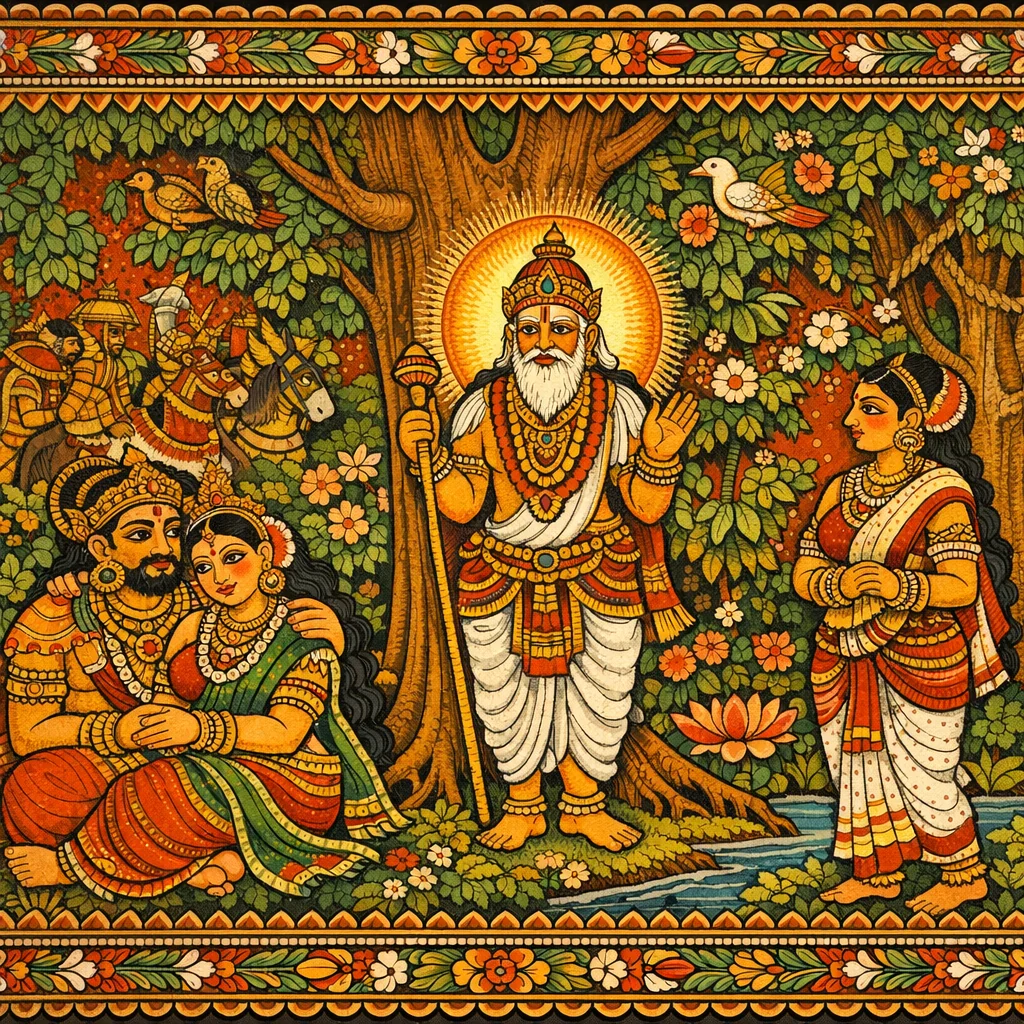
Adhyaya 30: Devayānī Meets Yayāti: Courtship, Varṇa-Concerns, and Śukra’s Sanctioned Marriage
देवयानी-ययाति-समागमः तथा विवाहानुज्ञा
Speaker: Śaunaka, Yayāti, Devayānī, Śukra (Bhārgava/Kāvya)
Śaunaka recounts Devayānī’s spring outing in the forest with her attendants and Śarmiṣṭhā. King Yayāti arrives while hunting and seeking water, sees the women, and asks their gotra and names. Devayānī identifies herself as Śukra’s daughter and introduces Śarmiṣṭhā as Vṛṣaparvan’s daughter who now serves her. Yayāti questions this reversal of status; Devayānī attributes it to destiny and then asks who he is. Yayāti explains that he is a kṣatriya, trained in Vedic learning. Devayānī proposes marriage, but Yayāti hesitates for lack of a formal paternal bestowal and from fear of varṇa disorder, warning of the peril of an angered brāhmaṇa. Devayānī insists she has chosen him and that accepting a gift that is offered is blameless. Through her nurse the matter reaches Śukra; he comes, receives homage, and formally gives Devayānī to Yayāti, removing doubts of adharma. Śukra also gives Śarmiṣṭhā into Yayāti’s household with a strict condition: honor her always, but do not summon her to the bed. Yayāti circumambulates Śukra in reverence and returns to his city with permission.
Key Concepts
Shlokas in Adhyaya 30
Verse 1
*शौनक उवाच अथ दीर्घेण कालेन देवयानी नृपोत्तम वनं तदैव निर्याता क्रीडार्थं वरवर्णिनी //
Śaunaka said: After a long time, O best of kings, the fair-complexioned Devayānī then set out to the forest at once, for the sake of recreation.
Verse 2
तेन दासीसहस्रेण सार्धं शर्मिष्ठया तदा तमेव देशं सम्प्राप्ता यथाकामं चचार सा //
Then, accompanied by that thousand maidservants and by Śarmiṣṭhā, she reached that very region and moved about there freely, as she wished.
Verse 3
ताभिः सखीभिः सहिता सर्वाभिर्मुदिता भृशम् क्रीडन्त्यो ऽभिरताः सर्वाः पिबन्त्यो मधु माधवम् //
Accompanied by those female companions, she—together with them all—became exceedingly joyful; all of them, delighted in play and pleasure, drank sweet honeyed liquor in the spring season of Mādhava.
Verse 4
खादन्त्यो विविधान्भक्ष्यान् फलानि विविधानि च पुनश्च नाहुषो राजा मृगलिप्सुर्यदृच्छया //
While they were eating various kinds of food and many kinds of fruits, King Nahusha too—by chance—came there, eager to obtain game, intent on hunting deer.
Verse 5
तमेव देशं सम्प्राप्तो जललिप्सुः प्रतर्षितः ददर्श देवयानीं च शर्मिष्ठां ताश्च योषितः //
Having reached that very place, longing for water and scorched by thirst, he beheld Devayānī and Śarmiṣṭhā there, together with those young women.
Verse 6
पिबन्त्यो ललनास्ताश्च दिव्याभरणभूषिताः उपविष्टां च ददृशे देवयानीं शुचिस्मिताम् //
Those young women, drinking and sporting, adorned with divine ornaments, then beheld Devayānī seated there, smiling with pure and gentle grace.
Verse 7
रूपेणाप्रतिमां तासां स्त्रीणां मध्ये वराङ्गनाम् शर्मिष्ठया सेव्यमानां पादसंवाहनादिभिः //
Among those women was a most excellent lady, incomparable in beauty; and she was attended by Śarmiṣṭhā with services such as massaging her feet and other acts of personal care.
Verse 8
*ययातिरुवाच द्वाभ्यां कन्यासहस्राभ्यां द्वे कन्ये परिवारिते गोत्रे च नामनी चैव द्वयोः पृच्छाम्यतो ह्य् अहम् //
Yayāti said: “These two young women are attended by two thousand maidens. Therefore I ask about both of them—their gotra (lineage) and their names.”
Verse 9
*देवयान्युवाच आख्यास्याम्यहम् आदत्स्व वचनं मे नराधिप शुको नामासुरगुरुः सुतां जानीहि तस्य माम् //
Devayānī said: “I shall tell you who I am. Accept my words, O king. Śukra, renowned as the preceptor of the Asuras—know me to be his daughter.”
Verse 10
इयं च मे सखी दासी यत्राहं तत्र गामिनी दुहिता दानवेन्द्रस्य शर्मिष्ठा वृषपर्वणः //
“And this one is my companion and handmaid; wherever I go, she is to accompany me—Śarmiṣṭhā, the daughter of Vṛṣaparvan, lord of the Dānavas.”
Verse 11
*ययातिरुवाच कथं तु ते सखी दासी कन्येयं वरवर्णिनी असुरेन्द्रसुता सुभूः परं कौतूहलं हि मे //
Yayāti said: “How is it that this maiden of radiant beauty—though your friend—is (now) your maidservant? She is Śubhū, the daughter of the lord of the Asuras. This fills me with the greatest curiosity.”
Verse 12
*देवयान्युवाच सर्वमेव नरव्याघ्र विधानमनुवर्तते विधिना विहितं ज्ञात्वा मा विचित्रं मनः कृथाः //
Devayānī said: “O tiger among men, everything indeed follows the ordained course. Knowing that what has been set in place is established by divine order, do not let your mind become disturbed or perplexed.”
Verse 13
राजवद्रूपवेषौ ते ब्राह्मीं वाचं बिभर्षि च किंनामा त्वं कुतश्चासि कस्य पुत्रश्च शंस मे //
Your form and attire are like those of a king, and you also speak with a Brahmin’s refined speech. What is your name? From where have you come? And whose son are you? Tell me.
Verse 14
*ययातिरुवाच ब्रह्मचर्येण वेदो मे कृत्स्नः श्रुतिपथं गतः राजाहं राजपुत्रश्च ययातिरिति विश्रुतः //
Yayāti said: “Through the discipline of brahmacarya, the entire Veda has come within my hearing and study. I am a king, and also the son of a king; I am renowned by the name ‘Yayāti.’”
Verse 15
*देवयान्युवाच केन चार्थेन नृपते ह्य् एनं देशं समागतः जिघृक्षुर्वारि यत्किंचिद् अथवा मृगलिप्सया //
Devayānī said: “For what purpose, O King, have you come to this region—have you arrived seeking a little water to drink, or else out of desire to hunt game?”
Verse 16
*ययातिरुवाच मृगलिप्सुरहं भद्रे पानीयार्थम् इहागतः बहुधाप्यनुयुक्तो ऽस्मि त्वम् अनुज्ञातुमर्हसि //
Yayāti said: “O auspicious lady, seeking game I have come here, and also in search of water to drink. Though I have been questioned in many ways, you should grant me leave now.”
Verse 17
*देवयान्युवाच द्वाभ्यां कन्यासहस्राभ्यां दास्या शर्मिष्ठया सह त्वदधीनास्मि भद्रं ते सखे भर्ता च मे भव //
Devayānī said: “Together with two thousand maiden attendants, and with the maidservant Śarmiṣṭhā, I am now under your protection. Good fortune to you, friend—be also my husband.”
Verse 18
*ययातिरुवाच विद्ध्यौशनसि भद्रं ते न त्वदर्हो ऽस्मि भामिनि अविवाह्याः स्म राजानो देवयानि पितुस्तव //
Yayāti said: “Know this, O daughter of Uśanas (Śukra); blessings upon you. O passionate lady, I am not a suitable match for you. Devayānī, kings like us are not to be married by your father.”
Verse 19
*देवयान्युवाच संसृष्टं ब्रह्मणा क्षत्रं क्षत्रं ब्रह्मणि संश्रितम् ऋषिश्च ऋषिपुत्रश्च नाहुषाद्य भजस्व माम् //
Devayānī said: “The Kṣatriya order was fashioned by Brahmā, and the Kṣatriya is established in dependence upon the Brāhmaṇa. You are a Ṛṣi, and also a Ṛṣi’s son—therefore, O descendant of Nahusha, accept me as your wife.”
Verse 20
*ययातिरुवाच एकदेहोद्भवा वर्णाश् चत्वारो ऽपि वरानने पृथग्धर्माः पृथक्छौचास् तेषां वै ब्राह्मणो वरः //
Yayāti said: “O fair-faced one, though the four varṇas arise from a single body, their duties are distinct and their standards of purity are distinct; among them, indeed, the Brāhmaṇa is the foremost.”
Verse 21
*देवयान्युवाच पाणिग्रहो नाहुषायं न पुंभिः सेवितः पुरा त्वं पाणिमग्रहीदग्रे वृणोमि त्वामहं ततः //
Devayānī said: “This rite of taking the hand has not formerly been observed for Nahusha by men. But you first took my hand—therefore I choose you.”
Verse 22
कथं तु मे मनस्विन्याः पाणिमन्यः पुमान्स्पृशेत् गृहीतमृषिपुत्रेण स्वयं वाप्यृषिणा त्वया //
How, indeed, could any other man touch the hand of my high-minded daughter, when it has already been taken—either by the sage’s son, or by you yourself, O sage?
Verse 23
*ययातिरुवाच क्रुद्धादाशीविषात् सर्पाज् ज्वलनात्सर्वतोमुखात् दुराधर्षतरो विप्रः पुरुषेण विजानता //
Yayāti said: “For a discerning person, a wrathful brāhmaṇa is even harder to withstand than a venomous serpent or an all-devouring fire blazing on every side.”
Verse 24
*देवयान्युवाच कथमाशीविषात् सर्पाज् ज्वलनात् सर्वतोमुखात् दुराधर्षतरो विप्र इत्यात्थ पुरुषर्षभ //
Devayānī said: “How is it that you, O brāhmaṇa, are even more unassailable than a venomous serpent—like an all-devouring fire with mouths on every side? Tell me, O bull among men.”
Verse 25
*ययातिरुवाच दशेदाशीविषस्त्वेकं शस्त्रेणैकश्च वध्यते हन्ति विप्रः सराष्ट्राणि पुराण्यपि हि कोपितः //
Yayāti said: “A single venomous serpent may slay ten, and a single man may be slain by a weapon; but when a brāhmaṇa is enraged, he can destroy entire kingdoms—even fortified cities.”
Verse 26
दुराधर्षतरो विप्रस् तस्माद्भीरु मतो मम अतो ऽदत्तां च पित्रा त्वां भद्रे न विवहाम्यहम् //
That brāhmaṇa is exceedingly unassailable; therefore, O timid one, this is my view: since your father has not given you (to me), O noble lady, I will not marry you.
Verse 27
*देवयान्युवाच दत्तां वहस्व पित्रा मां त्वं हि राजन्वृतो मया अयाचतो भयं नास्ति दत्तां च प्रतिगृह्णतः //
Devayānī said: “Carry me away, for my father has given me (to you). O King, you have been chosen by me. For one who does not beg, there is no fear; and for one who accepts what is given, there is no fault.”},{
Verse 28
*शौनक उवाच त्वरितं देवयान्याथ प्रेषिता पितुरात्मनः सर्वं निवेदयामास धात्री तस्मै यथातथम् //
Śaunaka said: Then Devayānī, swiftly dispatched by her father himself, reported everything to him exactly as it had happened, through her nurse (Dhātrī).
Verse 29
श्रुत्वैव च स राजानं दर्शयामास भार्गवः दृष्ट्वैवम् आगतं विप्रं ययातिः पृथिवीपतिः //
Hearing of it, Bhārgava at once presented himself before the king. And King Yayāti, lord of the earth, on seeing that brāhmaṇa who had thus arrived, received him with due regard.
Verse 30
ववन्दे ब्राह्मणं काव्यं प्राञ्जलिः प्रणतः स्थितः तं चाप्यभ्यवदत्काव्यः साम्ना परमवल्गुना //
Kāvya, standing with folded hands and bowed in reverence, saluted the Brāhmaṇa; then Kāvya addressed him as well with a most sweet and melodious Sāman chant.
Verse 31
*देवयान्युवाच राजायं नाहुषस्तात दुर्गमे पाणिमग्रहीत् नमस्ते देहि मामस्मै लोके नान्यं पतिं वृणे //
Devayānī said: “O dear father, this king Nahuṣa has taken my hand in marriage in a time of hardship. I bow to you—give me to him; in this world I choose no other husband.”
Verse 32
*शुक्र उवाच वृतो ऽनया पतिर्वीर सुतया त्वं ममेष्टया गृहाणेमां मया दत्तां महिषीं नहुषात्मज //
Śukra said: “O hero, you have been chosen as husband by this daughter of mine, dear to me. Therefore, O son of Nahuṣa, accept her as your chief queen, bestowed by me.”
Verse 33
*ययातिरुवाच अधर्मो मां स्पृशेदेवं पापम् अस्याश्च भार्गव वर्णसंकरतो ब्रह्मन्न् इति त्वां प्रवृणोम्यहम् //
Yayāti said: “May adharma not touch me in this way, nor may sin arise in her case. O Bhārgava, O Brāhmaṇa—fearing varṇa-saṅkara, the confusion of social order, I therefore choose you as the proper authority and guide in this matter.”
Verse 34
*शुक्र उवाच अधर्मात्त्वां विमुञ्चामि वरं वरय चेप्सितम् अस्मिन्विवाहे त्वं श्लाघ्यो रहः पापं नुदामि ते //
Śukra said: “I release you from adharma. Choose a boon—whatever you desire. In this marriage you are worthy of praise; and in private I dispel your sin.”
Verse 35
वहस्व भार्यां धर्मेण देवयानीं शुचिस्मिताम् अनया सह सम्प्रीतिम् अतुलां समवाप्नुहि //
Take Devayānī—whose smile is pure—as your lawful wife in accordance with dharma; and with her, attain an incomparable and enduring mutual affection.
Verse 36
इयं चापि कुमारी ते शर्मिष्ठा वार्षपर्वणी संपूज्या सततं राजन् न चैनां शयने ह्वय //
“This maiden too is yours—Śarmiṣṭhā, the daughter of Vṛṣaparvan. O King, she should always be duly honored; but do not call her to your bed.”
Verse 37
*शौनक उवाच एवमुक्तो ययातिस्तु शुक्रं कृत्वा प्रदक्षिणम् जगाम स्वपुरं हृष्टः सो ऽनुज्ञातो महात्मना //
Śaunaka said: Thus addressed, King Yayāti—having circumambulated Śukra in reverence—departed, delighted, to his own city, having received permission from that great-souled sage.
Frequently Asked Questions
The chapter teaches that marital legitimacy and social harmony are secured through proper dharmic authorization—especially the Brāhmaṇa father’s sanction—while also emphasizing restraint in kingship: Yayāti may accept Devayānī by Śukra’s gifting, but must honor Śarmiṣṭhā without sexual access, establishing an ethical boundary within royal household governance.
This adhyāya is primarily Genealogy and Dharma/Rājadharma, not Vāstu. It develops the Yayāti–Devayānī lineage narrative, discusses varṇa-dharma and varṇa-saṅkara anxieties in marriage, highlights Brāhmaṇa ritual authority (pāṇigraha and paternal gifting), and sets a rule of royal conduct regarding Śarmiṣṭhā’s treatment.
Read Matsya Purana in the Vedapath app
Scan the QR code to open this directly in the app, with audio, word-by-word meanings, and more.