Adhyaya 61
Adhyāya 61: Saṃmohana-astra and the Kuru Withdrawal (संमोहनास्त्रं तथा कुरुनिवृत्तिः)
Upa-parva: Gogrāhaṇa (Cattle-Raid) Upa-Parva
Vaiśaṃpāyana describes a battlefield reversal in which Duryodhana, checked and redirected like an enraged elephant restrained by a goad, turns back under pressure. Senior Kuru fighters—Karna, Bhīṣma, Droṇa, Kṛpa, and others—re-form to protect Duryodhana and surround Arjuna. Arjuna counters their missile-rain by weapon-to-weapon defense, then deploys a saṃmohana (stupefaction) weapon to neutralize the encircling force without wholesale slaughter. Amplifying psychological dominance, he sounds the conch Devadatta, further disorienting the Kuru warriors, who drop their bows and become pacified. During this interval, Arjuna instructs Uttara (Virāṭa’s son) to move through the immobilized ranks and collect identifying garments from leading warriors—white cloth from Droṇa and Kṛpa, yellow from Karṇa, and blue from Aśvatthāman and the king—while noting Bhīṣma’s tactical awareness. As the Kurus regain composure, Bhīṣma counsels withdrawal, criticizing Duryodhana’s lapse in judgment and urging a swift retreat with the recovered cattle, arguing that Arjuna will not commit to indiscriminate harm. Duryodhana, frustrated, complies. Arjuna honors elders with controlled gestures, symbolically cuts Duryodhana’s jeweled crown with an arrow, and then orders Uttara to turn back, declaring the cattle secured and the enemy departed.
Chapter Arc: कर्ण के पलायन के बाद रणभूमि में धूल और शंखनाद के बीच अर्जुन (बृहन्नला) उत्तरकुमार को धैर्य बँधाते हैं—और सामने कौरवों की विशाल, रथ-हाथी-घोड़े से भरी सेना फिर से चुनौती बनकर खड़ी है। → उत्तर, जो बाणों से बुरी तरह घायल और भयाक्रान्त है, कौरव-सेना की महत्ता देखकर अर्जुन से पूछता है; अर्जुन उसे रथ-चालन में स्थिर रहने, सम-विषम भूमि में न घबराने और घोड़ों को साधे रखने का उपदेश देता है। साथ ही वह अपने दिव्यास्त्र-शिक्षण और सामर्थ्य का स्मरण कराकर उत्तर के भीतर टूटती हुई हिम्मत को जोड़ता है। → अर्जुन प्रतिज्ञा करता है कि वह कौरव-सेना को अपने बाणों से ‘चक्र’ की भाँति घुमाकर, व्याध की तरह घोंसले में बैठे पक्षियों को गिराने जैसा संहार-प्रदर्शन करेगा; फिर किरीटधारी कौन्तेय लक्ष्य साधकर दिशाओं में बाण-वर्षा करता है और दुःशासन आदि कौरववीरों को पराजित कर देता है। → उत्तर का भय शान्त होता है; अर्जुन की अजेयता और धनुर्विद्या का प्रत्यक्ष प्रमाण कौरव-पक्ष को पीछे हटने/अस्त-व्यस्त होने को बाध्य करता है, और गो-रक्षा का उद्देश्य सुरक्षित दिशा में बढ़ता है। → कौरव-सेना के शेष प्रमुख योद्धा (विशेषतः भीष्म जैसे महारथी) अभी मैदान में हैं—अर्जुन की अगली चाल और कौरवों की पुनर्संरचना का संकट बना रहता है।
Shlokas
Verse 1
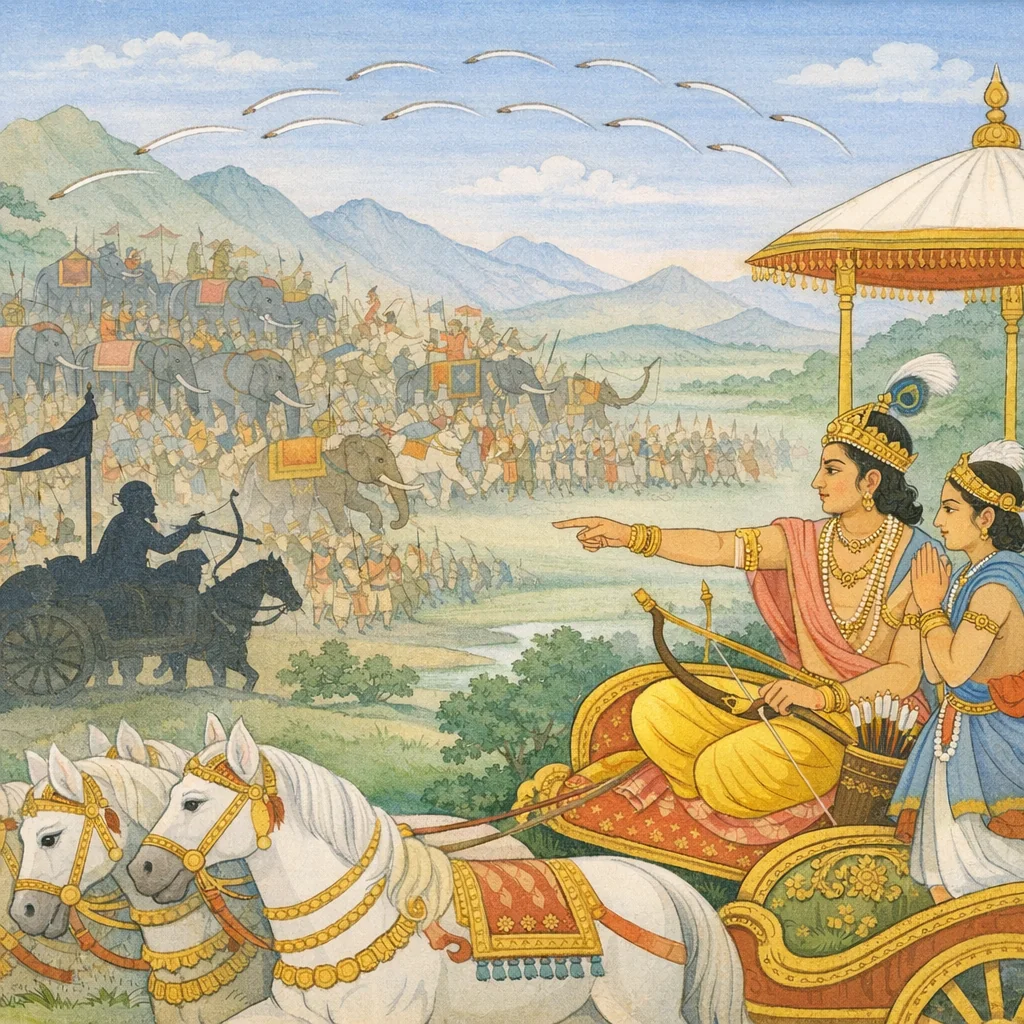
हि >> सो न (0) है 7-2 एकषेष्टितमो< ध्याय: अर्जुनका उत्तरकुमारको आश्वासन तथा अर्जुनसे दुःशासन आदिकी पराजय वैशम्पायन उवाच ततो वैकर्तनं जित्वा पार्थों वैराटिमब्रवीत् | एतन्मां प्रापयानीकं यत्र तालो हिरण्मय:,वैशम्पायनजी कहते हैं--जनमेजय! इस प्रकार वैकर्तन कर्णको जीतकर अर्जुनने विराटकुमार उत्तरसे कहा--'सारथे! तुम मुझे इस सेनाकी ओर ले चलो, जिसकी ध्वजापर सुवर्णमय ताड़ वृक्षका चिह्न है
Vaiśampāyana said: Then, having overcome Vaikartana (Karna), Pārtha (Arjuna) spoke to the prince of Virāṭa (Uttara): “Charioteer, drive me toward that division of the army where the banner bears the golden emblem of a palm tree.” In the ethical frame of the episode, Arjuna—though concealed in disguise—acts with disciplined purpose, directing the battle away from panic and toward a decisive, targeted engagement rather than indiscriminate violence.
Verse 2
अत्र शान्तनवो भीष्मो रथेडस्माकं पितामह: । काड्क्षमाणो मया युद्ध तिष्ठत्यमरदर्शन:,“उस रथपर हम सबके पितामह शान्तनुनन्दन भीष्मजी बैठे हैं। वे मेरे साथ युद्धकी इच्छा रखकर खड़े हैं। उनका दर्शन देवताओंके समान है”
Vaiśampāyana said: “Here is Bhīṣma, the son of Śāntanu—our grandsire—seated upon his chariot. Desiring to engage me in battle, he stands ready; his presence is awe-inspiring, like the very sight of the gods.”
Verse 3
अथ सैन्यं महद् दृष्टवा रथनागहयाकुलम् | अब्रवीदुत्तर: पार्थमपविद्ध: शरैर्भुशम्,यह सुनकर उत्तरने, जो बाणोंसे अत्यन्त घायल हो चुका था, रथों, हाथियों और घोड़ोंसे भरी हुई विशाल सेनाकी ओर देखकर कहा--“वीर! अब मैं युद्धभूमिमें आपके उत्तम घोड़ोंको नहीं सँभाल सकूँगा। मेरे प्राण बड़ी व्यथामें हैं और मन व्याकुल-सा हो रहा है!
Vaiśampāyana said: Then, seeing the vast host—crowded with chariots, elephants, and horses—Uttara, grievously struck by arrows, spoke to Pārtha (Arjuna). Overwhelmed by fear and pain before the spectacle of war, he admits his failing strength and wavering mind, confessing that he can no longer control Arjuna’s excellent horses on the battlefield.
Verse 4
नाहं शक्ष्यामि वीरेह नियन्तुं ते हयोत्तमान् । विषीदन्ति मम प्राणा मनो विह्ललतीव मे,यह सुनकर उत्तरने, जो बाणोंसे अत्यन्त घायल हो चुका था, रथों, हाथियों और घोड़ोंसे भरी हुई विशाल सेनाकी ओर देखकर कहा--“वीर! अब मैं युद्धभूमिमें आपके उत्तम घोड़ोंको नहीं सँभाल सकूँगा। मेरे प्राण बड़ी व्यथामें हैं और मन व्याकुल-सा हो रहा है!
Vaiśampāyana said: “O hero, here and now I will not be able to restrain and drive your excellent horses. My very life-breaths are sinking; my mind is reeling, as it were.”
Verse 5
अस्त्राणामिव दिव्यानां प्रभाव: सम्प्रयुज्यताम् । त्वया च कुरुभिश्नैव द्रवन्तीव दिशो दश,“आपके तथा कौरव वीरोंके द्वारा प्रयुक्त होनेवाले दिव्यास्त्रोंका प्रभाव यह है कि मुझे दसों दिशाएँ भागती-सी प्रतीत होती हैं
Vaiśampāyana said: “Such is the overwhelming force of the divine missiles being discharged—by you and by the Kuru heroes as well—that to me the ten directions themselves seem to be fleeing.”
Verse 6
गन्धेन मूर्च्छित श्वाह॑ं वसारुधिरमेदसाम् | द्वैधीभूतं मनो मेड्द्य तव चैव प्रपश्यत:,“मैं चर्बी, रक्त और मेदकी गन्धसे मूर्च्छित हो रहा हूँ। आज आपके देखते-देखते मेरा मन दुविधामें पड़ गया है”
Vaiśampāyana said: “Overpowered by the stench of fat, blood, and flesh, I am as though stunned. And today, even as you look on, my mind has fallen into painful indecision.”
Verse 7
अदृष्टपूर्व: शूराणां मया संख्ये समागम: । गदापातेन महता शड्खानां निःस्वनेन च,'युद्धमें इतने शूरवीरोंका जमघट मैंने पहले कभी नहीं देखा था। वीरवर! गदाओंके भारी आघात, शंखोंके भयंकर शब्द, शूरवीरोंके सिंहनाद, हाथियोंके चिग्धाड़ तथा वज्रकी गड़गड़ाहटके समान गाण्डीव धनुषकी भारी टंकारथ्वनिसे मेरा चित्त मोहित हो गया है। मेरी श्रवणशक्ति और स्मरणशक्ति भी जवाब दे चुकी है
Vaiśampāyana said: “Never before have I seen such a gathering of heroes assembled in battle. The mind is overwhelmed by the great blows of maces and by the dreadful reverberation of conches—signs that the field has filled with valor, resolve, and the fierce momentum of war.”
Verse 8
सिंहनादैश्व शूराणां गजानां बृंहितैस्तथा । गाण्डीवशब्देन भूशमशनिप्रतिमेन च । श्रुति: स्मृतिश्च मे वीर प्रणष्टा मूढचेतस:,'युद्धमें इतने शूरवीरोंका जमघट मैंने पहले कभी नहीं देखा था। वीरवर! गदाओंके भारी आघात, शंखोंके भयंकर शब्द, शूरवीरोंके सिंहनाद, हाथियोंके चिग्धाड़ तथा वज्रकी गड़गड़ाहटके समान गाण्डीव धनुषकी भारी टंकारथ्वनिसे मेरा चित्त मोहित हो गया है। मेरी श्रवणशक्ति और स्मरणशक्ति भी जवाब दे चुकी है
Vaiśaṃpāyana said: “Amid the lions’ roars of the heroes and the trumpeting of elephants, and with the thunderous twang of the Gāṇḍīva—like a lightning-bolt striking the earth—my mind has been overwhelmed. O hero, my powers of hearing and even of recollection have failed; my thoughts are thrown into confusion by the sheer terror and tumult of battle.”
Verse 9
अलातचक्रप्रतिमं मण्डलं सततं त्वया । व्याक्षिप्पमाणं समरे गाण्डीवं च प्रकर्षता । दृष्टि: प्रचलिता वीर हृदयं दीर्यतीव मे,“रणभूमिमें आप निरन्तर गाण्डीव धनुषको खींचते और टंकारते रहते हैं, जिससे यह अलातचक्रके समान गोल प्रतीत होता है। उसे देखकर मेरी आँखें चौधियाँ रही हैं तथा हृदय फटा-सा जा रहा है
Vaiśampāyana said: “As you ceaselessly draw and whirl the Gāṇḍīva in battle, it appears like a circular blaze, like a firebrand spun into a wheel. Seeing it, my sight is unsettled, O hero, and my heart feels as though it is being torn apart.”
Verse 10
वपुश्चोग्रं तव रणे क्रुद्धस्येव पिनाकिन: । व्यायच्छतस्तव भुजं दृष्टवा भीर्मे भवत्यपि,“इस संग्राममें कुपित हुए पिनाकपाणि भगवान् रुद्रकी भाँति आपका शरीर भयानक जान पड़ता है और लगातार धनुष-बाण चलानेके व्यायाममें संलग्न रहनेवाले आपकी भुजाओंको देखकर भी मुझे भय लगता है
Vaiśampāyana said: “In this battle, your very form appears terrifying—like that of Pinākin (Śiva) when enraged. And when I behold your arms, ever engaged in the exertion of ceaselessly shooting bow and arrows, fear arises in me as well.”
Verse 11
नाददानं न संधानं न मुछ्चन्तं शरोत्तमान् । त्वामहं सम्प्रपश्यामि पश्यन्नपि न चेतन:,“आप कब उत्तम बाणोंको हाथमें लेते, कब धनुषपर रखते और कब उन्हें छोड़ते हैं, यह सब मैं नहीं देख पाता और देखनेपर भी मुझे चेत नहीं रहता
Vaiśampāyana said: “I cannot perceive when you take up the finest arrows, when you set them upon the bow, or when you release them. Though I keep watching you, my awareness fails—as if my senses are stunned by the sheer speed and mastery of your archery.”
Verse 12
अवसीदन्ति मे प्राणा भूरियं चलतीव च । नच प्रतोदं रश्मींश्व॒ संयन्तुं शक्तिरस्ति मे,“इस समय मेरे प्राण अकुला रहे हैं। यह पृथ्वी काँपती-सी जान पड़ती है। इस समय मुझमें इतनी शक्ति नहीं है कि घोड़ोंकी रास सँभालूँ और चाबुक लेकर इन्हें हाँकूँ”
Vaiśampāyana said: “My vital energies are failing; the earth itself seems to tremble. At this moment I do not have the strength to hold the reins and the whip and keep the horses under control.”
Verse 13
अजुन उवाच मा भैषी:ः स्तम्भयात्मानं त्वयापि नरपुज्भव | अत्यद्भुतानि कर्माणि कृतानि रणमूर्धनि,अर्जुन बोले--नरश्रेष्ठ] डरो मत। अपने-आपको सँभालो। तुमने भी युद्धके मुहानेपर बड़े अद्भुत पराक्रम दिखाये हैं
Arjuna said: “Do not be afraid. Steady yourself. You too, O best of men, have performed exceedingly wondrous deeds at the very forefront of battle.”
Verse 14
राजपुत्रो$सि भद्रे ते कुले मत्स्यस्य विश्रुते । जातत्त्वं शत्रुदमने नावसीदितुमरहसि,तुम राजकुमार हो। तुम्हारा कल्याण हो। तुमने मत्स्यनरेशके विख्यात वंशमें जन्म ग्रहण किया है; अतः शत्रुओंके संहारके अवसरपर तुम्हें शिथिल नहीं होना चाहिये। राजपुत्र! तुम तो शत्रुओंका नाश करनेवाले हो, अतः पूर्णरूपसे धैर्य धारण करके रथपर बैठो और युद्ध करते समय मेरे घोड़ोंको काबूमें रखो
Arjuna said: “O prince, blessings upon you. You are born in the renowned royal line of the Matsya king; therefore, at the moment when enemies must be subdued, you should not give way to faintheartedness. You are one who can crush foes—so steady your courage, mount the chariot, and in the press of battle keep my horses firmly under control.”
Verse 15
धृतिं कृत्वा सुविपुलां राजपुत्र रथे मम । युध्यमानस्य समरे हयान् संयच्छ शत्रुहन्,तुम राजकुमार हो। तुम्हारा कल्याण हो। तुमने मत्स्यनरेशके विख्यात वंशमें जन्म ग्रहण किया है; अतः शत्रुओंके संहारके अवसरपर तुम्हें शिथिल नहीं होना चाहिये। राजपुत्र! तुम तो शत्रुओंका नाश करनेवाले हो, अतः पूर्णरूपसे धैर्य धारण करके रथपर बैठो और युद्ध करते समय मेरे घोड़ोंको काबूमें रखो
Arjuna said: “O prince, steady yourself with abundant courage. Mount my chariot and, while I fight in the thick of battle, keep my horses firmly under control, O slayer of foes.”
Verse 16
वैशम्पायन उवाच एवमुक््त्वा महाबाहुर्वैराटिं नरसत्तम: । अर्जुनो रथिनां श्रेष्ठ उत्तरं वाक्यमब्रवीत्,वैशम्पायनजी कहते हैं--राजन! इस प्रकार समझा-बुझाकर रथियोंमें श्रेष्ठ और मनुष्योंमें सर्वोत्तम महाबाहु अर्जुन विराट-कुमार उत्तरसे पुनः: यह वचन बोले--
Vaiśampāyana said: “Having spoken thus, mighty-armed Arjuna—the best of men and foremost among chariot-warriors—again addressed Prince Uttara, son of Virāṭa.”
Verse 17
सेनाग्रमाशु भीष्मस्य प्रापयस्वैतदेव माम् आच्छेत्स्याम्यहमेतस्य धनुज्यामपि चाहवे,“राजकुमार! तुम शीघ्र ही पितामह भीष्मकी इसी सेनाके सामने मेरा रथ ले चलो, मुझे पहुँचाओ। इस युद्धमें मैं इनकी प्रत्यंचा भी काट डालूँगा
Vaiśampāyana said: “Prince, quickly drive my chariot straight to the very front of Bhīṣma’s army and bring me there. In this battle I shall cut even his bowstring.”
Verse 18
अस्यन्तं दिव्यमस्त्रं मां चित्रमद्य निशामय । शतह्नदामिवायान्तीं स्तनयित्नोरिवाम्बरे,“आज मुझे विचित्र दिव्यास्त्रोंका प्रहार करते देखो। जैसे आकाशमें मेघोंकी घटासे बिजली प्रकट होती है, उसी प्रकार (बाणोंकी विद्युच्छटा प्रकट करनेवाले) मेरे गाण्डीव धनुषको, जिसके पृष्ठभागमें सोना मढ़ा है, आज कौरवलोग विस्मित होकर देखेंगे। आज सारी शत्रुमण्डली इकट्ठी होकर यह अनुमान लगायेगी कि अर्जुन किस हाथसे बाण चलाते हैं? दाहिने हाथसे या बायेंसे? आज मैं परलोककी ओर प्रवाहित होनेवाली (शत्रुसेनारूप) दुर्लड्घ्य नदीको मथ डालूँगा, जिसमें रक्त ही जल है, रथ भँवर हैं और हाथी ग्राहके स्थानमें हैं
Vaiśaṃpāyana said: “Watch me today as I unleash a wondrous, divine weapon. It will come flashing like lightning in the sky amid thunderclouds.”
Verse 19
सुवर्णपृष्ठं गाण्डीवं द्रक्ष्यन्ति कुरवो मम । दक्षिणेनाथ वामेन कतरेण स्विदस्यति,“आज मुझे विचित्र दिव्यास्त्रोंका प्रहार करते देखो। जैसे आकाशमें मेघोंकी घटासे बिजली प्रकट होती है, उसी प्रकार (बाणोंकी विद्युच्छटा प्रकट करनेवाले) मेरे गाण्डीव धनुषको, जिसके पृष्ठभागमें सोना मढ़ा है, आज कौरवलोग विस्मित होकर देखेंगे। आज सारी शत्रुमण्डली इकट्ठी होकर यह अनुमान लगायेगी कि अर्जुन किस हाथसे बाण चलाते हैं? दाहिने हाथसे या बायेंसे? आज मैं परलोककी ओर प्रवाहित होनेवाली (शत्रुसेनारूप) दुर्लड्घ्य नदीको मथ डालूँगा, जिसमें रक्त ही जल है, रथ भँवर हैं और हाथी ग्राहके स्थानमें हैं
Vaiśampāyana said: “The Kurus shall behold my Gāṇḍīva, whose back is plated with gold. And they will be left to wonder: ‘With which hand does he shoot—right or left?’”
Verse 20
इति मां सड़ता: सर्वे तर्कयिष्यन्ति शत्रव: । शोणितोदां रथावर्ता नागनक्रां दुरत्ययाम् | नदीं प्रस्कन्दयिष्यामि परलोकप्रवाहिनीम्,“आज मुझे विचित्र दिव्यास्त्रोंका प्रहार करते देखो। जैसे आकाशमें मेघोंकी घटासे बिजली प्रकट होती है, उसी प्रकार (बाणोंकी विद्युच्छटा प्रकट करनेवाले) मेरे गाण्डीव धनुषको, जिसके पृष्ठभागमें सोना मढ़ा है, आज कौरवलोग विस्मित होकर देखेंगे। आज सारी शत्रुमण्डली इकट्ठी होकर यह अनुमान लगायेगी कि अर्जुन किस हाथसे बाण चलाते हैं? दाहिने हाथसे या बायेंसे? आज मैं परलोककी ओर प्रवाहित होनेवाली (शत्रुसेनारूप) दुर्लड्घ्य नदीको मथ डालूँगा, जिसमें रक्त ही जल है, रथ भँवर हैं और हाथी ग्राहके स्थानमें हैं
Vaiśampāyana said: “Thus, all the enemies, filled with suspicion, will speculate about me: ‘With which hand does Arjuna release his arrows—right or left?’ Today I shall leap into and churn through that hard-to-cross river that flows toward the other world—the river whose water is blood, whose whirlpools are chariots, and whose crocodiles are elephants.”
Verse 21
पाणिपादशिर:पृष्ठबाहुशाखानिरन्तरम् । वनं कुरूणां छेत्स्यामि शरै: संनतपर्वभि:,“आज झुकी हुई गाँठवाले बाणोंद्वारा कौरवसेनारूपी जंगलको काट डालूँगा। हाथ, पैर, सिर, पृष्ठ (पीठ) तथा बाहु आदि अड़ ही विविध शाखाओंके रूपमें फैलकर इस कौरव-वनको सघन किये हुए हैं
Vaiśampāyana said: “With arrows whose joints are bent, I shall hew down the Kuru host as though it were a forest—made dense by branches in the form of hands, feet, heads, backs, and arms.”
Verse 22
जयत: कौरवीं सेनामेकस्य मम धन्विन: । शतं मार्गा भविष्यन्ति पावकस्येव कानने,'जैसे वनमें लगे हुए दावानलको आगे बढ़नेके लिये सैकड़ों मार्ग सुलभ होते हैं, उसी प्रकार कौरवसेनापर विजय पानेवाले मुझ एकमात्र धनुर्धर वीरके लिये इसमें सैकड़ों मार्ग प्रकट हो जायँगे
“For me alone—the bowman who will prevail over the Kuru army—hundreds of paths will appear, just as a forest fire finds a hundred ways to surge forward through the woods.”
Verse 23
मया चक्रमिवादिद्धं सैन्यं द्रक्ष्यसि केवलम् । इष्वस्त्रे शिक्षितं चित्रमहं दर्शयितास्मि ते,“मेरे बाणोंसे घायल हुई सारी सेनाको तुम चक्रकी भाँति घूमती हुई देखोगे। आज तुम्हें बाणविद्यामें प्राप्त की हुई अपनी विचित्र शिक्षाका परिचय कराऊँगा
“You will see the entire army, struck down by my arrows, whirling like a wheel. Today I shall show you the wondrous skill I have mastered in the science of archery.”
Verse 24
असम्भ्रान्तो रथे तिष्ठ समेषु विषमेषु च । दिवमावृत्य तिष्ठन्तं गिरिं भिन््द्यां सम पत्रिभि:
Vaiśampāyana said: “Stand firm upon the chariot, unshaken in mind, whether the ground is even or uneven. With well-aimed, evenly feathered arrows, you should be able to pierce even a mountain that seems to rise and cover the very sky.”
Verse 25
“तुम सम-विषम (ऊँची-नीची) भूमियोंमें सम्भ्रमरहित (सावधान) होकर रथपर बैठो (और घोड़ोंकी सँभाल रखो)। आज मैं सारे आकाशको घेरकर खड़े हुए (महान) पर्वतको भी अपने बाणोंसे विदीर्ण कर डालूँगा ।। अहमिन्द्रस्य वचनात् संग्रामे5भ्यहनं पुरा । पौलोमान् कालखज्जांश्व सहस्नाणि शतानि च,“मैंने पहले देवराज इन्द्रकी आज्ञासे युद्धमें उनके शत्रु पौलोम और कालखंज नामक लाखों दानवोंका वध किया है
Vaiśampāyana said: “Seat yourself firmly on the chariot, steady and unconfused even over uneven ground, and keep the horses under control. Today I shall split with my arrows even a mighty mountain that seems to fill the whole sky. For in former times, at Indra’s command, I slew in battle countless demons—the Paulomas and the Kālakhañjas—by the hundreds and thousands.”
Verse 26
अहमिन्द्राद् दृढां मुष्टिं ब्रह्मण: कृतहस्तताम् | प्रगाढे तुमुलं चित्रमिति विद्धि प्रजापते:,“तुम्हें यह मालूम होना चाहिये कि मैंने धनुष पकड़ते समय मुद्टीको दृढ़ रखना इन्द्रसे, बाण चलाते समय हाथोंकी फुर्ती ब्रह्माजीसे तथा संकटके समय विचित्र प्रकारसे तुमुल युद्ध करनेकी कला प्रजापतिसे सीखी है
Vaiśampāyana said: “Know this: I learned from Indra how to keep a firm grip when taking up the bow; from Brahmā I learned the trained quickness and mastery of the hand in releasing arrows; and from Prajāpati I learned the art of fighting—deep in crisis—with tumultuous, varied, and astonishing tactics. Thus, skill in war is not mere violence, but disciplined training directed by higher exemplars.”
Verse 27
अहं पारे समुद्रस्य हिरण्यपुरवासिनाम् । जित्वा षष्टिं सहस्राणि रथिनामुग्रधन्विनाम्,“पहलेकी बात है, मैंने समुद्रके उस पार हिरण्यपुरमें निवास करनेवाले साठ हजार अत्यन्त भयंकर धनुर्धर महारथियोंको परास्त किया था
Vaiśampāyana said: “Formerly, I crossed beyond the ocean and, having conquered the inhabitants of Hiraṇyapura, I defeated sixty thousand chariot-warriors—archers of terrifying might.”
Verse 28
शीर्यमाणानि कूलानि प्रवृद्धेनेव वारिणा । मया कुरूणां वृन्दानि पात्यमानानि पश्य वै
Vaiśampāyana said: “Look—just as riverbanks crumble when the waters rise in flood, so too I saw the Kuru hosts being hurled down and broken apart.”
Verse 29
“आज देख लेना, जैसे प्रबल वेगसे आयी हुई जलकी बाढ़ किनारोंको काट-काटकर गिरा देती है, उसी प्रकार मैं कौरवदलके सैन्यसमूहोंको मार गिराऊँगा ।। ध्वजवृक्ष॑ पत्तितृणं रथसिंहगणायुतम् । वनमादीपयिष्यामि कुरूणामस्त्रतेजसा,“कौरवोंकी सेना एक जंगलके समान है, उसमें ध्वज ही वृक्ष हैं, पैदल सैनिक घास- फूस हैं तथा रथ ही सिंहोंके स्थानमें हैं। मैं अपने अस्त्र-शस्त्ररूपी अग्निसे आज इस कौरववनको जलाकर भस्म कर दूँगा
“Today you shall see: just as a flood, rushing with irresistible force, tears away the riverbanks piece by piece and casts them down, so will I strike down the massed battalions of the Kaurava host. The Kauravas’ army is like a forest—its banners are the trees, its foot-soldiers the grass and straw, and its chariots the lions within it. With the blazing power of my weapons, I will set this Kuru-forest alight today and reduce it to ashes.”
Verse 30
तानहं रथनीडेभ्य: शरै: संनतपर्वभि: | यत्तान् सर्वानतिबलान् योत्स्यमानानवस्थितान् । एक: संकालयिष्यामि वज्रपाणिरिवासुरान्
Vaiśampāyana said: “From their chariots I shall strike them down with arrows whose joints are well-tempered. Though they are all exceedingly mighty and stand ready to fight, I alone will destroy them—just as Vajrapāṇi (Indra), with his thunderbolt, annihilates the Asuras.”
Verse 31
'जैसे व्याध घोंसलेमें बैठे हुए पक्षियोंको भी मार गिराता है, उसी प्रकार मैं मुड़ी हुई नोकवाले (तीखे) बाणोंसे मारकर उन सभी कौरववीरोंको रथोंकी बैठकोंसे नीचे गिरा दूँगा। जैसे वज्रधारी इन्द्र अकेले ही समस्त असुरोंका संहार कर डालते हैं, उसी प्रकार मैं भी अकेला ही यहाँ युद्धके लिये सावधान होकर खड़े हुए समस्त महाबली योद्धाओंका भलीभाँति विनाश कर डालूँगा ।। रौद्रे रुद्रादहं हूस्त्रं वारुणं वरुणादपि । अस्त्रमाग्नेयमग्नेक्ष॒ वायव्यं मातरिश्वन: । वज्रादीनि तथास्त्राणि शक्रादहमवाप्तवान्,“मैंने भगवान् रुद्रसे रौद्रासत्रकी, वरुणसे वारुणास्त्रकी, अग्निसे आग्नेयास्त्रकी और वायु देवतासे वायव्यास्त्रकी शिक्षा प्राप्त की है। इसी प्रकार साक्षात् इन्द्रसे मैंने वज्ञ आदि अस्त्र प्राप्त किये हैं
Vaiśampāyana said: He declared that he would strike down the Kaurava heroes from their chariots as effortlessly as a hunter fells birds in a nest; and that—like Indra, wielder of the thunderbolt, who alone destroys the hosts of demons—he too, standing ready for battle, would single-handedly bring about the ruin of the assembled mighty warriors. He then affirmed the sources of his martial authority: from Rudra he had obtained the fierce Raudra weapon; from Varuṇa the Varuṇa weapon; from Agni the Agneya weapon; from Vāyu (Mātariśvan) the Vāyavya weapon; and from Śakra (Indra) the thunderbolt and other divine missiles.
Verse 32
धार्तराष्ट्रवनं घोर नरसिंहाभिरक्षितम् । अहमुत्पाटयिष्यामि वैराटे व्येतु ते भयम्,“वीर मानवरूपी सिंहोंसे सुरक्षित इस भयंकर कौरववनको मैं अकेला ही उजाड़ डालूँगा, अत: विराटकुमार! तुम्हारा भय दूर हो जाना चाहिये”
Vaiśampāyana said: “This dreadful forest of the Dhārtarāṣṭras, guarded by lion-like men, I shall uproot all by myself. Therefore, O prince of Virāṭa, let your fear be dispelled.”
Verse 33
वैशम्पायन उवाच एवमाश्वासितस्तेन वैराटि: सव्यसाचिना । व्यवागाहद् रथानीकं भीम॑ भीष्माभिरक्षितम्,वैशम्पायनजी कहते हैं--जनमेजय! सव्यसाची अर्जुनके इस प्रकार सान्त्वना देनेपर विराटकुमार उत्तरने भीष्मजीके द्वारा सब ओरसे सुरक्षित रथियोंकी भयंकर सेनामें प्रवेश किया
Vaiśampāyana said: Thus reassured by Savyasācin (Arjuna), the prince of Virāṭa entered the chariot-formation—terrible and formidable—guarded on all sides by Bhīṣma.
Verse 34
तमायान्तं महाबाहुं जिगीषन्तं रणे कुरून् । अभ्यवारयदव्यग्र: क्रूरकर्मा55पगासुत:,रणभूमिमें कौरवोंको जीतनेकी इच्छासे आते हुए महाबाहु अर्जुनको कठोर कर्म करनेवाले गंगानन्दन भीष्मने बिना किसी घबराहटके रोक दिया
As the mighty-armed Arjuna advanced, intent on defeating the Kurus in battle, Bhīṣma—the son of the Gaṅgā, famed for stern and formidable deeds—calmly and without agitation checked his advance.
Verse 35
तस्य जिष्णुरुपावृत्य ध्वजं मूलादपातयत् । विकृष्य कलधौताग्रै: स विद्ध: प्रापतद् भुवि,तब अर्जुनने उनकी ओर घूमकर सुनहरी धारवाले बाणोंसे भीष्मजीकी ध्वजाको जड़से काट गिराया, बाणोंसे छिद जानेके कारण वह ध्वजा पृथ्वीपर गिर पड़ी
Vaiśampāyana said: Then Jiṣṇu (Arjuna), wheeling his chariot toward him, struck down the banner from its very base. Dragged and pierced by arrows whose tips shone like refined gold, that standard—riddled through—fell upon the earth.
Verse 36
त॑ं चित्रमाल्याभरणा: कृतविद्या मनस्विन: । आगच्छन् भीमधन्वानं चत्वारश्न महाबला:,इतनेहीमें विचित्र माला और आभूषणोंसे विभूषित और अस्त्रसंचालनकी विद्यामें निपुण चार महाबली मनस्वी वीर दुःशासन, विकर्ण, दुःसह और विविंशति वहाँ भयंकर धनुषवाले अर्जुनपर चढ़ आये और वहाँ आकर उन्होंने उग्रधन्वा बीभत्सुको चारों ओरसे घेर लिया
Vaiśampāyana said: Adorned with splendid garlands and ornaments, accomplished in the arts of weaponry, and resolute in spirit, four mighty warriors advanced upon Arjuna of the terrible bow. Reaching him, they surrounded Bībhatsu (Arjuna) on all sides—Duhśāsana, Vikarṇa, Duhsaha, and Vivimśati.
Verse 37
दुःशासनो विकर्णश्न दुःसहो5थ विविंशति: । आगत्य भीमधन्वानं बीभत्सुं पर्यवारयन्,इतनेहीमें विचित्र माला और आभूषणोंसे विभूषित और अस्त्रसंचालनकी विद्यामें निपुण चार महाबली मनस्वी वीर दुःशासन, विकर्ण, दुःसह और विविंशति वहाँ भयंकर धनुषवाले अर्जुनपर चढ़ आये और वहाँ आकर उन्होंने उग्रधन्वा बीभत्सुको चारों ओरसे घेर लिया
Vaiśampāyana said: Duḥśāsana, Vikarṇa, Duḥsaha, and Viviṁśati came up and surrounded Bībhatsu (Arjuna), the wielder of a formidable bow. As the conflict unfolded, the Kaurava princes sought to overwhelm a single foe by encirclement.
Verse 38
दुःशासनस्तु भल्लेन विद्ध्वा वैराटमुत्तरम् । द्वितीयेनार्जुनं वीर: प्रत्यविध्यत् स्तनान्तरे,वीर दुःशासनने भल्ल नामक एक बाणसे विराटकुमार उत्तरको घायल करके दूसरेसे अर्जुनकी छाती छेद डाली
Vaiśampāyana said: Duḥśāsana, having struck Virāṭa’s son Uttara with a bhalla-arrow, then with a second shaft the warrior pierced Arjuna in the region of the chest.
Verse 39
तस्य जिष्णुरुपावृत्य पृथुधारेण कार्मुकम् | चकर्त गार्ध्रपत्रेण जातरूपपरिष्कृतम्,तब अर्जुन उसकी ओर मुड़े और मोटी धार और गीधकी पाँख-जैसे पंखवाले बाणसे उन्होंने दुःशासनके सुवर्णजटित धनुषको काट डाला
Vaiśampāyana said: Turning toward him, Jiṣṇu (Arjuna) severed that bow—adorned with gold—using a broad-edged shaft feathered like a vulture’s wing.
Verse 40
अथैनं पज्चभि: पश्चात् प्रत्यविध्यत् स्तनान्तरे | सो<पयातो रणं हित्वा पार्थबाणप्रपीडित:,तत्पश्चात् उसकी छातीमें भी पाँच बाण मारे। पार्थके बाणोंसे अत्यन्त पीड़ित हो दुःशासन युद्ध छोड़कर भाग गया
Then Arjuna struck him again from behind with five arrows in the region of the chest. Tormented by the shafts of Pārtha, Duḥśāsana abandoned the fight and withdrew from the battlefield.
Verse 41
त॑ विकर्ण: शरैस्ती&णैर्गुप्रपत्रैरजिह्ागै: । विव्याध परवीरघ्नमर्जुनं धृतराष्ट्रज:,तब धुृतराष्ट्रपुत्र विकर्णने शत्रुवीरोंका नाश करनेवाले अर्जुनको सीधे लक्ष्यकी ओर जानेवाले गृध्रपत्रयुक्त तीखे बाणोंसे बींध डाला
Vaiśampāyana said: Then Vikarṇa, son of Dhṛtarāṣṭra, pierced Arjuna—slayer of enemy heroes—with sharp arrows, feathered with vulture-plumes and flying straight to their mark.
Verse 42
ततस्तमपि कौन्तेय: शरेणानतपर्वणा । ललाटे< भ्यहनत् तूर्ण स विद्ध: प्रापतद् रथात्,तत्पश्चात् कुन्तीनन्दन अर्जुनने झुकी हुई गाँठवाले बाणसे उसको भी ललाटमें बींध डाला। उस बाणसे घायल होकर विकर्ण तुरंत ही रथसे नीचे गिर पड़ा
Then the son of Kuntī struck him too—swiftly—on the forehead with an arrow whose knot was unbent. Wounded by that shaft, he fell down at once from his chariot.
Verse 43
ततः पार्थमभिद्रुत्य दु:सह: सविविंशति: । अवाकिरच्छरैस्ती&$णै: परीप्सुर्भ्रातरं रणे,तब दुःसह और विविंशति अर्जुनकी ओर दौड़े और युद्धमें भाईका बदला लेनेके लिये उनके ऊपर तीखे बाणोंकी वर्षा करने लगे
Then Duḥsaha, together with Viviṁśati, rushed at Pārtha (Arjuna) and, seeking in battle to avenge their brother, showered him with sharp arrows.
Verse 44
तावुभौ गार्ध्रपत्राभ्यां निशिताभ्यां धनंजय: । विद्धवा युगपदव्यग्रस्तयोरवाहानसूदयत्,फिर धनंजयने गृध्रकी पाँखवाले दो तीखे बाणोंद्वारा उन दोनोंको एक ही साथ घायल करके बिना किसी घबराहटके उनके घोड़ोंको भी मार गिराया
Vaiśaṃpāyana said: Then Dhanaṃjaya (Arjuna), with two sharp arrows feathered like a vulture’s wings, struck both of them at the same moment; and, without the least agitation, he also slew their horses.
Verse 45
तौ हताश्वौ विभिन्नाज्ै धृतराष्ट्रात्मजावुभौ । अभिपत्य रथैरन्यैरपनीतौ पदानुगै:,घोड़ोंके मारे जाने और शरीरके बिंध जानेपर उन दोनों धृतराष्ट्रकुमारोंक पास उनके सेवक आ पहुँचे और उन्हें दूसरे रथपर डालकर अन्यत्र हटा ले गये
Vaiśampāyana said: When their horses had been slain and their bodies pierced, those two sons of Dhṛtarāṣṭra were rushed upon by their attendants, who brought other chariots, lifted them away, and removed them from the spot—an act of loyal service amid the harsh necessities of battle.
Verse 46
सर्वा दिशश्वाभ्यपतद् बीभत्सुरपराजित: । किरीटमाली कौन्तेयो लब्धलक्षो महाबल:,किसीसे परास्त न होनेवाले किरीट-मालाधारी महाबली कुन्तीनन्दन अर्जुनका निशाना कभी चूकता नहीं था। वे उस सेनामें सब ओर विचरने लगे
Vaiśampāyana said: The unconquered Bībhatsu (Arjuna), the mighty son of Kuntī, wearing his diadem and garland, whose aim never failed once it was fixed, ranged through the army in every direction.
Verse 60
इस प्रकार श्रीमह्या भारत विराटपर्वके अन्तर्गत गोहरणपर्वमें कर्णका पलायनविषयक साठवाँ अध्याय पूरा हुआ
Thus, in the revered Mahābhārata, within the Virāṭa Parva—specifically in the Go-haraṇa (Cattle-Raid) section—the sixtieth chapter, dealing with Karṇa’s retreat, comes to an end.
Verse 61
इति श्रीमहाभारते विराटपर्वणि गोहरणपर्वणि अर्जुनदु:ःशासनादियुद्धे एकषष्टितमो5ध्याय:
Thus ends the sixty-first chapter in the Virāṭa Parva of the Śrī Mahābhārata, within the section on the cattle-raid, describing Arjuna’s battle with Duḥśāsana and other Kaurava warriors.
Frequently Asked Questions
The dilemma is how to secure victory and protect Virāṭa’s assets while avoiding excessive harm to revered elders and mass casualties—resolved through disabling measures (stupefaction and deterrence) rather than annihilative force.
Power is ethically governed by restraint: superior capability is shown not only by defeating opponents, but by choosing methods that preserve social and pedagogical hierarchies (guru-elder respect) and limit irreversible damage.
No explicit phalaśruti appears in this passage; its meta-function is narrative-ethical—demonstrating that dharmic victory can be achieved through controlled, non-lethal dominance and deference to legitimate authority figures.