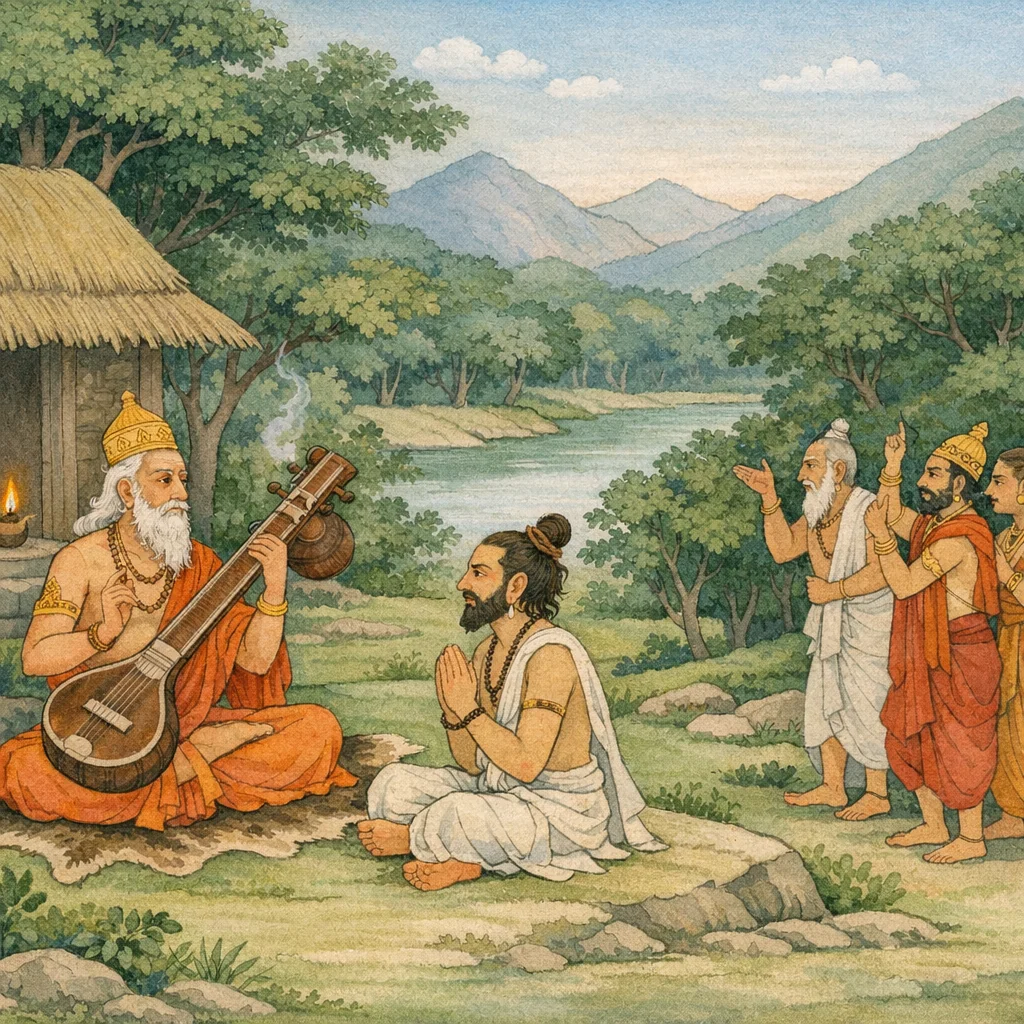
Adhyaya 287
Adhyāya 287 — Janaka’s Inquiry on Śreyas, Abhayadāna, and Asaṅga (Non-attachment)
Upa-parva: Mokṣa-dharma (Liberation Teachings) — Parāśara–Janaka Dialogue (excerpted discourse)
Bhīṣma recounts that Janaka of Mithilā again questions the sage Parāśara about (i) the highest good (śreyas), (ii) the trajectory/destination (gati), (iii) which performed acts do not perish, and (iv) the state from which one does not return. Parāśara answers by prioritizing asaṅga (non-attachment) as the root of śreyas and identifying jñāna as the supreme movement toward liberation. He asserts the durability of practiced tapas and emphasizes that cutting the ‘cord’ of adharma and cultivating dharma leads to success. A distinctive ethical claim is advanced: abhayadāna (granting fearlessness to all beings) exceeds even immense material charity. The chapter contrasts the wise person who remains inwardly unentangled even amid sense-objects with the unwise who clings even in poor conditions; adharma does not adhere to the discerning, but clings to the undiscerning. Karma is presented as inescapably returning to the agent in due time; the mind’s attachment drags embodied life, while disciplined mind supports yoga and clarity. A sequence of analogies (lotus leaf and water, boat in the ocean, rivers to sea, blind person navigating by practice) illustrates moral psychology, impermanence, and the urgency of dharma since death does not wait. The discourse also relativizes familial and social claims, insisting that each being consumes its own karma-fruit. The chapter closes with Bhīṣma noting Janaka’s satisfaction upon hearing the truthful instruction.
Chapter Arc: युधिष्ठिर की जिज्ञासा—जो तत्त्व को नहीं जानता, शास्त्रों में उलझकर सदा संशय में रहता है; ऐसे मनुष्य के लिए ‘श्रेय’ का मार्ग क्या है? → भीष्म ‘कूटस्थ श्रेय’ का संकेत देते हैं—गुरुपूजा, वृद्ध-सेवा और शास्त्र-श्रवण; फिर उदाहरण के रूप में देवर्षि नारद और महर्षि गालव का पुरातन संवाद उठता है, जहाँ शास्त्र-गर्वी पण्डित अपने-अपने मत में तृप्त होकर भी वास्तविक कल्याण नहीं पा रहे। → नारद का तीखा निदान—मूढ़ और अवलिप्त जनों की असार वाणी उनके भीतर के दूषित अन्तःकरण को ही प्रकट करती है; शास्त्र का उद्देश्य ‘विवाद-विजय’ नहीं, अहंकार-क्षय और आश्रम-धर्म के वास्तविक अभिप्राय की प्राप्ति है। → श्रेय का व्यावहारिक सूत्र—जहाँ लोग मात्सर्य और शंका से रहित होकर धर्माचरण करते हों, पुण्यशील साधुओं के बीच निवास करो; प्राणिहित वृत्ति से जीवन चलाओ, तब तप के द्वारा यहाँ ही स्पष्ट कल्याण प्रकट होता है।
Shlokas
Verse 1
ऑपन-मा_ज (_) डे सप्ताशीरत्याधिकद्विशततमो< ध्याय: नारदजीका गालव मुनिको श्रेयका उपदेश युधिछिर उवाच अतत्त्वज्ञस्य शास्त्राणां सततं संशयात्मन: | अकृतव्यवसायस्य श्रेयो ब्रूहि पितामह,युधिष्ठिरने पूछा--पितामह! जो शास्त्रोंके तत््वको नहीं जानता, जिसका मन सदा संशयमें ही पड़ा रहता है तथा जिसने परमार्थके लिये कोई निश्चित ध्येय नहीं बनाया है, उस पुरुषका कल्याण कैसे हो सकता है? यह मुझे बताइये
Yudhiṣṭhira said: “O Grandfather, tell me what true good (śreyas) can be for a man who does not understand the real purport of the scriptures, whose mind is continually beset by doubt, and who has formed no firm resolve or disciplined pursuit. How can such a person attain welfare?”
Verse 2
भीष्म उवाच गुरुपूजा च सतत वृद्धानां पर्युपासनम् । श्रवण चैव शास्त्राणां कूटस्थं श्रेय उच्यते,भीष्मजीने कहा--युधिष्ठि!! सदा गुरुजनोंकी पूजा, वृद्ध पुरुषोंकी सेवा और शास्त्रोंका श्रवण--ये तीन कल्याणके अमोघ साधन बताये जाते हैं
Bhishma said: Constant reverence to one’s teachers, attentive service to the aged, and the listening to sacred teachings—these are declared to be steady and unfailing means of true welfare.
Verse 3
अत्राप्युदाहरन्तीममितिहासं पुरातनम् । गालवस्य च संवादं देवर्षेनरिदस्थ च,इस विषयमें भी जानकार मनुष्य देवर्षि नारद और महर्षि गालवके संवादरूप प्राचीन इतिहासका उदाहरण दिया करते हैं
Bhishma said: “In this matter too, discerning people cite an ancient precedent: the old narrative presented as a dialogue between the sage Galava and the divine seer Narada.”
Verse 4
स्वाश्रमं समनुप्राप्तं नारदं देववर्चसम् । वीतमोहक्लमं विप्र॑ ज्ञानतृप्तं जितेन्द्रिय: । श्रेयस्कामो यतात्मानं नारदं गालवोडब्रवीत्,एक समयकी बात है, कल्याणकी इच्छा रखनेवाले जितेन्द्रिय गालव मुनिने अपने आश्रमपर पधारे हुए देवोपम तेजस्वी ब्राह्मण, मोह और क्लान्तिसे रहित, ज्ञानानन्दसे परिपूर्ण एवं मनको वशमें रखनेवाले देवर्षि नारदजीसे इस प्रकार पूछा--
Bhishma said: Once, the sage Gālava—self-restrained and intent on the highest good—addressed Devarṣi Nārada when he arrived at Gālava’s hermitage. Nārada shone with divine radiance, was free from delusion and fatigue, satisfied through knowledge, and master of his senses. Gālava then questioned him in this manner.
Verse 5
यै: कश्चित् सम्मतो लोके गुणैश्न पुरुषो मुने । भवत्यनपगान् सर्वास्तान् गुणान् लक्षयामहे,“मुने! संसारमें कोई भी पुरुष जिन गुणोंद्वारा सम्मानित होता है, उन समस्त गुणोंका मैं आपमें कभी अभाव नहीं देखता हूँ
Bhishma said: “O sage, whatever virtues make a man esteemed in this world—none of those virtues are ever found lacking in you. I perceive all those qualities present in you.”
Verse 6
भवानेवंविधो<स्माकं संशयं छेत्तुमरहति । अमूढश्चिरमूढानां लोकतत्त्वमजानताम्,“लोक-तत्त्वके ज्ञानसे शून्य और चिरकालसे अज्ञानमें पड़े हुए हम-जैसे लोगोंके संशयका निवारण सर्वगुणसम्पन्न आप-जैसा ज्ञानी महात्मा ही कर सकता है
Bhishma said: “A wise one like you is truly fit to cut through our doubt. For we have long remained deluded, not understanding the true principles of the world; only an undeluded knower such as you can remove the uncertainty of people like us.”
Verse 7
ज्ञाने होवं प्रवृत्ति: स््थात् कार्याणामविशेषत: । यत् कार्य न व्यवस्यामस्तद् भवान् वक्तुमहति,“'मुने! शास्त्रोंमें बहुत-से कर्तव्यकर्म बताये गये हैं, उनमेंसे अमुक कर्मके इस प्रकार करनेसे ज्ञानमार्ममें प्रवृत्ति हो सकती है, इसका विशेषरूपसे हमें निश्चय नहीं हो पाता है; अतः हमारे लिये जो कर्तव्य हो और जिसका निर्धारण हम न कर पाते हों, उसे आप ही हमें बतानेकी कृपा करें
Bhīṣma said: “From the performance of duties in general, one may indeed come to be engaged in the pursuit of knowledge; yet we cannot determine with certainty which particular act, performed in what manner, leads to that awakening. Therefore, O sage, please tell us what should be done—especially in those matters of duty where we are unable to decide for ourselves.”
Verse 8
भगवन्नाश्रमा: सर्वे पृथगाचारदर्शिन: । इदं श्रेय इदं श्रेय इति सर्वे प्रबोधिता:,“भगवन्! सभी आश्रमोंवाले पृथक्ू-पृथक् आचारका दर्शन कराते हैं तथा “यह श्रेष्ठ है' यह श्रेष्ठ है” ऐसा उपदेश देते हुए वे (अपने ही सिद्धान्तोंकी श्रेष्ठठाका प्रतिपादन करते हैं और) सभी मनुष्योंकी बुद्धिमें यही बात जमा देते हैं
Bhishma said: “O venerable one, all the stages of life (āśramas) present their own distinct codes of conduct. Each proclaims, ‘This is the highest good, this is the highest good,’ and thus they instruct people—asserting the excellence of their own discipline and impressing that conviction upon human understanding.”
Verse 9
तांस्तु विप्रस्थितान् दृष्टवा शास्त्रै: शास्त्राभिनन्दिन: । स्वशास्त्रै: परितुष्टाश्न श्रेयो नोपलभामहे,“जिनके मनमें वह बात बैठ गयी है, उन सबको उन शास्त्रोंके उपदेशके अनुसार नाना प्रकारके आचार-मार्गसे चलते और अपने-अपने शास्त्रोंका अभिनन्दन करते देखकर जैसे हम अपनी मान्यतामें संतुष्ट हैं, वैसे ही उन्हें भी संतुष्ट पाकर हमारे मनमें संशय उत्पन्न हो गया है। हम यह ठीक-ठीक निश्चय नहीं कर पा रहे हैं कि परम कल्याणकी प्राप्तिका सर्वश्रेष्ठ उपाय क्या है?
Bhishma said: “But when we see those people—each firmly established in his own doctrine—living according to the disciplines taught in their respective scriptures and praising those very scriptures, and when we find them as satisfied in their own convictions as we are in ours, doubt arises in our mind. We cannot clearly determine what the highest means is for attaining the supreme good.”
Verse 10
शास्त्र यदि भवेदेकं श्रेयो व्यक्ते भवेत् तदा । शास्त्रैश्व बहुभिर्भूय: श्रेयो गुहां प्रवेशितम्,“यदि शास्त्र एक होता तो श्रेयकी प्राप्तिका उपाय भी एक ही होनेके कारण वह स्पष्टरूपसे समझमें आ जाता, परंतु बहुत-से शास्त्रोंने नाना प्रकारसे वर्णन करके श्रेयको गुहा अवस्थामें पहुँचा दिया है--उसे अत्यन्त गूढ़ बना डाला है
Bhīṣma said: “If there were only a single authoritative teaching, then the path to the highest good would stand out clearly. But because many śāstras speak in many different ways, that very highest good has been pushed into a cave—made exceedingly hidden and difficult to discern.”
Verse 11
एतस्मात् कारणाच्छेय: कलिलं प्रतिभाति मे । ब्रवीतु भगवांस्तन्मे उपसन्नोडस्म्यधीहि भो:,“इस कारणसे मुझे श्रेयका स्वरूप संशयाच्छन्न जान पड़ता है। भगवान्! अब आप ही मुझे उसका उपदेश दें। मैं आपकी शरणमें आया हूँ, आप मुझ शिष्यको श्रेयोमार्गका बोध करायें!
Bhishma said: “For this reason, the true nature of what is best (śreyas) appears to me as obscured by doubt and confusion. Therefore, O Blessed One, please tell me that teaching. I have come to you for refuge—kindly instruct me, O venerable sir, and make me understand the path that leads to the highest good.”
Verse 12
नारद उवाच आश्रमास्तात चत्वारो यथासंकल्पिता: पृथक् । तान् सर्वाननुपश्य त्वं समाश्रित्येति गालव,नारदजीने कहा--तात! आश्रम चार हैं और शास्त्रोंमें उनकी पृथक्-पृथक् व्यवस्था की गयी है। गालव! तुम ज्ञानका आश्रय लेकर उन सबको यथार्थरूपसे जानो
Narada said: “Dear one, there are four āśramas, each distinctly laid down according to the scriptural design. O Gālava, take refuge in true understanding and examine them all as they really are.”
Verse 13
तेषां तेषां यथा हि त्वमाश्रमाणां ततस्ततः । नानारूपगुणोद्देशं पश्य विप्र स्थितं पृथक्,विप्रवर! उन-उन आश्रमोंके जो नाना प्रकारसे गुण-सम्पन्न धर्म बताये गये हैं, उनकी पृथक्-पृथक् स्थिति है। इस बातको तुम देखो और समझो
Nārada said: “As you consider each of the āśramas in turn, observe how their teachings on dharma—endowed with diverse forms and qualities—stand distinct from one another, O brāhmaṇa. See their separate foundations clearly and understand them.”
Verse 14
न यान्ति चैव ते सम्यगभिप्रेतमसंशयम् । अन्येडपश्यंस्तथा सम्यगाश्रमाणां परां गतिम्,जो साधारण मनुष्य हैं, वे उन आश्रमोंके वास्तविक अभिप्रायको भलीभाँति संशयरहित नहीं जान पाते, किंतु उनसे भिन्न जो तत्त्वज्ञ हैं, वे इन आश्रमोंके परमतत्त्वको ठीक-ठीक समझते हैं
Nārada said: “Ordinary people cannot truly know, in a correct and doubtless way, the real intent of those āśramas. But those who know the truth, different from the rest, rightly perceive the highest goal of the āśramas.”
Verse 15
यत् तु निश्रेयसं सम्यक् तच्चैवासंशयात्मकम्,जो अच्छी तरह कल्याण करनेवाला साधन होता है, वह सर्वथा संशयरहित होता है। सुहृदोंपर अनुग्रह करना, शत्रुभाव रखनेवाले दुष्टोंको दण्ड देना तथा धर्म, अर्थ और कामका संग्रह करना--इसे मनीषी पुरुष श्रेय कहते हैं
Nārada said: “That which truly leads to the highest good, when rightly understood, is by its very nature free from doubt. Showing favor and support to well-wishers, punishing the wicked who harbor enmity, and securing the three aims—dharma, material prosperity, and legitimate desire—this is what the wise call ‘the good’ (śreyas).”
Verse 16
अनुग्रहं च मित्राणाममित्राणां च निग्रहम् । संग्रह च त्रिवर्गस्थ श्रेय आहुर्मनीषिण:,जो अच्छी तरह कल्याण करनेवाला साधन होता है, वह सर्वथा संशयरहित होता है। सुहृदोंपर अनुग्रह करना, शत्रुभाव रखनेवाले दुष्टोंको दण्ड देना तथा धर्म, अर्थ और कामका संग्रह करना--इसे मनीषी पुरुष श्रेय कहते हैं
Nārada said: “Showing favor and support to one’s friends, restraining and punishing those who act as enemies, and maintaining the resources that stand within the three aims of life—dharma, artha, and kāma—this, the wise declare, is what truly leads to one’s welfare (śreyas).”
Verse 17
निवृत्ति: कर्मण: पापात् सततं पुण्यशीलता । सद्धिश्व समुदाचार: श्रेय एतदसंशयम्
Nārada said: “Turning back from sinful action, maintaining a constant disposition toward merit, and living with right conduct—this indeed is the highest good, without doubt.”
Verse 18
पापकर्मसे दूर रहना, निरन्तर पुण्यकर्मोमें लगे रहना और सत्पुरुषोंक साथ रहकर सदाचारका ठीक-ठीक पालन करना--यह संशयरहित कल्याणका मार्ग है ।। मार्दवं सर्वभूतेषु व्यवहारेषु चार्जवम् | वाक् चैव मधुरा प्रोक्ता श्रेय एतदसंशयम्,सम्पूर्ण प्राणियोंके प्रति कोमलताका बर्ताव करना, व्यवहारमें सरल होना तथा मीठे वचन बोलना--यह भी कल्याणका संदेहरहित मार्ग है
Nārada said: Keeping far from sinful actions, remaining constantly engaged in meritorious deeds, and living in the company of the good while carefully practicing right conduct—this is a path to welfare, free from doubt. Gentleness toward all beings, straightforwardness in one’s dealings, and speech that is sweet—this too is a doubtless path to the highest good.
Verse 19
दैवतेभ्य: पितृभ्यश्न संविभागो$तिथिष्वपि । असंत्यागश्च भृत्यानां श्रेय एतदसंशयम्,देवताओं, पितरों और अतिथियोंको उनका भाग देना तथा भरण-पोषण करनेयोग्य व्यक्तियोंका त्याग न करना--यह कल्याणका निश्चित साधन है
Narada teaches that true welfare lies, without doubt, in faithfully allotting due shares to the gods and the ancestors, extending proper hospitality to guests, and never abandoning those dependents who ought to be maintained. Such steady fulfillment of obligations is presented as a sure path to auspiciousness and moral good.
Verse 20
सत्यस्य वचन श्रेय: सत्यज्ञानं तु दुष्करम् । यद् भूतहितमत्यन्तमेतत् सत्य॑ ब्रवीम्पहम्
To speak the truth is indeed beneficial; yet to truly know the truth is difficult. That which is supremely for the welfare of all beings—this I declare to be ‘truth’.
Verse 21
सत्य बोलना भी श्रेयस्कर है; परंतु सत्यको यथार्थरूपसे जानना कठिन है। मैं तो उसीको सत्य कहता हूँ, जिससे प्राणियोंका अत्यन्त हित होता हो ।। अहंकारस्य च त्याग: प्रमादस्य च निग्रह: । संतोषश्लैकचर्या च कूटस्थं श्रेय उच्यते,अहंकारका त्याग, प्रमादको रोकना, संतोष और एकान्तवास--यह सुनिश्चित श्रेय कहलाता है
Nārada said: Speaking the truth is indeed beneficial; yet to know truth in its exact reality is difficult. I call that alone “truth” by which living beings gain the highest welfare. The abandonment of ego, the restraint of heedlessness, contentment, and a life of solitude—these are declared to be the steady and unshakable good.
Verse 22
धर्मेण वेदाध्ययनं वेदान्तानां तथैव च । ज्ञानार्थानां च जिज्ञासा श्रेय एतदसंशयम्,धर्मांचरणपूर्वक वेद और वेदाड़ोंका स्वाध्याय करना तथा उनके सिद्धान्तको जाननेकी इच्छाको जगाये रखना निस्संदेह कल्याणका साधन है
Narada said: Studying the Vedas in a spirit of dharma, and likewise studying the Vedānta, and sustaining an earnest inquiry into the meaning that leads to true knowledge—this, without doubt, is a means to the highest good.
Verse 23
शब्दरूपरसस्पर्शान् सह गन्धेन केवलान् । नात्यर्थमुपसेवेत श्रेयसो$र्थी कथंचन,जिसे कल्याणप्राप्तिकी इच्छा हो, उस मनुष्यको किसी तरह भी शब्द, स्पर्श, रूप, रस और गन्ध--इन विषयोंका अधिक सेवन नहीं करना चाहिये
Narada said: One who seeks true welfare should never indulge excessively in the bare objects of the senses—sound, touch, form, taste, and smell. For the aspirant of the highest good, restraint from over-enjoyment is itself a safeguard of ethical and spiritual progress.
Verse 24
नक्तंचर्या दिवास्वप्रमालस्यं पैशुनं मदम् | अतियोगमयोगं च श्रेयसो<र्थी परित्यजेत्,कल्याण चाहनेवाला पुरुष रातमें घूमना, दिनमें सोना, आलस्य, चुगली, मादक वस्तुका सेवन, आहार-विहारका अधिक मात्रामें सेवन और उसका सर्वथा त्याग--ये सब बातें त्याग दे
Narada said: One who seeks true welfare should renounce these habits: roaming about at night, sleeping by day, laziness, slanderous tale-bearing, intoxication, and also both extremes—overindulgence and total abstention—in one’s regimen of food and conduct. Such self-restraint supports a life oriented toward the good.
Verse 25
आत्मोत्कर्ष न मार्गेत परेषां परिनिन्दया । स्वगुणैरेव मार्गेत विप्रकर्ष पृथग्जनात्,दूसरोंकी निन्दा करके अपनी श्रेष्ठता सिद्ध करनेका प्रयत्न न करे। साधारण मनुष्योंकी अपेक्षा जो अपनी उत्कृष्टता है, उसे अपने गुणोंद्वारा ही सिद्ध करे (बातोंसे नहीं)। गुणहीन मनुष्य ही अधिकतर अपनी प्रशंसा किया करते हैं। वे अपनेमें गुणोंकी कमी देखकर दूसरे गुणवान् पुरुषोंके गुणोंमें दोष बताकर उनपर आक्षेप किया करते हैं
Nārada teaches that one should not seek to establish one’s own superiority by disparaging others. If one truly possesses excellence beyond ordinary people, it should be demonstrated through one’s own virtues and conduct, not through talk or fault-finding. Those who lack merit commonly resort to self-praise; seeing their own deficiency, they try to diminish the worthy by pointing out defects in their qualities.
Verse 26
निर्गुणास्त्वेव भूयिष्ठमात्मसम्भाविता नरा: । दोषैरन्यान् गुणवत: क्षिपन्त्यात्मगुणक्षयात्,दूसरोंकी निन्दा करके अपनी श्रेष्ठता सिद्ध करनेका प्रयत्न न करे। साधारण मनुष्योंकी अपेक्षा जो अपनी उत्कृष्टता है, उसे अपने गुणोंद्वारा ही सिद्ध करे (बातोंसे नहीं)। गुणहीन मनुष्य ही अधिकतर अपनी प्रशंसा किया करते हैं। वे अपनेमें गुणोंकी कमी देखकर दूसरे गुणवान् पुरुषोंके गुणोंमें दोष बताकर उनपर आक्षेप किया करते हैं
Nārada said: Those who are largely devoid of real merit are, in fact, the ones who most often proclaim their own greatness. Seeing the deficiency of virtues within themselves, they try to pull down truly virtuous people by pointing out faults in them. Therefore, one should not attempt to establish one’s superiority by censuring others; whatever excellence one has should be demonstrated through one’s own qualities, not through mere talk.
Verse 27
अनूच्यमानास्तु पुनस्ते मन्यन्तु महाजनात् | गुणवत्तरमात्मानं स्वेन मानेन दर्पिता:,यदि उनको उत्तर दिया जाय तो फिर वे घमंडमें भरकर अपने-आपको महापुरुषोंसे भी अधिक गुणवान् मानने लगें
Narada said: “If they are answered again and again, they may become puffed up with pride and, by their own self-estimation, come to regard themselves as more virtuous and capable than even the truly great. Therefore, one should be cautious in replying to the vain, lest a response feed their arrogance rather than their understanding.”
Verse 28
अब्रुवन् कस्यचिचन्निन्दामात्मपूजामवर्णयन् । विपश्चिद् गुणसम्पन्न: प्राप्नोत्येव महद् यश:,परंतु जो दूसरे किसीकी निन््दा तथा अपनी प्रशंसा नहीं करता, ऐसा उत्तम गुणसम्पन्न विद्वान् पुरुष ही महान् यशका भागी होता है
Narada said: The truly wise and virtuous person attains great renown—one who neither speaks in blame of another nor indulges in self-praise. Such restraint in speech, grounded in discernment and good qualities, becomes the ethical cause of lasting honor.
Verse 29
अनब्रुवन् वाति सुरभिर्गन्ध: सुमनसां शुचि: । तथैवाव्याहरन् भाति विमलो भानुरम्बरे,फूलोंकी पवित्र एवं मनोरम सुगन्ध बिना कुछ बोले ही महक उठती है। निर्मल सूर्य अपनी प्रशंसा किये बिना ही आकाशमें प्रकाशित होने लगते हैं
Narada said: “Without speaking, the pure and delightful fragrance of flowers spreads on the breeze. In the same way, without proclaiming itself, the spotless sun shines in the sky.” The teaching is that true excellence and virtue do not require self-advertisement; their presence becomes evident through their natural effects.
Verse 30
एवमादीनि चान्यानि परित्यक्तानि मेधया । ज्वलन्ति यशसा लोके यानि न व्याहरन्ति च,इस प्रकार संसारमें और भी बहुत-सी ऐसी बुद्धिसे रहित वस्तुएँ हैं, जो अपनी प्रशंसा नहीं करती हैं, किंतु अपने यशसे जगमगाती रहती हैं
Nārada said: “So too, there are many other such things—left behind by discerning intelligence—that do not proclaim themselves. Yet, in the world, they shine by their own fame.”
Verse 31
न लोके दीप्यते मूर्ख: केवलात्मप्रशंसया । अपि चापिहित: श्वश्रे कृतविद्य: प्रकाशते
Nārada said: “In this world, a fool does not truly shine merely by praising himself. But one who has genuinely acquired learning and skill becomes evident by his own worth—even if he is kept hidden, as though covered by a mother-in-law.”
Verse 32
मूर्ख मनुष्य केवल अपनी प्रशंसा करनेसे ही जगत्में ख्याति नहीं पा सकता। विद्वान् पुरुष गुफामें छिपा रहे तो भी उसकी सर्वत्र प्रसिद्धि हो जाती है ।। असदुच्चैरपि प्रोक्त: शब्द: समुपशाम्यति । दीप्यते त्वेव लोकेषु शनैरपि सुभाषितम्,बुरी बात जोर-जोरसे कही गयी हो तो भी वह शून्यमें विलीन हो जाती है, लोकमें उसका आदर नहीं होता है; किंतु अच्छी बात धीरेसे कही जाय तो भी वह संसारमें प्रकाशित होती है--उसका आदर होता और प्रभाव बढ़ता है
Nārada said: “A foolish man cannot gain true renown in the world merely by praising himself. But a learned person, even if he remains hidden in a cave, becomes widely known. Even a bad saying, though shouted loudly, soon dies away and finds no honor among people; whereas a good saying, even if spoken softly, gradually shines throughout the world—its respect and influence grow.”
Verse 33
मूढानामवलिप्तानामसारं भाषितं बहु । दर्शयत्यन्तरात्मानमग्निरूपमिवांशुमान्,घमंडी मूर्खोॉंकी कही हुई असार बातें उनके दूषित अन्त:करणका ही प्रदर्शन कराती हैं, ठीक उसी तरह जैसे सूर्य सूर्यकान्तमणिके योगसे अपने दाहक अग्निरूपको ही प्रकट करता है
Nārada said: “The many hollow words spoken by the foolish and the arrogant end up revealing their own inner self—just as the radiant sun, through its contact with a sunstone, manifests its burning, fire-like nature. Empty, prideful speech is not harmless; it exposes the speaker’s inner impurity and lack of discernment.”
Verse 34
एतस्मात् कारणातू प्रज्ञां मृगयन्ते पृथग्विधाम् । प्रज्ञालाभो हि भूतानामुत्तम: प्रतिभाति मे
For this reason, people seek wisdom in many different ways. For to all beings, the gaining of true discernment seems to me the highest good—because it guides right conduct and steadies one amid life’s changing conditions.
Verse 35
इस कारण कल्याणकी इच्छा रखनेवाले साधु पुरुष अनेक शास्त्रोंके अध्ययनसे नाना प्रकारकी प्रज्ञा (उत्तम बुद्धि) का ही अनुसंधान करते हैं। मुझे तो सभी प्राणियोंके लिये प्रज्ञाका लाभ ही उत्तम जान पड़ता है ।। नापृष्ट: कस्यचिद् ब्रूयान्नाप्यन्यायेन पृच्छत: । ज्ञानवानपि मेधावी जडवत् समुपाविशेत्,बुद्धिमान् पुरुष ज्ञानवान् होनेपर भी बिना पूछे किसीको कोई उपदेश न करे। अन्यायपूर्वक पूछनेपर भी किसीके प्रश्नका उत्तर न दे। जडकी भाँति चुपचाप बैठा रहे
Narada said: “For this reason, virtuous men who seek true welfare investigate many kinds of wisdom—excellent discernment—through the study of numerous śāstras. To me, the gain of such wisdom seems the highest good for all living beings. Therefore, even a learned and intelligent person should not offer instruction unasked, nor respond when questioned in an improper or unjust manner. In such situations, the wise should remain seated in silence, as though inert—guarding speech so that knowledge is not misused and dharma is not compromised.”
Verse 36
ततो वासं परीक्षेत धर्मनित्येषु साधुषु । मनुष्येषु वदान्येषु स्वधर्मनिरतेषु च,मनुष्यको सदा धर्ममें लगे रहनेवाले साधु-महात्माओं तथा स्वधर्मपरायण उदार पुरुषोंके समीप निवास करनेकी इच्छा रखनी चाहिये
Therefore, one should choose one’s place of residence with discernment—seeking to live near saintly people steadfast in dharma, and among generous persons devoted to their own rightful duties. Such company supports ethical stability and strengthens one’s commitment to righteous conduct.
Verse 37
चतुर्णा यत्र वर्णानां धर्मव्यतिकरो भवेत् । न तत्र वासं कुर्वीत श्रेयोडर्थी वै कथंचन,जहाँ चारों वर्णोके धर्मोका उल्लड्घन होता हो, वहाँ कल्याणकी इच्छावाले पुरुषको किसी तरह भी नहीं रहना चाहिये
Nārada said: Wherever the duties of the four social orders are thrown into confusion and violated, a person who seeks true welfare should not reside there in any way. One should avoid such a place, for living amid the breakdown of dharma endangers one’s own ethical life and spiritual good.
Verse 38
निरारम्भो5प्ययमिह यथालब्धोपजीवन: । पुण्य॑ पुण्येषु विमल॑ पापं पापेषु चाप्तुयात्,किसी कर्मका आरम्भ न करनेवाला और जो कुछ मिल जाय, उसीसे जीवन-निर्वाह करनेवाला पुरुष भी यदि पुण्यात्माओंके समाजमें रहे तो उसे निर्मल पुण्यकी प्राप्ति होती है और पापियोंके संसर्गमें रहे तो वह पापका ही भागी होता है
Nārada said: Even a man who undertakes no new enterprises and lives only on whatever comes to him here—if he dwells among the virtuous, he attains pure merit; but if he keeps company with the wicked, he becomes a sharer of sin. The verse stresses that moral outcome is shaped not only by one’s personal activity, but also by the ethical atmosphere of one’s associations.
Verse 39
अपाममग्नेस्तथेन्दोश्न स्पर्श वेदयते यथा । तथा पश्यामहे स्पर्शमुभयो: पुण्यपापयो:,जैसे जल, अग्नि और चन्द्रमाकी किरणोंके संसर्गमें आनेपर मनुष्य क्रमश: शीत, उष्ण और सुखदायी स्पर्शका अनुभव करता है, उसी प्रकार हम पुण्यात्मा और पापियोंके संगसे पुण्य और पाप दोनोंके स्पर्शका प्रत्यक्ष अनुभव करते हैं
Nārada said: “Just as a person distinctly feels the touch of water, of fire, and of the moon’s rays—cool, hot, and soothing—so too do we directly experience the ‘touch’ of both merit and sin through association with the virtuous and with the wicked.”
Verse 40
अपश्यन्तो<5नुविषयं भुज्जते विघसाशिन: । भुज्जानाश्षात्मविषयान् विषयान् विद्धि कर्मणाम्,जो विघसाशी (भृत्यवर्ग ओर अतिथि आदिको भोजन करानेके बाद बचा हुआ भोजन करनेवाले) हैं, वे तिक्त-मधुर रस या स्वादकी आलोचना न करते हुए अन्न ग्रहण करते हैं; किंतु जो अपनी रसनाका विषय समझकर स्वादु और अस्वादुका विचार रखते हुए भोजन करते हैं, उन्हें कर्मपाशमें बँधा हुआ ही समझना चाहिये
Narada said: Those who live on what remains after feeding dependents and guests eat without fastening their mind on sense-objects; they take food without judging it by bitter or sweet. But those who eat while treating taste as the object of their own craving—discriminating between pleasant and unpleasant flavors—should be understood as still bound by action, for their enjoyment turns the senses into the motive and the chain of karma into their restraint.
Verse 41
यत्रागमयमानानामसत्कारेण पृच्छताम् | प्रत्ूयाद् ब्रह्मणो धर्म त्यजेत् तं देशमात्मवान्,जहाँ ब्राह्मण अनादर एवं अन्यायपूर्वक धर्म-शास्त्रविषयक प्रश्न करनेवाले पुरुषोंको धर्मका उपदेश करता हो, आत्मपरायण साधकको उस देशका परित्याग कर देना चाहिये
Where people, lacking sincerity, ask about dharma with disrespect, and a brāhmaṇa still expounds dharma to them—an inwardly disciplined seeker should abandon that country.
Verse 42
शिष्योपाध्यायिकावृत्तिर्यत्र स्थात् सुसमाहिता । यथावच्छास्त्रसम्पन्ना कस्तं देशं परित्यजेत्,जहाँ गुरु और शिष्यका व्यवहार सुव्यवस्थित, शास्त्र-सम्मत एवं यथावत् रूपसे चलता है, कौन उस देशका परित्याग करेगा?
Nārada said: In a land where the conduct between teacher and disciple is well-ordered, disciplined, and in full accord with the scriptures, who would ever abandon such a country?
Verse 43
आकाशबमस्था ्र॒वं यत्र दोषं ब्रूयुविपश्चिताम् । आत्मपूजाभिकामो वै को वसेत् तत्र पण्डित:,जहाँके लोग बिना किसी आधारके ही विद्वान् पुरुषोंपर निश्चितरूपसे दोषारोपण करते हों, उस देशमें आत्मसम्मानकी इच्छा रखनेवाला कौन मनुष्य निवास करेगा?
Nārada said: In a land where people, without any real ground, confidently speak faults against the truly discerning and wise, what learned person—one who values self-respect and inner dignity—would choose to live there?
Verse 44
यत्र संलोडिता लुब्धै: प्रायशो धर्मसेतव: । प्रदीप्तमिव चैलान्तं कस्तं देशं न संत्यजेत्,जहाँ लालची मनुष्योंने प्राय: धर्मकी मर्यादाएँ तोड़ डाली हों, जलते हुए कपड़ेकी भाँति उस देशको कौन नहीं त्याग देगा?
Where greedy people have, for the most part, shattered the boundaries and safeguards of dharma, who would not abandon such a land—like a garment already aflame, fit only to be cast away?
Verse 45
यत्र धर्ममनाशड्काश्षरेयुवीतमत्सरा: । भवेत् तत्र वसेच्चैव पुण्यशीलेषु साधुषु,परंतु जहाँके लोग मात्सर्य और शंकासे रहित होकर धर्मका आचरण करते हों, वहाँ पुण्यशील साधु पुरुषोंके पास अवश्य निवास करे
Nārada said: Wherever people practice dharma free from suspicion and jealousy, intent on what is truly beneficial, one should certainly dwell there—among virtuous, meritorious, and saintly persons.
Verse 46
धर्ममर्थनिमित्तं च चरेयुर्यत्र मानवा: । न ताननुवसेज्जातु ते हि पापकृतो जना:,जहाँके मनुष्य धनके लिये धर्मका अनुष्ठान करते हों, वहाँ उनके पास कदापि न रहे; क्योंकि वे सब-के सब पापाचारी होते हैं
Nārada said: Where people practice dharma only as a means to gain wealth, one should never dwell among them; for such persons are doers of sin, their conduct corrupted by ulterior motive rather than righteousness.
Verse 47
कर्मणा यत्र पापेन वर्तन्ते जीवितेप्सव: । व्यवधावेत् ततस्तूर्ण ससर्पाच्छ0एणादिव,जहाँ जीवनकी रक्षाके लिये लोग पापकर्मसे जीविका चलाते हों, सर्पयुक्त घरके समान उस स्थानसे तुरंत दूर हट जाना चाहिये
Nārada said: Wherever people, eager merely to preserve their lives, sustain themselves by sinful deeds, one should quickly withdraw from that place—just as one would flee at once from a house infested with snakes or from a deserted, unsafe dwelling.
Verse 48
येन खट्वां समारूढ: कर्मणानुशयी भवेत् | आदितस्तन्न कर्तव्यमिच्छता भवमात्मन:
Nārada said: “If by some deed a person would end up ‘mounting the cot’—that is, lying helpless at the end of life—still burdened with the residue of actions, then one who truly seeks his own lasting welfare should not undertake such a deed from the very beginning.”
Verse 49
अपनी उन्नति चाहनेवाले साधकको चाहिये कि जिस पापकर्मके संस्कारोंसे युक्त हुआ मनुष्य खाटपर पड़कर दुःख भोगता है, उस कर्मको पहलेसे ही न करे ।। यत्र राजा च राज्ञश्न पुरुषा: प्रत्यनन्तरा: । कुटम्बिनामग्रभुजस्त्यजेत् तद् राष्ट्रमात्मवान्,जहाँ राजा और राजाके निकटवर्ती अन्य पुरुष कुटुम्बी-जनोंसे पहले ही भोजन कर लेते हैं, उस राष्ट्रको मनस्वी पुरुष अवश्य त्याग दे
Narada said: A practitioner who seeks his own true uplift should be careful not to commit in advance that sinful deed whose residual impressions later bind a person to suffering—so that he lies helpless on his bed, enduring pain. And where the king and those closest to the king eat first, taking precedence over householders, a self-possessed and principled man should abandon such a realm.
Verse 50
श्रोत्रियास्त्वग्रभोक्तारो धर्मनित्या: सनातना: | याजनाध्यापने युक्ता यत्र तद् राष्ट्रमावसेत्
Nārada said: “Where there dwell Vedic scholars—those who do not seize the first share for themselves, who are ever steadfast in dharma and rooted in ancient tradition, and who are devoted to conducting sacrifices for others and to teaching—there that kingdom truly abides (in stability and well-being).”
Verse 51
जिस देशमें सदा धर्मपरायण, यज्ञ कराने और पढ़ानेके कार्यमें संलग्न सनातनधर्मी श्रोत्रिय ब्राह्मण ही सबसे पहले भोजन पाते हों, उस राष्ट्रमें अवश्य निवास करे ।। स्वाहास्वधावषट्कारा यत्र सम्यगनुषछिता: । अजसंत्रं चैव वर्तन्ते वसेत् तत्राविचारयन्,जहाँ स्वाहा (अन्निहोत्र), स्वथा (श्राद्धकर्म) तथा वषट्कारका भलीभाँति अनुष्ठान होता हो और निरन्तर ये सभी कर्म किये जाते हों, वहाँ बिना विचारे ही निवास करना चाहिये
Nārada said: One should choose to live in that land where the foremost share of food is given first to Veda-trained, orthodox Brāhmaṇas devoted to dharma—those engaged in conducting sacrifices and teaching. Where the rites marked by the invocations svāhā (offerings to the fire), svadhā (ancestral offerings), and the vaṣaṭ-call are properly performed and continue without interruption, one should reside there without hesitation.
Verse 52
अशुचीन् यत्र पश्येत ब्राह्मुणान् वृत्तिकर्शितान् त्यजेत् तद् राष्ट्रमासन्नमुपसृष्टमिवामिषम्,जहाँ ब्राह्मणोंको जीविकाके लिये कष्ट पाते तथा अपवित्र अवस्थामें रहते देखे, उस राष्ट्रको निकटवर्ती होनेपर भी विषमिश्रित भोग्यवस्तुकी भाँति त्याग दे
Narada said: “Where one sees Brahmins living in impurity and worn down by hardship in earning their livelihood, one should abandon that kingdom—even if it is close at hand—just as one would reject food that has been tainted, as though mixed with poison.”
Verse 53
प्रीयमाणा नरा यत्र प्रयच्छेयुरयाचिता: । स्वस्थचित्तो वसेत् तत्र कृतकृत्य इवात्मवान्,जहाँके लोग प्रसन्नतापूर्वक बिना माँगे ही भिक्षा देते हों, वहाँ मनको वशमें करनेवाला पुरुष कृतकृत्यकी भाँति स्वस्थचित्त होकर निवास करे
Nārada said: In a place where people, being pleased, give alms even without being asked, a self-controlled man should dwell there with a tranquil mind, living as though his duties were already fulfilled—steady and self-possessed.
Verse 54
दण्डो यत्राविनीतेषु सत्कारश्न कृतात्मसु । चरेत् तत्र वसेच्चैव पुण्यशीलेषु साधुषु,जहाँ उद्दण्ड पुरुषोंको दण्ड दिया जाता हो और जितात्मा पुरुषोंका सत्कार किया जाता हो, वहाँ पुण्यशील श्रेष्ठ पुरुषोंक बीच विचरना और निवास करना चाहिये
Where the unruly are restrained by just punishment and the self-controlled are honored with due respect—one should move about and also dwell in such a place, among the virtuous and the good.
Verse 55
उपसूष्टेषु दान्तेषु दुराचारेषु साधुषु । अविनीतेषु लुब्धेषु सुमहद् दण्डधारणम्,जो जितेन्द्रिय पुरुषोंपर क्रोध और श्रेष्ठ पुरुषोंपर अत्याचार करते हों, उद्धण्ड और लोभी हों, ऐसे लोगोंको जहाँ अत्यन्त कठोर और महान् दण्ड दिया जाता हो, उस देशमें बिना विचारे निवास करना चाहिये
Nārada said: “Where even the self-controlled are harassed, where the virtuous are treated with cruelty, and where the undisciplined and greedy prevail—where punishments are imposed with extreme harshness—one should not reside in such a country without careful deliberation.”
Verse 56
यत्र राजा धर्मनित्यो राज्यं धर्मेण पालयेत् । अपास्य कामान् कामेशो वसेत् तत्राविचारयन्,जहाँका राजा सदा धर्मपरायण रहकर धर्मानुसार ही राज्यका पालन करता हो और सम्पूर्ण कामनाओंका स्वामी होकर भी विषयभोगसे विमुख रहता हो, वहाँ बिना कुछ सोचे- विचारे निवास करना चाहिये
Where a king is ever devoted to Dharma and rules his realm by Dharma, casting aside desires—though lord of all desires, yet turned away from sense-enjoyments—there one should dwell without hesitation.
Verse 57
यथाशीला हि राजान: सर्वान् विषयवासिन: । श्रेयसा योजयत्याशु श्रेयसि प्रत्युपस्थिते,क्योंकि राजाके शील-स्वभाव जैसे होते हैं वैसे ही प्रजाके भी हो जाते हैं। वह अपने कल्याणका अवसर उपस्थित होनेपर समस्त प्रजाको भी शीघ्र ही कल्याणका भागी बना देता है
Nārada said: “As is the king’s character, so too do all who dwell in his realm become. And when an opportunity for the higher good presents itself, he swiftly joins the entire populace to that good as well, making them participants in welfare and uplift.”
Verse 58
पृच्छतस्ते मया तात श्रेय एतदुदाह्तम् । न हि शव्यं प्रधानेन श्रेय: संख्यातुमात्मन:,तात! मैंने तुम्हारे प्रश्नके अनुसार यह श्रेयोमार्गका वर्णन किया है। पूर्णतया तो आत्मकल्याणकी परिगणना हो ही नहीं सकती
Nārada said: “Dear child, in response to your question I have set forth this path of the highest good. For the true measure of what is ultimately beneficial for the self cannot be fully computed or exhaustively enumerated.”
Verse 59
एवं प्रवर्तमानस्य वृत्तिं प्राणिहितात्मन: । तपसैवेह बहुल श्रेयो व्यक्त भविष्यति,जो इस प्रकारकी वृत्तिसे रहकर जीविका चलाता है और प्राणियोंके हितमें मन लगाये रहता है, उस पुरुषको स्वधर्मरूप तपके अनुष्ठानसे इस लोकमें ही परम कल्याणकी प्रत्यक्ष उपलब्धि हो जायगी
He who earns his living in such a way and keeps his mind intent on the welfare of beings—by practicing tapas as his own svadharma—will, in this very world, attain a clear and manifest realization of the highest good.
Verse 286
इस प्रकार श्रीमह्ा भारत शान्तिपवकि अन्तर्गत मोक्षधर्मपर्वमें सम और नारदजीका संवादविषयक दो सौ छियासीवाँ अध्याय पूरा हुआ
Thus ends the two hundred and eighty-sixth chapter of the Mokṣadharma section within the Śānti Parva of the Śrī Mahābhārata, concerning the dialogue between Sama and the sage Nārada.
Verse 287
इति श्रीमहाभारते शान्तिपर्वणि मोक्षधर्मपर्वणि श्रेयोवाचिको नाम सप्ताशीत्यधिकद्धिशततमो< ध्याय:,इस प्रकार श्रीमहाभारत शान्तिपर्वके अन्तर्गत गोक्षधर्मपर्वनें श्रेयोमार्गका प्रतिपादन नामक दो सौ सत्तासीवाँ अध्याय पूरा हुआ
Thus, in the Śrī Mahābhārata, within the Śānti Parva and specifically the Mokṣa-dharma section, the two-hundred-and-eighty-seventh chapter—called “Śreyovācika” (Discourse on the Highest Good)—comes to an end.
Frequently Asked Questions
Parāśara states that asaṅga (non-attachment) is the root of śreyas, and that knowledge (jñāna) is the supreme path/trajectory leading beyond ordinary return.
Because granting fearlessness to all beings directly reduces harm and insecurity; the text ranks this ethical protection above quantity-based giving such as cattle or horses, treating safety as a higher good.
A formal phalaśruti is not stated; the closing frame functions as validation: Bhīṣma reports Janaka’s joy and assent after hearing the truthful instruction, marking the discourse as authoritative within mokṣa-dharma.