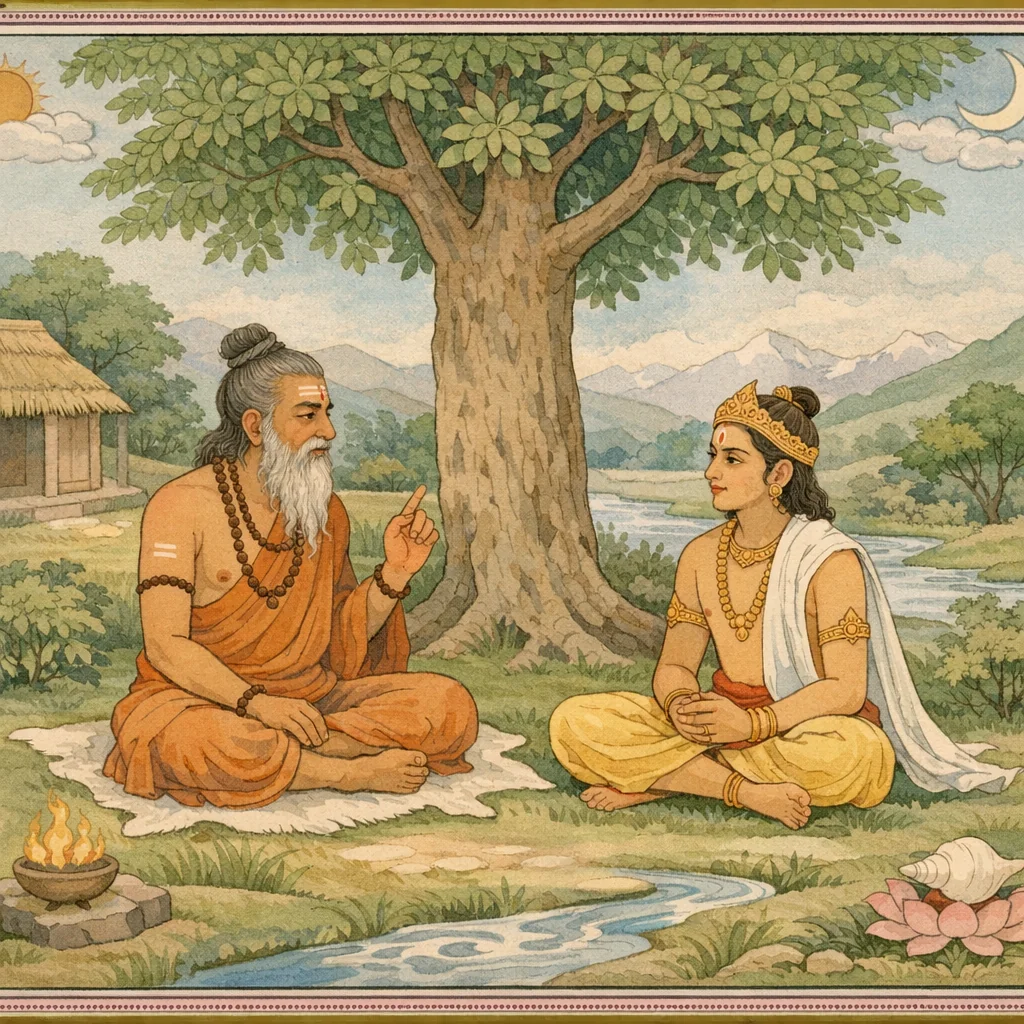
Adhyaya 210
Vyaktāvyakta-Viveka and Nivṛtti as Paramā Gati (Manifest–Unmanifest Discrimination and the Supreme Path of Withdrawal)
Upa-parva: Mokṣa-dharma (Liberation Teachings) — Vyaktāvyakta–Pravṛtti–Nivṛtti Discourse Unit
A guru-voice instructs that higher dharma is not grasped without knowing a ‘catuṣṭaya’ (a fourfold analytic), anchored in discriminating vyakta (manifest, tied to mortality) from avyakta (unmanifest, characterized as deathless). The discourse defines pravṛtti-dharma as a mode associated with return (punarāvṛtti), while nivṛtti-dharma is presented as the highest destination (paramā gati). Two subtle, beginningless and endless principles—avyakta and puruṣa—are treated as difficult to apprehend, and the kṣetrajña is characterized as the witness of prakṛti and its transformations, not constituted by guṇas. The chapter then explains how embodied identity is linguistically and karmically constructed through conjunction, action, and the instruments of action, while the self is ‘covered’ by sattva, rajas, and tamas. Practical disciplines follow: tapas defined as purifying action that diminishes rajas and tamas, including bodily austerities (brahmacarya, ahiṃsā) and mental disciplines (restraint of speech and mind, equanimity). Regulation of food and gradual, non-distressing practice are recommended to support knowledge, especially toward life’s end. The text concludes with binding metaphors: craving as an endless fiber/thread that stitches saṃsāra, and liberation as the state of being free from thirst through correct knowledge of prakṛti, vikāra, and the eternal puruṣa, attributed to Nārāyaṇa’s compassionate instruction for the welfare of beings.
Chapter Arc: भीष्म युधिष्ठिर से कहते हैं कि ‘सनातन’ और मोक्ष-तत्त्व को समझाने हेतु वे एक प्राचीन इतिहास—गुरु और शिष्य के संवाद—का उपाख्यान सुनाते हैं। → शिष्य ब्रह्म-गुह्य अध्यात्म का रहस्य पूछता है; गुरु इन्द्रियों और मन के सूक्ष्म रूपान्तरण, पंचमहाभूत-गुणों के साथ इन्द्रियों के सम्बन्ध, तथा जगत् के आधार-तत्त्व का क्रमशः निरूपण करते हैं—जिससे साधक के भीतर ‘मैं कौन हूँ’ का प्रश्न तीव्र होता जाता है। → गुरु निर्णायक रूप से बताते हैं कि मन ही भिन्न-भिन्न क्रियाओं में रसना/वाणी आदि इन्द्रियों का रूप धारण करता है; जिह्वा-जल, गन्ध-पृथ्वी, श्रोत्र-आकाश, चक्षु-अग्नि, स्पर्श-वायु—इन गुण-संबंधों के पार जो रजोगुण-रहित परमात्म-आश्रय है वही समस्त चराचर का आधार है, और जीव कर्मानुसार देह त्यागकर अन्य देह ग्रहण करता है। → उपदेश का फल यह स्थापित होता है कि त्रैलोक्य चक्रवत् परिवर्तित है; देह-इन्द्रिय-मन के परिवर्तनशील संघात से परे आत्म-तत्त्व का आश्रय लेना ही मोक्षमार्ग है, और शिष्य को इस श्रवण का अधिकारी मानकर गुरु कल्याणमय परम-तत्त्व (वार्ष्णेय-माहात्म्य/परमात्म-आश्रय) की ओर बुद्धि स्थिर करने को प्रेरित करते हैं। → परम कल्याणमय तत्त्व/वार्ष्णेय-माहात्म्य का संकेत देकर अध्याय समाप्त होता है—अगले प्रसंग में उसके विस्तृत प्रतिपादन की अपेक्षा बनी रहती है।
Shlokas
Verse 1
(दाक्षिणात्य अधिक पाठके ८६३ “लोक मिलाकर कुल १२२६ “लोक हैं) भस्न्ैमा सन () अं िमाने + इस श्लोकमें वर्णित भावके अनुसार सनातन शब्दकी व्युत्पत्ति इस प्रकार समझनी चाहिये--नादनेन सहितः सनादन:। दकारस्थाने तकारो छान्दस:। जो नादके साथ हो, वह 'सनादन” कहलाता है। सनादनके दकारके स्थानमें तकार हो जानेसे “सनातन” बनता है। ३. आश्रावय, २. अस्तु श्रौषट्, ३. यज, ४. ये यजामहे, ५. वषट्। दशाधिकद्वधिशततमो< ध्याय: गुरु-शिष्यके संवादका उल्लेख करते हुए श्रीकृष्ण-सम्बन्धी अध्यात्मतत्त्वका वर्णन युधिछिर उवाच योगं मे परमं तात मोक्षस्य वद भारत | तमहं तत्त्वतो ज्ञातुमिच्छामि वदतां वर,युधिष्ठिरने कहा--वक्ताओंमें श्रेष्ठ तात भरतनन्दन! आप मुझे मोक्षके साधनभूत परम योगका उपदेश कीजिये। मैं उसे यथार्थरूपसे जानना चाहता हूँ
Yudhiṣṭhira said: “O revered one, O Bhārata—teach me the supreme discipline that leads to liberation. I wish to understand it in its true nature; O best among speakers, please explain.”
Verse 2
भीष्म उवाच अत्राप्युदाहरन्तीममितिहासं पुरातनम् । संवादं मोक्षसंयुक्त शिष्यस्य गुरुणा सह,भीष्मजी बोले--राजन्! इस विषयमें एक शिष्यका गुरुके साथ जो मोक्षसम्बन्धी संवाद हुआ था, उसी प्राचीन इतिहासका उदाहरण दिया जाता है
Bhishma said: “O King, in this matter too an ancient precedent is cited: a venerable old account describing a dialogue on liberation that took place between a disciple and his teacher.”
Verse 3
वश्चिद् ब्राह्मणमासीनमाचार्यमृषिसत्तमम् | तेजोराशिं महात्मानं सत्यसंध॑ जितेन्द्रियम्,किसी समयकी बात है, एक दिद्वान् ब्राह्मण श्रेष्ठ आसनपर विराजमान थे। वे आचार्यकोटिके पण्डित और श्रेष्ठतम महर्षि थे। देखनेमें महान् तेजकी राशि जान पड़ते थे। बड़े महात्मा, सत्यप्रतिज्ञ और जितेन्द्रिय थे। एक दिन उनकी सेवामें कोई परम मेधावी कल्याणकामी एवं समाहितचित्त शिष्य आया (जो चिरकालतक उनकी शुश्रूषा कर चुका था), वह उनके दोनों चरणोंमें प्रणाम करके हाथ जोड़ सामने खड़ा हो इस प्रकार बोला --
Bhishma said: Once there was a learned brāhmaṇa seated in a place of honor—an ācārya, the foremost among sages. He appeared like a mass of radiance: a great-souled man, steadfast in truth, and master of his senses. (The narrative sets up an ethical exemplar—one whose authority rests on learning, self-control, and fidelity to truth—before introducing the disciple who approaches him in reverence.)
Verse 4
शिष्य: परममेधावी श्रेयो<र्थी सुसमाहित: । चरणावुपसंगृहा[ स्थित: प्राउजलिरब्रवीत्,किसी समयकी बात है, एक दिद्वान् ब्राह्मण श्रेष्ठ आसनपर विराजमान थे। वे आचार्यकोटिके पण्डित और श्रेष्ठतम महर्षि थे। देखनेमें महान् तेजकी राशि जान पड़ते थे। बड़े महात्मा, सत्यप्रतिज्ञ और जितेन्द्रिय थे। एक दिन उनकी सेवामें कोई परम मेधावी कल्याणकामी एवं समाहितचित्त शिष्य आया (जो चिरकालतक उनकी शुश्रूषा कर चुका था), वह उनके दोनों चरणोंमें प्रणाम करके हाथ जोड़ सामने खड़ा हो इस प्रकार बोला --
Bhīṣma said: A disciple of exceptional intelligence, seeking the highest good and steady in mind, approached his teacher, clasped both of his feet in reverence, and then stood with folded hands and spoke—thus setting the scene for a respectful inquiry into what is truly beneficial and righteous.
Verse 5
उपासनात् प्रसन्नोडसि यदि वै भगवन् मम । संशयो मे महान् कश्रित् तन्मे व्याख्यातुमरहसि । कुतश्चाहं कुतश्च त्वं तत् सम्यग्ब्रूहि यत्परम्,“भगवन्! यदि आप मेरी सेवासे प्रसन्न हैं तो मेरे मनमें जो एक बड़ा भारी संदेह है, उसे दूर करनेकी कृपा करें--ेरे प्रश्नकी विशद व्याख्या करें। मैं इस संसारमें कहाँसे आया हूँ और आप भी कहाँसे आये हैं? यह भलीभाँति समझाकर बताइये। इसके सिवा जो परम तत्त्व है, उसका भी विवेचन कीजिये
Bhishma said: “O Blessed one, if you are indeed pleased with my devoted service, then please resolve a great doubt that has arisen in me. Deign to explain it clearly: from where have I come into this world, and from where have you come? Tell me this rightly—and also expound that highest reality beyond all else.”
Verse 6
कथं च सर्वभूतेषु समेषु द्विजसत्तम | सम्यग्वृत्ता निवर्तन्ते विपरीता: क्षयोदया:,द्विजश्रेष्ठ) पृथ्वी आदि सम्पूर्ण महाभूत सर्वत्र समान हैं; सम्पूर्ण प्राणियोंके शरीर उन्हींसे निर्मित हुए हैं तो भी उनमें क्षय और वृद्धि--ये दोनों विपरीतभाव क्यों होते हैं?
Bhīṣma said: “O best of the twice-born, if the great elements—beginning with earth—are everywhere the same, and if the bodies of all beings are fashioned from those very elements, then why do the contrary conditions of decline and increase arise among creatures? By what right order do such opposites come to be and pass away?”
Verse 7
वेदेषु चापि यद् वाक््यं लौकिकं व्यापकं च यत् । एतद् विद्वन् यथातत्त्वं सर्व व्याख्यातुमहसि,“वेदों और स्मृतियोंमें भी जो लौकिक और व्यापक धर्मोका वर्णन है, उनमें भी विषमता है। अतः विद्वन्! इन सबकी आप यथार्थरूपसे व्याख्या करें!
Bhishma said: “Even within the Vedas there are statements, and likewise teachings that are worldly in scope and broadly applicable. Yet in these too there appears to be inconsistency. Therefore, O learned one, you ought to explain all of this in accordance with the true reality—so that the meaning of these teachings may be properly understood.”
Verse 8
गुरुउ्वाच शृणु शिष्य महाप्राज्ञ ब्रह्मगुह्ममिदं परम् । अध्यात्मं सर्वविद्यानामागमानां च यद्धसु,गुरुने कहा--वत्स! सुनो। महामते! तुमने जो बात पूछी है, वह वेदोंका उत्तम एवं गूढ़ रहस्य है। यही अध्यात्मतत्त्व है तथा यही समस्त विद्याओं और शास्त्रोंका सर्वस्व है जैसे ऋतु-परिवर्तनके साथ ही भिन्न-भिन्न ऋतुओंके नाना प्रकारके वे-ही-वे लक्षण प्रकट होते रहते हैं, वैसे ही प्रत्येक कल्पके आरम्भमें पूर्व कल्पोंके अनुसार तदनुरूप भावोंकी अभिव्यक्ति होती रहती है ।। अथ यद्यद् यदा भाति कालयोगाद्ू युगादिषु | तत् तदुत्पद्यते ज्ञानं लोकयात्राविधानजम्
The teacher said: “Listen, O disciple of great understanding. What you have asked is the supreme and secret mystery of Brahman. It is the principle of the inner Self (adhyātma), the very essence and stable core of all branches of knowledge and of the sacred traditions. And whatever appears at whatever time—through the conjunction of time, at the beginnings of ages—corresponding knowledge arises again and again, born of the ordering of the world’s course and the needs of living beings.”
Verse 9
वासुदेव: परमिदं विश्व॒स्य ब्रह्मणो मुखम् । सत्यं ज्ञानमथो यज्ञस्तितिक्षा दम आर्जवम्,सम्पूर्ण वेदका मुख जो प्रणव है वह तथा सत्य, ज्ञान, यज्ञ, तितिक्षा, इन्द्रिय-संयम, सरलता और परम तत्त्व--यह सब कुछ वासुदेव ही है
Bhishma said: “Vāsudeva is the supreme source and the very ‘face’—the foremost manifestation—of the universe and of Brahman. Truthfulness, spiritual knowledge, sacrifice, forbearance, self-restraint, and straightforwardness—these virtues, and the highest principle they indicate, are in essence Vāsudeva Himself.”
Verse 10
पुरुषं सनातन विष्णुं यं त॑ वेदविदो विदु: । स्वर्गप्रलयकर्तारमव्यक्तं ब्रह्म शाश्वतम्,वेदज्ञजन उसीको सनातन पुरुष और विष्णु भी मानते हैं। वही संसारकी सृष्टि और प्रलय करनेवाला अव्यक्त एवं सनातन ब्रह्म है
Bhīṣma said: “The knowers of the Veda recognize Him as the eternal Person—Viṣṇu. He is the one who brings about the world’s creation and dissolution, the unmanifest (avyakta) and everlasting Brahman.”
Verse 11
तदिदं ब्रह्म वाष्णेयमितिहासं शृणुष्व मे । ब्राह्मणो ब्राह्मुणै: श्राव्यो राजन्य: क्षत्रियैस्तथा,वही ब्रह्म वृष्णिकुलमें श्रीकृष्णरूपमें अवतीर्ण हुआ, इस कथाको तुम मुझसे सुनो। ब्राह्मण ब्राह्मणको, क्षत्रिय क्षत्रियको, वैश्य वैश्यको तथा शूद्र महामनस्वी शूद्रको, अमित तेजस्वी देवाधिदेव विष्णुका माहात्म्य सुनावे
Bhīṣma said: “Now hear from me this sacred account connected with the Vārṣṇeya line. A brāhmaṇa should recite it to brāhmaṇas, and a kṣatriya (rājanya) likewise to kṣatriyas.”
Verse 12
वैश्यो वैश्यैस्तथा श्राव्य: शूद्र: शूद्रैमहामना: । माहात्म्यं देवदेवस्य विष्णोरमिततेजस:,वही ब्रह्म वृष्णिकुलमें श्रीकृष्णरूपमें अवतीर्ण हुआ, इस कथाको तुम मुझसे सुनो। ब्राह्मण ब्राह्मणको, क्षत्रिय क्षत्रियको, वैश्य वैश्यको तथा शूद्र महामनस्वी शूद्रको, अमित तेजस्वी देवाधिदेव विष्णुका माहात्म्य सुनावे
Bhīṣma said: “A Vaiśya should be instructed by Vaiśyas, and a Śūdra of noble mind by Śūdras. Thus should the greatness of Viṣṇu—the God of gods, of immeasurable splendor—be recounted.”
Verse 13
अ्हस्त्वमसि कल्याण वार्ष्णेयं शृणु यत्परम् । कालचक्रमनाद्यन्तं भावाभावस्वलक्षणम्
Bhīṣma said: “O auspicious one, O Vārṣṇeya, you are not helpless. Listen now to the highest teaching: the wheel of Time—without beginning or end—whose very mark is the arising and passing away of all states of being and non-being.”
Verse 14
यत्तदक्षरमव्यक्तममृतं ब्रह्म शाश्वतम् | वदन्ति पुरुषव्याप्र केशवं पुरुषर्षभम्,पुरुषसिंह! पुरुषोत्तम श्रीकृष्णको ही अक्षर, अव्यक्त, अमृत एवं सनातन परब्रह्म कहते हैं
Bhishma said: “O tiger among men, that Imperishable, Unmanifest, Deathless, eternal Brahman is spoken of as Keśava—Śrī Kṛṣṇa: the bull among men, the lion among men, the Supreme Person.”
Verse 15
पितृन देवानृषींश्वैव तथा वै यक्षराक्षसान् | नागासुरमनुष्यांश्ष सृूजते परमोडव्यय:,ये अविनाशी परमात्मा श्रीकृष्ण ही पितर, देवता, ऋषि, यक्ष, राक्षस, नाग, असुर और मनुष्य आदिकी रचना करते हैं
Bhishma said: “The Supreme, imperishable Lord brings forth all orders of beings—ancestors, gods, and seers, as well as yakshas and rakshasas, and likewise nagas, asuras, and human beings.”
Verse 16
तथैव वेदशास्त्राणि लोकधर्माश्च शाश्वतान् । प्रलयं प्रकृति प्राप्प युगादौ सृजते पुन:,इसी प्रकार प्रलयकाल बीतनेपर कल्पके आरम्भमें प्रकृतिका आश्रय ले भगवान् श्रीकृष्ण ही ये वेद-शास्त्र और सनातन लोक-धर्मोंको पुनः प्रकट करते हैं
“In the same way, the eternal Vedas and śāstras, and the everlasting norms of worldly dharma—after the dissolution, having entered back into Prakṛti—are brought forth again at the beginning of a new age.”
Verse 17
यथर्र्तावृतुलिड्रानि नानारूपाणि पर्यये । दृश्यन्ते तानि तान्येव तथा भावा युगादिषु
Bhīṣma said: “Just as the signs of the seasons, taking on many different forms in their recurring cycle, are seen again and again as the very same seasonal markers, so too do the conditions of existence reappear in the successive ages (yugas).”
Verse 18
काल-क्रमसे युगादिमें जब-जब जो-जो वस्तु भासित होती है, लोक-व्यवहारवश तब- तब उसी-उसी विषयका ज्ञान प्रकट होता रहता है
Bhishma said: “As time proceeds, whenever and whatever thing becomes manifest at the beginning of an age, then—because of the world’s practical dealings—knowledge concerning that very subject repeatedly becomes evident.”
Verse 19
युगान्ते5न्तर्हितान् वेदान् सेतिहासान् महर्षय: । लेभिरे तपसा पूर्वमनुज्ञाता: स्वयम्भुवा,कल्पके अन्तमें लुप्त हुए वेदों और इतिहासोंको कल्पके आरम्भमें स्वयम्भू ब्रह्माके आदेशसे महर्षियोंने तपस्याद्वारा सबसे पहले उपलब्ध किया था
Bhīṣma said: At the close of an age, when the Vedas together with the Itihāsas had vanished from sight, the great seers—having received leave from the Self-born Creator—were the first, at the dawn of the new cycle, to recover them through the power of austerity (tapas).
Verse 20
वेदविद् वेद भगवान् वेदाड़नि बृहस्पति: । भार्गवो नीतिशास्त्रं तु जगाद जगतो हितम्,उस समय स्वयं भगवान् ब्रह्माको वेदोंका, बृहस्पतिजीको वेदांगोंका और शुक्राचार्यको नीति-शास्त्रका ज्ञान हुआ तथा उन लोगोंने जगत्के हितके लिये उन सब विषयोंका उपदेश किया
Bhīṣma said: The Blessed Lord Brahmā, knower of the Veda, taught the Vedas; Bṛhaspati taught the Vedāṅgas; and Bhārgava (Śukra) expounded nītiśāstra, the science of polity and ethics—all for the welfare of the world.
Verse 21
गान्धर्व नारदो वेद भरद्वाजो धर्नुग्रहम् । देवर्षिचरितं गार्ग्य: कृष्णात्रेयश्विकित्सितम्,नारदजीको गान्धर्व वेदका, भरद्वाजको धरनुर्वेदका, महर्षि गार्ग्यको देवर्षियोंके चरित्रका तथा कृष्णात्रेयको चिकित्साशास्त्रका ज्ञान हुआ
Bhīṣma said: Narada mastered Gandharva lore (music and celestial arts); Bharadvaja mastered Dhanur-veda, the science of archery; the sage Gargya knew the deeds and traditions of the divine seers; and Krishna Atreya mastered the medical science.
Verse 22
न्यायतन्त्राण्यनेकानि तैस्तैरुक्तानि वादिभि: । हेत्वागमसदाचारैर्यदुक्ते तदुपास्यताम्,तर्कशील दिद्वानोंने तर्कशास्त्रके अनेक ग्रन्थोंका प्रणणयन किया। उन महर्षियोंने युक्तियुक्त शास्त्र और सदाचारके द्वारा जिस ब्रह्मका उपदेश किया है, उसीकी तुम भी उपासना करो
Bhīṣma said: “Many systems of reasoning and debate have been propounded by various disputants. Yet that Reality which the sages have taught through sound reasoning, authoritative tradition (āgama), and righteous conduct—let that alone be worshipped and adhered to.”
Verse 23
अनाट्य॑ तत्परं ब्रह्म न देवा नर्षयो विदुः । एकस्तदू वेद भगवान् धाता नारायण: प्रभु:,वह परब्रह्म अनादि और सबसे परे है। उसे न देवता जानते हैं न ऋषि। उसे तो एकमात्र जगत्पालक नारायण ही जानते हैं
Bhīṣma said: That supreme Brahman—beginningless, beyond all manifestation, utterly transcendent—is not known even to the gods or the seers. Only the Lord, the Creator and Protector of the world, Narayana, truly knows it.
Verse 24
नारायणादृषिगणास्तथा मुख्या: सुरासुरा: । राजर्षय: पुराणाश्न परमं दुःखभेषजम्,नारायणसे ही ऋषियों, मुख्य-मुख्य देवताओं, असुरों तथा प्राचीन राजर्षियोंने उस ब्रह्मको जाना है; वह ब्रह्म-ज्ञान ही समस्त दुःखोंका परम औषध है
Bhīṣma said: From Nārāyaṇa, the hosts of seers—as well as the foremost among gods and asuras, and the ancient royal sages—have come to know that supreme remedy for sorrow. That highest knowledge (of Brahman) is taught as the final medicine that cures all suffering.
Verse 25
पुरुषाधिछितान् भावान् प्रकृति: सूयते यदा । हेतुयुक्तमत: पूर्व जगत् सम्परिवर्तते,पुरुषद्वारा संकल्पमें लाये गये विविध पदार्थोकी रचना प्रकृति ही करती है। इस प्रकृतिसे सर्वप्रथम कारणसहित जगत् उत्पन्न होता है
Bhishma said: When Nature (prakṛti) brings forth the various states and forms that are presided over by the Person (puruṣa), it is Nature alone that fashions the manifold objects conceived through the agency of that Person. From this Nature, first arises the world together with its causal order; thereafter the universe proceeds in its cyclical transformations.
Verse 26
दीपादन्ये यथा दीपा: प्रवर्तन्ते सहस्रश: । प्रकृति: सूयते तद्धदानन्त्यान् नापचीयते
Bhīṣma said: “Just as countless lamps can be kindled from a single lamp, so too does Prakṛti continually bring forth manifold forms. Yet, even while producing this endless multiplicity, she is not diminished.”
Verse 27
जैसे एक दीपकसे दूसरे सहस्रों दीप जला लिये जाते हैं और पहले दीपकको कोई हानि नहीं होती, उसी प्रकार एक प्रकृति ही असंख्य पदार्थोंको उत्पन्न करती है और अनन्त होनेके कारण उसका क्षय नहीं होता ।। अव्यक्तकर्मजा बुद्धिरहंकारं प्रसूयते । आकाशं चाप्यहंकाराद् वायुराकाशसम्भव:,अव्यक्त प्रकृतिमें क्षोभ होनेपर जिस बुद्धि (महत्तत्त्व) की उत्पत्ति होती है, वह बुद्धि अहंकारको जन्म देती है। अहंकारसे आकाश और आकाशसे वायुकी उत्पत्ति होती है
Bhīṣma said: Just as from a single lamp thousands of other lamps may be lit, yet the first lamp suffers no loss, so too a single Prakṛti brings forth innumerable entities; and because it is without end, it is not diminished. When the unmanifest Prakṛti is stirred into activity, the intellect (the great principle, mahat) arises; from that intellect is born ego-sense (ahaṅkāra). From ego-sense arises space (ākāśa), and from space arises wind (vāyu).
Verse 28
वायोस्तेजस्ततश्चाप अद्भ्योडथ वसुधोद्गता । मूलप्रकृतयो हराष्टी जगदेतास्ववस्थितम्,वायुसे अग्निकी, अग्निसे जलकी और जलसे पृथ्वीकी उत्पत्ति हुई है। इस प्रकार ये आठ मूल-प्रकृतियाँ बतायी गयी हैं। इन्हींमें सम्पूर्ण जगत् प्रतिष्ठित है
Bhīṣma explains the chain of elemental emergence: from wind arises fire; from fire, water; and from water, the earth. These are taught as part of the eight fundamental root-principles (mūla-prakṛtis), and upon these foundational constituents the entire world is said to be established.
Verse 29
ज्ञानेन्द्रियाण्यत: पठच पज््च कर्मेन्द्रियाण्यपि । विषया: पञ्च चैकं॑ च विकारे षोडशं मन:,पाँच ज्ञानेन्द्रियाँ, पाँच कर्मेन्द्रियाँ, पाँच विषय और एक मन--ये सोलह विकार कहे गये हैं। (इनमें मन तो अहंकारका विकार है और अन्य पन्द्रह अपने-अपने कारणरूप सूक्ष्म महाभूतोंके विकार हैं)
Bhīṣma said: “Next come the five organs of knowledge, and also the five organs of action. Together with the five sense-objects and the single mind—these are declared to be sixteen modifications. By understanding these constituents of embodied experience, one learns to distinguish the self from the changing instruments of perception and action, a key step toward self-mastery and right conduct.”
Verse 30
श्रोत्रं त्वक्चक्षुषी जिद्ना प्राणं ज्ञानेन्द्रियाण्यथ । पादौ पायुरुपस्थश्न हस्तौ वाक्कर्मणी अपि,श्रोत्र, त्वचा, नेत्र, जिह्ला और नासिका--ये पाँच ज्ञानेन्द्रियाँ हैं। हाथ, पैर, गुदा, उपस्थ (लिंग) और वाक्ू--ये पाँच कर्मेन्द्रियाँ हैं
Bhīṣma explains the human faculties by classifying the senses and organs of action: the ear, skin, eyes, tongue, and (with the vital breath counted among them here) the instruments of knowing; and the feet, anus, genitals, hands, and speech as the instruments of doing. The teaching frames ethical self-governance: understanding these faculties is a basis for restraint, right conduct, and disciplined living.
Verse 31
शब्द: स्पर्शक्ष रूपं च रसो गन्धस्तथैव च । विज्ञेयं व्यापकं चित्तं तेषु सर्वगतं मन:,शब्द, स्पर्श, रूप, रस और गन्ध--ये पाँच विषय हैं तथा इनमें व्यापक जो चित्त है, उसीको मन समझना चाहिये। मन सर्वगत कहा गया है
Bhīṣma said: “Sound, touch, form, taste, and smell—these are the five objects of experience. Know that the mind is that all-pervading consciousness (citta) which extends through them all; therefore the mind is said to be everywhere-present, moving through every field of sense-perception.”
Verse 32
रसज्ञाने तु जिद्देयं व्याहृते वाक् तथोच्यते । इन्द्रियैविविधैर्युक्त सर्व व्यक्त मनस्तथा
Bhishma said: In the cognition of taste, what is to be known is the knowing principle; and when it is articulated, it is called speech. Likewise, all that becomes manifest is connected with the various senses—and so too with the mind. The teaching points to how experience and expression arise through the instruments of perception, while the inner knower remains the basis of awareness.
Verse 33
रस-ज्ञानके समय मन ही यह रसना (जिह्ला)-रूप हो जाता है तथा बोलनेके समय वह मन ही वागिन्द्रिय कहलाता है। इस प्रकार भिन्न-भिन्न इन्द्रियोंके साथ मिलकर उन सबके रूपमें मन ही व्यका होता है ।। विद्यात् तु षोडशैतानि दैवतानि विभागश: । देहेषु ज्ञानकर्तारमुपासीनमुपासते,दस इन्द्रिय, पञजच महाभूत और एक मन--ये सोलह तत्त्व इस शरीरमें विभागपूर्वक रहते हैं। इनको देवतारूप जानना चाहिये। शरीरके भीतर जो ज्ञान प्रकट करनेवाला परमात्माके निकटस्थ जीवात्मा है, उसकी ये सोलहों देवता उपासना करते हैं
Bhishma said: At the time of tasting, the mind itself becomes the tongue; at the time of speaking, that very mind is called the organ of speech. Thus, joining with the various senses, the mind alone manifests in the form of them all. Know, moreover, these sixteen as distinct deities: within bodies they abide in their respective divisions and worship the indwelling knower who is seated near the Supreme Self. The ten senses, the five great elements, and the one mind—these sixteen principles dwell in the body in an ordered distribution. They should be understood as divine powers. These deities, in turn, revere the inner individual self, proximate to the Supreme, by whom knowledge is made manifest within the body.
Verse 34
तद्धत् सोमगुणा जिद्ना गन्धस्तु पृथिवीगुण: । श्रोत्रं नभोगुणं चैव चक्षुरग्नेर्गुणस्तथा । स्पर्श वायुगुणं विद्यात् सर्वभूतेषु सर्वदा,जिह्ना जलका कार्य है, प्राणेन्द्रिय पृथ्वीका कार्य है, श्रवणेन्द्रिय आकाशका और नेत्रेन्द्रिय अग्निका कार्य है तथा सम्पूर्ण भूतोंमें त्वचा नामकी इन्द्रियको सदा वायुका कार्य समझना चाहिये
Bhīṣma said: The tongue should be understood as bearing the quality associated with Soma—taste and sap. Smell is the quality of earth. Hearing belongs to the quality of space (ākāśa). Sight likewise is the quality of fire. And touch should always be known as the quality of wind, in all beings at all times. Thus the senses are taught as operating through elemental qualities, leading to discernment of the body’s nature and detachment from mere sensory identification.
Verse 35
मन: सत्त्वगुणं प्राहु: सत्त्वमव्यक्तजं तथा । सर्वभूतात्मभूतस्थं तस्माद् बुद्धोत बुद्धिमान्,मनको महत्तत्त्वका कार्य कहा है और महत्तत्त्वको अव्यक्त प्रकृतिका कार्य कहा है। अतः बुद्धिमान् पुरुषको चाहिये कि वह समस्त भूतोंके आत्मारूप परमेश्वरको समस्त प्राणियोंमें स्थित जाने
Bhishma said: “They declare the mind (manas) to be constituted of the quality of sattva, and sattva itself to arise from the Unmanifest (Prakṛti). Therefore, the awakened and discerning person should recognize the Supreme Lord—who is the Self of all beings—as abiding within all creatures.”
Verse 36
एते भावा जगत् सर्व वहन्ति सचराचरम् | श्रिता विरजसं देव॑ यमाहु: प्रकृतेः परम्
Bhishma said: “These fundamental states and principles sustain the entire universe—everything moving and unmoving. They rest upon that stainless, passionless Divine Being, whom the wise declare to be beyond Prakriti (material nature).”
Verse 37
इस प्रकार ये सम्पूर्ण पदार्थ समस्त चराचर जगत्का भार वहन करते हैं। ये सब जो प्रकृतिसे अतीत रजोगुणरहित हैं, उस परमदेव परमात्माके आश्रित हैं ।। नदद्वारं पुरं पुण्यमेतैर्भावै: समन्वितम् । व्याप्य शेते महानात्मा तस्मात् पुरुष उच्यते,इन्हीं चौबीस पदार्थोंसे सम्पन्न इस नौ द्वारोंवाले पवित्र पुर (शरीर)-को व्याप्त करके इसमें इन सबसे जो महान् है वह आत्मा शयन करता है; इसलिये उसे “पुरुष” कहते हैं
Bhīṣma explains that thus all these principles bear the burden of the entire world—moving and unmoving. They all depend upon the Supreme God, the Paramātman, who transcends Prakṛti and is free from rajas. And this sacred ‘city’ of the body, with nine gates and constituted by these principles, is pervaded from within by the great Self; that indwelling Self ‘rests’ in it and permeates it while remaining distinct from its material constituents. Therefore He is called Puruṣa—“the one who dwells in the city (pura)”—the inner ruler upon whom the world’s moving and unmoving beings ultimately depend.
Verse 38
अजर: सो<मरश्वैव व्यक्ताव्यक्तोपदेशवान् | व्यापक: सगुण: सूक्ष्म: सर्वभूतगुणाश्रय:,वह पुरुष जरा-मरणसे रहित, व्यापक, समस्त स्थूल-सूक्ष्म तत्त्वोंका प्रेरक, सर्वज्ञत्व आदि गुणोंसे युक्त, सूक्ष्म तथा सम्पूर्ण भूतों और उनके गुणोंका आश्रय है
Bhishma said: That Supreme Person is free from decay and death. He teaches both the manifest and the unmanifest, pervades all things, and—though subtle—supports the qualities of every being. Endowed with attributes such as omniscience, He is the inner impeller of all gross and subtle principles, and the refuge in which all creatures and their properties abide.
Verse 39
यथा दीप: प्रकाशात्मा हस्वो वा यदि वा महान् | ज्ञानात्मानं तथा विद्यात् पुरुष सर्वजन्तुषु,जैसे दीपक छोटा हो या बड़ा, प्रकाशस्वरूप ही है, उसी प्रकार समस्त प्राणियोंमें स्थित जीवात्मा ज्ञानस्वरूप है, ऐसा समझे
Bhīṣma said: Just as a lamp—whether small or great—is by its very nature light, so should one understand that the indwelling Self present in all creatures is of the nature of knowledge (consciousness).
Verse 40
श्रोत्रं वेदयते वेद्यं स शृणोति स पश्यति । कारणं तस्य देहो5यं स कर्ता सर्वकर्मणाम्,वही श्रवणेन्द्रियको उसके ज्ञेयभूत शब्दका बोध कराता है। तात्पर्य यह कि श्रवण और नेत्रोंद्राय वही सुनता और देखता है। यह शरीर उसके शब्द आदि विषयोंके अनुभवमें निमित्त है। वह जीवात्मा ही समस्त कर्मोका कर्ता है
Bhīṣma said: “The ear makes the knowable sound known; it is that inner Self who truly hears and who truly sees. This body is merely the instrumental cause for his experience of sound and the other objects of sense. That very individual self (jīva) is the doer of all actions.”
Verse 41
अग्निदरिंगतो यद्वद् भिन्ने दारौ न दृश्यते । तथैवात्मा शरीरस्थो योगेनैवानुदृश्यते,जिस प्रकार अग्नि काष्ठमें व्याप्त रहनेपर भी काष्ठके चीरनेपर भी उसमें दिखायी नहीं देती, उसी प्रकार आत्मा शरीरमें रहता है, परंतु दिखायी नहीं देता--योगसे ही उसका दर्शन होता है। जैसे मन्थन आदि उपायोंद्वारा काष्ठको मथकर उनमें अग्निको प्रत्यक्ष किया जाता है, उसी प्रकार योगके द्वारा शरीरस्थ आत्माका साक्षात्कार किया जा सकता है
Bhīṣma explains that just as fire, though pervading a piece of wood, is not seen even when the wood is split, so too the Self dwells within the body yet is not directly visible. It is apprehended only through yoga—by disciplined inner practice that makes the indwelling reality manifest, as fire is made evident from wood by appropriate means.
Verse 42
अग्निर्यथा हुपायेन मथित्वा दारु दृश्यते । तथैवात्मा शरीरस्थो योगेनैवात्र दृश्यते,जिस प्रकार अग्नि काष्ठमें व्याप्त रहनेपर भी काष्ठके चीरनेपर भी उसमें दिखायी नहीं देती, उसी प्रकार आत्मा शरीरमें रहता है, परंतु दिखायी नहीं देता--योगसे ही उसका दर्शन होता है। जैसे मन्थन आदि उपायोंद्वारा काष्ठको मथकर उनमें अग्निको प्रत्यक्ष किया जाता है, उसी प्रकार योगके द्वारा शरीरस्थ आत्माका साक्षात्कार किया जा सकता है
Bhīṣma explains that just as fire, though pervading wood, is not seen until the wood is churned by a proper method, so too the Self dwelling within the body is not directly visible; it is realized here only through yoga. The ethical point is that inner truth is not grasped by mere outward observation or argument, but by disciplined practice that reveals what is already present.
Verse 43
नदीष्वापो यथा युक्ता यथा सूर्ये मरीचय: । संततत्वाद् यथा यान्ति तथा देहा: शरीरिणाम्,जैसे नदियोंमें जल रहता ही है और सूर्यमें किरणें भी रहती ही हैं तथा वे जल और किरणें नदी और सूर्यसे नित्य सम्बद्ध होनेके कारण उनके साथ-साथ जाती हैं, उसी प्रकार देहधारियोंके सूक्ष्म शरीर भी जीवात्माके साथ ही रहते हैं और उसे साथ लेकर ही आते- जाते हैं
Bhishma said: “Just as water remains joined to rivers, and rays remain joined to the sun—and, because of their unbroken connection, they move along with the river and the sun—so too the bodies (subtle embodiments) of embodied beings remain associated with the individual self and accompany it as it comes and goes.”
Verse 44
स्वप्नयोगे यथैवात्मा पज्चेन्द्रियसमायुत: । देहमुत्सज्य वै याति तथैवात्मोपलभ्यते,जैसे स्वप्नमें पाँच ज्ञानेन्द्रियोंसहित जीवात्मा इस शरीरको छोड़कर अन्यत्र चला जाता है, वैसे ही मृत्युके बाद भी वह इस शरीरको छोड़कर दूसरा शरीर ग्रहण कर लेता है
Bhishma said: “Just as, in the state of dreaming, the self—accompanied by the five senses—seems to leave this body and move elsewhere, so too after death the self is understood to depart from this body and take up another embodiment.”
Verse 45
कर्मणा बाध्यते रूपं कर्मणा चोपलभ्यते । कर्मणा नीयते<न्यत्र स्वकृतेन बलीयसा,कर्मके द्वारा ही इस देहका बाध होता है; कर्मसे ही अन्य देहकी उपलब्धि होती है तथा अपने किये हुए प्रबल कर्मके द्वारा ही वह अन्य शरीरमें ले जाया जाता है
Bhishma said: “A being’s embodied form is constrained and shaped by its actions; by actions alone another embodiment is obtained. And by the force of one’s own powerful deeds, the self is carried elsewhere—into that other body.”
Verse 46
स तु देहाद् यथा देहं त्यक्त्वान्यं प्रतिपद्यते । तथान्यं सम्प्रवक्ष्यामि भूतग्रामं स्वकर्मजम्,वह जीवात्मा जिस प्रकार एक शरीर छोड़कर दूसरा शरीर ग्रहण करता है तथा अपने कर्मोसे उत्पन्न हुआ प्राणिसमुदाय जिस प्रकार अन्य देह धारण करता है, वह सब मैं तुम्हें बतलाता हूँ
Bhishma said: “Just as the embodied self, leaving one body, attains another, so too I shall explain to you how the multitude of living beings—brought forth in accordance with one’s own deeds—comes to assume another embodiment.”
Verse 136
त्रैलोक्यं सर्वभूतेशे चक्रवत्परिवर्तते । तुम भी यह सब सुननेके योग्य अधिकारी हो; अतः भगवान् श्रीकृष्णका जो कल्याणमय उत्कृष्ट माहात्म्य है, उसे सुनो। यह जो सृष्टि-प्रलयरूप अनादि, अनन्त कालचक्र है, वह श्रीकृष्णका ही स्वरूप है। सर्वभूतेश्वर श्रीकृष्णमें ये तीनों लोक चक्रकी भाँति घूम रहे हैं
Bhīṣma said: “The three worlds revolve like a wheel within Śrī Kṛṣṇa, the Lord of all beings. You are fit to hear this; therefore listen to the auspicious and supreme greatness of Bhagavān Śrī Kṛṣṇa. This beginningless and endless wheel of time—manifesting as creation and dissolution—is itself His very form; and within Him the three worlds turn ceaselessly like a wheel.”
Verse 230
इति श्रीमहाभारते शान्तिपर्वणि मोक्षधर्मपर्वणि वार्ष्णेया ध्यात्मक थने दशाधिकद्वधिशततमो<ध्याय:
Thus, in the Śrī Mahābhārata, within the Śānti Parva—specifically the Mokṣa-dharma section—ends the two-hundred-and-tenth chapter, presenting an instruction on adhyātma (spiritual teaching) in connection with the Vārṣṇeya lineage. (Closing colophon)
Frequently Asked Questions
The chapter foregrounds the choice between pravṛtti (continuing action-identity that tends toward recurrence) and nivṛtti (withdrawal from craving and misidentification), presenting the latter as the ethically and soteriologically superior trajectory.
Correct discrimination—knowing prakṛti and its modifications, and recognizing puruṣa/kṣetrajña as the non-guṇic witness—combined with disciplined tapas and dispassion, removes confusion at life’s end and supports liberation.
Yes: it states that knowing the fourfold analytic and maintaining accurate self-understanding prevents delusion at the end of life, and it frames Nārāyaṇa’s instruction as ‘amṛta’ given compassionately for the welfare of beings.