Adhyaya 183
सत्य–अनृत, प्रकाश–तमस्, स्वर्ग–नरक विवेचनम् (Truth and Untruth as Light and Darkness; Svarga and Naraka as Ethical Consequences)
Upa-parva: Mokṣa-dharma (Discourse on Liberation) — Bṛghu–Bharadvāja Saṃvāda (Truth, Untruth, Light, Darkness, and the Psychology of Suffering)
Bṛghu defines satya (truth) as brahman-like and tapas-like, a generative and sustaining principle by which the world is upheld and by which one reaches svarga. He contrasts anṛta (untruth) as the form of tamas that drags beings downward; those seized by darkness fail to perceive light. Svarga is characterized as prakāśa (illumination) and naraka as tamas (obscuration), both attained through the polarity of satya and anṛta. The discourse maps a moral ontology: satya → dharma → light → sukha, and anṛta → adharma → darkness → duḥkha. It then distinguishes bodily and mental suffering and notes that the wise, observing the constructed nature of worldly experience, do not become confused and should strive for release from suffering since pleasure is impermanent. A simile (the moon eclipsed by Rāhu) illustrates how tamas eclipses happiness. Bṛghu outlines two kinds of pleasure (bodily, mental) and the general human orientation toward action for pleasure; Bharadvāja objects by citing ascetic exemplars (Brahmā solitary; Śiva subduing desire) and the moral maxim that merit yields pleasure and demerit yields pain. Bṛghu replies that tamas arises from untruth and enumerates the physical and psychological afflictions that follow adharma (disease, fear, hunger, grief, loss, aging, death). He contrasts this with svarga, where such defects do not arise, and concludes with a cosmological note on generation (earth as mother; Prajāpati as male principle) and the karmic cycling of beings under their actions.
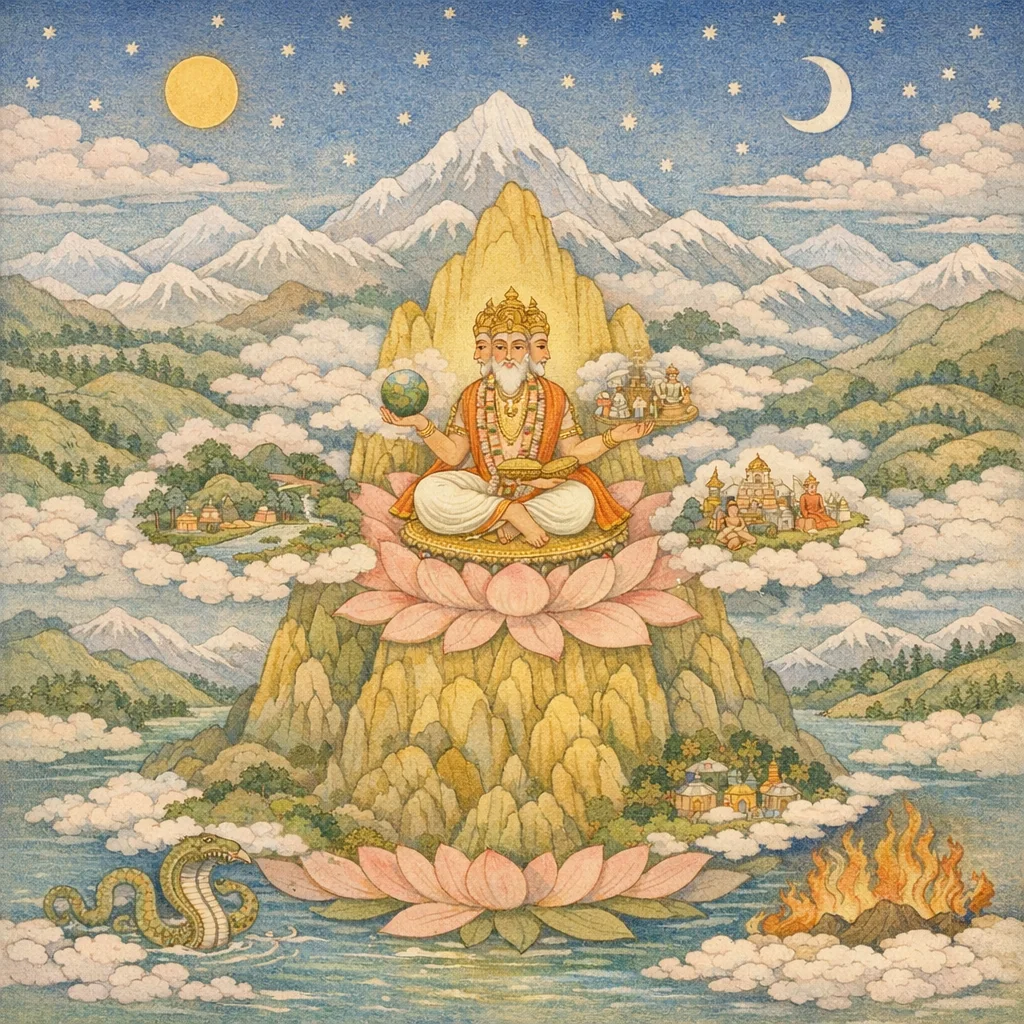
Chapter Arc: भरद्वाज मुनि भृगु महर्षि से जगत् के रहस्य पूछते हैं—समुद्र, आकाश, पर्वत, मेघ, भूमि, अग्नि और वायु सहित यह लोक किसने रचा? → प्रश्न गहराते जाते हैं: भूतों की सृष्टि कैसे हुई, वर्ण-विभाग कैसे बना, शौच-अशौच और धर्म-अधर्म की व्यवस्था किस आधार पर ठहरी, और मृत्यु के बाद जीव कहाँ जाता है? जिज्ञासा ब्रह्माण्ड-रचना से आत्मा-गति तक फैल जाती है। → भृगु ‘मानसदेव’/परमात्मा के अनन्त स्वरूप का प्रतिपादन करते हैं—जिसका अन्त देवता-नक्षत्र भी नहीं देख पाते; उसी अनन्त से ब्रह्मत्व को प्राप्त मूर्ति प्रकट होती है और ‘पृथिवी’ को पद्म कहा जाता है, जिसकी कर्णिका मेरु है; मेरु-मध्य में स्थित होकर ब्रह्मा समस्त लोकों की सृष्टि करते हैं। → सृष्टि-रचना का प्रतीकात्मक मानचित्र स्पष्ट होता है: अनन्त परमात्मा—ब्रह्मरूप—पद्मरूप पृथिवी—मेरु-कर्णिका—और उसके मध्य में सृष्टिकर्ता ब्रह्मा। भरद्वाज के ‘किसने बनाया’ प्रश्न को एक दार्शनिक-पुराणात्मक उत्तर मिलता है। → जीव, वर्ण-विभाग, शौच-अशौच और मृत्युोत्तर गति के सूक्ष्म प्रश्न अभी पूर्ण विस्तार की माँग करते हैं।
Shlokas
Verse 1
ऑपन-आक्रात बछ। >> ्र:-अ महर्षि भूगुके साथ भरद्वाज मुनिका प्रश्नोत्तर द्यशीत्याधेकशततमोब< ध्याय: भरद्वाज और भृगुके संवादमें जगत्की उत्पत्तिका और विभिन्न तत्त्वोंका वर्णन युधिछिर उवाच कुतः सृष्टमिदं विश्व जगत् स्थावरजड्रमम् । प्रलये च कमभ्येति तन्मे ब्रूहि पितामह,युधिष्ठिरने पूछा--पितामह! इस सम्पूर्ण स्थावर-जंगम जगतकी उत्पत्ति कहाँसे हुई है? प्रलयकालमें यह किसमें लीन होता है? यह मुझे बताइये
Yudhiṣṭhira said: “Grandfather, from what source has this entire universe—this world of the immovable and the moving—been created? And at the time of dissolution, into what does it merge? Please tell me.”
Verse 2
ससागर: सगगन: सशैल: सबलाहकः । सभूमि: साग्निपवनो लोको<यं केन निर्मित:,समुद्र, आकाश, पर्वत, मेघ, भूमि, अग्नि और वायुसहित इस संसारका किसने निर्माण किया है?
Yudhiṣṭhira asked: “This world—together with the oceans, the sky, mountains, clouds, the earth, and with fire and wind—by whom was it created?”
Verse 3
कथं सृष्टानि भूतानि कथ॑ं वर्णविभक्तय: । शौचाशौचं कथं तेषां धर्माधर्मविधि: कथम्,प्राणियोंकी सृष्टि किस प्रकार हुई? वर्णोका विभाग किस तरह किया गया? उनमें शौच और अशौचकी व्यवस्था कैसे हुई? तथा धर्म और अधर्मका विधान किस प्रकार किया गया?
Yudhiṣṭhira asked: “How were living beings brought into existence? How was the division into social orders (varṇas) established? How were purity and impurity determined among them? And how were the ordinances of dharma and adharma laid down?”
Verse 4
कीदृशो जीवतां जीव: कक््व वा गच्छन्ति ये मृता: । अस्माल्लोकादमुं लोकं सर्व शंसतु नो भवान्
Yudhiṣṭhira asked: “Among the living, what is the true nature of the living self? And where do those who have died depart? From this world to that other world—pray explain all of it to us with clarity.”
Verse 5
जीवित प्राणियोंका जीवात्मा कैसा है? जो मर गये, वे कहाँ चले जाते हैं? इस लोकसे उस लोकमें जानेका क्रम क्या है? ये सब बातें आप हमें बतावें ।। भीष्म उवाच अत्राप्युदाहरन्तीममितिहासं पुरातनम् । भगुणाभिहितं शास्त्र भरद्वाजाय पृच्छते,भीष्मजी बोले--राजन्! विज्ञ पुरुष इस विषयमें एक प्राचीन इतिहासका उदाहरण दिया करते हैं, जिसमें भरद्वाजके प्रश्न करनेपर भूगुके उपदेशका उल्लेख हुआ है
Bhīṣma said: “On this very subject, the learned cite an ancient tale from the olden time. It tells how Bharadvāja questioned, and how Bhṛgu set forth the teaching—an instruction on the nature of the living self and the passage from this world to the next.”
Verse 6
कैलासशिखरे दृष्टवा दीप्यमानं महौजसम् | भगुं महर्षिमासीनं भरद्वाजो<न्वपृच्छत,कैलास पर्वतके शिखरपर अपने तेजसे देदीप्यमान होते हुए महातेजस्वी महर्षि भूगुको बैठा देख भरद्वाज मुनिने पूछा--
Bhīṣma said: “Upon the summit of Mount Kailāsa, Bharadvāja beheld the great sage Bhṛgu seated there, blazing with his own radiance. Seeing that ṛṣi of mighty splendor, he drew near and put forth a question—thus beginning a dialogue meant to make dharma clear through the authority of an illumined seer.”
Verse 7
ससागर: सगगन: सशैल: सबलाहकः: । सभूमि: साग्निपवनो लोको<यं केन निर्मित:,“समुद्र, आकाश, पर्वत, मेघ, भूमि, अग्नि और वायुसहित इस संसारका किसने निर्माण किया है?
Bhīṣma said: “This world—together with the ocean, the sky, the mountains, the clouds, the earth, and with fire and wind—by whom has it been created?”
Verse 8
कथं सृष्टानि भूतानि कथं वर्णविभक्तय: । शौचाशौचं कथं तेषां धर्माधर्मविधि: कथम्,'प्राणियोंकी सृष्टि किस प्रकार हुई? वर्णोका विभाग किस तरह किया गया? उनमें शौच और अशौचकी व्यवस्था कैसे हुई? तथा धर्म और अधर्मका विधान किस प्रकार किया गया?
Bhīṣma said: “How were living beings first brought into existence? How was the division into varṇas established? By what rule were purity and impurity determined among them? And how, from the very beginning, was the ordinance of dharma and adharma laid down?”
Verse 9
कीदृशो जीवतां जीव: कक््य वा गच्छन्ति ये मृता: । परलोकमिमं चापि सर्व शंसितुमरहसि,“जीवित प्राणियोंका जीवात्मा कैसा है? जो मर गये, वे कहाँ चले जाते हैं? तथा यह लोक और परलोक कैसा है? यह सब मुझे बतानेकी कृपा करें”
Bhīṣma asks for a clear account of the nature of the living self within beings: where those who die proceed after death, and what this world and the next are like. He urges the teacher to explain these matters fully, as essential to right understanding and right conduct.
Verse 10
एवं स भगवान् पृष्टो भरद्वाजेन संशयम् | ब्रद्मर्षिब्रह्मसंकाश: सर्व तस्मै ततोडब्रवीत्,भरद्वाज मुनिके इस प्रकार अपना संशय पूछनेपर ब्रह्माजीके समान तेजस्वी ब्रह्मर्षि भगवान् भृगुने उन्हें सब कुछ बताया
Bhīṣma said: Thus questioned by Bharadvāja, who had raised a doubt, that blessed sage—radiant like Brahmā—then explained everything to him in full, resolving the uncertainty through authoritative instruction.
Verse 11
भूगुरुवाच (नारायणो जगमन्मूर्तिरन्तरात्मा सनातन: । कूटस्थो$क्षर अव्यक्तो निर्लेपो व्यापक: प्रभु: ।। प्रकृते:ः परतो नित्यमिन्द्रियैरप्पगोचर: । स सिसृक्षु:ः सहस्रांशादसृजत् पुरुष प्रभु: ।) मानसो नाम विख्यात: श्रुतपूर्वो महर्षिभि: । अनादिनिधनो देवस्तथाभेद्योडजरामर:,भगु बोले--ब्रह्मन! भगवान् नारायण सम्पूर्ण जगत्स्वरूप हैं। वे ही सबके अन्तरात्मा और सनातन पुरुष हैं। वे ही कूटस्थ, अविनाशी, अव्यक्त, निर्लेप, सर्वव्यापी, प्रभु, प्रकृतिसे परे और इन्द्रियातीत हैं। उन भगवान् नारायणके हृदयमें जब सृष्टिविषयक संकल्पका उदय हुआ तो उन्होंने अपने हजारवें अंशसे एक पुरुषको उत्पन्न किया, महर्षियोंने सर्वप्रथम जिसको इसी नामसे सुना था, जो मानसपुरुषके नामसे प्रसिद्ध है। पूर्वकालमें उत्पन्न वह मानसदेव अनादि, अनन्त, अभेद्य, अजर और अमर है
Bhishma said: Bhrigu declared—Nārāyaṇa is the very embodied form of the universe, the inner Self of all beings, and the eternal Person. He is the unchanging (kūṭastha), imperishable, unmanifest, untouched by qualities, all-pervading, and sovereign Lord—ever beyond Prakṛti and inaccessible even to the senses. When the resolve to create arose in that Lord, He brought forth, from a thousandth part of Himself, a ‘Person’ first heard of by the great seers and renowned as the Mānasa (mind-born) Puruṣa. That primordial mind-born deity is without beginning or end, inviolable, undecaying, and deathless.
Verse 12
अव्यक्त इति विख्यात: शाश्रवृतो5थाक्षयोडव्यय: । यतः सृष्टानि भूतानि जायन्ते च ग्रियन्ति च,उसीकी अव्यक्त नामसे प्रसिद्धि है। वही शाश्वत, अक्षय और अविनाशी है। उससे उत्पन्न सब प्राणी जन्मते और मरते रहते हैं
Bhishma said: That supreme principle is renowned as the “Unmanifest.” It is eternal, imperishable, and undecaying. From it all created beings arise, and in the course of time they are born and they die—again and again.
Verse 13
सो<5सृजत् प्रथमं देवो महान्तं नाम नामतः । महान् ससर्जाहँंकारं स चापि भगवानथ,उस स्वयम्भू देवने पहले महत्तत्त्व (समष्टि बुद्धि) की रचना की। फिर उस महत्तत्त्वस्वरूप भगवानने अहंकार (समघष्टि अहंकार) की सृष्टि की
Bhīṣma said: In the beginning, the self-born Lord first brought forth the principle called Mahat (the cosmic intellect). From that Mahat, that very Blessed Lord then produced Ahaṅkāra (the cosmic sense of ‘I’).
Verse 14
आकाशमिति विख्यात॑ सर्वभूतधर: प्रभु: । आकाशादभवदू वारि सलिलादग्निमारुतौ | अग्निमारुतसंयोगात् ततः समभवन्मही,सम्पूर्ण भूतोंको धारण करनेवाले अहंकारस्वरूप भगवानने शब्दतन्मात्रा रूप आकाशको उत्पन्न किया। आकाशसे जल और जलसे अग्नि एवं वायुकी उत्पत्ति हुई। अग्नि और वायुके संयोगसे इस पृथ्वीका प्रादुर्भाव हुआ-
Bhishma said: The sovereign Lord, famed as the supporter of all beings, brought forth the principle known as “ākāśa” (space/ether). From ākāśa arose water; from water arose fire and wind. From the conjunction of fire and wind, thereafter, the earth came into manifestation.
Verse 15
ततस्तेजोमयं दिव्यं पद्म सृष्टं स्वयम्भुवा । तस्मात् पद्मात् समभवद् ब्रह्मा वेदमयो निधि:,उसके बाद उस स्वयम्भू मानसदेवने पहले एक तेजोमय दिव्य कमल उत्पन्न किया। उसी कमलसे वेदमय निधिरूप ब्रह्माजी प्रकट हुए
Then the Self-born Lord brought forth a radiant, divine lotus. From that lotus appeared Brahmā—an inexhaustible treasury of the Vedas.
Verse 16
अहंकार इति ख्यात: सर्वभूतात्मभूतकृत् । ब्रह्मा वै स महातेजा य एते पञच धातव:,वे अहंकार नामसे भी विख्यात हैं और समस्त भूतोंके आत्मा तथा उन भूतोंकी सृष्टि करनेवाले हैं। ये जो पाँच महाभूत हैं, इनके रूपमें महातेजस्वी ब्रह्मा ही प्रकट हुए हैं
Bhishma said: He is known as “Ahaṅkāra”—the inner self of all beings and the maker of those beings. That very radiant Brahmā is manifested as these five elemental constituents; in the form of the five great elements, the cosmic source appears and sustains creation.
Verse 17
शैलास्तस्यास्थिसंज्ञास्तु मेदो मांसं च मेदिनी । समुद्रास्तस्य रुधिरमाकाशमुदरं तथा
Bhīṣma said: “The mountains are known as his bones; the earth is his fat and flesh. The oceans are his blood, and the sky is likewise his belly.”
Verse 18
पर्वत उनकी हड्डियाँ हैं, पृथ्वी उनका मेद और मांस है। समुद्र उनका रुधिर है और आकाश उदर है ।। पवनश्चैव निः:श्वासस्तेजो 5ग्निर्निम्नगा: शिरा: । अग्नीषोमोौ तु चन्द्रार्कों नयने तस्य विश्रुते,वायु नि:श्वास है, अग्नि तेज है, नदियाँ नाड़ियाँ हैं, सूर्य और चन्द्रमा जिन्हें अग्नि और सोम भी कहते हैं, ब्रह्माजीके नेत्रोंके रूपमें प्रसिद्ध हैं
The wind is his breath; fire is his radiance; the rivers are his veins. The sun and the moon—also spoken of as Agni and Soma—are renowned as Brahmā’s two eyes.
Verse 19
नभश्नोर्ध्व शिरस्तस्य क्षिति: पादौ भुजी दिश: । दुर्विज्ञेयो ह्मचिन्त्यात्मा सिद्धेरपि न संशय:
Bhīṣma said: “The sky above is his head; the earth is his feet; the directions are his arms. Such a Self—unthinkable and beyond ordinary grasp—is exceedingly hard to know. Yet there is no doubt: realization of him is possible for the accomplished.”
Verse 20
आकाशका ऊपरी भाग उनका सिर है, पृथ्वी पैर है और दिशाएँ भुजाएँ हैं। वे अचिन्त्यस्वरूप ब्रह्मा सिद्ध पुरुषोंके लिये भी दुर्विज्ञेय हैं, इसमें संशय नहीं है ।। स एष भगवान् विष्णुरनन्त इति विश्रुतः । सर्वभूतात्मभूतस्थो दुर्विज्ञेयोडकृतात्मभि:,वह स्वयम्भू ही भगवान् विष्णु हैं, जो अनन्त नामसे प्रसिद्ध हैं, वे ही सम्पूर्ण भूतोंके अन्त:करणमें अन्तर्यामी आत्माके रूपमें विद्यमान हैं। जिनका हृदय शुद्ध नहीं है, उनके लिये इनके स्वरूपको ठीक-ठीक जानना बहुत कठिन है
Bhishma said: “The upper expanse of the sky is His head, the earth is His feet, and the directions are His arms. His form is inconceivable; even Brahmā and the perfected sages find Him hard to comprehend—of this there is no doubt. He is that very Lord Viṣṇu, famed as Ananta, abiding as the inner Self within the hearts of all beings. For those whose inner nature is unrefined and impure, truly knowing His reality is exceedingly difficult.”
Verse 21
अहंकारस्य यः सत्रष्टा सर्वभूतभवाय वै । यत: समभवद् विश्व पृष्टो5हं यदिह त्वया,वे ही सम्पूर्ण भूतोंकी उत्पत्तिके लिये प्राकृत अहंकारकी सृष्टि करनेवाले हैं। तुमने मुझसे जो पूछा था कि इस विश्वकी उत्पत्ति किससे हुई है, वह सब मैंने तुम्हें बता दिया
Bhishma said: “He who is the creator of primordial egoity (ahaṅkāra), for the coming-to-be of all creatures—he is the source from whom this entire universe arose. What you asked me here about the origin of the world, I have now explained to you in full.”
Verse 22
भरद्वाज उवाच गगनस्य दिशां चैव भूतलस्यानिलस्य वा । कान्यत्र परिमाणानि संशयं छिन्धि तत्त्वतः,भरद्वाजने पूछा--प्रभो! आकाश, दिशा, पृथ्वी और वायुका कितना-कितना परिमाण है? यह ठीक-ठीक बताकर मेरा संशय दूर कीजिये
Bharadvāja said: “Tell me, in truth, the exact measures of the sky, the directions, the earth, and the wind. Resolve my doubt by stating what their dimensions are.”
Verse 23
भूगुरुवाच अनन्तमेतदाकाशं सिद्धदैवतसेवितम् । रम्यं नानाश्रयाकीर्ण यस्यान्तो नाधिगम्यते,भगुजीने कहा--मुने! यह आकाश तो अनन्त है, इसमें अनेकानेक सिद्ध और देवता निवास करते हैं। इसमें उनके भिन्न-भिन्न लोक भी स्थित हैं। यह बड़ा ही रमणीय है और इतना महान् है कि कहीं इसका अन्त नहीं मिलता
Bhṛgu said: “This sky is endless, frequented and revered by perfected beings and the gods. It is delightful, filled with many abodes and supports; and its limit cannot be reached or known.”
Verse 24
ऊर्ध्व॑ गतेरधस्तात्तु चन्द्रादित्यौ न दृश्यतः । तत्र देवा: स्वयं दीप्ता भास्वराभाग्निवर्चस:,ऊपर तथा नीचे जानेसे जहाँ सूर्य और चन्द्रमा नहीं दिखायी देते, वहाँ सूर्य और अग्निके समान तेजस्वी देवता स्वयं अपने प्रकाशसे ही प्रकाशित होते हैं
Bharadvāja said: In that region—beyond the paths of ascent and descent—neither the moon nor the sun is seen. There, the gods shine by their own inherent radiance, resplendent like the sun and blazing like fire.
Verse 25
ते चाप्यन्तं न पश्यन्ति नभसः प्रथितौजस: । दुर्गमत्वादनन्तत्वादिति मे विद्धि मानद,मानद! परंतु वे तेजस्वी नक्षत्रस्वरूप देवता भी इस आकाशका अन्त नहीं देख पाते; क्योंकि यह दुर्गग और अनन्त है, यह बात तुम्हें मेरे मुखसे सुनकर अच्छी तरह समझ लेनी चाहिये
Bharadvāja said: Even those radiant deities who shine in the form of stars do not behold the limit of the sky. Know this well from my words, O giver of honor: it is because the heavens are difficult to traverse and without end.
Verse 26
उपरिष्टोपरिष्ट त्तु प्रज्वलद्धिः स्वयंप्रभै: । निरुद्धमेतदाकाशमप्रमेयं सुरैरपि,ऊपर-ऊपर प्रकाशित होनेवाले स्वयंप्रकाश देवताओंसे यह अप्रमेय आकाश भी भरा हुआ-सा प्रतीत होता है
Bharadvāja said: Above and above, this immeasurable sky appears as though hemmed in and filled by self-luminous, blazing beings. Even the gods cannot fully measure or comprehend it.
Verse 27
पृथिव्यन्ते समुद्रास्तु समुद्रान्ते तम: स्मृतम् । तमसो३न््ते जल प्राहुर्जलस्यान्तेडग्निरेव च,पृथ्वीके अन्तमें समुद्र हैं। समुद्रके अन्तमें घोर अन्धकार है। अन्धकारके अन्तमें जल है और जलके अन्तमें अग्निकी स्थिति बतायी गयी है
Bharadvāja said: At the outer limit of the earth lie the oceans; beyond the oceans, it is said, there is darkness. Beyond that darkness, the sages declare, there is water; and beyond the water, indeed, there is fire.
Verse 28
रसातलान्ते सलिलं जलान्ते पन्नगाधिपा: । तदन्ते पुनराकाशमाकाशान्ते पुनर्जलम्,रसातलके अन्तमें जल है। जलके अन्तमें नागराज शेष हैं। उनके अन्तमें पुन: आकाश और आकाशके ही अन्तभागमें पुन: जल है
Bharadvāja said: At the far end of Rasātala there is water. At the end of that water are the lords of serpents. Beyond them again is space, and at the far limit of space there is water once more.
Verse 29
एवमन्तं भगवत: प्रमाणं सलिलस्य च । अग्निमारुततोये भ्यो दुर्ज्ञेयं दैवतैरपि,इस प्रकार भगवानका, आकाशका, जलका तथा अग्नि और वायुका भी अन्त और परिमाण जानना देवताओंके लिये भी अत्यन्त कठिन है
Bharadvāja said: “In this way, even the limit and measure of the Blessed Lord—and likewise of the waters—are exceedingly hard to know; indeed, the true extent of fire, wind, and water is difficult to comprehend even for the gods.”
Verse 30
अग्निमारुततोयानां वर्णा: क्षितितलस्य च | आकाशादवगृहान्ते भिद्यन्ते5तत्त्वदर्शनात्
Bharadvāja said: “The distinctive qualities of fire, wind, and water—and also of the earth’s surface—are understood to be differentiated, from space down to the smallest enclosed form, through true insight into reality. By seeing the principles as they are, one discerns how the elements and embodied forms are marked off by their own natures.”
Verse 31
अग्नि, वायु, जल और पृथ्वी--इनके रंग-रूप आकाशसे ही गृहीत होते हैं; अत: उससे भिन्न नहीं हैं। तत्त्वज्ञान न होनेसे ही उनमें भेदकी प्रतीति होती है ।। पठन्ति चैव मुनय: शास्त्रेषु विविधेषु च । त्रैलोक्ये सागरे चैव प्रमाणं विहितं यथा,ऋषियोंने विविध शास्त्रोंमें तीनों लोकों और समुद्रोंके विषयमें तो कुछ निश्चित प्रमाण बताया भी है; परंतु जो दृष्टिसे परे हैं और जहाँतक इन्द्रियोंकी पहुँच नहीं है, उस परमात्माका परिमाण कोई कैसे बतायेगा? आखिर इन सिद्धों और देवताओंका ज्ञान भी तो परिमित ही है
Bharadvāja said: “Fire, wind, water, and earth take on their perceived color and form only through space; therefore they are not truly separate from it. It is only from the absence of true knowledge of reality that difference is imagined among them. The sages indeed recite in many treatises that certain measures and standards are laid down for the three worlds and even for the oceans; but how could anyone state the ‘measure’ of the Supreme Self—who lies beyond sight and beyond the reach of the senses? In the end, even the knowledge of perfected beings and of the gods is limited.”
Verse 32
अदृश्याय त्वगम्याय कः प्रमाणमुदाहरेत् । सिद्धानां देवतानां च यदा परिमिता गति:,ऋषियोंने विविध शास्त्रोंमें तीनों लोकों और समुद्रोंके विषयमें तो कुछ निश्चित प्रमाण बताया भी है; परंतु जो दृष्टिसे परे हैं और जहाँतक इन्द्रियोंकी पहुँच नहीं है, उस परमात्माका परिमाण कोई कैसे बतायेगा? आखिर इन सिद्धों और देवताओंका ज्ञान भी तो परिमित ही है
Bharadvāja said: “For That which is invisible and beyond the reach of the senses, who could possibly cite any measure or definitive proof? Even the range of knowledge of the Siddhas and the gods is limited; how then could the ‘measure’ of the Supreme Self be stated?”
Verse 33
तदा गौणमनन्तस्य नामानन्तेति विश्ुतम् । नामधेयानुरूपस्य मानसस्य महात्मन:,अतः परमात्मा मानसदेव अपने नामके अनुरूप ही अनन्त हैं। उनका सुप्रसिद्ध अनन्त नाम उनके गुणके अनुसार ही है
Bharadvāja said: “Then the well-known, secondary (descriptive) name of that great-souled Mānas—whose very nature accords with his appellation—became famed as ‘Ananta’ (the Infinite). Thus, the Supreme Self is called ‘Ananta’ in keeping with His qualities: limitless, unbounded, and beyond measure.”
Verse 34
यदा तु दिव्यं तद् रूप॑ हसते वर्धते पुन: । कोडन्यस्तद्वेदितुं शक्तो योडपि स्यात् तद्विधोडपर:,जब उन परमात्माका वह दिव्यरूप उनकी मायासे कभी बहुत छोटा हो जाता है और कभी बहुत बढ़ जाता है, तब कोई उनसे भिन्न दूसरा उन्हींके समान प्रतिभाशाली कौन है, जो कि उस स्वरूपका यथार्थ परिमाण जान सके अर्थात् ऐसा कोई नहीं है
Bharadvāja said: When that divine form—by the power of its own māyā—sometimes becomes exceedingly small and at other times grows vast again, who else, distinct from Him, could be capable of truly knowing its exact measure? Indeed, there is none: no other being, even if seemingly comparable in brilliance, can fully comprehend the real extent of that supreme, wondrous form.
Verse 35
ततः पुष्करत: सृष्ट: सर्वज्ञो मूर्तिमान् प्रभु: ब्रह्मा धर्ममय: पूर्व: प्रजापतिरनुत्तम:,तदनन्तर पूर्वोक्त कमलसे सर्वज्ञ, मूर्तिमानू, प्रभाव-शाली, परम उत्तम तथा प्रथम प्रजापति धर्ममय ब्रह्माका प्रादुर्भाव हुआ
Then, from the lotus there came forth the Lord—omniscient and embodied—Brahmā, the first and unsurpassed Prajāpati, whose very nature is Dharma. The passage emphasizes that the origin of creation is grounded in righteous order, with Brahmā arising as the primordial upholder of dharma.
Verse 36
भरद्वाज उवाच पुष्कराद् यदि सम्भूतो ज्येष्ठ भवति पुष्करम् | ब्रह्माणं पूर्वजं चाह भवान् संदेह एव मे,भरद्वाजने पूछा--प्रभो! यदि ब्रह्माजी कमलसे प्रकट हुए तब तो कमल ही ज्येष्ठ प्रतीत होता है; परंतु आपने ब्रह्माजीको पूर्वज बताया है; अतः यह संदेह मेरे मनमें बना ही रह गया
Bharadvāja asked: “O Lord! If Brahmā has arisen from the lotus, then the lotus would seem to be the elder. Yet you have called Brahmā the one who came before. Therefore this doubt still remains in my mind.”
Verse 37
भूगुरुवाच मानसस्येह या मूर्तिर्ब्रिह्म॒त्वं समुपागता । तस्यासनविधानार्थ पृथिवी पद्ममुच्यते,भगुने कहा--मुने! मानसदेवका जो स्वरूप बताया गया है, वही ब्रह्मरूपमें प्रकट है। उन्हीं ब्रह्माजीके आसनके लिये इस पृथ्वीको ही पद्म (कमल) कहते हैं
Bhṛgu said: “The form of the ‘mental’ (mānasa) principle described here is manifested as Brahman itself. For the purpose of providing a seat for that Brahmā, this very earth is therefore spoken of as the ‘lotus’ (padma).”
Verse 38
कर्णिका तस्य पद्मस्य मेरुर्गगनमुच्छित: । तस्य मध्ये स्थितो लोकान् सृजते जगत: प्रभु:
Bharadvāja said: “The pericarp of that lotus is Mount Meru, rising up to the sky. Seated in its very center, the Lord of the universe brings forth the worlds.”
Verse 182
इस कमलकी कर्णिका मेरुपर्वत है, जो आकाशमें बहुत ऊँचेतक गया है। उसी पर्वतके मध्यभागमें स्थित होकर जगदीश्वर ब्रह्मा सम्पूर्ण लोकोंकी सृष्टि करते हैं ।। इति श्रीमहाभारते शान्तिपर्वणि मोक्षधर्मपर्वणि भुगुभरद्वाजसंवादे द्यशीत्यधिकशततमो<ध्याय:
Bharadvāja said: “The pericarp of this lotus is Mount Meru, rising very high into the sky. Seated in the very middle of that mountain, Brahmā—the Lord of the universe—brings forth the creation of all the worlds.”
Frequently Asked Questions
It presents a chain: satya aligns with dharma, which manifests as prakāśa (clarity/illumination) and results in sukha; anṛta aligns with adharma, manifesting as tamas (obscuration) and resulting in duḥkha.
To strive for duḥkha-vimokṣa (freedom from suffering) because sukha is unstable in both this world and the next, and tamas can eclipse happiness like an eclipse obscures moonlight.
Yes: it reinforces the causal framing that sukṛta tends toward sukha and duṣkṛta toward duḥkha, then elaborates how tamas-driven conduct concretely produces bodily and mental afflictions, while svarga is described as lacking these defects.