Adhyaya 47
बदरपाचन-तीर्थमाहात्म्यम् | Badarapācana Tīrtha Māhātmya (Indratīrtha and the Austerities of Srucāvatī & Arundhatī)
Upa-parva: Tīrtha-yātrā Context: Badarapācana–Indratīrtha Māhātmya (Pilgrimage Episode)
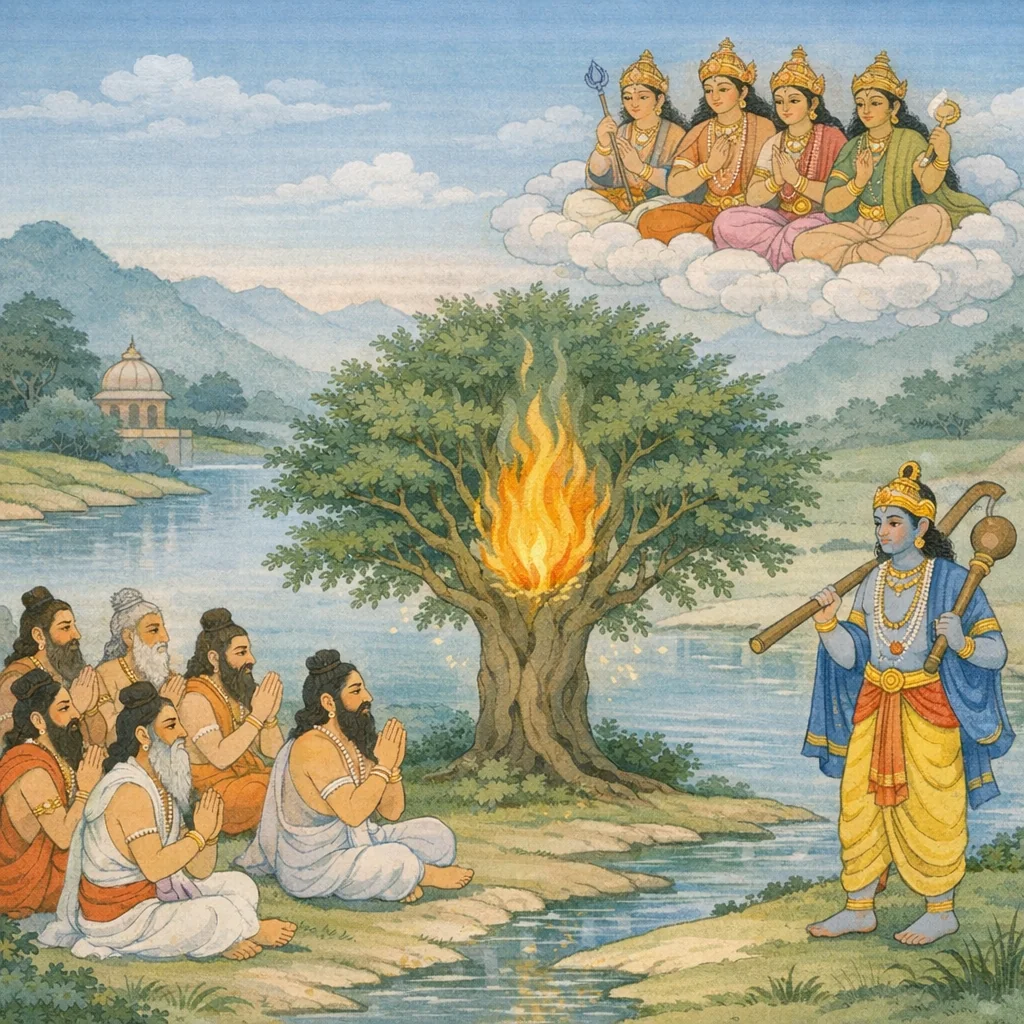
Vaiśaṃpāyana narrates how Rāma reaches the eminent tīrtha Badarapācana, a place sanctified by extraordinary vow-practice. The account introduces Srucāvatī, the celibate daughter of Bharadvāja, who undertakes severe austerities with the intention of attaining Indra (Pākaśāsana) as spouse. Indra approaches her āśrama disguised as Vasiṣṭha; she offers service and hospitality yet refuses marriage, stating her exclusive devotion to Indra and her commitment to please him through vrata, niyama, and tapas. Indra, testing her resolve, instructs her to cook badara fruits; despite prolonged effort the fruits do not cook, and when fuel is exhausted she attempts to sustain the fire with her own body, demonstrating extreme endurance. Satisfied, Indra reveals his true form, grants her desired attainment, and declares the tīrtha’s enduring fame and sin-removing power, naming it Badarapācana. The chapter then parallels this with an older precedent involving Arundhatī and the Saptarṣis during a twelve-year drought in the Himavat forest. Śiva (Triṇayana), disguised as a brāhmaṇa, requests alms; Arundhatī, lacking provisions, offers badara fruits and cooks them while fasting, hearing sacred narratives as time passes. Śiva reveals himself, praises her tapas as surpassing the sages’ efforts, and grants a boon: residence of three nights with fasting at this tīrtha yields the fruit of twelve years’ austerity; additionally, a single night’s disciplined stay and bathing grants rare worlds. The sages marvel at Arundhatī’s undiminished composure. Returning to Srucāvatī, the narration states that after Indra departs, divine signs occur, she relinquishes her body, attains Indra’s consorthood by the power of tapas, and Janamejaya’s curiosity leads to a brief account of her birth: Bharadvāja’s seed, diverted upon seeing the apsaras Ghṛtācī, is placed in a leaf-vessel, from which Srucāvatī is born and named.
Chapter Arc: वैशम्पायन जनमेजय को बताते हैं कि बलराम की तीर्थयात्रा में ऐसे-ऐसे तीर्थ आते हैं जिनका स्मरण मात्र मन को पवित्र कर देता है—श्रोता के रोमांच और कौतूहल का उदय होता है। → कथा तीर्थ-स्थानों की उत्पत्ति-कथाओं में गहराती है: शमी के गर्भ में छिपे अग्नि का प्रसंग, लोकालोक-विनाश की आशंका में प्रकट होने वाले तेज का संकेत, और फिर कुबेर के तप तथा वर-प्राप्ति की स्मृति—हर स्थल के पीछे देव-शक्ति और भय/रक्षा का द्वंद्व उभरता है। → अग्नितीर्थ में देवताओं द्वारा शमी-गर्भ में विधिपूर्वक निवास करते ज्वलनदेव का साक्षात् दर्शन—भय से छिपे तेज का पुनः प्रतिष्ठित होना—और उसके बाद ब्रह्मयोनि तीर्थ में सृष्टि-आरम्भ के मूल-स्थल का स्पर्श, जहाँ ब्रह्मा ने सृष्टि रची थी। → बलराम इन तीर्थों में स्नान-पूजन कर कथा-श्रवण/दर्शन से प्राप्त पवित्रता को स्थिर करते हैं; कुबेर-तीर्थ की महिमा (रुद्र-मित्रता, धनाधिपत्य, लोकपालत्व, नलकूबर) और ब्रह्मयोनि की सृष्टि-स्मृति के साथ यात्रा का यह खंड पूर्ण होता है। → तीर्थयात्रा आगे और भी उत्पत्ति-कथाओं तथा महिमा-स्थलों की ओर बढ़ती है, जिनका वर्णन अगले प्रसंग में खुलता है।
Shlokas
Verse 1
/ (दाक्षिणात्य अधिक पाठका ई श्लोक मिलाकर कुल १०८३ श्लोक हैं।) सप्तचत्वारिशो< ध्याय: वरुणका अभिषेक तथा अन्नितीर्थ, ब्रह्मययोनि और कुबेरतीर्थकी उत्पत्तिका प्रसंग जनमेजय उवाच अत्यद्भुतमिदं ब्रह्मन् श्रुतवानस्मि तत्त्वतः । अभिषेक कुमारस्य विस्तरेण यथाविधि,जनमेजयने कहा--ब्रह्म! आज मैंने आपके मुखसे कुमारके विधिपूर्वक अभिषेकका यह अद्धुत वृत्तान्त यथार्थरूपसे और विस्तारपूर्वक सुना है
Janamejaya said: “O Brahmin, I have now heard—truly and in full detail—the exceedingly wondrous account of the Prince’s consecration (abhiṣeka), performed according to proper rite. The narration has been received by me exactly as it should be, in both truth and elaboration.”
Verse 2
यच्छुत्वा पूतमात्मानं विजानामि तपोधन । प्रह्षशनि च रोमाणि प्रसन्न च मनो मम,तपोधन! उसे सुनकर मैं अपने-आपको पवित्र हुआ समझता हूँ। हर्षसे मेरे रोयें खड़े हो गये हैं और मेरा मन प्रसन्नतासे भर गया है
Janamejaya said: “Having heard this, O treasure of austerity, I know myself to be purified. My hairs stand on end with joy, and my mind is filled with serene gladness.”
Verse 3
अभिषेक कुमारस्य दैत्यानां च वधं तथा । श्रुत्वा मे परमा प्रीतिर्भूय: कौतूहलं हि मे
Janamejaya said: “Having heard of the prince’s consecration and likewise the slaying of the Daityas, I feel the highest delight; and my curiosity has only grown all the more.”
Verse 4
कुमारके अभिषेक और उनके द्वारा दैत्योंके वधका वृत्तान्त सुनकर मुझे बड़ा आनन्द प्राप्त हुआ है और पुनः मेरे मनमें इस विषयको सुननेकी उत्कण्ठा जाग्रत् हो गयी है ।। अपां पति: कथं हास्मिन्नभिषिक्त: पुरा सुरै: । तनमे ब्रूहि महाप्राज्ञ कुशलो हासि सत्तम,साधुशिरोमणे! महाप्राज्ञ! इस तीर्थमें देवताओंने पहले जलके स्वामी वरुणका अभिषेक किस प्रकार किया था, वह सब मुझे बताइये; क्योंकि आप प्रवचन करनेमें कुशल हैं
Janamejaya said: “Hearing the account of the consecration at Kumāraka and of the slaying of the Dāityas by him, I have felt great joy; and once again a keen desire has arisen in my mind to hear more on this matter. How, in this very sacred place, was Varuṇa—the lord of the waters—formerly consecrated by the gods? Tell me that in full, O great sage; you are skilled in exposition, best of men, crest-jewel among the virtuous.”
Verse 5
वैशम्पायन उवाच शृणु राजन्निदं चित्र पूर्वकल्पे यथातथम् । आदी कृतयुगे राजन् वर्तमाने यथाविधि
Vaiśampāyana said: “Listen, O king, to this wondrous account, exactly as it occurred in a former age. In the beginning, in the Kṛta Yuga, O king, when things proceeded according to the ordained rule…”
Verse 6
यथास्मान् सुरराट् शक्रो भयेभ्य: पाति सर्वदा
Vaiśampāyana said: “Just as Śakra, the sovereign of the gods, always protects us from dangers.”
Verse 7
वासश्न ते सदा देव सागरे मकरालये
Vaiśampāyana said: “O divine one, you ever dwell in the ocean—the abode of makaras.”
Verse 8
समुद्रोडयं तव वशे भविष्यति नदीपति: । सोमेन सार्थ च तव हानिवृद्धी भविष्यत:
Vaiśampāyana said: “The ocean, lord of rivers, with its tides, will come under your control. And with Soma (the Moon), your states of loss and increase—decline and prosperity—will also be in your power.”
Verse 9
“देव! मकरालय समुद्रमें आपका सदा निवासस्थान होगा और यह नदीपति समुद्र सदा आपके वशरमें रहेगा। चन्द्रमाके साथ आपकी भी हानि और वृद्धि होगी” ।। एवमस्त्विति तान् देवान् वरुणो वाक्यमत्रवीत् । समागम्य तत: सर्वे वरुणं सागरालयम्
Vaiśampāyana said: “So be it.” Thus Varuṇa replied to those gods. Thereafter they all approached Varuṇa, whose abode is the ocean. The passage affirms a divinely ordered governance of the sea: the ocean is established as Varuṇa’s perpetual dwelling and remains under his control, and his waxing and waning are linked with the Moon—an ethical reminder that cosmic order (ṛta) is maintained through rightful stewardship rather than force.
Verse 10
अभिषिच्य ततो देवा वरुणं यादसां पतिम्
Vaiśampāyana said: Thereafter the gods performed the consecration and installed Varuṇa—lord of the aquatic beings—as their sovereign over the waters. The act underscores a dharmic principle of cosmic order: authority is ritually affirmed and assigned according to function, so that the world’s domains remain governed and balanced.
Verse 11
अभिषिक्तस्ततो देवैर्वरुणो5पि महायशा:
Vaiśampāyana said: Thereafter, the illustrious Varuṇa too was consecrated by the gods—formally installed and honored in his rightful station, affirming divine order through a sanctioned rite of authority.
Verse 12
सरित: सागरांश्षैव नदांक्षापि सरांसि च । पालयामास विधिना यथा देवान् शतक्रतु:
Vaiśampāyana said: He governed, in due order and according to proper rule, the rivers and the seas, the streams and the lakes as well—just as Śatakratu (Indra) protects and upholds the gods. The verse underscores kingship as disciplined guardianship: maintaining the natural and social order through lawful, measured protection rather than arbitrary power.
Verse 13
देवताओंद्वारा अभिषिक्त होकर महायशस्वी वरुण देवगणोंकी रक्षा करनेवाले इन्द्रके समान सरिताओं, सागरों, नदों और सरोवरोंका भी विधिपूर्वक पालन करने लगे ।। ततत्तत्राप्युपस्पृश्य दत्त्वा च विविध वसु । अग्नितीर्थ महाप्राज्ञो जगामाथ प्रलम्बहा,प्रलम्बासुरका वध करनेवाले महाज्ञानी बलरामजी उस तीर्थमें स्नान और भाँति- भाँतिके धनका दान करके अग्नितीर्थमें गये
Consecrated by the gods, the illustrious Varuṇa—like Indra, guardian of the divine hosts—duly upheld and protected the order of rivers, seas, streams, and lakes. Thereafter, the wise Balarāma, slayer of the demon Pralamba, performed ritual ablutions at various sacred places and bestowed diverse gifts of wealth; then he proceeded to the holy ford known as Agni-tīrtha.
Verse 14
नष्टो न दृश्यते यत्र शमीगर्भे हुताशन: । लोकालोकविनाशे च प्रादुर्भूते तदानघ
Vaiśampāyana said: “There, where the fire hidden within the womb of the śamī tree cannot be seen, and when, at that time, the destruction of light and darkness—the ordered world—has manifested, O sinless one.”
Verse 15
उपतस्थु: सुरा यत्र सर्वतलोकपितामहम् । अग्नि: प्रणष्टो भगवान् कारणं च न विद्यहे
Vaiśampāyana said: “There, the gods approached the Grandsire of all the worlds. Yet the divine Fire had vanished, and no cause for it could be ascertained.”
Verse 16
सर्वभूतक्षयो मा भूत् सम्पादय विभोडनलम् । निष्पाप नरेश! जब शमीके गर्भमें छिप जानेके कारण कहीं अग्निदेवका दर्शन नहीं हो रहा था और सम्पूर्ण जगतके प्रकाश अथवा दृष्टिशक्तिके विनाशकी घड़ी उपस्थित हो गयी, तब सब देवता सर्वलोक-पितामह ब्रह्माजीकी सेवामें उपस्थित हुए और बोले--'प्रभो! भगवान् अग्निदेव अदृश्य हो गये हैं। इसका क्या कारण है, यह हमारी समझमें नहीं आता। सम्पूर्ण भूतोंका विनाश न हो जाय, इसके लिये अग्निदेवको प्रकट कीजिये” || १४-१५ || जनमेजय उवाच किमर्थ भगवानग्नि: प्रणष्टो लोकभावन:
“Let there be no destruction of all beings; O Lord, bring forth the Fire (Anala).” O sinless king! When, because Agni had hidden himself within the womb of the śamī tree, he could be seen nowhere, and the hour had come for the ruin of the world’s light—or its power of sight—then all the gods appeared before Brahmā, the Grandsire of all the worlds, and said: “Lord, the venerable Agni has become invisible; we cannot discern the cause. Lest all creatures perish, make Agni manifest again.” Then Janamejaya asked: “For what reason has the venerable Fire-god, nourisher and sustainer of the worlds, disappeared?”
Verse 17
वैशम्पायन उवाच भूगो: शापाद् भृशं भीतो जातवेदा: प्रतापवान्
Vaiśampāyana said: Because of Bhṛgu’s curse, the mighty Jātavedas (Agni), seized with intense fear, was constrained to act accordingly.
Verse 18
प्रणष्टे तु तदा वह्लौ देवा: सर्वे सवासवा:
Vaiśampāyana said: When the sacred fire had then disappeared, all the gods—together with Vāsava (Indra)—were thrown into alarm, sensing a rupture in the proper order upheld by ritual and divine presence.
Verse 19
अन्वैषन्त तदा नष्ट ज्वलनं भृशदु:खिता: । उस समय अग्निदेवके दिखायी न देनेपर इन्द्रसहित सम्पूर्ण देवता बहुत दुःखी हो उनकी खोज करने लगे ।। ततोडग्नितीर्थमासाद्य शमीगर्भस्थमेव हि
Vaiśampāyana said: When Agni (the Fire-god) could no longer be seen, the gods—together with Indra—were overwhelmed with grief and began searching for him. Then, reaching the sacred ford known as Agni-tīrtha, they found that he was indeed hidden within the womb (hollow) of a śamī tree.
Verse 20
देवा: सर्वे नरव्यात्र बृहस्पतिपुरोगमा:
Vaiśampāyana said: All the gods, with Bṛhaspati at their head, gathered together—an assembly that frames the ensuing events as being witnessed and morally weighed by the divine order.
Verse 21
ज्वलनं तं॑ समासाद्य प्रीताभूवन् सवासवा: । नरव्याप्र! इन्द्रसहित सब देवता बृहस्पतिको आगे करके अग्निदेवके समीप आये और उन्हें देखकर बड़े प्रसन्न हुए || २० ह ।। पुनर्यथागतं जग्मु: सर्वभक्षश्च सो5भवत्
Vaiśampāyana said: Approaching that blazing Fire (Agni), the gods—together with Indra—became delighted. Then they departed, returning as they had come; and Agni thereafter became ‘all-devouring,’ able to consume everything. In narrative terms, the episode underscores how divine satisfaction and proper approach to a sacred power can result in a transformative boon—yet one that carries immense, potentially fearsome consequence when a force like fire becomes unrestricted in what it may consume.
Verse 22
भगो: शापान्महाभाग यदुक्तं ब्रह्मवादिना । महाभाग! फिर वे जैसे आये थे, वैसे लौट गये और अग्निदेव महर्षि भृूगुके शापसे सर्वभक्षी हो गये। उन ब्रह्मवादी मुनिने जैसा कहा था, वैसा ही हुआ ।। तत्राप्याप्लुत्य मतिमान् ब्रह्मयोनिं जगाम ह
Vaiśaṃpāyana said: “O noble one, what the Brahman-speaking sage had declared came to pass because of Bhṛgu’s curse. Those beings returned exactly as they had come, and Agni, by the great seer Bhṛgu’s imprecation, became ‘all-devouring.’ Thus, precisely as that sage had spoken, so it happened. And there too, the wise one, having plunged in, went to the source of Brahmā.”
Verse 23
तत्राप्लुत्य ततो ब्रह्मा सह देवै: प्रभु: पुरा,ससर्ज तीर्थानि तथा देवतानां यथाविधि । पूर्वकालमें देवताओंसहित भगवान् ब्रह्माने वहाँ स्नान करके विधिपूर्वक देवतीर्थोंकी रचना की थी
Vaiśampāyana said: Having bathed there, in ancient times the Lord Brahmā, together with the gods, duly established the sacred fords (tīrthas) and the divine bathing-places in accordance with prescribed rite—thereby sanctifying the spot through orderly, rule-governed consecration.
Verse 24
।। तत्र स्नात्वा च दत्त्वा च वसूनि विविधानि च
There, having bathed and having made gifts as well—bestowing various kinds of wealth—he performed the customary acts of purification and generosity, affirming dharma through charity even amid the harsh aftermath of war.
Verse 25
कौबेरं प्रययौ तीर्थ तत्र तप्त्वा महत्तप: । धनाधिपत्यं सम्प्राप्तो राजन्नैलविल: प्रभु:,राजन! उस तीर्थमें स्नान और नाना प्रकारके धनका दान करके बलरामजी कुबेरतीर्थमें गये, जहाँ बड़ी भारी तपस्या करके भगवान् कुबेरने धनाध्यक्षका पद प्राप्त किया था
Vaiśampāyana said: O King, Balarāma proceeded to the sacred ford known as Kaubera-tīrtha. There he bathed and made gifts of various kinds of wealth. That place is famed as the spot where the mighty lord Kubera (also called Ailavila) performed severe austerities and thereby attained the sovereignty of being the overlord of riches. The passage underscores the ethical linkage between disciplined austerity, righteous giving, and the legitimate attainment of prosperity.
Verse 26
तत्रस्थमेव तं राजन् धनानि निधयस्तथा । उपतस्थुर्नरश्रेष्ठ तत् तीर्थ लाड़ली बल:
Vaiśampāyana said: “O King, while he remained there itself, treasures and hidden hoards came forth to attend upon that foremost of men; and that sacred ford (tīrtha) too—together with its beloved strength and support—stood ready in service.”
Verse 27
गत्वा स्नात्वा च विधिवद् ब्राह्मणेभ्यो धनं ददौ । नरेश्वर! वहीं उनके पास धन और निधियाँ पहुँच गयी थीं। नरश्रेष्ठ हलधारी बलरामने उस तीर्थमें जाकर स्नानके पश्चात् ब्राह्मणोंके लिये विधिपूर्वक धनका दान किया || २६३ || ददृशे तत्र तत् स्थानं कौबेरे काननोत्तमे,तत्पश्चात् उन्होंने वहाँके एक उत्तम वनमें कुबेरके उस स्थानका दर्शन किया, जहाँ पूर्वकालमें महात्मा यक्षराज कुबेरने बड़ी भारी तपस्या की और बहुत-से वर प्राप्त किये
Vaiśampāyana said: Having gone there and bathed according to proper rite, he bestowed wealth upon the Brahmins in due form. O king, this act frames the pilgrimage as dharmic conduct: purification through bathing followed by rightful generosity, affirming that sacred travel is completed not by sight alone but by disciplined giving.
Verse 28
पुरा यत्र तपस्तप्तं विपुलं सुमहात्मना । यक्षराज्ञा कुबेरेण वरा लब्धाश्न पुष्कला:,तत्पश्चात् उन्होंने वहाँके एक उत्तम वनमें कुबेरके उस स्थानका दर्शन किया, जहाँ पूर्वकालमें महात्मा यक्षराज कुबेरने बड़ी भारी तपस्या की और बहुत-से वर प्राप्त किये
Vaiśampāyana said: “Thereafter they beheld, within that excellent forest, the sacred spot of Kubera, the lord of the Yakṣas—where in ancient times that great-souled one had performed abundant austerities and obtained many splendid boons.”
Verse 29
धनाधिपत्यं सख्यं च रुद्रेणामिततेजसा । सुरत्वं लोकपालत्वं पुत्र च नलकूबरम्
Vaiśampāyana said: He obtained lordship over wealth and friendship with Rudra of immeasurable splendor; he also attained divine status and the office of a guardian of the world—and, as a son, Nalakūbara.
Verse 30
यत्र लेभे महाबाहो धनाधिपतिरञ्जसा । महाबाहो! धनपति कुबेरने वहाँ अमिततेजस्वी रुद्रके साथ मित्रता, धनका स्वामित्व, देवत्व, लोकपालत्व और नलकूबर नामक पुत्र अनायास ही प्राप्त कर लिये ।। अभिकषिक्तश्च तत्रेव समागम्य मरुद्गणै:,वहीं आकर देवताओंने उनका अभिषेक किया तथा उनके लिये हंसोंसे जुता हुआ और मनके समान वेगशाली वाहन दिव्य पुष्पक विमान दिया। साथ ही उन्हें यक्षोंका राजा बना दिया
Vaiśampāyana said: In that very place, O mighty-armed one, Kubera—lord of wealth—effortlessly obtained what he sought: friendship with the immensely radiant Rudra, sovereignty over riches, divine status, the office of a world-guardian, and a son named Nalakūbara. Then the gods, assembling there with the Marut hosts, consecrated him and bestowed upon him the celestial Puṣpaka aerial car, yoked with swans and swift as thought; and they appointed him king of the Yakṣas.
Verse 31
वाहनं चास्य तद् दत्त हंसयुक्तं मनोजवम् | विमान पुष्पकं दिव्य॑ नैर्ऋतैश्वर्यमेव च,वहीं आकर देवताओंने उनका अभिषेक किया तथा उनके लिये हंसोंसे जुता हुआ और मनके समान वेगशाली वाहन दिव्य पुष्पक विमान दिया। साथ ही उन्हें यक्षोंका राजा बना दिया
Vaiśampāyana said: They also bestowed upon him that conveyance—yoked with swans and swift as thought—the divine aerial car named Puṣpaka; and they granted him sovereignty associated with the Naiṛtas as well.
Verse 32
तत्राप्लुत्य बलो राजन् दत्त्वा दायांश्व पुष्कलान् | जगाम त्वरितो रामस्तीर्थ श्वेतानुलेपन:,राजन! उस तीर्थमें स्नान और प्रचुर दान करके श्वेत चन्दनधारी बलरामजी शीघ्रतापूर्वक बदरपाचन नामक शुभ तीर्थमें गये, जो सब प्रकारके जीव-जन्तुओंसे सेवित, नाना ऋतुओंकी शोभासे सम्पन्न वनस्थलियोंसे युक्त तथा निरन्तर फूलों और फलोंसे भरा रहनेवाला था
Vaiśampāyana said: “O king, after bathing there and giving abundant gifts, Balarāma—his body anointed with white sandal paste—set out in haste for the next sacred ford.”
Verse 33
निषेवितं सर्वसत्त्वैनाम्ना बदरपाचनम् | नानर्तुकवनोपेतं सदापुष्पफलं शुभम्,राजन! उस तीर्थमें स्नान और प्रचुर दान करके श्वेत चन्दनधारी बलरामजी शीघ्रतापूर्वक बदरपाचन नामक शुभ तीर्थमें गये, जो सब प्रकारके जीव-जन्तुओंसे सेवित, नाना ऋतुओंकी शोभासे सम्पन्न वनस्थलियोंसे युक्त तथा निरन्तर फूलों और फलोंसे भरा रहनेवाला था
Vaiśampāyana said: O King, Balarāma went to the auspicious sacred ford named Badarapācana—frequented by all kinds of living beings, adorned with forest-groves displaying the beauty of many seasons, and ever filled with flowers and fruits. Having bathed at that holy place and given abundant gifts, Balarāma, bearing white sandalwood paste, proceeded there swiftly.
Verse 46
इस प्रकार श्रीमहाभारत शल्यपर्वके अन्तर्गत गदापव॑में बलदेवजीकी तीर्थयात्रा एवं सारस्वतोपाख्यानके प्रसंगरमें तारकायुरका वधविषयक छियालीसवाँ अध्याय पूरा हुआ
Thus, in the Śalya Parva of the Mahābhārata—within the section concerning the mace—this forty-sixth chapter comes to an end, in the context of Baladeva’s pilgrimage and the Sārasvata episode, dealing with the slaying of Tārakāyu.
Verse 47
इति श्रीमहाभारते शल्यपर्वणि गदापर्वणि बलदेवतीर्थयात्रायां सारस्वतोपाख्याने सप्तचत्वारिंशो5ध्याय:
Thus ends the forty-seventh chapter in the Śalya Parva of the Śrī Mahābhārata—within the section on the club-fight—set in Balarāma’s pilgrimage to sacred fords, in the episode concerning Sārasvata.
Verse 53
वरुणं देवता: सर्वा यमेत्येदमथाब्रुवन् वैशम्पायनजीने कहा--राजन्! इस विचित्र प्रसंगको यथार्थरूपसे सुनो। पूर्वकल्पकी बात है, जब आदि कृतयुग चल रहा था, उस समय सम्पूर्ण देवताओंने वरुणके पास जाकर इस प्रकार कहा--
Vaiśampāyana said: O King, listen in its true form to this remarkable episode. It is an account from a former cosmic age: when the primordial Kṛta Yuga was in progress, all the gods went to Varuṇa and addressed him in these words.
Verse 66
तथा त्वमपि सर्वासां सरितां वै पतिर्भव । 'जैसे देवराज इन्द्र सदा भयसे हमलोगोंकी रक्षा करते हैं, उसी प्रकार आप भी समस्त सरिताओंके अधिपति हो जाइये (और हमारी रक्षा कीजिये)
“So you too, like Indra who constantly protects us from fear, become the rightful lord of all rivers—and protect us.”
Verse 96
अपां पतिं प्रचक्रुर्हि विधिदृष्टेन कर्मणा । तब वरुणने उन देवताओंसे कहा--'एवमस्तु”। इस प्रकार उनकी अनुमति पाकर सब देवता इकट्ठे होकर उन्होंने समुद्रनिवासी वरुणको शास्त्रीय विधिके अनुसार जलका राजा बना दिया
Vaiśampāyana said: Following the rite prescribed by sacred rule, the gods appointed a lord over the waters. Then Varuṇa said to the deities, “So be it.” Having received his consent, all the gods assembled and, by scriptural procedure, established Varuṇa—dweller of the ocean—as the king of waters.
Verse 103
जग्मुः स्वान्येव स्थानानि पूजयित्वा जलेश्वरम् । जलजन्तुओंके स्वामी जलेश्वर वरुणका अभिषेक और पूजन करके सम्पूर्ण देवता अपने-अपने स्थानको ही चले गये
Vaiśampāyana said: Having duly honored the Lord of the waters, Varuṇa—the sovereign over aquatic beings—the assembled gods departed, each returning to his own proper abode.
Verse 166
विज्ञातश्ष कथं देवैस्तन्ममाचक्ष्व तत्त्वतः । जनमेजयने पूछा--ब्रह्म! लोकभावन भगवान् अग्नि क्यों अदृश्य हो गये थे और देवताओंने कैसे उनका पता लगाया? यह यथार्थरूपसे बताइये
Janamejaya said: “O Brahman, tell me the truth in full: why did the world-sustaining Lord Agni become invisible, and how did the gods discover his whereabouts?”
Verse 173
शमीगर्भमथासाद्य ननाश भगवांस्तत: । वैशम्पायनजीने कहा--राजन्! एक समयकी बात है कि प्रतापी भगवान् अग्निदेव महर्षि भूगुके शापसे अत्यन्त भयभीत हो शमीके भीतर जाकर अदृश्य हो गये
Vaiśampāyana said: “O King, once the glorious Lord Agni, terrified by the curse of the sage Bhṛgu, reached the interior of a śamī tree and vanished from sight.”
Verse 196
ददृशुर्ज्वलनं तत्र वसमानं यथाविधि । तत्पश्चात् अग्नितीर्थमें आकर देवताओंने अग्निको शमीके गर्भमें विधिपूर्वक निवास करते देखा
They beheld there the Fire, abiding in due and prescribed manner. Thereafter, having come to the sacred ford called Agnitīrtha, the gods saw Agni dwelling, according to ritual rule, within the womb of the śamī tree.
Verse 223
ससर्ज भगवान् यत्र सर्वलोकपितामह: । उस तीर्थमें गोता लगाकर बुद्धिमान् बलरामजी ब्रह्मयोनि तीर्थमें गये, जहाँ सर्वलोकपितामह ब्रह्माने सृष्टि की थी
Vaiśampāyana said: Having bathed at that sacred ford where the divine Grandsire of all worlds—Brahmā—once brought forth creation, the wise Balarāma proceeded to the Brahmayoni Tīrtha, the holy place associated with Brahmā’s creative origin.
Frequently Asked Questions
The chapter stages a conflict between hospitality and personal vow: Srucāvatī must honor the visiting ascetic with service while maintaining strict fidelity to her declared intention, refusing marriage to the disguised visitor without violating guest-reception ethics.
Tapas is presented as outcome-bearing discipline when aligned with sustained niyama and clarity of intention; the narrative frames endurance and restraint as ethically formative acts that can transform both personal destiny and communal sacred geography.
Yes. The episode explicitly states that three nights of pure residence with fasting at the tīrtha yields the fruit of a twelve-year austerity, and that even a single night’s disciplined stay and bathing grants access to rare worlds otherwise difficult to attain.