Adhyaya 97
शैनेयचरितम् (The Exploits of Śaineya/Sātyaki amid Encirclement)
Upa-parva: Sātyaki–Śaineya-vikrama (Strategic Engagement of Sātyaki against Kaurava contingents)
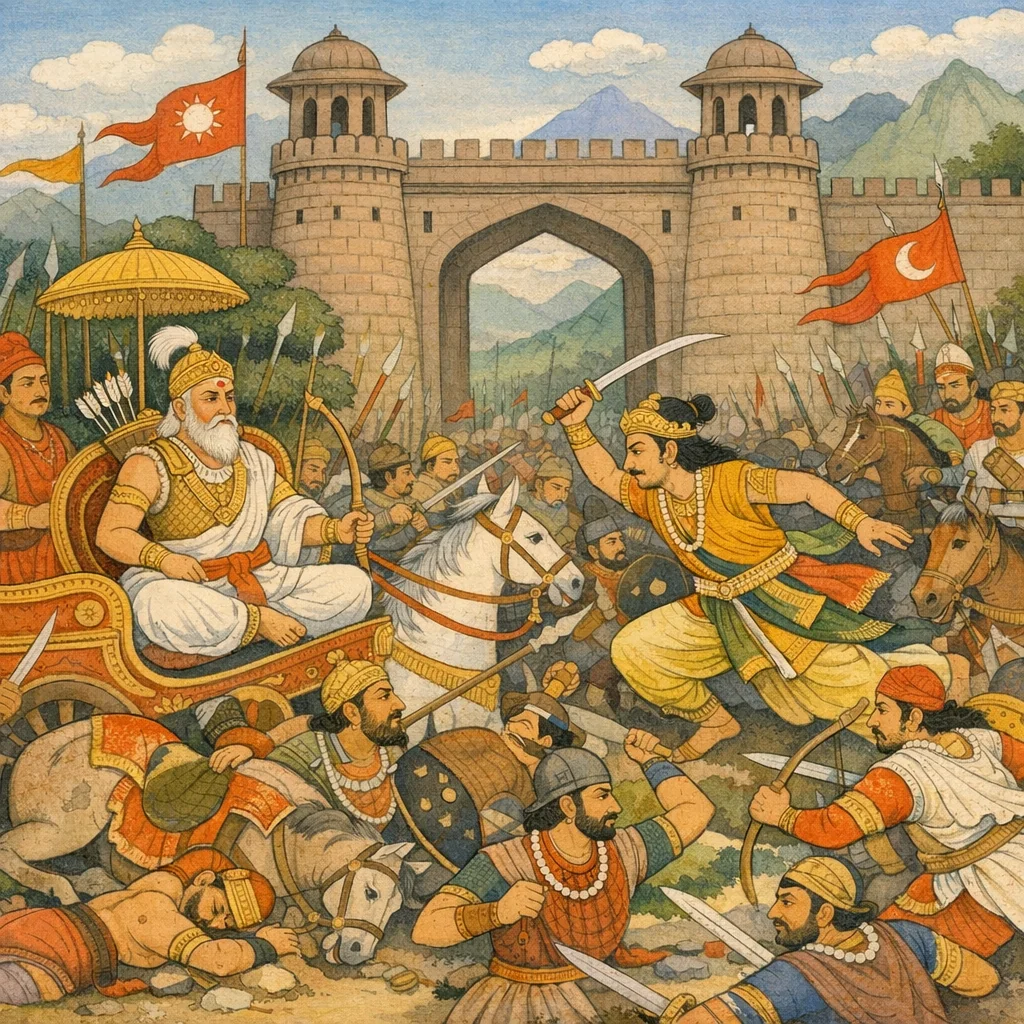
Dhṛtarāṣṭra interrogates Saṃjaya regarding the conduct of his sons and their forces when Śaineya (Sātyaki/Yuyudhāna) advanced after pressing through major opposition, expressing astonishment at one warrior meeting many mahārathas. Saṃjaya responds by attributing the unfolding crisis to defective counsel and Duryodhana’s agency, then describes a renewed Kaurava attempt to confront Śaineya with large, diverse contingents—chariots, elephants, cavalry, and infantry—drawn from multiple regions. Duḥśāsana is shown coordinating the encirclement and urging the troops to strike. The narrative emphasizes Śaineya’s composure and effectiveness: he breaks formations, destroys vehicles and mounts, and produces battlefield debris imagery (broken wheels, axles, standards, armor, ornaments). A specialized stone-throwing assault by mountain fighters is introduced; Śaineya counters by rapid archery, shattering the incoming barrage. The resulting panic and rout among the Kaurava elements creates a loud disturbance that reaches Droṇa; Droṇa orders his charioteer toward the tumult, while the charioteer reports broader operational pressure from Pāñcāla-Pāṇḍava forces and notes that Śaineya has moved far ahead. The chapter closes with Kaurava units abandoning the immediate engagement and fleeing toward Droṇa’s position, indicating a localized collapse with command-level implications.
Chapter Arc: संजय धृतराष्ट्र को बताता है कि व्यूह-द्वार पर श्रीकृष्ण-सहित अर्जुन के प्रविष्ट होते ही पाण्डव और सोमक-सेना महाशब्द के साथ द्रोण पर टूट पड़ी—और उसी क्षण युद्ध का रूप ‘संकुल’ हो उठा। → द्रोणाचार्य पर्वत-सा अडिग होकर क्रुद्ध पाण्डवों, पाञ्चालों और कैकेयों की धारा रोकते हैं; पर धृष्टद्युम्न बार-बार सामने आकर द्रोण की सेना को चीरता है, और दोनों पक्षों के प्रमुख वीर परस्पर गुँथकर ऐसे भिड़ते हैं कि कोई भी भय से युद्ध से हट नहीं पाता। → धृष्टद्युम्न द्रोण के निकट पहुँचकर प्रचण्ड वेग से आक्रमण करता है और द्रोण की व्यवस्था को त्रिधा कर देता है—व्यूह-द्वार पर यह टक्कर पूरे रण का केन्द्र बन जाती है, जहाँ रोकने और तोड़ने की शक्ति का सीधा संघर्ष होता है। → कौरव-पक्ष अपने-अपने रक्षकों और महाधनुर्धरों को आगे कर (पीठ-रक्षा और मोर्चा-सम्हाल) धृष्टद्युम्न तथा अन्य अग्रणी पाण्डव-वीरों को रोकने का प्रयत्न करता है; युद्ध किसी एक निर्णायक परिणाम पर नहीं ठहरता, बल्कि घोर संकुलता में फैलता जाता है। → व्यूह-द्वार पर द्रोण की अडिग रोक और धृष्टद्युम्न की बार-बार की सेंध—इन दोनों में किसका पलड़ा अगले क्षण भारी होगा, यह अनिर्णीत रहकर अध्याय को आगे की उग्रता पर छोड़ देता है।
Shlokas
Verse 1
व बछ। जि पञ्चनवतितमो< ध्याय: द्रोण और धृष्टद्युम्नका भीषण संग्राम तथा उभय पक्षके प्रमुख वीरोंका परस्पर संकुल युद्ध संजय उवाच प्रविष्टयोर्महाराज पार्थवाष्णेययो रणे । दुर्योधने प्रयाते च पृष्ठतः पुरुषर्षभे,संजय कहते हैं--महाराज! उस रफणक्षेत्रमें जब श्रीकृष्ण और अर्जुन कौरव-सेनाके भीतर प्रवेश कर गये तथा पुरुषप्रवर दुर्योधन उनका पीछा करता हुआ आगे बढ़ गया, तब सोमकोंसहित पाण्डवोंने बड़ी भारी गर्जनाके साथ द्रोणाचार्यपर वेगपूर्वक धावा किया। फिर तो वहाँ बड़े जोरसे युद्ध होने लगा
Sañjaya said: O King, when Pārtha (Arjuna) and Vāṣṇeya (Kṛṣṇa) had entered deep into the battlefield, and when Duryodhana—the bull among men—advanced behind them in pursuit, the struggle intensified, setting the stage for a fierce clash in which the foremost heroes on both sides pressed into a dense and mutual melee.
Verse 2
जवेनाभ्यद्रवन् द्रोणं महता नि:स्वनेन च । पाण्डवा: सोमकै: सार्ध ततो युद्धमवर्तत,संजय कहते हैं--महाराज! उस रफणक्षेत्रमें जब श्रीकृष्ण और अर्जुन कौरव-सेनाके भीतर प्रवेश कर गये तथा पुरुषप्रवर दुर्योधन उनका पीछा करता हुआ आगे बढ़ गया, तब सोमकोंसहित पाण्डवोंने बड़ी भारी गर्जनाके साथ द्रोणाचार्यपर वेगपूर्वक धावा किया। फिर तो वहाँ बड़े जोरसे युद्ध होने लगा
Sañjaya said: Then the Pāṇḍavas, accompanied by the Somakas, rushed upon Droṇa with great speed and a thunderous roar. From that moment, a fierce battle surged forth there.
Verse 3
तद् युद्धमभवत् तीव्र तुमुलं लोमहर्षणम् । कुरूणां पाण्डवानां च व्यूहस्य पुरतो5द्भधुतम्,व्यूहके द्वारपर होनेवाला कौरवों तथा पाण्डवोंका वह अद्भुत युद्ध अत्यन्त तीव्र एवं भयंकर था। उसे देखकर लोगोंके रोंगटे खड़े हो जाते थे
Sañjaya said: Then that combat grew fierce and tumultuous, hair-raising to behold. Before the battle-array, the extraordinary fight between the Kurus and the Pāṇḍavas was so dreadful and astonishing that it made the onlookers’ hair stand on end.
Verse 4
राजन् कदाचित्नास्माभिद्दष्ट तादूडू न च श्रुतम् । यादृड मध्यगते सूर्य युद्धमासीद् विशाम्पते,राजन! प्रजानाथ! वहाँ मध्याह्नकालमें जैसा वह युद्ध हुआ था, वैसा न तो मैंने कभी देखा था और न सुना ही था
Sañjaya said: O King, never before have we seen—or even heard of—a battle like the one that took place when the sun stood at midday. O lord of the people, at the very height of the day a fierce, unprecedented conflict erupted, as though the world’s order itself were being tested by the fury of war.
Verse 5
धृष्टद्युम्नमुखा: पार्था व्यूढानीका: प्रहारिण: । द्रोणस्य सैन्यं ते सर्वे शरवर्षैरवाकिरन्,धृष्टद्युम्म आदि पाण्डवपक्षीय सब प्रहारकुशल योद्धा अपनी सेनाका व्यूह बनाकर द्रोणाचार्यकी सेनापर बाणोंकी वर्षा करने लगे
Sañjaya said: Led by Dhṛṣṭadyumna, the sons of Pṛthā, skilled in striking and arrayed in battle-order, all together showered Droṇa’s army with a rain of arrows.
Verse 6
वयं द्रोणं पुरस्कृत्य सर्वशस्त्रभृतां वरम् । पार्षतप्रमुखान् पार्थनिभ्यवर्षाम सायकै:,उस समय हमलोग सम्पूर्ण शस्त्रधारियोंमें श्रेष्ठ द्रोणाचार्यको आगे करके धृष्टद्युम्न आदि पाण्डव-सैनिकोंपर बाण-वर्षा कर रहे थे
Sañjaya said: Placing Droṇa—foremost among all bearers of weapons—at our head, we were showering arrows upon the Pāṇḍava forces led by Dhṛṣṭadyumna.
Verse 7
महामेघाविवोदीर्णों मिश्रवातौ हिमात्यये । सेनाग्रे प्रचकाशेते रुचिरे रथभूषिते,रथोंसे विभूषित हुई वे दोनों प्रधान एवं सुन्दर सेनाएँ हेमनतके अन्त (शिशिर)-में उठे हुए वायुयुक्त दो महामेघोंके समान प्रकाशित हो रही थीं
Sañjaya said: At the forefront of the host, those two splendid, chariot-adorned armies shone forth like two vast storm-clouds rising at the end of winter, driven by mingled winds.
Verse 8
समेत्य तु महासेने चक्रतुर्वेगमुत्तमम् । जाह्नवीयमुने नद्यौ प्रावषीवोल्बणोदके,वे दोनों विशाल सेनाएँ परस्पर भिड़कर विजयके लिये बड़े वेगसे आगे बढ़नेका प्रयत्न करने लगीं; मानो वर्षा-ऋतुमें जलकी बाढ़ आनेसे बड़ी हुई गंगा और यमुना दोनों नदियाँ बड़े वेगसे मिल रही हों
Sañjaya said: The two great armies met and collided, striving to surge forward with tremendous speed for victory—like the Gaṅgā and Yamunā, swollen in the rainy season, rushing together in a fierce confluence.
Verse 9
नानाशस्त्रपुरोवातो द्विपाश्वरथसंवृतः । गदाविद्युन्महारौद्र: संग्रामजलदो महान्,उस समय महान् सैन्यदलसे संयुक्त एवं हाथी, घोड़े और रथोंसे भरा हुआ वह संग्राम महान् मेघके समान जान पड़ता था। नाना प्रकारके शस्त्र पूर्ववात (पुरवैया)-के तुल्य चल रहे थे। गदाएँ विद्युतके समान प्रकाशित होती थीं। देखनेमें वह संग्राम-मेघ बड़ा भयंकर जान पड़ता था। द्रोणाचार्य वायुके समान उसे संचालित कर रहे थे तथा उससे बाणरूपी जलकी सहसोौरों धाराएँ गिर रही थीं और इस प्रकार वह अग्निके समान उठी हुई पाण्डव- सेनापर सब ओरसे वर्षा कर रहा था
Sañjaya said: The battlefield appeared like a vast storm-cloud of war—packed with elephants, horses, and chariots. Countless weapons swept forward like an easterly gale, and maces flashed like lightning. Terrible to behold, that war-cloud, driven on by Droṇācārya as by the wind, poured down torrents of arrow-rain on the Pāṇḍava host from every side, blazing in its violence like fire.
Verse 10
भारद्वाजानिलोद्धूत: शरधारासहस्रवान् । अभ्यवर्षन्महासैन्य: पाण्डुसेनाग्निमुद्धतम्,उस समय महान् सैन्यदलसे संयुक्त एवं हाथी, घोड़े और रथोंसे भरा हुआ वह संग्राम महान् मेघके समान जान पड़ता था। नाना प्रकारके शस्त्र पूर्ववात (पुरवैया)-के तुल्य चल रहे थे। गदाएँ विद्युतके समान प्रकाशित होती थीं। देखनेमें वह संग्राम-मेघ बड़ा भयंकर जान पड़ता था। द्रोणाचार्य वायुके समान उसे संचालित कर रहे थे तथा उससे बाणरूपी जलकी सहसोौरों धाराएँ गिर रही थीं और इस प्रकार वह अग्निके समान उठी हुई पाण्डव- सेनापर सब ओरसे वर्षा कर रहा था
Sañjaya said: Driven onward by the wind that was Droṇa, that vast host—pouring forth thousands of streams of arrows—rained down on the Pāṇḍava army, which had risen up like a blazing fire. The battle appeared like a dreadful storm-cloud: weapons moved like a strong forewind, maces flashed like lightning, and under Droṇa’s direction the ‘rain’ of arrows fell from every side upon the Pāṇḍavas’ fiery advance.
Verse 11
समुद्रमिव घर्मान्ते विशन् घोरो महानिल: । व्यक्षो भयदनीकानि पाण्डवानां द्विजोत्तम:,जैसे ग्रीष्म-ऋतुके अन्तमें बड़े जोरसे उठी हुई भयंकर वायु महासागरमें क्षोभ उत्पन्न करके वहाँ ज्वारका दृश्य उपस्थित कर देती है, उसी प्रकार विप्रवर द्रोणाचार्यने पाण्डव- सेनामें हलचल मचा दी
Like a dreadful gale rising at the end of summer and entering the ocean, churning it into a spectacle of surging tides, so did Droṇācārya—the foremost of Brahmins—throw the Pāṇḍavas’ battle-lines into fearful turmoil.
Verse 12
तेडपि सर्वप्रयत्नेन द्रोणमेव समाद्रवन् । बिभित्सन्तो महासेतु वार्योघा: प्रबला इव,पाण्डव-योद्धाओंने भी सारी शक्ति लगाकर द्रोणपर ही धावा किया था; मानो पानीके प्रखर प्रवाह किसी महान् पुलको तोड़ डालना चाहते हों
They too, exerting every effort, charged straight at Droṇa alone, intent on breaking him—like powerful torrents of water striving to shatter a mighty bridge.
Verse 13
वारयामास तान् द्रोणो जलौघमचलो यथा । पाण्डवान् समरे क्रुद्धान् पज्चलांश्व सकेकयान्,जैसे सामने खड़ा हुआ पर्वत आती हुर्ह जलराशिको रोक देता है, उसी प्रकार समरांगणमें द्रोणाचार्यने कुपित हुए पाण्डवों, पांचालों तथा केकयोंको रोक दिया था
As an unmoving mountain holds back a rushing flood, so did Droṇa restrain them on the battlefield—the enraged Pāṇḍavas, along with the Pāñcālas and the Kaikayas.
Verse 14
अथापरे च राजान: परिवृत्य समन्ततः । महाबला रणे शूरा: पञ्चालानन्ववारयन्,इसी प्रकार दूसरे महाबली शूरवीर नरेश भी उस युद्धस्थलमें सब ओरसे लौटकर पांचालोंका ही प्रतिरोध करने लगे
Sañjaya said: Then other kings as well—mighty and heroic in battle—wheeled about on every side and began to check the Pañcālas, hemming them in and resisting their advance.
Verse 15
ततो रणे नरव्यात्र: पार्षत: पाण्डवै: सह । संजघानासकृद् द्रोणं बिभित्सुररिवाहिनीम्,तदनन्तर रणक्षेत्रमें पाण्डवोंसहित नरश्रेष्ठ धृष्टद्युम्नने शत्रुसेनाके व्यूहका भेदन करनेकी इच्छासे द्रोणाचार्यपर बारंबार प्रहार किया
Sañjaya said: Then, in the thick of battle, the tiger among men—Dhṛṣṭadyumna, the son of Pṛṣata—together with the Pāṇḍavas, repeatedly struck at Droṇa, intent on breaking the enemy’s battle-formation.
Verse 16
यथैव शरवर्षाणि द्रोणो वर्षति पार्षते । तथैव शरवर्षाणि धृष्टद्युम्नो5प्यवर्षत,आचार्य द्रोण धृष्टद्युम्मपर जैसे बाणोंकी वर्षा करते थे, धृष्टद्युम्न भी द्रोणपर वैसे ही बाण बरसाते थे
Sañjaya said: Just as Droṇa was showering torrents of arrows upon the son of Pṛṣata, so too Dhṛṣṭadyumna, in the same manner, rained down volleys of arrows upon Droṇa.
Verse 17
सनिस्त्रिंशपुरोवात: शक्तिप्रासर्डिसंवृत: । ज्याविद्युच्चापसंदह्वादो धृष्टदुम्नबलाहक:,उस समय धृष्टद्युम्न एक महामेघके समान जान पड़ते थे। उनकी तलवार पुरवैया हवाके समान चल रही थी। वे शक्ति, प्रास एवं ऋष्टि आदि अस्त्र-शस्त्रोंसे सम्पन्न थे। उनकी प्रत्यंचा विद्युतके समान प्रकाशित होती थी। धनुषकी टंकार मेघगर्जनाके समान जान पड़ती थी। उस धृष्टद्युम्नरूपी मेघने श्रेष्ठ रथी और घुड़सवारोंके समूहरूपी खेतीको नष्ट करनेके लिये सम्पूर्ण दिशाओंमें बाणरूपी जलकी धारा और अस्त्र-शस्त्ररूपी पत्थर बरसाते हुए शत्रु-सेनाको आप्लावित कर दिया
Sañjaya said: Dhṛṣṭadyumna then appeared like a great rain-cloud. His sword moved like the driving easterly wind; he was equipped with weapons such as the śakti, prāsa, and ṛṣṭi. The flash of his bowstring shone like lightning, and the twang of his bow resounded like thunder. Like a cloud intent on destroying the ‘crop’ of foremost chariot-warriors and horsemen, that Dhṛṣṭadyumna-cloud flooded the enemy host, pouring in every direction torrents of arrow-rain and hurling weapon-stones.
Verse 18
शरधाराश्मवर्षाणि व्यसृजत् सर्वतो दिशम् | निघ्नन् रथवराश्वौघान् प्लावयामास वाहिनीम्,उस समय धृष्टद्युम्न एक महामेघके समान जान पड़ते थे। उनकी तलवार पुरवैया हवाके समान चल रही थी। वे शक्ति, प्रास एवं ऋष्टि आदि अस्त्र-शस्त्रोंसे सम्पन्न थे। उनकी प्रत्यंचा विद्युतके समान प्रकाशित होती थी। धनुषकी टंकार मेघगर्जनाके समान जान पड़ती थी। उस धृष्टद्युम्नरूपी मेघने श्रेष्ठ रथी और घुड़सवारोंके समूहरूपी खेतीको नष्ट करनेके लिये सम्पूर्ण दिशाओंमें बाणरूपी जलकी धारा और अस्त्र-शस्त्ररूपी पत्थर बरसाते हुए शत्रु-सेनाको आप्लावित कर दिया
Sañjaya said: He sent forth, in every direction, showers of arrows and volleys like a rain of stones. Striking down masses of excellent chariot-warriors and surging troops of horsemen, he flooded and overwhelmed the opposing host.
Verse 19
यं यमार्च्छच्छरैद्रोण: पाण्डवानां रथव्रजम् । ततस्तत: शरैद्रोणमपाकर्षत पार्षत:,द्रोणाचार्य बाणोंद्वारा पाण्डवोंकी जिस-जिस रथसेनापर आक्रमण करते थे, धृष्टद्युम्न तत्काल बाणोंकी वर्षा करके उस-उस ओरसे उन्हें लौटा देते थे
Sañjaya said: Whichever division of the Pāṇḍavas’ chariot-host Droṇa struck with his arrows, from that very quarter Dhṛṣṭadyumna, the son of Pṛṣata, at once drove Droṇa back, showering him with arrows in return.
Verse 20
तथा तु यतमानस्य द्रोणस्य युधि भारत । धृष्टद्युम्न॑ समासाद्य त्रिधा सैन्यमभिद्यत,भारत! युद्धमें इस प्रकार विजयके लिये प्रयत्नशील हुए द्रोणाचार्यकी सेना धृष्टद्युम्नके पास पहुँचकर तीन भागोंमें बँट गयी
Sañjaya said: As Droṇācārya strove on the battlefield for victory, O Bhārata, his army, on reaching Dhṛṣṭadyumna, split into three divisions and surged forward.
Verse 21
भोजमेके<भ्यवर्तन्त जलसंधं तथापरे । पाण्डवै्न्यमानाश्न द्रोणमेवापरे ययु:,पाण्डव-योद्धाओंकी मार खाकर कुछ सैनिक कृतव्माके पास चले गये, दूसरे जलसंधके पास भाग गये और शेष सभी योद्धा द्रोणाचार्यका ही अनुसरण करने लगे
Sañjaya said: Some of the warriors turned back toward Bhoja; others fled to Jalasandha. But, being struck down by the Pāṇḍava fighters, the rest—seeking protection and rallying around their commander—followed Droṇācārya alone.
Verse 22
संघट्टयति सैन्यानि द्रोणस्तु रथिनां वर: । व्यधमच्चापि तान्यस्य धृष्टद्युम्नो महारथ:,रथियोंमें श्रेष्ठ द्रोण बारंबार अपनी सेनाओंको संगठित करते और महारथी धुष्टद्युम्न उनकी सब सेनाओंको छित्न-भिन्न कर देते थे
Sañjaya said: Drona, foremost among chariot-warriors, repeatedly regrouped and pressed his forces into formation; yet Dhṛṣṭadyumna, a great chariot-fighter, kept shattering and scattering those very troops.
Verse 23
धार्रराष्ट्रास्तथाभूता वध्यन्ते पाण्डुसृञ्जयै: । अगोपा: पशवो<रण्ये बहुभि: श्वापदैरिव,जैसे वनमें बिना रक्षकके पशुओंको बहुत-से हिंसक जन्तु मार डालते हैं, उसी प्रकार पाण्डव और सूंजय आपके सैनिकोंका वध कर रहे थे
Sañjaya said: Thus situated, the Dhārtarāṣṭra troops were being cut down by the Pāṇḍavas and the Sṛñjayas—like unguarded cattle in a forest, slain by many wild beasts.
Verse 24
काल: सम ग्रसते योधान् धृष्टद्युम्नेन मोहितान् | संग्रामे तुमुले तस्मिन्निति सम्मेनिरे जना:,उस भयंकर संग्राममें सब लोग ऐसा मानने लगे कि काल ही धृष्टद्युम्नके द्वारा कौरवयोद्धाओंको मोहित करके उन्हें अपना ग्रास बना रहा है
Sañjaya said: In that fierce and tumultuous battle, people came to believe that Time (Death) itself—using Dhṛṣṭadyumna as its instrument—was deluding the warriors and swallowing them up. The scene suggested an ethical inevitability: once the frenzy of war takes hold, even mighty fighters appear powerless before the consuming force of kāla, which spares none.
Verse 25
कुनृपस्य यथा राष्ट्र दुर्भिक्षव्याधितस्करै: । द्राव्यते तद्गधदापन्ना पाण्डवैस्तव वाहिनी,जैसे दुष्ट राजाका राज्य दुर्भिक्ष, भाँति-भाँतिकी बीमारी और चोर-डाकुओंके उपद्रवके कारण उजाड़ हो जाता है, उसी प्रकार पाण्डव-सैनिकोंद्वारा विपत्तिमें पड़ी हुई आपकी सेना इधर-उधर खदेड़ी जा रही थी
Sañjaya said: “Just as the kingdom of a wicked ruler is laid waste—driven into ruin by famine, disease, and bands of thieves—so too your army, struck by calamity, was being scattered and chased in all directions by the Pāṇḍavas.”
Verse 26
अर्करश्मिविभिश्रेषु शस्त्रेषु कवचेषु च । चक्षूंषि प्रत्यहन्यन्त सैन्येन रजसा तथा,योद्धाओंके अस्त्र-शस्त्रों और कवचोंपर सूर्यकी किरणें पड़नेसे वहाँ आँखें चौंधिया जाती थीं और सेनासे इतनी धूल उठती थी कि उससे सबके नेत्र बंद हो जाते थे
Sañjaya said: As the sun’s rays struck the warriors’ weapons and armor, eyes were dazzled and vision was repeatedly disturbed; and from the marching host such dust rose that it made men’s eyes close. The scene conveys how war overwhelms human perception itself—glare and dust becoming instruments of confusion amid the clash of arms.
Verse 27
त्रिधाभूतेषु सैन्येषु वध्यमानेषु पाण्डवै: । अमर्षितस्ततो द्रोण: पञ्चालान् व्यधमच्छरै:,जब पाण्डवोंके द्वारा मारी जाती हुई कौरव-सेना तीन भागोंमें बँट गयी, तब द्रोणाचार्यने अत्यन्त कुपित होकर अपने बाणोंद्वारा पांचालोॉंका विनाश आरम्भ किया
Sañjaya said: When the Kaurava host, being cut down by the Pāṇḍavas, split into three divisions, Droṇa—unable to bear it—grew fiercely enraged and began to destroy the Pañcālas with volleys of arrows. The verse highlights how wounded pride and anger, once unleashed in war, intensify violence and widen the circle of suffering.
Verse 28
मृद्नतस्तान्यनीकानि निध्नतश्चापि सायकै: । बभूव रूपं॑ द्रोणस्प कालाग्नेरिव दीप्यत:,पांचालोंकी उन सेनाओंको रौंदते और बाणोंद्वारा उनका संहार करते हुए द्रोणाचार्यका स्वरूप प्रलयकालकी प्रज्वलित अग्निके समान जान पड़ता था
Sañjaya said: As Droṇa trampled those battle-formations and cut them down with volleys of arrows, his appearance blazed like the fire of cosmic dissolution—an image of overwhelming martial power that turns the battlefield into a scene of inevitable ruin.
Verse 29
रथं नागं हयं॑ चापि पत्तिनश्न विशाम्पते । एकैकेनेषुणा संख्ये निर्बिभेद महारथ:,प्रजानाथ! महारथी द्रोणने उस युद्धस्थलमें शत्रुसेनाके प्रत्येक रथ, हाथी, अश्व और पैदल सैनिकको एक-एक बाणसे घायल कर दिया
Sañjaya said: O lord of the people, that great chariot-warrior, in the thick of battle, struck each enemy unit—chariots, elephants, horses, and foot-soldiers—severally with a single arrow.
Verse 30
पाण्डवानां तु सैन्येषु नास्ति कश्चित् स भारत । दधार यो रणे बाणान् द्रोणचापच्युतान् प्रभो,भारत! प्रभो! उस समय पाण्डवोंकी सेनामें कोई ऐसा वीर नहीं था, जो रणक्षेत्रमें द्रोणाचार्यके धनुषसे छूटे हुए बाणोंको धैर्यपूर्वक सह सका हो
Sañjaya said: O Bhārata, within the armies of the Pāṇḍavas there was no warrior who, on the battlefield, could steadfastly endure the arrows released from Droṇa’s bow.
Verse 31
तत् पच्यमानमर्केण द्रोणसायकतापितम् | बश्राम पार्षत॑ सैन्यं तत्र तत्रैव भारत,भरतनन्दन! सूर्यके द्वारा अपनी किरणोंसे पकायी जाती हुई-सी धृष्टद्युम्नकी सेना द्रोणाचार्यके बाणोंसे संतप्त हो जहाँ-तहाँ चक्कर काटने लगी
Sañjaya said: “O Bhārata, the army of the son of Pṛṣata (Dhṛṣṭadyumna), as though being baked by the Sun’s heat, was scorched by Droṇa’s arrows and began to reel and wander in confusion here and there.”
Verse 32
तथैव पार्षतेनापि काल्यमानं बलं तव । अभवत् सर्वतो दीप्तं शुष्क वनमिवाग्निना,इसी प्रकार धृष्टद्युम्नके द्वारा खदेड़ी जाती हुई आपकी सेना भी सब ओरसे आग लग जानेके कारण प्रज्वलित हुए सूखे वनकी भाँति दग्ध हो रही थी
Sañjaya said: “In the same way, your army too, being relentlessly harried by the son of Pṛṣata (Dhṛṣṭadyumna), appeared to blaze on every side—like a dry forest set alight by fire—consumed amid the devastation of war.”
Verse 33
बाध्यमानेषु सैन्येषु द्रोणपार्षतसायकै: । त्यक्त्वा प्राणान् परं शक््त्या युध्यन्ते सर्वतोमुखा:,द्रोणाचार्य और धृष्टद्युम्नके बाणोंद्वारा सेनाओंके पीड़ित होनेपर भी सब लोग प्राणोंका मोह छोड़कर पूरी शक्तिसे सब ओर युद्ध कर रहे थे
Sañjaya said: Even as the armies were being hard-pressed by the arrows of Droṇa and the son of Pārṣata (Dhṛṣṭadyumna), the warriors—casting aside all clinging to life—fought with their utmost strength, turning to face the battle on every side.
Verse 34
तावकानां परेषां च युध्यतां भरतर्षभ । नासीत् कश्चिन्महाराज योज्त्याक्षीत् संयुगं भयात्,भरतभूषण! महाराज! वहाँ युद्ध करते हुए आपके और शत्रुओंके योद्धाओंमें कोई ऐसा नहीं था, जिसने भयके कारण युद्धका मैदान छोड़ दिया हो
Sañjaya said: O bull among the Bharatas, O King—among your warriors and the opposing warriors engaged in battle, there was not a single man who, out of fear, abandoned the fight. The scene was one of steadfastness under peril: both sides remained bound to the kṣatriya’s duty, even at the cost of life itself.
Verse 35
भीमसेन तु कौन्तेयं सोदर्या: पर्यवारयन् । विविंशतिकश्षित्रसेनो विकर्णश्ष् महारथ:,उस समय विविंशति, चित्रसेन तथा महारथी विकर्ण--इन तीनों भाइयोंने कुन्तीपुत्र भीमसेनको घेर लिया
Sañjaya said: Then Bhīmasena, the Kuntī-born, was surrounded by his own brothers—Viviṃśati, Citrasena, and Vikarna, the great chariot-warrior. In the press of battle, kinship was set aside as the Kauravas sought to check Bhīma’s overwhelming force, turning even bonds of blood into instruments of strategy and duty.
Verse 36
विन्दानुविन्दावावन्त्यी क्षेमधूर्तिश्व वीर्यवान् । त्रयाणां तव पुत्राणां त्रय एवानुयायिन:,अवन्न्तीके राजकुमार विन्द और अनुविन्द तथा पराक्रमी क्षेमधूर्ति--ये तीनों ही आपके पूर्वोक्त तीनों पुत्रोंके अनुयायी थे
Sañjaya said: Vindā and Anuvindā, the princes of Avanti, and the mighty Kṣemadhūrti—these three were indeed the followers and supporters of those three sons of yours just mentioned. The verse underscores how loyalties and alliances bind warriors to a cause, deciding who stands with whom amid the wider contest of dharma and power.
Verse 37
बाह्लीकराजस्तेजस्वी कुलपुत्रो महारथ: । सहसेन: सहामात्यो द्रौपदेयानवारयत्,उत्तम कुलमें उत्पन्न हुए तेजस्वी महारथी बाह्लीकराजने सेना और मन्त्रियोंसहित जाकर द्रौपदी-पुत्रोंको रोका
Sañjaya said: The radiant king of Bāhlīka, a noble-born great chariot-warrior, went forth with his troops and ministers and checked the advance of the sons of Draupadī. In the moral texture of the war, this shows how lineage-pride and kṣātra-dharma drive leaders to restrain the enemy, even as the struggle tightens around the young heirs who bear their side’s hopes.
Verse 38
शैब्यो गोवासनो राजा योधैर्दशशतावरै: । काश्यस्याभि भुव: पुत्र पराक्रान्तमवारयत्,शिबिदेशीय राजा गोवासनने कम-से-कम एक सहस्र योद्धा साथ लेकर काशिराज अभिभूके पराक्रमी पुत्रका सामना किया
Sañjaya said: King Govāsana of the Śibi country, accompanied by warriors numbering in the thousands, checked the advance of the valiant son of Abhibhū of Kāśī. In the press of battle, a regional ruler stood as a bulwark against a famed Kāśī prince, showing how duty is carried out through organized resistance and loyalty to one’s side amid overwhelming violence.
Verse 39
अजातशशत्रुं कौन्तेयं ज्वलन्तमिव पावकम् | मद्राणामी श्वर: शल्यो राजा राजानमावृणोत्,प्रजवलित अग्निके समान तेजस्वी अजातशशत्रु कुन्तीपुत्र राजा युधिष्ठिरका सामना मद्रदेशके स्वामी राजा शल्यने किया
Sañjaya said: King Śalya, lord of the Madras, confronted King Yudhiṣṭhira—the son of Kuntī, Ajātaśatru—who blazed like a flaming fire. In the midst of war, the encounter is framed as a meeting of royal duty and martial resolve, where kings face one another as instruments of their pledged allegiance and the larger demands of dharma in battle.
Verse 40
दुःशासनस्त्ववस्थाप्य स्वमनीकममर्षण: । सात्यकिं प्रत्ययौ क्रुद्ध: शूरो रथवरं युधि
Sañjaya said: Having set his own division in order, the irascible Duḥśāsana—angered—advanced against Sātyaki, that heroic and foremost of chariot-warriors, in the midst of battle. The verse underscores how wrath and wounded pride drive combatants to single out worthy opponents, intensifying the moral and human cost of war.
Verse 41
अमर्षशील शूरवीर दुःशासनने अपनी भागती हुई सेनाको पुनः स्थिरतापूर्वक स्थापित करके कुपित हो युद्धस्थलमें रथियोंमें श्रेष्ठ सात्यकिपर आक्रमण किया ।। स्वकेनाहमनीकेन संनद्ध: कवचावृत: । चतुःशतैर्महेष्वासै श्वेकितानमवारयम्,अपनी सेना तथा चार सौ महाथधनुर्धरोंक साथ कवच धारण करके सुसज्जित हो मैंने चेकितानको रोका
Sañjaya said: Armoured and fully equipped, I—supported by my own division and accompanied by four hundred great bowmen—checked Cekitāna’s advance. The passage underscores the hardening of resolve on the battlefield: disciplined regrouping and forceful resistance are presented as tactical necessities, even as they intensify the moral weight of violence in a fratricidal war.
Verse 42
शकुनिस्तु सहानीको माद्रीपुत्रमवारयत् । गान्धारकै:ः सप्तशतैश्लापशक्त्यसिपाणिशभि:,सेनासहित शकुनिने माद्रीपुत्र नकुलका प्रतिरोध किया। उसके साथ हाथोंमें धनुष, शक्ति और तलवार लिये सात सौ गान्धार-देशीय योद्धा मौजूद थे
Sañjaya said: Śakuni, supported by his own contingent, checked Mādrī’s son (Nakula). With him stood seven hundred warriors of Gandhāra, bearing arrows, spears, and swords—an organized resistance raised to halt Nakula’s advance amid the moral chaos of war.
Verse 43
विन्दानुविन्दावावन्त्यौ विराट मत्स्यमार्च्छताम् । प्राणांस्त्यक्त्वा महेष्वासौ मित्रार्थे भ्युद्यतायुधौ,अवन्तीके राजकुमार विन्द और अनुविन्दने मत्स्य-नरेश विराटपर आक्रमण किया। उन दोनों महाधनुर्धर वीरोंने प्राणोंका मोह छोड़कर अपने मित्र दुर्योधनके लिये हथियार उठाया था
Sañjaya said: The Avanti princes Vindā and Anuvindā advanced against Virāṭa, the king of the Matsyas. Those mighty bowmen, casting aside concern for their own lives, took up their weapons for the sake of their friend—Duryodhana—showing how loyalty in war can harden into a resolve that risks eclipsing prudence and dharmic restraint.
Verse 44
शिखण्डिनं याज्ञसेनिं रुन्धानमपराजितम् । बाह्लीक: प्रतिसंयत्त: पराक्रान्तमवारयत्,किसीसे परास्त न होनेवाले पराक्रमी यज्ञसेन-कुमार शिखण्डीको, जो राह रोककर खड़ा था, बाह्लीकने पूर्ण प्रयत्नशील होकर रोका
Sañjaya said: Bāhlīka, fully resolved and exerting himself, checked Śikhaṇḍin—the son of Yājñasena—who stood barring the way, a valiant warrior not easily overcome.
Verse 45
धृष्टय्युम्नं तु पाज्चाल्यं क्रूरै: सार्थ प्रभद्रकै: । आवन्त्य: सहसौवीरै: क्रुद्धसरूपमवारयत्
Sañjaya said: The Pāñcāla prince Dhṛṣṭadyumna was checked and held back by the fierce Prabhadrakas, together with the Avantis and the Sauviras, who confronted him in wrathful array.
Verse 46
अवन्तीके एक दूसरे वीरने क्रूर स्वभाववाले प्रभद्रकों और सौवीरदेशीय सैनिकोंके साथ आकर क्रोधमें भरे हुए पांचालराजकुमार धृष्टद्युम्नको रोका ।। घटोत्कचं तथा शूरं राक्षसं क्रूरकर्मिणम् । अलायुधोडद्रवत् तूर्ण क्रुद्धमायान्तमाहवे,क्रोधमें भरकर युद्धके लिये आते हुए क्रूरकर्मा तथा शूरवीर राक्षस घटोत्कचपर अलायुधने शीघ्रतापूर्वक आक्रमण किया
Sañjaya said: A warrior from Avanti, arriving with the fierce Prabhadrakas and the troops of the Sauvīra country, checked Dhrishtadyumna, the Panchala prince who was seething with anger. At the same time, Alayudha rushed swiftly to strike Ghaṭotkaca—the valiant, ruthless-acting Rākṣasa—who was advancing in wrath to the battlefield.
Verse 47
अलम्बुषं राक्षसेन्द्रे कुन्तिभोजो महारथ: । सैन्येन महता युक्त: क्रुद्धसब्पमवारयत्,पाण्डवपक्षके महारथी राजा कुन्तिभोजने विशाल सेनाके साथ आकर कुपित हुए कौरवपक्षीय राक्षसराज अलम्बुषका सामना किया
Sañjaya said: Then Kuntibhoja, a great chariot-warrior, joined with a vast host, angrily confronted and checked Alambuṣa, the lord of the Rākṣasas, in the battle.
Verse 48
सैन्धव: पृष्ठतस्त्वासीत् सर्वसैन्यस्य भारत । रक्षित: परमेष्वासै: कृपप्रभृतिभी रथै:
Sañjaya said: O Bhārata, the Saindhava was positioned at the rear of the entire army, protected by the foremost bowmen—warriors in chariots led by Kṛpa.
Verse 49
भरतनन्दन! उस समय सिंधुराज जयद्रथ सारी सेनाके पीछे महाधनुर्धर कृपाचार्य आदि रथियोंसे सुरक्षित था ।। तस्यास्तां चक्ररक्षौ द्वौ सैन्धवस्य बृहत्तमौ । दौणिर्दक्षिणतो राजन् सूतपुत्रश्न वामत:,राजन! जयद्रथके दो महान् चक्ररक्षक थे। उसके दाहिने चक्रकी अश्वत्थामा और बायें चक्रकी रक्षा सूतपुत्र कर्ण कर रहा था
Sanjaya said: O descendant of Bharata, at that time the king of Sindhu, Jayadratha, stood behind the main body of the army, heavily guarded by great bowmen—foremost among them Kripacharya and other leading chariot-warriors. For Jayadratha there were two eminent guardians of his chariot-wheels: on his right stood Drona’s son, Ashvatthama, and on his left the charioteer’s son, Karna.
Verse 50
पृष्ठगोपास्तु तस्यासन् सौमदत्तिपुरोगमा: । कृपश्च वृषसेनश्व॒ शल: शल्यश्न दुर्जय:,भूरिश्रवा आदि वीर उसके पृष्ठ भागकी रक्षा करते थे। कृप, वृषसेन, शल और दुर्जय वीर शल्य--ये सभी नीतिज्ञ, महान् धनुर्धर एवं युद्धकुशल थे और इस प्रकार सिंधुराजकी रक्षाका प्रबन्ध करके वहाँ युद्ध कर रहे थे
Sanjaya said: Guarding his rear were warriors led by Saumadatti. Kripa, Vrishasena, Sala, Shalya, and the hard-to-conquer Durjaya stood as his protectors—seasoned in policy and discipline, great archers and skilled in battle—thus arranging the defence of the Sindhu king and fighting on that field.
Verse 51
नीतिमन्तो महेष्वासा: सर्वे युद्धविशारदा: । सैन्धवस्य विधायैवं रक्षां युयुधिरे ततः,भूरिश्रवा आदि वीर उसके पृष्ठ भागकी रक्षा करते थे। कृप, वृषसेन, शल और दुर्जय वीर शल्य--ये सभी नीतिज्ञ, महान् धनुर्धर एवं युद्धकुशल थे और इस प्रकार सिंधुराजकी रक्षाका प्रबन्ध करके वहाँ युद्ध कर रहे थे
Sanjaya said: All of them—men of sound counsel, mighty archers, and thoroughly skilled in war—having thus arranged a protective guard for the king of Sindhu (Jayadratha), then engaged in battle.
Verse 94
इस प्रकार श्रीमह्ाभारत द्रोणपर्वके अन्तर्गत जयद्रथवधपर्वनें दुर्योधनका कवच- बन्धनविषयक चौरानबेवाँ अध्याय पूरा हुआ
Thus, in the Śrī Mahābhārata, within the Droṇa Parva—specifically in the section concerning the slaying of Jayadratha—the ninety-fourth chapter, dealing with the fastening of Duryodhana’s armor, comes to its close.
Verse 95
इति श्रीमहाभारते द्रोणपर्वणि जयद्रथवधपर्वणि संकुलयुद्धे पजचनवतितमो ध्याय:,इस प्रकार श्रीमह्ाभारत द्रोणपर्वके अन्तर्गत जयद्रथवधपर्वमें संकुलयुद्धाविषयक पंचानबेवाँ अध्याय पूरा हुआ
Sanjaya said: Thus, in the Śrī Mahābhārata, within the Droṇa Parva, in the sub-section concerning the slaying of Jayadratha, the ninety-fifth chapter—describing the tangled, confused intensity of battle—comes to its close.
Frequently Asked Questions
The chapter implicitly contrasts reliance on massed force and coercive coordination with the responsibility of rulers for outcomes produced by durmantra (misguided counsel), raising the question of whether leadership can claim innocence when strategy predictably yields disorder and suffering.
Operational success is shown to depend on disciplined counsel, realistic assessment of capability, and coherent command; when policy is flawed, even large formations can fail against focused competence and composure.
No explicit phalaśruti appears in the provided passage; the meta-level reflection is indirect, conveyed through Saṃjaya’s attribution of causality to counsel and decision-making rather than through a formal concluding benediction.