Adhyaya 171
नारायणास्त्र-शमनं द्रौणि-प्रहारश्च (Pacification of the Nārāyaṇāstra and Drauni’s Renewed Assault)
Upa-parva: Nārāyaṇāstra-pratīhāra (Pacification of the Nārāyaṇāstra) Episode
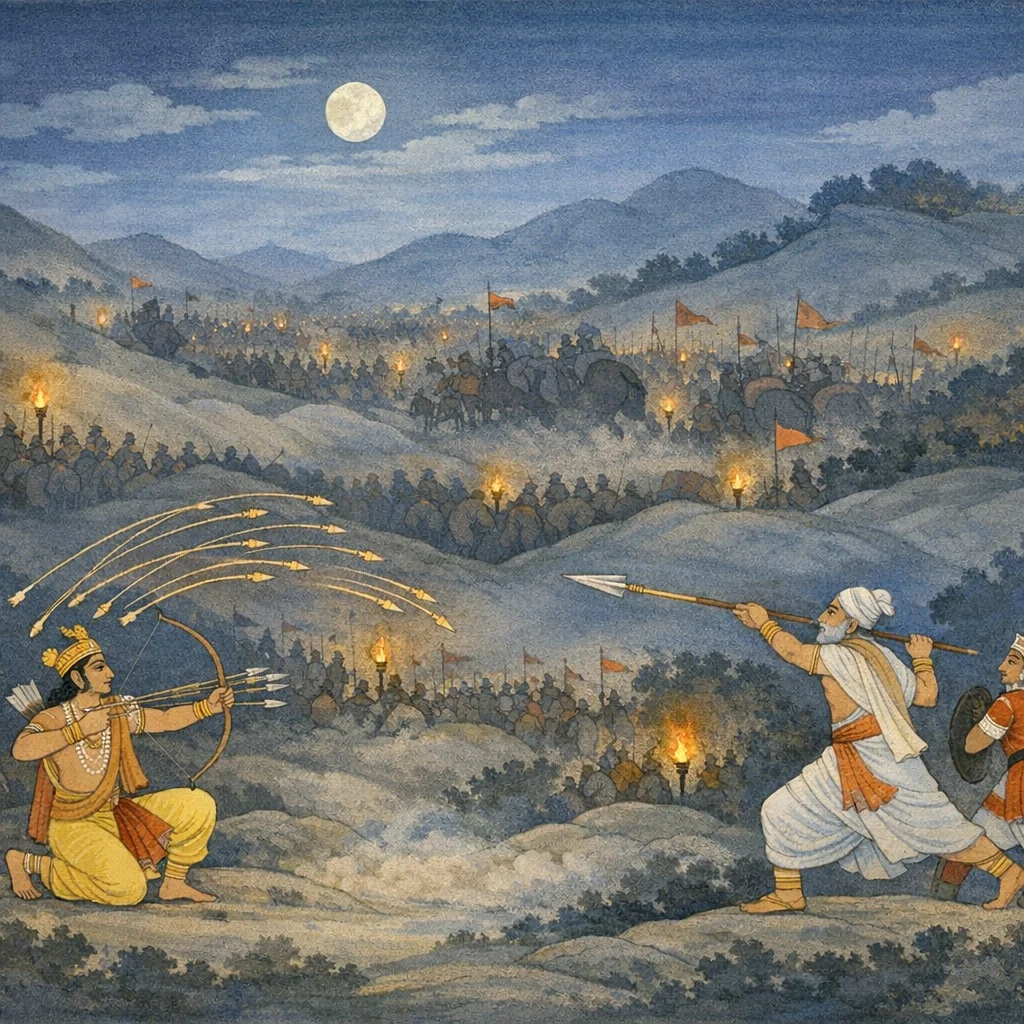
Sañjaya reports that Arjuna, seeing Bhīma engulfed by Aśvatthāman’s weapon-force, veils the field with the Vāruṇāstra to blunt the radiance and render Bhīma difficult to perceive. The Nārāyaṇāstra’s pressure induces panic and disarray; Arjuna and Kṛṣṇa urgently move to Bhīma and enforce the prescribed protocol—disarmament and withdrawal from active resistance—so the weapon’s destructive agency does not intensify. Kṛṣṇa admonishes Bhīma’s refusal to desist and compels him down from the chariot; once weapons are abandoned, the astra pacifies and the directions clear, restoring composure to forces and animals. Duryodhana urges Aśvatthāman to redeploy the astra, but Aśvatthāman explains its non-repeatability and the danger of rebound upon the user, noting that Kṛṣṇa has already applied the proper countermeasure. Combat then resumes in conventional mode: Aśvatthāman, enraged by his father’s death, charges Dhṛṣṭadyumna, exchanges volleys, disables his chariot elements, and routs Pāñcāla units. Sātyaki attacks, is gravely wounded and withdrawn; Aśvatthāman continues striking multiple opponents, felling key warriors and pressing the Pāṇḍava-aligned host into flight.
Chapter Arc: संजय धृतराष्ट्र से कहते हैं—रणभूमि में नकुल अपनी तीव्रता से शत्रु-वाहिनी को रौंदते हुए आगे बढ़ते हैं, और उनके सामने सौबलराज शकुनि आ खड़ा होता है। → पुराने वैर से बँधे दोनों वीर एक-दूसरे के वध की आकांक्षा से, समान कौशल का प्रदर्शन करते हुए, बाण-वर्षा से बाण-वर्षा का उत्तर देते हैं—जैसे नकुल छोड़ते हैं, वैसे ही शकुनि भी ‘शिक्षा संदर्शयन्’ युद्ध-विद्या दिखाता है। उधर शिखण्डी और कृपाचार्य का घोर संग्राम भी साथ-साथ भड़कता है; रथ, घोड़े, पैदल—सब दिशाओं में धूल और अंधकार फैलाते हैं। → नकुल के प्रहारों से शकुनि की स्थिति डगमगाती है; ‘विसंज्ञ निपतित’ श्याल को गिरा देख कौरव-पक्ष में क्षणिक स्तब्धता छा जाती है। उसी उन्मादित क्षण में कृपाचार्य क्रोध से दारुण शक्ति फेंकते हैं—और शिखण्डी के साथ उनका युद्ध प्रलय-सा उग्र हो उठता है। → युद्ध का विस्तार इतना बढ़ता है कि रात्रि भी प्रदीपों से दिन-सी हो जाती है; धूल और तम से ढँकी दिशाएँ फिर प्रकाश से चमक उठती हैं। पर उस प्रकाश में भी कोलाहल ऐसा कि योद्धा ‘मैं कौन हूँ’ तक नहीं जान पाते—स्व-चेतना रण-उन्माद में गल जाती है। → प्रदीप्त रात्रि में युद्ध थमता नहीं; पृथ्वी पैदल सैनिकों की धमक से भयभीत-सी काँपती रहती है—अगले क्षण किसका पतन होगा, यह अनिश्चित रह जाता है।
Shlokas
Verse 1
अतड-४--क+ एकोनसप्तत्याधिकशततमो< ध्याय: नकुलके द्वारा शकुनिकी पराजय तथा शिखण्डी और कृपाचार्यका घोर युद्ध संजय उवाच नकुलं॑ रभसं युद्धे निघ्नन्तं वाहिनीं तव । अभ्ययात् सौबल: क्रुद्धस्तिष्ठ तिछेति चाब्रवीत्,संजय कहते हैं--राजन्! वेगशाली नकुल युद्धमें आपकी सेनाका संहार कर रहे थे। उनका सामना करनेके लिये क्रोधमें भरा हुआ सुबलपुत्र शकुनि आया और बोला “अरे! खड़ा रह, खड़ा रह' इस प्रकार श्रीमह्याभारत द्रोणपर्वके अन्तर्गत घटोत्कचवधपर्वमें रात्रियुद्धके समय संकुलयुद्धविषयक एक सौ उनहठत्तरवाँ अध्याय पूरा हुआ ॥/ १६९ ॥/ नस ह्य ४-3 सप्तत्याधेकशततमो< ध्याय: धृष्टद्युम्न और द्रोणाचार्यका युद्ध, धृष्टदय्युम्नद्वारा द्रमसेनका वध, सात्यकि और कर्णका युद्ध, कर्णकी दुर्योधनको सलाह तथा शकुनिका पाण्डव-सेनापर आक्रमण संजय उवाच तस्मिन् सुतुमुले युद्धे वर्तमाने भयावहे । धृष्टद्युम्नो महाराज द्रोणमेवाभ्यवर्तत
Sañjaya said: O King, the impetuous Nakula was cutting down your army in the battle. Enraged, Śakuni—the son of Subala—advanced to confront him and cried, “Stand! Stand!”
Verse 2
कृतवैरौ तु तौ वीरावन्योन्यवधकाड्क्षिणौ । शरै: पूर्णायतोत्सूष्टैरन्योन्यमभिजष्नतु:,उन दोनों वीरोंने पहलेसे ही आपसमें वैर बाँध रखा था, वे एक-दूसरेका वध करना चाहते थे; इसलिये पूर्णतः: कानतक खींचकर छोड़े हुए बाणोंसे वे एक-दूसरेको घायल करने लगे
Sañjaya said: Those two heroes, having long since fixed their mutual enmity and intent on each other’s death, began to strike one another with arrows shot at full draw.
Verse 3
यथैव नकुलो राजन् शरवर्षाण्यमुज्चत । तथैव सौबलश्चापि शिक्षां संदर्शयन् युधि,राजन्! नकुल जैसे-जैसे बाणोंकी वर्षा करते, शकुनि भी वैसे-ही-वैसे युद्धविषयक शिक्षाका प्रदर्शन करता हुआ बाण छोड़ता था
Sañjaya said: “O King, just as Nakula kept releasing showers of arrows, so too did Saubala (Śakuni) let fly his shafts in the battle, displaying his training and tactical skill. Thus the fight is shown not merely as force, but as a contest of practiced martial discipline.”
Verse 4
तावुभौ समरे शूरौ शरकण्टकिनौ तदा । व्यराजेतां महाराज श्वाविधौ शललैरिव,महाराज! वे दोनों शूरवीर समरांगणमें बाणरूपी कंटकोंसे युक्त होकर काँटेदार शरीरवाले साहीके समान सुशोभित हो रहे थे
Sañjaya said: “O King, those two heroes, standing in the thick of battle, bristling with arrows like thorn-spikes, shone brilliantly—like two porcupines covered with quills. The image underscores the grim splendor of warfare: valor is visible, yet inseparable from suffering and the bodily cost of combat.”
Verse 5
रुक्मपुड्खैरजिद्ाग्रै: शरैश्छिन्नतनुच्छदौ । रुधिरौघपरिक्लिन्नौ व्यभ्राजेतां महामृथे,सोनेके पंख और सीधे अग्रभागवाले बाणोंसे उन दोनोंके कवच छिन्न-भिन्न हो गये थे। दोनों ही उस महासमरमें खूनसे लथपथ हो सुवर्णके समान विचित्र कान्तिसे सुशोभित हो रहे थे। वे दो कल्पवृक्षों और खिले हुए दो ढाकके पेड़ोंके समान समरांगणमें प्रकाशित हो रहे थे
Sañjaya said: “With arrows whose shafts were fitted with golden feathers and whose points were straight and unyielding, the two warriors had their body-armour and coverings cut to pieces. Drenched in streams of blood, they yet shone in that great battle with a strange, gold-like radiance—standing forth on the field like two wish-fulfilling trees, or like two blossoming palāśa trees in full bloom.”
Verse 6
तपनीयनिभौ चित्रौ कल्पवृक्षाविव द्रुमौ । किंशुकाविव चोत्फुल्लो प्रकाशेते रणाजिरे,सोनेके पंख और सीधे अग्रभागवाले बाणोंसे उन दोनोंके कवच छिन्न-भिन्न हो गये थे। दोनों ही उस महासमरमें खूनसे लथपथ हो सुवर्णके समान विचित्र कान्तिसे सुशोभित हो रहे थे। वे दो कल्पवृक्षों और खिले हुए दो ढाकके पेड़ोंके समान समरांगणमें प्रकाशित हो रहे थे
Sañjaya said: “Those two, radiant like refined gold and splendid in appearance, shone on the battlefield like a pair of wish-fulfilling trees. Like two kiṃśuka trees in full bloom, they stood out brilliantly in the arena of war.”
Verse 7
तावुभौ समरे शूरौ शरकण्टकिनौ तदा । व्यराजेतां महाराज कण्टकैरिव शाल्मली,महाराज! जैसे काँटोंसे सेमरका वृक्ष सुशोभित होता है, उसी प्रकार वे दोनों शूरवीर समरभूमिमें बाणरूपी कंटकोंसे युक्त दिखायी देते थे
Sañjaya said: “O King, those two heroes on the battlefield then appeared resplendent, bristling with arrows like thorns—just as a śālmalī (silk-cotton) tree looks striking when covered with its sharp spines. The image underscores the grim splendor of valor in war: courage endures even when the body is pierced, and the battlefield’s ‘beauty’ is inseparable from suffering.”
Verse 8
सुजिह्दां प्रेक्षमाणी च राजन् विवृतलोचनौ । क्रोधसंरक्तनयनौ निर्दहन्तौ परस्परम्,राजन! वे अत्यन्त कुटिलभावसे परस्पर आँखें फाड़-फाड़कर देख रहे थे और क्रोधसे लाल नेत्र करके एक-दूसरेको ऐसे देखते थे, मानो भस्म कर देंगे
Sañjaya said: “O King, with eyes stretched wide open, their gaze fixed fiercely upon one another, their eyes reddened by anger, they stared as though they would burn each other down.”
Verse 9
श्यालस्तु तव संक्रुद्धो माद्रीपुत्रं हसन्निव । कर्णिनिकेन विव्याध हृदये निशितेन ह,तदनन्तर अत्यन्त क्रोधमें भरकर हँसते हुए-से आपके सालेने एक तीखे कर्णी नामक बाणसे माद्रीपुत्र नकुलकी छातीमें गहरा आघात किया
Sañjaya said: Your brother-in-law, inflamed with anger, as though laughing, struck Mādrī’s son Nakula in the region of the heart with a sharp arrow of the karṇinī type.
Verse 10
नकुलस्तु भृशं विद्ध: श्यालेन तव धन्विना । निषसाद रथोपस्थे कश्मलं चाविशन्महत्,आपके धनुर्धर सालेके द्वारा अत्यन्त घायल किये हुए नकुल रथके पिछले भागमें बैठ गये और भारी मूर्च्छामें पड़ गये
Sañjaya said: Nakula, grievously wounded by your archer brother-in-law, sank down upon the rear of his chariot; and a great faintness—born of shock and pain—overcame him.
Verse 11
अत्यन्तवैरिणं दृप्तं दृष्टवा शत्रुं तथागतम् । ननाद शकुनी राजंस्तपान्ते जलदो यथा,राजन! अपने अत्यन्त वैरी और अभिमानी शत्रुको वैसी अवस्थामें पड़ा देख शकुनि वर्षाकालके मेघके समान जोर-जोरसे गर्जना करने लगा
Sañjaya said: Seeing his most bitter foe—proud and overbearing—lying in that condition, Śakuni roared loudly, O King, like a rain-cloud thundering at the end of summer.
Verse 12
प्रतिलभ्य तत: संज्ञां नकुल: पाण्डुनन्दन: । अभ्ययात् सौबल भूयो व्यात्तानन इवान्तक:,इतनेमें ही पाण्डुनन्दन नकुल होशमें आकर मुँह बाये हुए यमराजके समान पुनः सुबलपुत्रका सामना करनेके लिये आगे बढ़े
Sañjaya said: Regaining consciousness, Nakula—the son of Pāṇḍu—advanced once more to confront the son of Subala, his mouth agape like Death itself.
Verse 13
संक्रुद्ध: शकुनिं षष्ट्या विव्याध भरतर्षभ | पुनश्चैनं शतेनैव नाराचानां स्तनान्तरे,भरतश्रेष्ठ! इन्होंने कुपित होकर शकुनिको साठ बाणोंसे घायल कर दिया। फिर उसकी छातीमें इन्होंने सौ नाराच मारे
Sañjaya said: Enraged, he pierced Śakuni with sixty arrows, O bull among the Bharatas. Then again he struck him with a full hundred nārāca shafts, driving them into his chest.
Verse 14
अथास्य सशरं चापं मुष्टिदेशेडच्छिनत् तदा । ध्वजं च त्वरितं छित्त्वा रथाद् भूमावपातयत्
Sañjaya said: Then, in that very moment, he cut off his bow together with the arrow at the grip. Swiftly severing the banner as well, he caused it to fall from the chariot onto the ground.
Verse 15
तत्पश्चात् नकुलने शकुनिके बाणसहित धनुषको मुट्ठी पकड़नेकी जगहसे काट दिया और तुरंत ही उसकी ध्वजाको भी काटकर रथसे भूमिपर गिरा दिया ।। विशिखेन च तीक्ष्णेन पीतेन निशितेन च । ऊरू निर्भिद्य चैकेन नकुल: पाण्डुनन्दन:
Sañjaya said: Thereafter Nakula, the son of Pāṇḍu, struck Śakuni’s bow and severed it at the very grip where the hand holds it—arrow and all. In the same instant he also cut down Śakuni’s banner, casting it from the chariot to the ground. Then, with a single sharp, keen, yellow-hued arrow, Nakula pierced Śakuni’s thigh.
Verse 16
सो5तिविद्धो महाराज रथोपस्थ उपाविशत्
Sañjaya said: O King, though grievously pierced, he sat down upon the seat of his chariot.
Verse 17
त॑ विसंज्ञ निपतितं दृष्टवा श्यालं तवानघ
Sañjaya said: “O sinless one, seeing your brother-in-law lying fallen and unconscious…”
Verse 18
ततः संचुक्रुशुः पार्था ये च तेषां पदानुगा:,फिर तो कुन्तीके पुत्र और उनके सेवक बड़े जोरसे सिंहनाद करने लगे। इस प्रकार रणभूमिमें शत्रुको परास्त करके क्रोधमें भरे हुए शत्रुसंतापी नकुलने अपने सारथिसे कहा --'सूत! मुझे द्रोणाचार्यकी सेनाके पास ले चलो”
Sañjaya said: Then the sons of Pṛthā (the Pāṇḍavas), with those who followed in their train, raised a mighty cry of triumph. Having subdued the enemy on the battlefield, Nakula—afflicter of foes, his wrath still blazing—addressed his charioteer: “O sūta, drive me toward the army of Droṇācārya.”
Verse 19
निर्जित्य च रणे शत्रुं नकुल: शत्रुतापन: । अब्रवीत् सारथिं क्रुद्धों द्रोणानीकाय मां वह,फिर तो कुन्तीके पुत्र और उनके सेवक बड़े जोरसे सिंहनाद करने लगे। इस प्रकार रणभूमिमें शत्रुको परास्त करके क्रोधमें भरे हुए शत्रुसंतापी नकुलने अपने सारथिसे कहा --'सूत! मुझे द्रोणाचार्यकी सेनाके पास ले चलो”
Sañjaya said: Having conquered the enemy in battle, Nakula—scorcher of foes—spoke in anger to his charioteer: “Charioteer, drive me toward Droṇa’s battle-array.” Then the Kuntī-born prince and his attendants raised a mighty lion-roar, proclaiming resolve and challenging the opposing force.
Verse 20
तस्य तद्ू वचन श्रुत्वा माद्रीपुत्रस्थ सारथि: । प्रायात् तेन तदा राजन् यत्र द्रोणो व्यवस्थित:,राजन! माद्रीकुमारका वह वचन सुनकर सारथि उस रथके द्वारा जहाँ द्रोणाचार्य खड़े थे, वहाँ तत्काल जा पहुँचा
Sañjaya said: Hearing those words, the charioteer stationed with the son of Mādrī at once drove that chariot, O King, to the place where Droṇa stood in battle formation.
Verse 21
शिखण्डिनं तु समरे द्रोणप्रेप्सुं विशाम्पते । कृप: शारद्वतो यत्त: प्रत्यगच्छत् सवेगित:,प्रजानाथ! द्रोणाचार्यके साथ युद्धकी इच्छावाले शिखण्डीका समरभूमिमें सामना करनेके लिये प्रयत्नशील हो शरद्वानके पुत्र कृपाचार्य बड़े वेगसे आगे बढ़े
Sañjaya said: O lord of the people, seeing Śikhaṇḍin eager to engage Droṇa in battle, Kṛpa—son of Śaradvat—strove to confront him and rushed forward with great speed.
Verse 22
गौतमं द्रुतमायान्तं द्रोणानीकमरिंदमम् । विव्याध नवभिर्भल्लै: शिखण्डी प्रहसन्निव,शत्रुओंको दमन करनेवाले, द्रोणरक्षक, गौतमगोत्रीय कृपाचार्यको शीघ्रतापूर्वक आते देख हँसते हुए-से शिखण्डीने उन्हें नौ भल्लोंसे बींध डाला
Sañjaya said: Seeing Kṛpa of the Gautama lineage—the protector of Droṇa’s battle-array and a subduer of foes—rushing forward, Śikhaṇḍin, as if laughing, pierced him with nine sharp arrows.
Verse 23
तमाचार्यों महाराज विद्ध्वा पठ्चभिराशुगै: । पुनर्विव्याध विंशत्या पुत्राणां प्रियकृत् तव,महाराज! तब आपके पुत्रोंका प्रिय करनेवाले कृपाचार्यने शिखण्डीको पाँच बाणोंसे बींधकर फिर बीस बाणोंसे घायल कर दिया
Sañjaya said: O King, having struck him, the preceptor Kṛpa—ever intent on doing what was dear to your sons—pierced that warrior with five swift arrows, and then again wounded him with twenty more.
Verse 24
महद् युद्ध तयोरासीद् घोररूपं भयानकम् । यथा देवासुरे युद्धे शम्बरामरराजयो:,पूर्वकालमें देवासुर-संग्रामके अवसरपर शम्बरासुर और इन्द्रमें जैसा युद्ध हुआ था, वैसा ही घोर भयानक एवं महान् युद्ध उन दोनोंमें भी हुआ
Sañjaya said: A mighty battle arose between those two—terrible in form and fearsome to behold. It was like the ancient clash of gods and demons, when Śambara the Asura fought with Indra, the king of the immortals.
Verse 25
शरजालावृतं व्योम चक्रतुस्ती महारथौ । मेघाविव तपापाये वीरौ समरदुर्मदौ
Sañjaya said: Those two great chariot-warriors so filled the sky with a net of arrows that it seemed like clouds gathering at the end of the hot season. Both heroes, intoxicated with the fury of battle, pressed the fight on with relentless force.
Verse 26
उन दोनों रणदुर्मद वीर महारथियोंने वर्षाकालके दो मेघोंके समान आकाशको बाणसमूहोंसे व्याप्त कर दिया ।। प्रकृत्या घोररूपं तदासीद् घोरतरं पुन: । रात्रिश्व भरतश्रेष्ठ योधानां युद्शशालिनाम्
Sañjaya said: Those two proud, battle-maddened heroes—great chariot-warriors—filled the sky with masses of arrows, like two monsoon clouds spreading across the heavens. By its very nature the scene was dreadful, and then it grew even more terrible; for night fell, O best of the Bharatas, upon warriors who were skilled and relentless in war.
Verse 27
शिखण्डी तु महाराज गौतमस्य महद् धनु:
Sañjaya said: O great king, Śikhaṇḍī bore the mighty bow that belonged to Gautama.
Verse 28
तस्य क्रुद्ध: कृपो राजन् शक्ति चिक्षेप दारुणाम्
Sañjaya said: O King, Kripa, inflamed with anger at him, hurled a dreadful śakti-weapon—an act that deepens the battlefield’s moral darkness, where wrath again and again overrules restraint and duty is pursued by ever more lethal means.
Verse 29
तामापतन्तीं चिच्छेद शिखण्डी बहुभि: शरै:
Sañjaya said: As she came rushing down upon him, Śikhaṇḍī cut her down with many arrows—an image of the battlefield’s relentless momentum, where resolve and skill swiftly turn an onrushing threat into a fallen adversary.
Verse 30
अथान्यद् धनुरादाय गौतमो रथिनां वर:
Sañjaya said: Then Gautama—foremost among chariot-warriors—took up another bow, ready to continue the fight with renewed resolve and skill amid the pressures of battle.
Verse 31
प्राच्छादयच्छितैर्बाणैमहाराज शिखण्डिनम् । महाराज! तब रथियोंमें श्रेष्ठ कृपाचार्यने दूसरा धनुष हाथमें लेकर पैने बाणोंद्वारा शिखण्डीको ढक दिया ।। स च्छाद्यमान: समरे गौतमेन यशस्विना
Sañjaya said: O King, with sharp arrows Kṛpācārya—foremost among the chariot-warriors—took up another bow and showered Śikhaṇḍin so densely that he was as if covered over. Thus, in the thick of battle, Śikhaṇḍin found himself being overwhelmed by the illustrious Gautama (Kṛpa). The scene underscores the relentless discipline of kṣatriya warfare: skill and resolve are pressed to their limits, even as the larger moral tensions of the war continue to unfold.
Verse 32
सीदन्तं चैनमालोक्य कृप: शारद्वतो युधि
Sañjaya said: Seeing him faltering and sinking in spirit amid the battle, Kṛpa Śāradvata took note of his condition on the field—an observation that underscores how even seasoned warriors may waver under the moral and physical weight of war.
Verse 33
विमुखं तु रणे दृष्टवा याज्ञसेनिं महारथम्
Sañjaya said: Seeing Yājñasenī’s mighty chariot-warrior turn away on the battlefield, the onlookers understood that even great valor can falter when resolve is shaken—an ominous sign amid the moral and strategic pressures of war.
Verse 34
पज्चाला: सोमकाश्वैव परिवद्रु: समनन््तत: । राजा द्रुपदके उस महारथी पुत्रको युद्धविमुख हुआ देख पांचालों और सोमकोंने उसे चारों ओरसे घेरकर अपने बीचमें कर लिया ।। ३३ $ || तथैव तव पुत्राश्न परिवद्र॒ुर्द्धिजोत्तमम्
Sañjaya said: The Pāñcālas and the Somakas surrounded him on every side. Seeing that the mighty chariot-warrior—King Drupada’s son—had turned away from the fight, they encircled him from all directions and drew him into their midst, both to restrain his retreat and to bring him back under the discipline of their cause amid the moral pressure of war.
Verse 35
रथानां च रणे राजन्नन्योन्यमभिधावताम्
Sañjaya said: “O King, in the thick of battle, as the chariots charged straight at one another…,” indicating the escalating intensity and headlong, mutual engagement of the opposing forces.
Verse 36
द्रवतां सादिनां चैव गजानां च विशाम्पते
Sañjaya said: “O lord of the people, there were also the horsemen in flight, and the elephants as well.”
Verse 37
पत्तीनां द्रवतां चैव पादशब्देन मेदिनी
Sañjaya said: As the footfalls of the fleeing foot-soldiers thundered, the very earth seemed to resound and tremble—an image of battle’s moral collapse, where fear and disorder overtake disciplined duty.
Verse 38
रथिनो रथमारुहा प्रद्रुता वेगवत्तरम्
Sañjaya said: The chariot-warriors, having mounted their chariots, surged forward at an even greater speed—driven by the urgent momentum of battle, where resolve and haste alike propel men toward their chosen duty and peril.
Verse 39
तथा गजानू प्रभिन्नांश्व॒ सम्प्रभिन्ना महागजा:
Sañjaya said: “Likewise, the great elephants were in full musth—some with their temples streaming—charging and surging amid the battle’s tumult.”
Verse 40
सादी सादिनमासाद्य पत्तयश्न पदातिनम्
Sañjaya said: Having closed in upon the charioteer and the chariot-warrior, the foot-soldiers too pressed forward against the infantry. The battle tightened into close quarters, where each class of fighter sought out its counterpart, revealing the grim ethic of war: skill meeting skill, and force answering force, as the slaughter intensified.
Verse 41
धावतां द्रवतां चैव पुनरावर्ततामपि
Sañjaya said: “(They were seen) running, fleeing, and even turning back again.”
Verse 42
दीप्यमाना: प्रदीपाश्च॒ रथवारणवाजिषु
Sañjaya said: “Blazing and brightly lit lamps were seen upon the chariots, elephants, and horses,” suggesting the battlefield’s night-time intensity—warfare continuing under illumination, heightening both the spectacle of valor and the moral weight of violence carried on without pause.
Verse 43
अदृश्यन्त महाराज महोल्का इव खाच्च्युता: । महाराज! रथों, हाथियों और घोड़ोंपर चलती हुई मशालें आकाशसे गिरी हुई बड़ी-बड़ी उल्काओंके समान दिखायी देती थीं || ४२ $ ।। सा निशा भरतश्रेष्ठ प्रदीपेरवभासिता
Sañjaya said: “O King, those moving torches—borne upon chariots, elephants, and horses—appeared like great meteors fallen from the sky. Thus, O best of the Bharatas, the night was lit up by lamps.”
Verse 44
आदित्येन यथा व्याप्तं तमो लोके प्रणश्यति
Sañjaya said: “Just as darkness in the world is dispelled when it is pervaded by the Sun, so too does obscurity vanish when the light of truth and discernment spreads.”
Verse 45
द्यौश्वैव पृथिवी चापि दिशश्व प्रदिशस्तथा
Sañjaya said: “The very sky and the earth, and likewise all the directions and sub-directions…”
Verse 46
अस्त्राणां कवचानां च मणीनां च महात्मनाम्
Sañjaya said: “(There was a gathering/mention) of the weapons, the armours, and the precious gems belonging to the great-souled warriors.”
Verse 47
अन्तर्दधु: प्रभा: सर्वा दीपैस्तैरव भासिता: । महामनस्वी योद्धाओंके अस्त्रों, कवचों और मणियोंकी सारी प्रभा उन प्रदीपोंके प्रकाशसे तिरोहित हो गयी थी ।। तस्मिन् कोलाहले युद्धे वर्तमाने निशामुखे
Sañjaya said: “All those radiances were swallowed up—outshone by the lamps that blazed there. The splendor that had shone from the great-souled warriors’ weapons, armor, and jeweled ornaments was eclipsed by the lamplight. And while that tumultuous battle raged, night was just beginning to fall.”
Verse 48
अवधीत् समरे पुत्र पिता भरतसत्तम
Sañjaya said: In the thick of battle, the son slew the father, O best of the Bharatas—an utter reversal of natural duty, showing how war can drive kin to commit deeds that violate the ordinary moral order.
Verse 49
पुत्रश्न पितरं मोहातू सखायं च सखा तथा । स्वस्त्रीयं मातुलश्चापि स्वस्रीयश्चापि मातुलम्
Sañjaya said: In delusion, a son may strike down his own father; a friend may strike a friend. Likewise, a man may strike his sister’s son, and even a maternal uncle may strike his sister’s son—so thoroughly does confusion overturn natural bonds in war.
Verse 50
भरतश्रेष्ठ] उस समरांगणमें मोहवश पिताने पुत्रका वध कर डाला और पुत्रने पिताका। मित्रने मित्रके प्राण ले लिये। मामाने भानजेको मार डाला और भानजेने मामाको ।। स्वे स्वान् परे परांश्ञापि निजघ्नुरितरेतरम् । निर्मर्यादम भूद् युद्ध रात्री भीरुभयानकम्,अपने पक्षके योद्धा अपने ही सैनिकोंपर तथा शत्रुपक्षेके सैनिक भी अपने ही योद्धाओंपर परस्पर घातक प्रहार करने लगे। इस प्रकार रात्रिमें वह युद्ध मर्यादारहित होकर कायरोंके लिये अत्यन्त भयानक हो उठा
Sañjaya said: In that night-battle, men struck down their own—some killing their own comrades, and even those taken for enemies turned out to be their own. Friend slew friend; father, deluded, killed son, and son killed father; maternal uncle killed sister’s son, and the sister’s son killed his uncle. Thus the fighting became utterly lawless, and the night turned into a terror even for the timid—an ethical collapse where confusion erased all restraint.
Verse 153
श्येनं सपक्ष॑ व्याधेन पातयामास तं तदा । इसके बाद एक पानीदार पैने एवं तीखे बाणसे पाण्डुनन्दन नकुलने शकुनिकी दोनों जाँघोंको विदीर्ण करके व्याधद्वारा विद्ध हुए पंखयुक्त बाज पक्षीके समान उसे गिरा दिया
Sañjaya said: At that moment Nakula, the son of Pāṇḍu, struck Śakuni with a sharp, piercing arrow and split both his thighs, bringing him down—like a winged hawk felled by a hunter. The image underscores how, in the ruthless ethics of battlefield combat, even the swift and powerful can be decisively cut down by a well-aimed blow.
Verse 163
ध्वजयष्टिं परिक्लिश्य कामुक: कामिनीं यथा । महाराज! उस बाणसे अत्यन्त घायल हुआ शकुनि, जैसे कामी पुरुष कामिनीका आलिंगन करता है, उसी प्रकार ध्वज-यष्टि (ध्वजाके डंडे)-को दोनों भुजाओंसे पकड़कर रथके पिछले भागमें बैठ गया
Sañjaya said: O King, grievously wounded by that arrow, Śakuni clutched the flagstaff with both arms and sank down into the rear of the chariot—like a lust-driven man embracing a woman. The simile underscores how, in the chaos of war, even the proud are reduced to instinctive grasping for support, revealing the body’s vulnerability and the moral ugliness that violence exposes.
Verse 169
इति श्रीमहाभारते द्रोणपर्वणि घटोत्कचवधपर्वणि रात्रियुद्धे संकुलयुद्धे एकोनसप्तत्यधिकशततमो< ध्याय:
Thus, in the Śrī Mahābhārata, within the Droṇa Parvan—specifically in the section on the slaying of Ghaṭotkaca—amid the night-battle and the confused, densely entangled fighting, the one-hundred-and-sixty-ninth chapter comes to an end. This colophon marks the close of a narrative unit that frames the ethical darkness of nocturnal warfare, where order and discernment are strained amid chaos and escalating violence.
Verse 173
अपोवाह रथेनाशु सारथिध्व॑जिनीमुखात् । निष्पाप नरेश! आपके सालेको बेहोश पड़ा देख सारथि रथके द्वारा शीघ्र ही उसे सेनाके आगेसे दूर हटा ले गया
Sañjaya said: Seeing your brother-in-law lying unconscious, O sinless king, the charioteer swiftly carried him away in the chariot from the very front of the army, removing him from immediate danger. The act reflects the battlefield ethic of preserving life where possible, even amid relentless combat.
Verse 263
कालरात्रिनिभा हासीद् घोररूपा भयानका । भरतश्रेष्ठ) स्वभावसे ही भयंकर दिखायी देनेवाला आकाश उस समय और भी घोरतर हो उठा। युद्धभूमिमें शोभा पानेवाले योद्धाओंके लिये वह घोर एवं भयानक रात्रि कालरात्रिके समान प्रतीत होती थी
Sañjaya said: The night looked like Kālarātri herself—terrible in form and frightening. O best of the Bharatas, the sky, already fearsome by its very nature, grew even more dreadful at that time. For the warriors who sought glory on the battlefield, that grim and terrifying night appeared like Kālarātri—an omen of destruction that darkened both sight and spirit amid the violence of war.
Verse 273
अर्धचन्द्रेण चिच्छेद सज्यं सविशिखं तदा । महाराज! शिखण्डीने उस समय अर्धचन्द्राकार बाण मारकर प्रत्यंचा और बाणसहित कृपाचार्यके विशाल धनुषको काट दिया
Sañjaya said: O King, at that moment Śikhaṇḍin, with a crescent-headed arrow, cut down Kṛpācārya’s great bow—already strung, and together with its arrow—thus checking his assault in the midst of battle. The episode underscores how, in war, mastery of weapons is used to disable an opponent’s means of harm rather than merely to strike the body, reflecting the tactical ethics of restraining violence by neutralizing capability.
Verse 286
स्वर्णदण्डामकुण्ठाग्रां कर्मारपरिमार्जिताम् । राजन्! तब कृपाचार्यने कुपित होकर सोनेके दण्ड और अप्रतिहत धारवाली तथा कारीगरके द्वारा साफ की हुई एक भयंकर शक्ति उसके ऊपर चलायी
Sañjaya said: “O King, then Kṛpācārya, inflamed with anger, hurled at him a dreadful spear—its shaft of gold, its point unblunted, and its edge freshly burnished by a smith. In the fury of battle, refined craftsmanship becomes an instrument of destruction, showing how wrath can turn even the finest human skill toward harm.”
Verse 296
सा5पतन्मेदिनीं दीप्ता भासयन्ती महाप्रभा | अपने ऊपर आती हुई उस शक्तिको शिखण्डीने बहुत-से बाण मारकर काट दिया। वह अत्यन्त कान्तिमती एवं प्रकाशमान शक्ति खण्डित हो सब ओर प्रकाश बिखेरती हुई पृथ्वीपर गिर पड़ी
Sañjaya said: The blazing spear, of great radiance, fell toward the earth, illuminating all around. As it rushed down upon him, Śikhaṇḍī struck it with many arrows and cut it apart. Shattered, that exceedingly brilliant, luminous weapon scattered its light in every direction and dropped to the ground.
Verse 316
न्यषीदत रथोपस्थे शिखण्डी रथिनां वर: । समरभूमिमें यशस्वी कृपाचार्यद्वारा बाणोंसे आच्छादित किया जाता हुआ रथियोंमें श्रेष्ठ शिखण्डी रथके पिछले भागमें शिथिल होकर बैठ गया
Sañjaya said: The illustrious Śikhaṇḍī—foremost among chariot-warriors—sank down upon the chariot-seat. On the battlefield, as he was being covered over by the arrows shot by Ācārya Kṛpa, the best of fighters grew slack and sat down, weakened, toward the rear of his chariot.
Verse 326
आजलेने बहुभिर्बाणर्जिघांसन्निव भारत । भरतनन्दन! युद्धस्थलमें शिखण्डीको शिथिल हुआ देख शरद्वानके पुत्र कृपाचार्यने उसपर बहुत-से बाणोंका प्रहार किया, मानो वे उसे मार डालना चाहते हों
Sañjaya said: O Bharata, as if intent on killing him, Kripacharya—the son of Sharadvat—rained many arrows. Seeing Shikhandi weakened on the battlefield, he struck him repeatedly, driven by the ruthless urgency of war where compassion is eclipsed by the aim to disable the foe.
Verse 343
महत्या सेनया सार्ध ततो युद्धमवर्तत । इसी प्रकार आपके पुत्रोंने भी विशाल सेनाके साथ आकर द्विजश्रेष्ठ कृपाचार्यको अपने बीचमें कर लिया। फिर दोनों दलोंमें घोर युद्ध होने लगा
Sañjaya said: Then, with a vast army assembled, the battle was set in motion. Likewise, your sons, arriving with their great host, placed the best of twice-born warriors, Kṛpācārya, in their midst; and thereafter a dreadful combat arose between the two forces.
Verse 353
बभूव तुमुल: शब्दो मेघानां गर्जतामिव । राजन! रणभूमिमें परस्पर धावा करनेवाले रथोंकी घर्घराहटका भयंकर शब्द मेघोंकी गर्जनाके समान जान पड़ता था
Sañjaya said: O King, on the battlefield a tumultuous roar arose—like clouds thundering. The dreadful grinding and rattling sound of chariots charging at one another seemed to be the very thunder of storm-clouds, announcing the fierce collision of warriors and the terror of war’s momentum.
Verse 363
अन्योन्यमभितो राजन् क्रूरमायोधनं बभौ । प्रजापालक नरेश! चारों ओर एक-दूसरेपर आक्रमण करनेवाले घुड़सवारों और हाथीसवारोंके संघर्षसे वह रणभूमि अत्यन्त दारुण प्रतीत होने लगी
Sañjaya said: O King, on every side the battle appeared grim and pitiless, as the warriors closed upon one another in mutual assault. The field, meant for the protection of subjects by righteous kings, now looked dreadful—its violence revealing how war, once unleashed, overwhelms restraint and turns guardianship into ruin.
Verse 383
अगृह्नन् बहवो राजन् शलभान् वायसा इव | राजन! जैसे कौए दौड़-दौड़कर टिड्डियोंको पकड़ते हैं, उसी प्रकार रथपर बैठकर बड़े वेगसे धावा करनेवाले बहुसंख्यक रथी शत्रुपक्षके सैनिकोंको दबोच लेते थे
Sañjaya said: “O King, many warriors were seizing the enemy’s men just as crows snatch up locusts. Mounted on chariots and charging with great speed, they overpowered and carried off opposing soldiers in the press of battle.”
Verse 396
तस्मिन्नेव पदे यत्ता निगृह्नन्ति सम भारत । भरतनन्दन! मदस्रावी विशाल हाथी मदकी धारा बहानेवाले दूसरे गजराजोंसे सहसा भिड़कर एक-दूसरेको यत्नपूर्वक काबूमें कर लेते थे
Sañjaya said: “Right there on the same ground, O Bhārata—O joy of the Bharatas—those great elephants, streaming with rut and pouring forth torrents of must, suddenly clashed with other lordly elephants and strove with all their might to bring one another under control.”
Verse 403
समासाद्य रणेडन्योन्यं संरब्धा नातिचक्रमु: । रणभूमिमें घुड़सवार घुड़सवारोंसे और पैदल पैदलोंसे भिड़कर परस्पर कुपित होते हुए भी एक-दूसरेको लाँधघकर आगे नहीं बढ़ पाते थे
Sañjaya said: Having closed in upon one another in the thick of battle, the warriors—though inflamed with anger—could not overrun or pass beyond their opponents; horsemen clashed with horsemen and foot-soldiers with foot-soldiers, each side holding its ground in a grim, evenly matched press of combat.
Verse 413
बभूव तत्र सैन्यानां शब्द: सुविपुलो निशि । उस रात्रिके समय दौड़ते, भागते और पुनः लौटते हुए सैनिकोंका महान् कोलाहल सुनायी पड़ता था
Sañjaya said: In that place, during the night, a vast uproar arose among the armies—an overwhelming din of soldiers running, fleeing, and then turning back again. The scene conveys the moral disarray that accompanies nocturnal warfare: fear, confusion, and the collapse of orderly conduct amid violence.
Verse 436
दिवसप्रतिमा राजन् बभूव रणमूर्थनि । भरतभूषण नरेश! प्रदीपोंसे प्रकाशित हुई वह रात्रि युद्धके मुहानेपर दिनके समान हो गयी थी
Sañjaya said: O King, on the very forefront of the battlefield that night—lit up by lamps—became like daytime. O ruler, ornament of the Bharatas, the darkness was dispelled at the mouth of battle, as if the war itself demanded unbroken vigilance and relentless resolve.
Verse 443
तथा नष्ट तमो घोरें दीपैर्दीप्तैरितस्ततः । जैसे सूर्यके प्रकाशसे सम्पूर्ण जगत्में फैला हुआ अन्धकार नष्ट हो जाता है, उसी प्रकार इधर-उधर जलती हुई मशालोंसे वहाँका भयानक अँधेरा नष्ट हो गया था
Sañjaya said: Just as the sun’s radiance dispels the darkness spread across the whole world, so too the dreadful gloom there was driven away by blazing torches lit here and there. In the midst of war’s fear and confusion, light becomes a practical safeguard and a moral image of clarity overcoming peril.
Verse 456
रजसा तमसा व्याप्ता द्योतिता: प्रभया पुन: । धूल और अन्धकारसे व्याप्त आकाश, पृथ्वी, दिशा और विदिशाएँ प्रदीपोंकी प्रभासे पुनः प्रकाशित हो उठी थीं
Sañjaya said: The expanse that had been engulfed by dust and darkness was once again lit up by radiance—so that the sky, the earth, and all the directions and intermediate quarters appeared illuminated, as if by lamps. In the midst of war’s confusion, this image underscores how clarity can briefly return even after overwhelming obscuration.
Verse 473
न किंचिद् विदुरात्मानमयमस्मीति भारत । भारत! उस रात्रिके समय जब वह भयंकर कोलाहलपूर्ण संग्राम चल रहा था, तब योद्धाओंको कुछ भी पता नहीं चलता था। वे अपने-आपके विषयमें भी यह नहीं जान पाते थेकि “मैं अमुक हूँ
Sañjaya said: O Bhārata, in that night, while the dreadful battle roared with tumult, the warriors could make out nothing clearly. In the confusion they could not even recognize themselves—unable to know, ‘I am this person.’
Verse 3736
अकम्पत महाराज भयत्रस्तेव चाड़ना | महाराज! दौड़ते हुए पैदल सैनिकोंके पैरोंकी धमकसे यह पृथ्वी भयभीत अबलाके समान काँपने लगी
Sanjaya said: O King, the earth began to tremble, as if seized by fear. O great king, struck by the thunderous pounding of the feet of the running infantry, the ground shook like a frightened, helpless woman—an image that underscores the overwhelming, dehumanizing force of war.
Frequently Asked Questions
The dilemma is whether heroic persistence (continuing to fight) is ethically valid when a weapon’s injunction requires non-resistance for communal survival; Bhīma’s impulse to continue is checked by Kṛṣṇa’s insistence on protocol.
Power is bounded by rule: even in sanctioned conflict, restraint and procedural compliance can be the highest form of duty when escalation risks indiscriminate harm and compounded karmic consequence.
No explicit phalaśruti appears; the meta-commentary functions implicitly through the narrative logic that correct observance of astra-protocol restores order, whereas defiance amplifies danger and disorder.