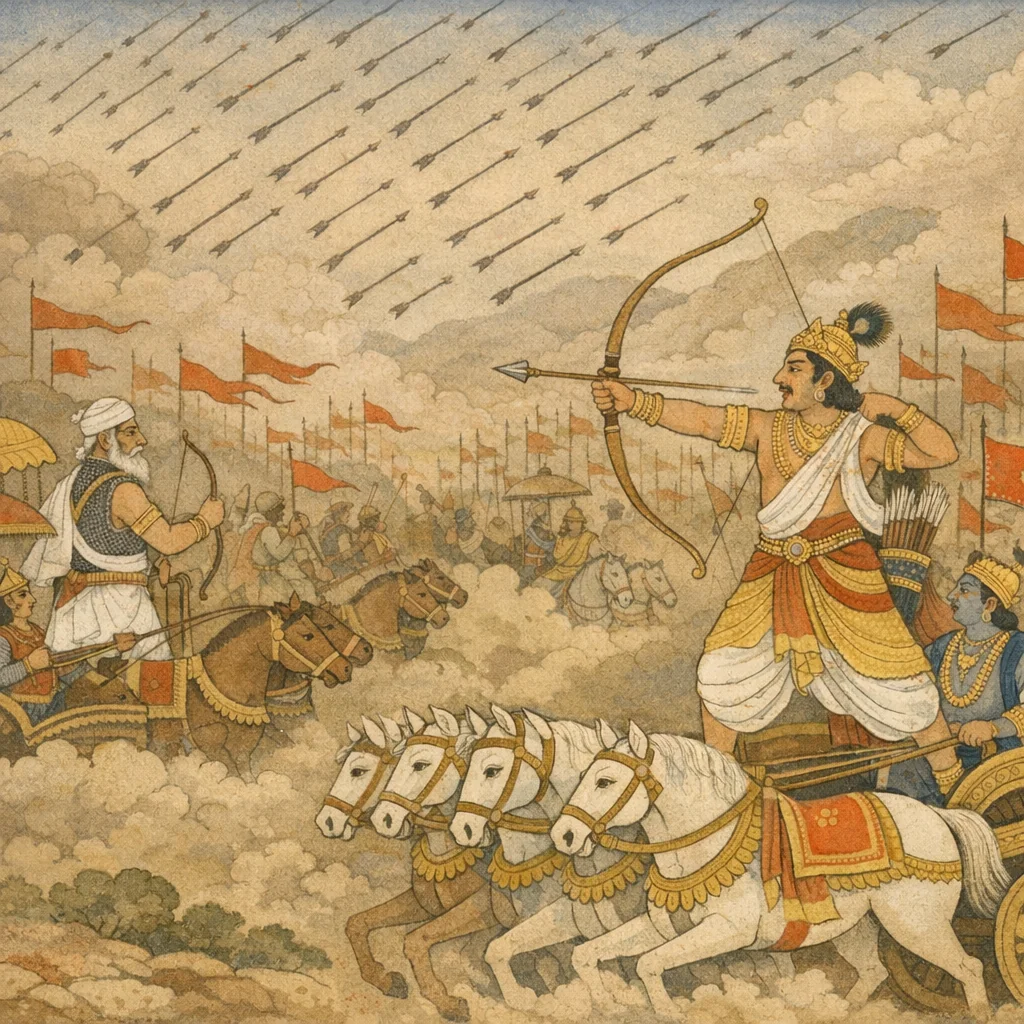
Adhyaya 16
Adhyāya 16: Saṃśaptaka-vrata and the Diversion of Arjuna (द्रोणपर्व, अध्याय १६)
Upa-parva: Saṃśaptaka-vrata and Droṇa’s Plan to Seize Yudhiṣṭhira (Context Unit for Adhyāya 16)
Saṃjaya reports that the forces return to camp and take positions in ordered divisions. Droṇa, dissatisfied, addresses Duryodhana, reiterating Arjuna’s battlefield dominance and proposing a method: have someone draw Arjuna away to another sector; in the resulting gap, Droṇa will break the Pāṇḍava array and seize Yudhiṣṭhira even before Dhṛṣṭadyumna can prevent it. The Trigarta king Suśarmā, with his brothers, recalls past humiliations at Arjuna’s hands and volunteers to confront him, vowing that the day will belong either to the Trigartas or to a world without Arjuna. A broader coalition joins, and the saṃśapta-vrata is formalized through ritual actions—offerings, donations, and a public oath with severe self-imprecations should they retreat without killing Arjuna. Challenged, Arjuna informs Yudhiṣṭhira that he is vow-bound not to refuse repeated summons; he requests leave to engage Suśarmā and promises decisive action. Yudhiṣṭhira, aware of Droṇa’s intention, instructs Arjuna to act so that Droṇa’s plan fails. Arjuna departs toward the Trigartas, and the Kaurava host is invigorated, moving aggressively toward the restraint of Yudhiṣṭhira as the armies collide again with great force.
Chapter Arc: धूल, शंख और रणघोष के बीच वृषसेन का उग्र पराक्रम फूट पड़ता है—उसके बाण ऐसे छूटते हैं मानो दिशाएँ ही शरमय हो उठीं। → वृषसेन के सहस्रों दीप्त बाण हाथी-घोड़े-रथ-नरों को भेदते हुए चारों ओर फैलते हैं; रणभूमि पर दृश्यता मिटती जाती है—दिशाएँ, आकाश, पृथ्वी सब ‘बाणभूत’ से लगते हैं। इसी उथल-पुथल में द्रोण का प्रचण्ड अभियान पाण्डव-पक्ष के अनेक वीरों को काटता चलता है, और कौरव सेना में आशा का संचार होता है कि द्रोण अभी निर्णायक प्रहार करेगा। → रण ‘विशसने नदी’ बन जाती है—रथ-भँवर, रक्त-जल, अस्थि-ढेर और प्रेत-तटों वाली भयावह धारा; उसी उन्माद में कुमार (अर्जुन) क्रुद्ध होकर सिंहनाद करता हुआ द्रोण के वक्ष पर बाण मारता है, और पलटवारों की आँधी में युद्ध का पलड़ा डगमगाता है। → अर्जुन-केशव शत्रुओं को दबाकर सेना के पीछे लौटते हैं; पाण्डव, सात्यकि और पांचाल वीर हर्ष में सूर्य-स्तुति-सी प्रशंसा करते हुए विजय-भाव से शिविर की ओर बढ़ते हैं। → धृतराष्ट्र-पक्ष में यह विश्वास उभरता है कि ‘इसी मुहूर्त’ द्रोण युधिष्ठिर को हर्षित करने (अर्थात् उसे लक्ष्य बनाकर निर्णायक स्थिति बनाने) रण में अवश्य पहुँचेगा—अगला प्रहार किस पर गिरेगा, यह अनिश्चित रह जाता है।
Shlokas
Verse 1
/ ऑपन-माज बछ। जि घोडशो< ध्याय: वृषसेनका पराक्रम, कौरव-पाण्डववीरोंका तुमुल युद्ध, द्रोणाचार्यके द्वारा पाण्डवपक्षके अनेक वीरोंका वध तथा अर्जुनकी विजय संजय उवाच तद् बल॑ सुमहद् दीर्ण त्वदीयं प्रेक्ष्य वीर्यवान् । दधारैको रणे राजन् वृषसेनो<स्त्रमायया,संजय कहते हैं--महाराज! आपकी विशाल सेनाको तितर-बितर हुई देख एकमात्र पराक्रमी वृषसेनने अपने अस्त्रोंकी मायासे रणक्षेत्रमें उसे धारण किया (भागनेसे रोका)
Sañjaya said: O King, seeing your vast army scattered and broken, the valiant Vṛṣasena alone held it together in the battle—by the strategic power and artifice of his weapons—preventing it from collapsing into flight.
Verse 2
शरा दश दिशो मुक्ता वृषसेनेन संयुगे | विचेरुस्ते विनिर्भिद्य नरवाजिरथद्विपान्,उस युद्धस्थलमें वृषसेनके छोड़े हुए बाण हाथी, घोड़े, रथ और मनुष्योंको विदीर्ण करते हुए दसों दिशाओंमें विचरने लगे
Sañjaya said: In the thick of battle, the arrows released by Vṛṣasena spread through all ten directions, tearing through men, horses, chariots, and elephants.
Verse 3
तस्य दीप्ता महाबाणा विनिश्चेरु: सहसत्रश: । भानोरिव महाराज धर्मकाले मरीचय:,महाराज! जैसे ग्रीष्म-ऋतुमें सूर्यससे निकलकर सहस्रों किरणें सब ओर फैलती हैं, उसी प्रकार वृषसेनके धनुषसे सहस्रों तेजस्वी महाबाण निकलने लगे
Sañjaya said: From his bow, blazing great arrows streamed forth by the thousand. O great king, as the sun’s rays at the appointed hour spread out in countless beams, so did those shafts flare and fan out in every direction.
Verse 4
तेनारदिता महाराज रथिन: सादिनस्तथा । निपेतुरुरव्या सहसा वातभग्ना इव द्रुमा:,राजन! जैसे प्रचण्ड आँधीसे सहसा बड़े-बड़े वृक्ष टूटकर गिर जाते हैं, उसी प्रकार वृषसेनके द्वारा पीड़ित हुए रथी और अन्य योद्धागण सहसा धरतीपर गिरने लगे
Sañjaya said: O great king, struck down by Vṛṣasena, the chariot-warriors and likewise the horsemen suddenly fell upon the earth—like trees shattered and toppled at once by a violent wind. The image underscores the irresistible momentum of battle, where prowess can fell many in an instant, and where the king must weigh the human cost that follows from the chosen course of war.
Verse 5
हयौघांश्र॒ रथौघांक्ष॒ गजौघांश्व॒ महारथ: । अपातयद्ू रणे राजन् शतशोडथ सहस्रश:,नरेश्वर! उस महारथी वीरने रणभूमिमें घोड़ों, रथों और हाथियोंके सैकड़ों-हजारों समूहोंको मार गिराया
Sañjaya said: O King, that great chariot-warrior struck down in battle—by the hundreds and even by the thousands—massed hosts of horses, chariots, and elephants. The verse underscores the overwhelming scale of violence on the battlefield, where martial prowess manifests as vast destruction rather than measured restraint.
Verse 6
दृष्टवा तमेक॑ समरे विचरन्तमभीतवत् | सहिता: सर्वराजान: परिवद्रु: समन््तत:,उसे अकेले ही समरभूमिमें निर्भय विचरते देख सब राजाओंने एक साथ आकर सब ओरसे घेर लिया
Sañjaya said: Seeing him moving alone upon the battlefield with fearless composure, all the kings, joining together, surrounded him from every side—an act of collective force meant to check a solitary warrior whose courage threatened the balance of the fight.
Verse 7
नाकुलिस्तु शतानीको वृषसेनं समभ्ययात् | विव्याध चैनं दशभिनरिचैर्मर्म भेदिभि:,इसी समय नकुलके पुत्र शतानीकने वृषसेनपर आक्रमण किया और दस मर्मभेदी नाराचोंद्वारा उसे बींध डाला
Sañjaya said: Then Śatānīka, the son of Nakula, charged straight at Vṛṣasena and pierced him with ten nārāca arrows that struck vital points. The scene underscores the relentless, skill-driven violence of the battlefield, where lineage and duty propel warriors into direct, lethal confrontation.
Verse 8
तस्य कर्णात्मजश्चापं छित्त्वा केतुमपातयत् । त॑ भ्रातरं परीप्सन्तो द्रौपदेया: समभ्ययु:,तब कर्णके पुत्रने शतानीकके धनुषको काटकर उनके ध्वजको भी गिरा दिया। यह देख अपने भाईकी रक्षा करनेके लिये द्रौपदीके दूसरे पुत्र भी वहाँ आ पहुँचे
Sañjaya said: Karṇa’s son cut down his bow and also struck down his banner. Seeing this, the sons of Draupadī rushed forward, intent on protecting their brother—an immediate surge of kin-duty amid the ruthless momentum of battle.
Verse 9
कर्णात्मजं शरख्रातैरदृश्यं चक्कुरञज्जसा । तान् नदन्तो<भ्यधावन्त द्रोणपुत्रमुखा रथा:,उन्होंने अपने बाणसमूहोंकी वर्षसे कर्णकुमार वृषसेनको अनायास ही आच्छादित करके अदृश्य कर दिया। महाराज! यह देख अश्वत्थामा आदि महारथी सिंहनाद करते हुए उनपर टूट पड़े और जैसे मेघ पर्वतोंपर जलकी धारा गिराते हैं, उसी प्रकार वे नाना प्रकारके बाणोंकी वर्षा करते हुए तुरंत ही महारथी द्रौपदीपुत्रोंकी आच्छादित करने लगे
Sañjaya said: With volleys of arrows they swiftly covered Karṇa’s son, Vṛṣasena, making him as if invisible. Seeing this, the chariot-warriors led by Droṇa’s son (Aśvatthāmā) roared and charged; like rain-clouds pouring streams upon mountains, they at once began to shroud the sons of Draupadī with showers of many kinds of arrows.
Verse 10
छादयन्तो महाराज द्रौपदेयान् महारथान् । शरैर्नानाविधैस्तूर्ण पर्वताउजलदा इव,उन्होंने अपने बाणसमूहोंकी वर्षसे कर्णकुमार वृषसेनको अनायास ही आच्छादित करके अदृश्य कर दिया। महाराज! यह देख अश्वत्थामा आदि महारथी सिंहनाद करते हुए उनपर टूट पड़े और जैसे मेघ पर्वतोंपर जलकी धारा गिराते हैं, उसी प्रकार वे नाना प्रकारके बाणोंकी वर्षा करते हुए तुरंत ही महारथी द्रौपदीपुत्रोंकी आच्छादित करने लगे
Sañjaya said: O King, they swiftly covered the Draupadeyas—those great chariot-warriors—with showers of many kinds of arrows, like clouds veiling mountains. In the press of battle, the missile-storm was so dense that warriors could be hidden from sight.
Verse 11
तान् पाण्डवा: प्रत्यगृह्लंस्त्वरिता: पुत्रगृद्धिन: । पज्चाला: केकया मत्स्या: सृज्जयाश्रोद्यतायुआ:,तब पुत्रोंकी प्राणरक्षा चाहनेवाले पाण्डवोंने तुरंत आकर उन कौरव महारथियोंको रोका। पाण्डवोंके साथ पांचाल, केकय, मत्स्य और सूंजयदेशीय योद्धा भी अस्त्र-शस्त्र लिये उपस्थित थे
Sañjaya said: Eager to protect their sons’ lives, the Pāṇḍavas swiftly came forward and checked those Kaurava great chariot-warriors. Along with the Pāṇḍavas stood the Pāñcālas, Kekayas, Matsyas, and the Sṛñjayas, all with weapons raised and ready for battle.
Verse 12
तद् युद्धमभवद् घोरं सुमहल्लोमहर्षणम् । त्वदीयै: पाण्डुपुत्राणां देवानामिव दानवै:,राजन! फिर तो दानवोंके साथ देवताओंकी भाँति आपके सैनिकोंके साथ पाण्डवोंका अत्यन्त भयंकर युद्ध छिड़ गया, जो रोंगटे खड़े कर देनेवाला था
Sañjaya said: Then there arose a battle—terrible, vast, and hair-raising—between the sons of Pāṇḍu and your warriors, O King, like the clash of the gods with the dānavas.
Verse 13
एवं युयुधिरे वीरा: संरब्धा: कुरुपाण्डवा: । परस्परमुदी क्षन्त: परस्परकृतागस:,इस प्रकार एक-दूसरेके अपराध करनेवाले कौरव-पाण्डववीर परस्पर क्रोधपूर्ण दृष्टिसे देखते हुए युद्ध करने लगे
Sañjaya said: Thus the warriors of the Kurus and the Pāṇḍavas, inflamed with rage—each considering the other guilty of wrongdoing—fought on, glaring at one another with wrathful looks.
Verse 14
तेषां ददृशिरे कोपाद् वपूंष्यमिततेजसाम् | युयुत्सूनामिवाकाशे पतत्त्रिवरभोगिनाम्,क्रोधवश युद्ध करते हुए उन अमित तेजस्वी राजाओंके शरीर आकाशमें युद्धकी इच्छासे एकत्र हुए पक्षिराज गरुड़ तथा नागोंके समान दिखायी देते थे
Sañjaya said: In their wrath, the bodies of those kings of immeasurable splendor seemed to appear in the very sky—like Garuḍas and great winged serpents, mighty and gathered with the desire to fight. The image shows how krodha (anger) turns warriors into embodiments of predatory force, heightening the moral peril of battle driven by fury rather than restraint.
Verse 15
भीमकर्णकृपद्रोणद्रौणिपार्षतसात्यकै: । बभासे स रणोद्ेश: कालसूर्य इवोदित:,भीम, कर्ण, कृपाचार्य, द्रोण, अश्वत्थामा, धृष्टद्युम्न तथा सात्यकि आदि वीरोंसे वह रणक्षेत्र ऐसी शोभा पा रहा था, मानो वहाँ प्रलयकालके सूर्यका उदय हुआ हो
Sañjaya said: That sector of the battlefield shone with dread splendor, crowded by Bhīma, Karṇa, Kṛpa, Droṇa, Droṇa’s son Aśvatthāmā, Pārṣata (Dhṛṣṭadyumna), and Sātyaki—as if the sun of the final dissolution had risen there. The image shows how these foremost warriors make the field a fate-laden scene of overwhelming violence, where human prowess seems to mirror cosmic destruction.
Verse 16
तदा<<सीत् तुमुल॑ युद्ध निध्नतामितरेतरम् । महाबलानां बलिभिरर्दानवानां यथा सुरै:,उस समय एक-दूसरेपर प्रहार करनेवाले उन महाबली वीरोंमें वैसा ही भयंकर युद्ध हो रहा था, जैसे पूर्वकालमें बलवान् देवताओंके साथ महाबली दानवोंका संग्राम हुआ था इति श्रीमहाभारते द्रोणपर्वणि द्रोणाभिषेकपर्वणि प्रथमदिवसावहारे षोडशो< ध्याय: इस प्रकार श्रीमह्या भारत द्रोणपर्वके अन्तर्गत द्रोणाभिषेकपर्वमें द्रोणके प्रथम दिनके युद्धमें सेनाको पीछे लौटानेसे सम्बन्ध रखनेवाला सोलहवाँ अध्याय पूरा हुआ
Sañjaya said: Then a tumultuous battle arose among those mighty warriors as they struck one another down—like the ancient war in which powerful Dānavas clashed with the gods. The scene evokes the moral weight of war: strength and valor surge, yet the outcome is measured in mutual destruction, recalling cosmic conflicts where pride and power collide beyond personal enmity.
Verse 17
ततो युधिष्ठटिरानीकमुद्धतार्णवनि:स्वनम् । त्वदीयमवधीत् सैन्यं सम्प्रद्रतमहारथम्,तदनन्तर उत्ताल तरंगोंसे युक्त महासागरकी भाँति गर्जना करती हुई युधिष्ठिरकी सेना आपकी सेनाका संहार करने लगी। इससे कौरव-सेनाके बड़े-बड़े रथी भाग खड़े हुए
Sañjaya said: Then Yudhiṣṭhira’s host, roaring like a heaving ocean, began to cut down your army; and in consequence, the great chariot-warriors of the Kauravas fled in disorder. The scene shows how, when courage and cohesion collapse, even the mighty are swept away by the momentum of a disciplined force.
Verse 18
तत् प्रभग्नं बल॑ दृष्टवा शत्रुभिर्भुशमर्दितम् । अलं द्रुतेन वः शूरा इति दोणो5भ्यभाषत,शत्रुओंके द्वारा अच्छी तरह रौंदी गयी आपकी सेनाको भागती देख द्रोणाचार्यने कहा --“शूरवीरो! तुम भागो मत, इससे कोई लाभ न होगा”
Sañjaya said: Seeing your army shattered and heavily trampled by the enemy, Droṇa addressed them: “Enough of fleeing, O heroes—running away will bring you no good.” In the epic’s moral frame, the call is to steadiness and duty in battle rather than panic and self-preserving flight.
Verse 19
(भारद्वाजममर्षश्न विक्रमश्न समाविशत् । समुद्धृत्य निषड्भाच्च धनुर्ज्यामवमृज्य च ।। महाशरघधनुष्पाणिर्यन्तारमिदमब्रवीत् । उस समय द्रोणाचार्यमें अमर्ष और पराक्रम दोनोंका समावेश हुआ। उन्होंने धनुषकी प्रत्यंचाको पोंछकर तूृणीरसे बाण निकाला और उस महान् बाण एवं धनुषको हाथमें लेकर सारथिसे इस प्रकार कहा। द्रोण उदाच सारथे याहि यत्रैव पाण्डरेण विराजता ।। टप्रियमाणेन छत्रेण राजा तिष्ठति धर्मराट् । द्रोणाचार्य बोले--सारथे! वहीं चलो, जहाँ सुन्दर श्वेत छत्र धारण किये धर्मराज राजा युधिष्ठिर खड़े हैं। तदेतद् दीर्यते सैन्यं धार्तराष्ट्रमनेकथा ।। एतत् संस्तम्भयिष्यामि प्रतिवार्य युधिष्ठिरम् । यह धुृतराष्ट्रकी सेना तितर-बितर हो अनेक भागोंमें बँटी जा रही हैं। मैं युधिष्ठिरको रोककर इस सेनाको स्थिर करूँगा (भागनेसे रोकूँगा)। न हि मामभिवर्षन्ति संयुगे तात पाण्डवा: ।। मात्स्या: पाड्चालराजान: सर्वे च सहसोमका: । तात! ये पाण्डव, मत्स्य, पांचाल और समस्त सोमक वीर मुझपर बाण-वर्षा नहीं कर सकते। अर्जुनो मत्प्रसादाद्धि महास्त्राणि समाप्तवान् ।। न मामुत्सहते तात न भीमो न च सात्यकि: । अर्जुनने भी मेरी ही कृपासे बड़े-बड़े अस्त्रोंको प्राप्त किया है। तात! वे भीमसेन और सात्यकि भी मुझसे लड़नेका साहस नहीं कर सकते। मत्प्रसादाद्धि बीभत्सु: परमेष्वासतां गतः ।। ममैवास्त्रं विजानाति धृष्टद्युम्नोडपि पार्षत: । अर्जुन मेरे ही प्रसादसे महान् धनुर्धर हो गये हैं। धृष्टद्युम्न भी मेरे ही दिये हुए अस्त्रोंका ज्ञान रखता है। नायं संरक्षितुं काल: प्राणांस्तात जयैषिणा ।। याहि स्वर्ग पुरस्कृत्य यशसे च जयाय च । तात सारथे। विजयकी अभिलाषा रखनेवाले वीरके लिये यह प्राणोंकी रक्षा करनेका अवसर नहीं है। तुम स्वर्गप्राप्तिका उद्देश्य लेकर यश और विजयके लिये आगे बढ़ो। संजय उवाच एवं संचोदितो यन्ता द्रोणम भ्यवहत् ततः ।। तदाश्वह्वदयेनाश्चवानभिमन्त्रयाशु हर्षयन् । रथेन सवरूथेन भास्वरेण विराजता ।। संजय कहते हैं--राजन्! इस प्रकार प्रेरित होकर सारथि अश्वह्ृदय नामक मन्त्रोंसे अभिमन्त्रित करके घोड़ोंका हर्ष बढ़ाता हुआ आवरणयुक्त प्रकाशमान एवं तेजस्वी रथके द्वारा शीघ्रतापूर्वक द्रोणाचार्यको आगे ले चला। त॑ करूषाश्न मत्स्याश्ष चेदयश्षु ससात्वता: । पाण्डवाश्न सपञ्चाला: सहिता: पर्यवारयन् ।।) उस समय करूष, मत्स्य, चेदि, सात्वत, पाण्डव तथा पांचाल वीरोंने एक साथ आकर द्रोणाचार्यको रोका। ततः शोणहय: क्रुदधश्वतुर्दन्त इव द्विप: । प्रविश्य पाण्डवानीकं युधिष्िरमुपाद्रवत्,तब लाल घोड़ोंवाले द्रोणाचार्यने कुपित हो चार दाँतोंवाले गजराजके समान पाण्डव- सेनामें घुसकर युधिष्ठिरपर आक्रमण किया
Sañjaya said: Then Droṇa, whose chariot was drawn by red horses, enraged and like a four-tusked lordly elephant, broke into the Pāṇḍava battle-array and charged straight at Yudhiṣṭhira. The scene underscores how wrath and martial resolve can drive a commander to pierce formations and seek the opposing king, making the struggle not merely of arms but of leadership, morale, and dharma under pressure.
Verse 20
तमाविध्यच्छितैर्बाणै: कड़कपन्रैर्युधिष्िर: । तस्य द्रोणो धनुश्कछित्त्वा तं द्रुतं समुपाद्रवत्,युधिष्ठिरने गीधकी पाँखोंसे युक्त पैने बार्णोद्वारा द्रोणाचार्यको बींध डाला। तब द्रोणाचार्यने उनका धनुष काटकर बड़े वेगसे उनपर आक्रमण किया
Sañjaya said: Yudhiṣṭhira pierced Droṇācārya with sharp arrows, feathered like the wings of a vulture. Droṇa then cut down Yudhiṣṭhira’s bow and swiftly rushed upon him. The episode underscores the grim ethics of battle: even revered teachers and righteous kings are compelled to meet with force, skill, and resolve when dharma is contested on the battlefield.
Verse 21
चक्ररक्ष: कुमारस्तु पठचालानां यशस्कर: । दधार द्रोणमायान्तं वेलेव सरितां प्रतिम,उस समय पांचालोंके यशको बढ़ानेवाले कुमारने, जो युधिष्ठिरके रथ-चक्रकी रक्षा कर रहे थे, आते हुए द्रोणाचार्यको उसी प्रकार रोक दिया, जैसे तटभूमि समुद्रको रोकती है
Sañjaya said: The young warrior, famed for enhancing the glory of the Pāñcālas and serving as the protector of Yudhiṣṭhira’s chariot-wheel, checked the advancing Droṇācārya—just as a shoreline holds back the sea (or as a riverbank restrains the waters).
Verse 22
द्रोणं निवारितं दृष्टवा कुमारेण द्विजर्षभम् | सिंहनादरवो हयासीत् साधु साध्विति भाषितम्,कुमारके द्वारा द्विजश्रेष्ठ द्रोणाचार्यको रोका गया देख पाण्डव-सेनामें चोर-जोरसे सिंहनाद होने लगा और सब लोग कहने लगे “बहुत अच्छा, बहुत अच्छा”
Sañjaya said: Seeing Droṇa—the bull among Brahmins—checked and held back by the young warrior, a loud lion-roar rose from the Pāṇḍava host, and people cried out, “Well done! Well done!” The moment underscores how, even amid war, the army publicly affirms valor and timely restraint against a formidable elder-teacher, treating the act as both strategic and worthy of praise.
Verse 23
कुमारस्तु ततो द्रोणं सायकेन महाहवे । विव्याधोरसि संक्रुद्ध: सिंहवच्च नदन् मुहुः,कुमारने उस महायुद्धमें कुपित हो बारंबार सिंहनाद करते हुए एक बाएणएद्धारा द्रोणाचार्यकी छातीमें चोट पहुँचायी
Sañjaya said: Then the young warrior, inflamed with wrath in that great battle, struck Droṇa on the chest with an arrow, repeatedly roaring like a lion—an image of fierce martial resolve amid the relentless ethics of war where prowess and restraint are constantly tested.
Verse 24
संवार्य च रणे द्रोणं कुमारस्तु महाबल: । शरैरनेकसाहसै: कृतहस्तो जितश्रम:,इतना ही नहीं, उस महाबली कुमारने कई हजार बाणोंद्वारा रणक्षेत्रमें द्रोणाचार्यको रोक दिया; क्योंकि उनके हाथ अस्त्र-संचालनकी कलामें दक्ष थे और उन्होंने परिश्रमको जीत लिया था
Sañjaya said: In the midst of battle, that mighty young warrior checked Droṇa, holding him back with many thousands of arrows—his hands trained to perfection in the art of weapon-use, and his endurance so mastered that fatigue could not overcome him.
Verse 25
त॑ शूरमार्यव्रतिनं मन्त्रास्त्रेषु कृतश्रमम् चक्ररक्षं परामृद्नात् कुमारं द्विजपुड़व:,परंतु द्विजश्रेष्ठ द्रोणाचार्यने शूर, आर्यव्रती एवं मन्त्रास्त्रविद्यामें परिश्रम किये हुए चक्र- रक्षक कुमारको परास्त कर दिया
Sañjaya said: Then the bull among Brahmins—Droṇācārya—overpowered that young warrior who was valiant, faithful to noble vows, and well-trained through hard effort in mantra-empowered weapons, even though he was serving as the protector of the chariot-wheel. The episode underscores how, in the brutal logic of war, personal virtue and disciplined training may still be crushed by superior mastery and circumstance.
Verse 26
स मध्यं प्राप्य सैन्यानां सर्वाः प्रविचरन् दिश: । तव सैन्यस्य गोप्ता5डसीद् भारद्वाजो द्विजर्षभ:,राजन! भरद्वाजनन्दन विप्रवर द्रोणाचार्य आपकी सेनाके संरक्षक थे। वे पाण्डव- सेनाके बीचमें घुसकर सम्पूर्ण दिशाओंमें विचरने लगे
Sañjaya said: Having penetrated into the very midst of the armies, he ranged through all directions. O King, the Bharadvāja-born, best of Brahmins—Droṇācārya—was the protector of your host, moving within the Pāṇḍava forces as a guardian of the Kaurava cause amid the chaos of war.
Verse 27
शिखण्डिनं द्वादशभिवविंशत्या चोत्तमौजसम् । नकुल॑ पज्चभिर्विद्ध्वा सहदेवं च सप्तभि:,उन्होंने शिखण्डीको बारह, उत्तमौजाको बीस, नकुलको पाँच और सहदेवको सात बाणोंसे घायल करके युधिष्छिरको बारह, द्रौपदीके पाँचों पुत्रोंको तीन-तीन, सात्यकिको पाँच और विराटको दस बाणोंसे बींध डाला
Sañjaya said: Having pierced Śikhaṇḍin with twelve arrows and Uttamaujā with twenty, and having struck Nakula with five and Sahadeva with seven, he continued to wound the Pāṇḍava side’s foremost warriors—Yudhiṣṭhira, Draupadī’s five sons, Sātyaki, and Virāṭa—each with the stated number of shafts. The passage underscores the relentless arithmetic of battle: prowess is displayed through measured, targeted violence, while the moral weight of the war remains implicit in the suffering inflicted on named persons rather than anonymous troops.
Verse 28
युधिष्ठिरं द्वादशभिद्रौपदेयांस्त्रिभिस्त्रिभि: | सात्यकिं पज्चभिर्विद्ध्वा मत्स्यं च दशभि: शरै:,उन्होंने शिखण्डीको बारह, उत्तमौजाको बीस, नकुलको पाँच और सहदेवको सात बाणोंसे घायल करके युधिष्छिरको बारह, द्रौपदीके पाँचों पुत्रोंको तीन-तीन, सात्यकिको पाँच और विराटको दस बाणोंसे बींध डाला
Sañjaya said: He pierced Yudhiṣṭhira with twelve arrows; Draupadī’s sons with three arrows each; Sātyaki with five; and the Matsya king (Virāṭa) with ten shafts. The report underscores the relentless arithmetic of battle—valor measured in wounds—while reminding the listener that even the righteous are not spared when dharma is tested amid war’s indiscriminate violence.
Verse 29
व्यक्षोभयद् रणे योधान् यथा मुख्यमभिद्रवन् । अभ्यवर्तत सम्प्रेप्सु: कुन्तीपुत्रं युधिछ्ठिरम्,राजन! उन्होंने रणक्षेत्रमें मुख्य-मुख्य योद्धाओंपर धावा करके उन सबको क्षोभमें डाल दिया और कुन्तीपुत्र युधिष्ठिरको पकड़नेके लिये उनपर वेगसे आक्रमण किया
On the field of battle he threw the warriors into turmoil, charging upon the foremost champions as though leading the vanguard. And intent on seizing Kuntī’s son Yudhiṣṭhira, O King, he rushed against him with swift, forceful assault.
Verse 30
युगन्धरस्ततो राजन् भारद्वाजं महारथम् | वारयामास संक्रुद्धं वातोद्धतमिवार्णवम्,राजन्! उस समय वायुके थपेड़ोंसे विक्षुब्ध हुए महासागरके समान क्रोधमें भरे हुए महारथी द्रोणाचार्यको राजा युगन्धरने रोक दिया
Sañjaya said: Then, O King, Yugandhara checked the great chariot-warrior Bhāradvāja (Droṇa), who was aflame with wrath—like the ocean churned into turmoil by gusting winds.
Verse 31
युधिष्ठिरं स विद्ध्वा तु शरै: संनतपर्वभि: । युगन्धरं तु भल्लेन रथनीडादपातयत्,तब झुकी हुई गाँठवाले बाणोंद्वारा युधिष्ठिरको घायल करके द्रोणाचार्यने एक भल्ल नामक बाणद्धारा मारकर युगन्धरको रथकी बैठकसे नीचे गिरा दिया
Sañjaya said: Having struck Yudhiṣṭhira with arrows whose joints were bent, Droṇācārya wounded him; then, with a bhalla arrow, he felled Yugandhara from the chariot-seat.
Verse 32
ततो विराटद्रुपदौ केकया: सात्यकि: शिबि: । व्याप्रदत्तश्न पाज्चाल्य: सिंहसेनश्न वीर्यवान्,यह देख विराट, ट्रपद, केकय, सात्यकि, शिबि, पांचालदेशीय व्याप्रदत्त तथा पराक्रमी सिंहसेन--ये तथा और भी बहुत-से नरेश राजा युधिष्ठिरकी रक्षा करनेके लिये बहुत-से सायकोंकी वर्षा करते हुए द्रोणाचार्यकी राह रोककर खड़े हो गये
Sañjaya said: Then Virāṭa and Drupada, the Kekayas, Sātyaki, Śibi, the Pāñcāla prince Vyāpradatta, and the valiant Siṃhasena—these and many other kings, intent on protecting King Yudhiṣṭhira, stood firm to block Droṇācārya’s advance, showering him with volleys of arrows.
Verse 33
एते चान्ये च बहव: परीप्सन्तो युधिष्ठिरम् । आवव्र॒स्तस्य पन्थानं किरन्त: सायकान् बहून्,यह देख विराट, ट्रपद, केकय, सात्यकि, शिबि, पांचालदेशीय व्याप्रदत्त तथा पराक्रमी सिंहसेन--ये तथा और भी बहुत-से नरेश राजा युधिष्ठिरकी रक्षा करनेके लिये बहुत-से सायकोंकी वर्षा करते हुए द्रोणाचार्यकी राह रोककर खड़े हो गये
Sañjaya said: Many others as well, intent on protecting Yudhiṣṭhira, blocked that route, showering countless arrows to hinder Droṇācārya’s advance.
Verse 34
व्याप्रदत्तस्तु पाउ्चाल्यो द्रोणं विव्याध मार्गणै: । पज्चाशता शितै राजंस्तत उच्चुक्रुशुर्जना:,राजन! पांचालदेशीय व्याप्रदत्तने पचास तीखे बाणोंद्वारा द्रोणाचार्यको घायल कर दिया। तब सब लोग जोर-जोरसे हर्षनाद करने लगे
Sañjaya said: Vyāpradatta of the Pāñcālas struck Droṇa with arrows. O King, pierced by fifty keen shafts, Droṇa became the cause of a great outcry—men shouted aloud in exultation, as the tide of battle momentarily turned against the formidable teacher.
Verse 35
त्वरितं सिंहसेनस्तु द्रोणं विदूध्वा महारथम् | प्राहसत् सहसा हृष्टसत्रासयन् वै महारथान्,हर्षमें भरे हुए सिंहसेनने तुरंत ही महारथी द्रोणाचार्यको घायल करके अन्य महारथियोंके मनमें त्रास उत्पन्न करते हुए सहसा चोरसे अट्टहास किया
Sañjaya said: Then Siṃhasena, acting swiftly, struck and wounded Droṇācārya—the great chariot-warrior. Exultant, he suddenly burst into loud laughter, and by that display he spread fear among the other foremost warriors.
Verse 36
ततो विस्फार्य नयने धनुज्यामवमृज्य च | तलशब्दं महत् कृत्वा द्रोणस्तं समुपाद्रवत्,तब द्रोणाचार्यने आँखें फाड़-फाड़कर देखते हुए धनुषकी डोरी साफ कर महान् टंकारघोष करके सिंहसेनपर आक्रमण किया
Then Droṇa, widening his eyes in fierce concentration, wiped and readied the bowstring; and, making a great twang of the bow, he rushed straight at him.
Verse 37
ततस्तु सिंहसेनस्य शिर: कायात् सकुण्डलम् | व्याप्रदत्तस्य चाक्रम्य भल्लाभ्यामाहरद् बली,फिर बलवान द्रोणने आक्रमणके साथ ही भल्ल नामक दो बाणोंद्वारा सिंहसेन और व्याप्रदत्तके शरीरसे उनके कुण्डलमण्डित मस्तक काट डाले
Sañjaya said: Then the mighty warrior, pressing his attack, struck down Siṁhasena and Vyāpradatta—severing from their bodies their heads adorned with earrings—by means of two bhalla arrows.
Verse 38
तान् प्रमथ्य शख्रातै: पाण्डवानां महारथान् | युधिष्ठिररथाभ्याशे तस्थौ मृत्युरिवान्तक:,इसके बाद पाण्डवोंके उन अन्य महारथियोंको भी अपने बाणसमूहोंसे मथित करके विनाशकारी यमराजके समान वे युधिष्ठिरके रथके समीप खड़े हो गये
Sañjaya said: Having battered those other great chariot-warriors of the Pāṇḍavas with volleys of weapons, he took his stand close to Yudhiṣṭhira’s chariot—like Death itself, like the destroyer who brings all to an end.
Verse 39
ततो5भवन्महाशब्दो राजन् यौधिष्ठिरे बले । हतो राजेति योधानां समीपस्थे यतव्रते,राजन! नियम एवं व्रतका पालन करनेवाले द्रोणाचार्य युधिष्ठिरके बहुत निकट आ गये। तब उनकी सेनाके सैनिकोंमें महान् हाहाकार मच गया। सब लोग कहने लगे “हाय, राजा मारे गये”
Sañjaya said: Then, O King, a great uproar arose in Yudhiṣṭhira’s army. The warriors nearby cried out, “The king has been slain!”—for the self-restrained, vow-observing Droṇācārya had come very close to Yudhiṣṭhira, and fear and confusion swept through the ranks.
Verse 40
अब्र॒ुवन् सैनिकास्तत्र दृष्टवा द्रोणस्य विक्रमम् । अद्य राजा धाररराष्ट्र: कृतार्थों वै भविष्यति,वहाँ द्रोणाचार्यका पराक्रम देख कौरव-सैनिक कहने लगे, “आज राजा दुर्योधन अवश्य कृतार्थ हो जायँगे
Sañjaya said: Seeing Droṇa’s mighty prowess there, the Kaurava soldiers began to say, “Today King Dhṛtarāṣṭra will surely be fulfilled in his purpose.” The remark reflects how battlefield success is quickly read as the validation of a ruler’s hopes—though such ‘fulfillment’ is ethically shadowed by the violence and partiality that drive the war.
Verse 41
अस्मिन् मुहूतें द्रोणस्तु पाण्डवं गृह हर्षितः । आगमिष्याति नो नून॑ धार्तराष्ट्रस्य संयुगे,“इस मुहूर्तमें द्रोणाचार्य रणक्षेत्रमें निश्चय ही राजा युधिष्ठिरको पकड़कर बड़े हर्षके साथ हमारे राजा दुर्योधनके समीप ले आयेंगे”
Sañjaya said: “At this very moment, Droṇa—surely—will seize the Pāṇḍava (Yudhiṣṭhira) on the battlefield and, rejoicing, bring him to our king Duryodhana in the Kauravas’ combat.” The line reflects the Kaurava camp’s hope that capturing Yudhiṣṭhira will decide the war swiftly, even as it underscores the ethical tension of seeking victory through the taking of a righteous king as a captive rather than through fair conquest.
Verse 42
एवं संजल्पतां तेषां तावकानां महारथ: । आयाज्जवेन कौन्तेयो रथघोषेण नादयन्,राजन्! जब आपके सैनिक ऐसी बातें कह रहे थे, उसी समय उनके समक्ष कुन्तीनन्दन महारथी अर्जुन अपने रथकी घरघराहटसे सम्पूर्ण दिशाओंको प्रतिध्वनित करते हुए बड़े वेगसे आ पहुँचे
Sañjaya said: While your warriors were speaking in this manner, O King, the great chariot-warrior Arjuna, Kuntī’s son, arrived before them at great speed, making all directions resound with the thunder of his chariot—an ominous proclamation of imminent combat and the unshakable resolve of the Pāṇḍava cause.
Verse 43
शोणितोदां रथावर्ता कृत्वा विशसने नदीम् | शूरास्थिचयसंकीर्णा प्रेतकूलापहारिणीम्
Sañjaya said: In that slaughter-field they made a river whose waters were blood and whose whirlpools were chariots—strewn with heaps of heroes’ bones, and sweeping away the very banks of the dead. The image lays bare the moral cost of war: valor and ambition, when unrestrained, turn the battlefield into a current that carries away life, dignity, and the rites owed to the fallen.
Verse 44
तां शरौघमहाफेनां प्रासमत्स्यसमाकुलाम् । नदीमुत्तीर्य वेगेन कुरून् विद्राव्य पाण्डव:
Sañjaya said: Crossing that river—whose surging foam was a torrent of arrows and whose waters teemed with spears like fish—the Pāṇḍava, with swift force, put the Kauravas to flight. The image shows how, in war, courage and resolve can “ford” even a seemingly impassable flood of weapons, while the ethical weight of violence remains ever-present in the epic’s vision of dharma under duress.
Verse 45
ततः किरीटी सहसा द्रोणानीकमुपाद्रवत् । ये उस मार-काटसे भरे हुए संग्राममें रक्तकी नदी बहाकर आये थे। उसमें शोणित ही जल था। रथकी भँवरें उठ रही थीं। शूरवीरोंकी हड्डियाँ उसमें शिलाखण्डोंके समान बिखरी हुई थीं। प्रेतोंके कंकाल उस नदीके कूल-किनारे जान पड़ते थे, जिन्हें वह अपने वेगसे तोड़- फोड़कर बहाये लिये जाती थी। बाणोंके समुदाय उसमें फेनोंके बहुत बड़े ढेरके समान जान पड़ते थे। प्रास आदि शस्त्र उसमें मत्स्यके समान छाये हुए थे। उस नदीको वेगपूर्वक पार करके कौरव-सैनिकोंको भगाकर पाण्डुनन्दन किरीटधारी अर्जुनने सहसा द्रोणाचार्यकी सेनापर आक्रमण किया ।। ४३-४४ $ || 7 १ लोड ० ! हर ॥ प्र है > मई छादयन्निषुजालेन महता मोहयन्निव,वे अपने बाणोंके महान् समुदायसे द्रोणाचार्यको मोहमें डालते हुए-से आच्छादित करने लगे। यशस्वी कुन्तीकुमार अर्जुन इतनी शीघ्रताके साथ निरन्तर बाणोंको धनुषपर रखते और छोड़ते थे कि किसीको इन दोनों क्रियाओंमें तनिक भी अन्तर नहीं दिखायी देता था
Sañjaya said: Then the diadem-crowned Arjuna suddenly charged straight at Droṇa’s battle-array. As he advanced, he seemed to bewilder Droṇa by veiling him with a vast net of arrows. The renowned son of Kuntī set arrows on his bow and released them with such unbroken speed that no one could perceive any gap between the placing and the shooting. In the moral atmosphere of the epic, this is prowess employed in a grim necessity of war—skill and resolve directed toward breaking an opposing command, even as the battlefield itself is portrayed as a river of blood that exposes the ethical cost of victory.
Verse 46
शीघ्रमभ्यस्यतो बाणान् संदधानस्य चानिशम् | नान्तरं ददृशे कश्चित् कौन्तेयस्थ यशस्विन:,वे अपने बाणोंके महान् समुदायसे द्रोणाचार्यको मोहमें डालते हुए-से आच्छादित करने लगे। यशस्वी कुन्तीकुमार अर्जुन इतनी शीघ्रताके साथ निरन्तर बाणोंको धनुषपर रखते और छोड़ते थे कि किसीको इन दोनों क्रियाओंमें तनिक भी अन्तर नहीं दिखायी देता था
Sañjaya said: As the glorious son of Kuntī (Arjuna) swiftly practiced and, without pause, kept fitting arrows to his bow, no one could perceive any interval between the placing of the arrow and its release. By that dense and unbroken shower of missiles, he seemed to bewilder and veil Droṇācārya, asserting mastery in battle through disciplined skill rather than mere rage.
Verse 47
न दिशो नान्तरिक्ष॑ च न द्यौर्नैव च मेदिनी । अदृश्यन्त महाराज बाणभूता इवाभवन्,महाराज! न दिशाएँ, न अन्तरिक्ष, न आकाश और न पृथिवी ही दिखायी देती थी। सम्पूर्ण दिशाएँ बाणमय हो रही थीं
Sañjaya said: O great king, neither the directions, nor the mid-air, nor the sky, nor even the earth could be seen. It was as though all quarters had turned into arrows—so thickly were missiles filling the field. The scene conveys the moral horror of war at its peak: when weapons dominate perception itself, discernment and humane restraint are eclipsed, and the world appears reduced to instruments of harm.
Verse 48
नादृश्यत तदा राजंस्तत्र किंचन संयुगे । बाणान्धकारे महति कृते गाण्डीवधन्चना,राजन! उस रफक्षेत्रमें गाण्डीवधारी अर्जुनने बाणोंके द्वारा महान् अन्धकार फैला दिया था। उसमें कुछ भी दिखायी नहीं देता था
Sañjaya said: O King, at that time in the battle nothing at all could be seen there, for the wielder of the Gāṇḍīva had created a vast darkness with his arrows. The scene conveys how martial prowess can overwhelm perception itself, turning the battlefield into a space where discernment and ordinary order collapse under the force of war.
Verse 49
सूर्ये चास्तमनुप्राप्ते तमसा चाभिसंवृते । नाज्ञायत तदा शत्रुर्न सुह्न्न च कश्चन,सूर्यदेव अस्ताचलको चले गये, सम्पूर्ण जगत् अन्धकारसे व्याप्त हो गया, उस समय न कोई शत्रु पहचाना जाता था न मित्र
Sañjaya said: When the sun had reached its setting and darkness had spread everywhere, no one could then be recognized—neither enemy nor friend. In the confusion of night, the ordinary moral and tactical distinctions of the battlefield blurred, and discernment itself became difficult.
Verse 50
ततो<वहारं चक्कुस्ते द्रोणदुर्योधनादय: । तान् विदित्वा पुनस्त्रस्तानयुद्धमनस: परान्
Sañjaya said: Thereupon Droṇa, Duryodhana, and the others devised a stratagem. Realizing that their opponents had again become frightened and were no longer resolved to fight, they sought to exploit that wavering—using tactical maneuver rather than straightforward combat, and revealing how fear can erode martial duty and invite opportunistic counsel in war.
Verse 51
स्वान्यनीकानि बीभत्सु: शनकैरवहारयत् | तब द्रोणाचार्य और दुर्योधन आदिने अपनी सेनाको पीछे लौटा लिया। शत्रुओंका मन अब युद्धसे हट गया है और वे बहुत डर गये हैं, यह जानकर अर्जुनने भी धीरे-धीरे अपनी सेनाओंको युद्धभूमिसे हटा लिया ।। ततोऊभितुष्टवुः पार्थ प्रह्ष्टा: पाण्ड्संंजया:
Sañjaya said: Seeing that the enemy’s resolve had slackened and that they were gripped by fear, Arjuna (Bībhatsu) gradually withdrew his own battle-formations from the field. Then Droṇācārya, along with Duryodhana and the others, also drew back their army. After this measured disengagement, the Pāṇḍava forces, delighted, praised Pārtha (Arjuna).
Verse 52
पज्चालाश्व मनोज्ञाभिववमग्धि: सूर्यमिवर्षय: । उस समय हर्षमें भरे हुए पाण्डव, सूंजय और पांचाल वीर जैसे ऋषिगण सूर्यदेवकी स्तुति करते हैं, उसी प्रकार मनोहर वाणीसे कुन्तीकुमार अर्जुनके गुणगान करने लगे ।। ५१ न् |! एवं स्वशिबिरं प्रायाज्जित्वा शत्रून् धनंजय:,इस प्रकार शत्रुओंको जीतकर सब सेनाओंके पीछे श्रीकृष्णसहित अर्जुन बड़ी प्रसन्नताके साथ अपने शिविरको गये
Sañjaya said: Just as seers, with pleasing hymns, praise the Sun like the Maruts, so too the Pāṇḍavas—filled with joy—together with the heroic Sṛñjayas and the Pañcāla warriors began to celebrate the virtues of Arjuna, Kuntī’s son, in delightful words. Thus, having overcome the enemies, Dhanañjaya (Arjuna) went back to his own camp, glad at heart, accompanied by Śrī Kṛṣṇa.
Verse 53
पृष्ठत: सर्वसैन्यानां मुदितो वै सकेशव:,इस प्रकार शत्रुओंको जीतकर सब सेनाओंके पीछे श्रीकृष्णसहित अर्जुन बड़ी प्रसन्नताके साथ अपने शिविरको गये
Sañjaya said: Keśava (Śrī Kṛṣṇa), positioned behind all the armies, was indeed joyful. Thus, having overcome the foes, Arjuna—accompanied by Kṛṣṇa—returned with great satisfaction to his own camp.
Verse 54
मसारगल्वर्कसुवर्णरूपै- वैज्रप्रवालस्फटिकैश्व मुख्य: । चित्रे रथे पाण्डुसुतो बभासे नक्षत्रचित्रे वियतीव चन्द्र:,जैसे नक्षत्रोंद्वारा चितकबरे प्रतीत होनेवाले आकाशमें चन्द्रमा सुशोभित होते हैं, उसी प्रकार इन्द्रनील, पद्मराग, सुवर्ण, वज्रमणि, मूँगे तथा स्फटिक आदि प्रधान-प्रधान मणिरत्नोंसे विभूषित विचित्र रथमें बैठे हुए पाण्डुनन्दन अर्जुन शोभा पा रहे थे
Sañjaya said: Seated in that splendid, variegated chariot adorned with foremost gems—masāra, galva, arka, gold-hued ornaments, diamond, coral, and crystal—Pāṇḍu’s son Arjuna shone forth like the moon in a sky patterned with stars.
Frequently Asked Questions
The dilemma concerns conflicting duties: Arjuna’s vow-bound obligation to accept a challenge versus his protective responsibility to remain near Yudhiṣṭhira, while Droṇa’s plan tests whether strategic manipulation of vows is compatible with righteous warfare.
Public commitments (vrata) function as moral constraints that can both ennoble and endanger; discernment requires aligning vows with higher protective duties and anticipating how adversaries may leverage reputation, oath, and predictability.
No explicit phalaśruti appears in this unit; its meta-significance lies in illustrating how oath-ethics and counsel operate as causal forces within the war narrative, shaping outcomes through duty, intention, and foreseeable consequence.