Adhyaya 71
Marakata (Emerald): Mythic Origin, Anti-Poison Virtue, Qualities, Defects, and Proper Wearing
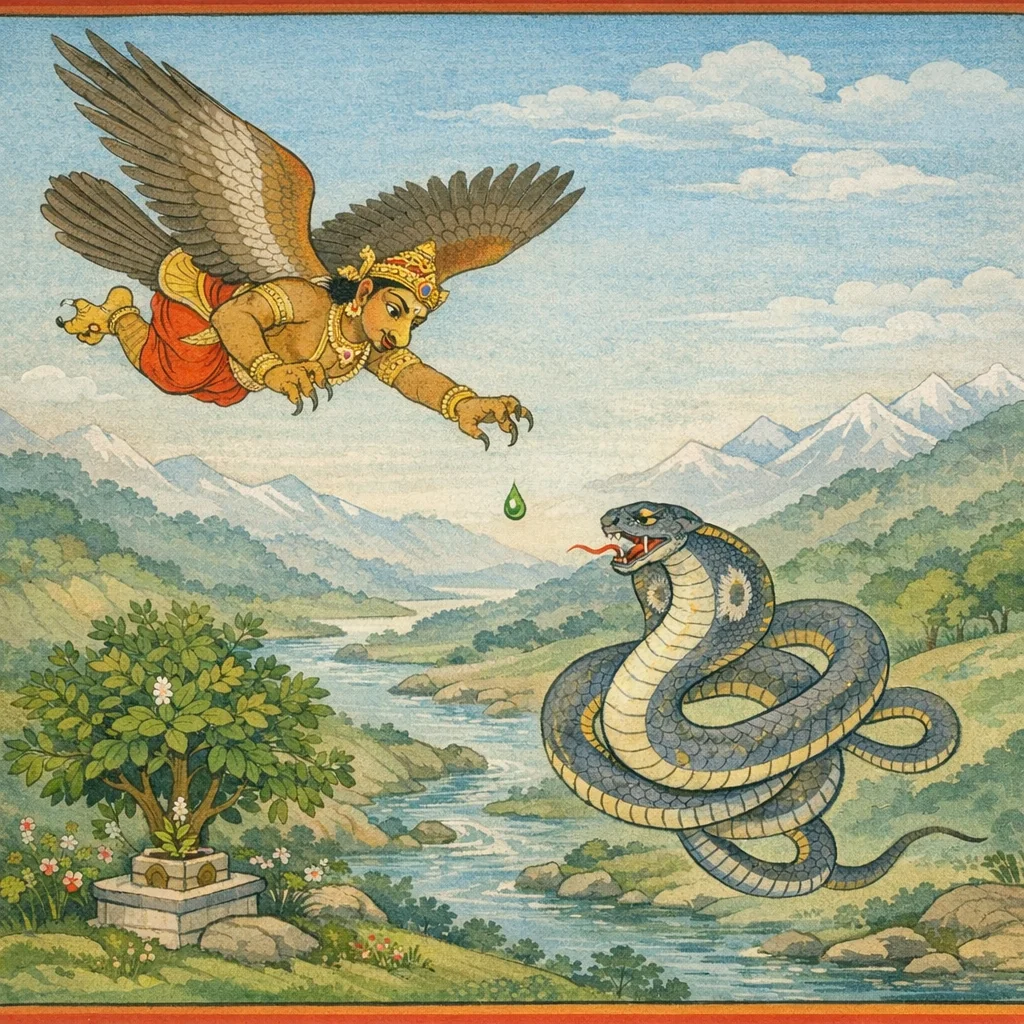
Sūta opens the chapter by telling how Vāsuki flees swiftly after obtaining a potent substance (bile) from the lord of the Dānavas. Garuḍa attacks; Vāsuki releases the substance near a turuṣka tree anointed with basil in a fragrant valley, then proceeds to a Lakṣmī-associated region by Māṇikya mountain. A little bile falls; Garuḍa seizes it but faints and expels it through his nostrils—mythically marking the place from which emeralds (marakata) arise. The text praises the emerald-bearing land as harsh yet uniquely empowered: everything produced there becomes medicine against poison, even venom beyond mantra and ordinary remedies. It then lists the signs of a superior emerald—deep green color, inner radiance, purity, and a pleasing effect on the mind—contrasting them with defects (mottling, impurity, grit, cracks, pitch-like smears) and with look-alikes (bhallāṭakī, putrikā; glass). It concludes with dharmic practical guidance: wear a flawless emerald set in gold (especially for warriors), noting its high value and how flaws sharply reduce its worth. The chapter thus moves from mythic causation to applied ratna-criteria, preparing for adjacent gem chapters on origins, virtues, and defects.
Shlokas
Verse 1
नाम सप्ततितमो ऽध्यायः सूत उवाच / दानवाधिपतेः पित्तमादाय भुजगाधिपः / द्विधा कुर्वन्निव व्योम सत्वरं वासुकिर्ययौ
Sūta said: “This is called the seventy-first chapter. Having taken the bile of the lord of the Dānavas, Vāsuki—the king of serpents—departed swiftly, as though splitting the sky in two.”
Verse 2
स तदा स्वशिरोरत्नप्रभादीप्ते नभो ऽम्बुधौ / राजतः समहानेकः खण्डसेतुरिवाबभौ
Then, in the sky-ocean lit by the radiance of the jewel upon his own head, he shone forth—vast and many-splendoured—like a great causeway broken into segments.
Verse 3
ततः पक्षनिपातेन संहरन्निव रोदसी / गरुत्मान्पन्नगेन्द्रस्य प्रहर्तुमुपचक्रमे
Then, with the downward beat of his wings—seeming as though he were drawing the two worlds together—Garutmān (Garuḍa) began to strike at the lord of serpents.
Verse 4
सहसैव मुमोच तत्फणीन्द्रः सुरसाभ्यक्ततुरुष्क (रष्क) पादपायाम् / कलिकाघनगन्धवासिता यां वरमाणिक्यगिरेरुपत्यकायाम्
At once that lord of serpents released it, at the foot of the turuṣka (raṣka) tree anointed with fragrant basil; in that excellent valley at the base of the jewel-like mountain, the air was perfumed by the dense fragrance of blossoms.
Verse 5
तस्य प्रपातसमनन्तरकालमेव तद्वद्वरालयमतीत्य रमासमीपे / स्थानं क्षितेरुपपयोनिधितीरलेखंयां वरमाणिक्यगिरेरुपत्यकायाम्
Immediately after that descent, he likewise passes beyond the excellent abode and reaches a place near Ramā (Lakṣmī)—a region upon the earth marked by the shoreline of the subsidiary ocean, situated in the valley of the auspicious Māṇikya mountain.
Verse 6
तत्रैव किञ्चित्पततस्तु पित्तादुपेत्य जग्राह ततो गरुत्मान् / मूर्छापरीतः सहसैव घोणारन्ध्रद्वयेन प्रमुमोच सर्वम्
Right there, as a little bile was falling, Garuḍa approached it and seized it; but suddenly, overcome by fainting, he discharged it all through both nostrils.
Verse 7
तत्राकठोरशुककण्ठशिरीषपुष्पखद्योतपृष्ठचरशाद्वलशैवलानाम् / कल्हारशष्पकभुजङ्गभुजाञ्च पत्रप्राप्तत्विषो मरकताः शुभदा भवन्ति
There, emeralds—shimmering like tender parrot-throats, śirīṣa blossoms, glow-worm backs, fresh grass and water-moss, and bearing also the lustre of lotus leaves, young shoots, and serpent-hoods—are esteemed auspicious, bestowing good fortune.
Verse 8
तद्यत्र भोगीन्द्रभुजाभियुक्तं पपात पित्तं दितिजाधिपस्य / तस्याकरस्यातितरां स देशो दुः खोपलभ्यश्च गुणैश्च युक्तः
That region where the bile of the lord of the Daityas fell—struck by the arms of the king of serpents—became exceedingly harsh: a place where suffering is keenly felt, yet endowed with distinctive qualities.
Verse 9
तस्मिन्मरकतस्थाने यत्किञ्चिदुपजायते / तत्सर्वं विषरोगाणां प्रशमाय प्रकीर्त्यते
Whatever arises in that emerald-bearing region—everything there is proclaimed a remedy for ailments born of poison.
Verse 10
सर्वमन्त्रौ षधिगणैर्यन्न शक्यं चिकित्सितुम् / महाहिदंष्ट्राप्रभवं विषं तत्तेन शाम्यति
That poison which cannot be treated even by all mantras and by the six groups of remedies—the venom arising from the fangs of a great serpent—is pacified by that (remedy).
Verse 11
अन्यदप्याकरे तत्र यद्दोषैरुपवर्जितम् / जायते तत्पवित्राणामुत्तमं परिकीर्तितम्
And further, whatever else is produced there in that source, if it is free from defects, is declared the highest among purifying things.
Verse 12
अत्यन्तहरितवर्णं कोमलमर्चिर्विभेदजटिलं च / काञ्चनचूर्णस्यान्तः पूर्णमिव लक्ष्यते यच्च
That which appears intensely green, with a soft radiance—variegated and intricately interwoven—seems as though within it were filled with powdered gold.
Verse 13
युक्तं संस्थानगुणैः समरागं गौरवेण न विहीनम् / सवितुः करसंस्पर्शाच्छुरयति सर्वाश्रमं दीप्त्या
Endowed with well-proportioned form and virtues, evenly radiant in hue and not bereft of majesty, by the touch of the Sun’s rays it flares forth, illuminating every stage of life with its brilliance.
Verse 14
हित्वा च हरितभावं यस्यान्तर्विनिहिता भवेद्दीप्तिः / अचिरप्रभाप्रभाहतनवशाद्वलसन्निभा भाति
Casting off its greenish hue, that form wherein an inner radiance is lodged shines with a pale glow, its body enfeebled as its brief brilliance is struck down.
Verse 15
यच्च मनसः प्रसादं विदधाति निरीक्ष्यमतिमात्रम् / नन्मरकतं महागणमिति रत्नविदां मनोवृत्तिः
Whatever, when gazed upon to the full, bestows a soothing clarity upon the mind—gem-knowers call that “marakata,” a noble emerald, a great cluster of brilliance; such is the bent of their thought.
Verse 16
वर्णस्याति विभुत्वाद्यस्यान्तः स्वच्छकिरणपरिधानम् / सान्द्रस्निग्धविशुद्धं कोमलबर्हिप्रभादिसमकान्ति
Its hue is exceedingly resplendent; within, it seems clad in a garment of clear rays. Dense, lustrous, and perfectly pure, its beauty is comparable to the soft radiance of peacock-feathers and the like.
Verse 17
वर्णोज्ज्वलया कान्त्या सान्द्राकारो विभासया भाति / तदपि गुणवत्संज्ञामाप्नोति हि यादृशी पूर्वम्
Shining with radiant, color-bright splendor, it appears as a dense and clearly formed presence. Even so, it is said to acquire the designation “endowed with qualities,” just as it was before.
Verse 18
शबलकठोरमलिनं रूक्षं पाषाणकर्करोपेतम् / दिग्धं शिलाजतुना मरकतमेवंविधं विगुणम्
A flawed emerald is one that is mottled, hard and impure, rough, filled with stony grit, and smeared with mineral pitch; an emerald of such a kind is considered defective.
Verse 19
यत्सन्धिशोषितं रत्नमन्यन्मरकताद्भवेत् / श्रेयस्कामैर्न तद्धार्यं क्रेतव्यं वा कतञ्चन
A gem that has been dried out at its joints (cracked or seam-worn), or any gem that has become merely an emerald-like stone, should never be worn by those who seek auspicious well-being—nor should it ever be purchased.
Verse 20
भल्लातकी पुत्रिका च तद्वर्णसमयोगतः / मणेर्मरकतस्यैते लक्षणीया विजातयः
Bhallāṭakī and Putrikā—because their coloration matches it—are to be recognized as inferior look-alike varieties of the emerald gem.
Verse 21
क्षौमेण वाससा मृष्टा दीप्तिं त्यजति पुत्रिका / लाघवेनैव काचस्य शक्या कर्तुं विभावना
A Putrikā, a glass bead, when rubbed with a linen cloth, casts off its dullness and becomes lustrous; likewise, by the very lightness of glass, brilliance can be produced in it.
Verse 22
कस्यचिदनेकरूपैर्मरकतमनुगच्छतो ऽपि गुणवर्णैः / भल्लातकस्यस्वनात्तु वैषम्यमुपैति वर्णस्य
Even if something follows an emerald in many ways—sharing its qualities and its color—still, by its own innate nature the bhallātaka (marking-nut) turns to a different hue; thus the coloration becomes unequal.
Verse 23
वज्राणि मुक्ताः सन्त्यन्ये ये च केचिद्द्विजातयः / तेषां नाप्रतिबद्धानां भा भवत्यूर्ध्वगामिनी
Others too are released from bonds hard as vajra—namely, certain dvija, the twice-born. For those not held back by attachment and obstruction, their radiance moves upward, leading them higher.
Verse 24
ऋजुत्वाच्चैव केषाञ्चित्कथञ्चिदुपजायते / तिर्यगालोच्यमानानां सद्यश्चैव प्रणश्यति
In some, straightforwardness arises only somehow, with difficulty; but in those who keep looking sideways with deceitful intent, it perishes at once.
Verse 25
स्नानाचमनजप्येषु रक्षामन्त्रक्रियाविधौ / ददद्भिर्गोहिरण्यानि कुर्वद्भिः साधनानि च
In acts such as bathing, ācāmana (sipping sanctified water), and japa, and in the prescribed procedure of protective rites performed with mantras—also among those who give cows and gold, and those who undertake the required sādhanas.
Verse 26
दैवपित्र्यातिथेयेषु गुरुसंपूजनेषु च / बाध्यमानेषु विविधैर्देषजातैर्विषोद्भवैः
When one is afflicted by various poisons arising from a particular region—during rites for the devas, offerings to the pitṛs (ancestors), hospitality to guests, and the worship of one’s guru—this teaching/remedy should be applied.
Verse 27
दौषैर्हेनं गुणैर्युक्तं काञ्चनप्रतियोजितम् / संग्रामे विचरद्भिश्च धार्यं मरकतं बुधैः
The wise should wear an emerald—free from defects, endowed with noble qualities, and set in gold—especially those who move about in the midst of battle.
Verse 28
तुलया पद्मरागस्य यन्मूल्यमुपजायते / लभते ऽभ्यधिकं तस्माद्गुणैर्मरकतं युतम्
Whatever value is obtained by weighing a padmarāga (ruby), an emerald endowed with excellent qualities commands a price even higher than that.
Verse 29
तथा च पद्मरागाणां दोषैर्मूल्यं प्रहीयते / ततो ऽस्याप्यधिका हानिर्देषैर्मरकते भवेत्
Likewise, the value of rubies is diminished by their flaws; and because of flaws, an even greater loss of value occurs in the case of emeralds as well.
Frequently Asked Questions
A superior emerald is described as intensely green with soft, pleasing radiance, internally luminous (as though filled with powdered gold), evenly colored, dense and pure, and producing soothing mental clarity when seen. Its beauty is compared to gentle natural lustres (e.g., peacock-feather-like softness).
Defects include mottling, hardness with impurity, rough texture, stony grit inclusions, mineral pitch-like smears, and especially cracking/seam-wear (‘dried out at joints’). Such stones should not be worn by those seeking auspicious well-being and should not be purchased.
The chapter advises wearing a defect-free, high-quality emerald set in gold, with special emphasis on those who move about in battle—implying protective and auspicious support in dangerous contexts.
It names bhallāṭakī and putrikā as inferior look-alikes due to similar coloration, and discusses glass becoming lustrous when rubbed, noting that despite resemblance in color/qualities, innate nature reveals differences (e.g., hue inequality).