Chapter 5: Adhyaya 5: Authority, Virtue-Testing, and Social Order
अध्याय ५
Duties Within the Household and Social Bonds
Adhyaya 5 presents a compact set of didactic aphorisms typical of the Subhāṣita and Nītiśāstra tradition, emphasizing how authority, reputation, and social stability are conceptualized in classical Sanskrit moral discourse. The verses map hierarchical relations (teacher, husband, guest; multiple “fathers” and “mothers”) as a historical model of social obligation and legitimacy. Several stanzas frame character as empirically testable—likening the assessment of a person to assaying gold—through sacrifice, conduct (śīla), qualities, and action. The chapter also records pragmatic observations about fear, conflict, and preparedness, alongside typological notes on envy and social antagonisms as perceived in premodern society. A recurrent contrast appears between transient goods (wealth, life, fortune) and enduring anchors such as dharma and satya, presented as cosmically foundational. Additional aphorisms treat knowledge as practice-dependent, governance as protected by gentleness, and the household as stabilized by an idealized “good woman,” reflecting archaic gendered norms as historical data. Overall, the chapter functions as an index of ethical heuristics and sociopolitical assumptions embedded in classical Indian strategic thought.
Key Concepts
Key Principles
Strategic Themes
Shlokas in Chapter 5
Verse 1
गुरुरग्निर्द्विजातीनां वर्णानां ब्राह्मणो गुरुः । पतिरेव गुरुः स्त्रीणां सर्वस्याभ्यागतो गुरुः ॥
For the twice-born, fire is the teacher; among the social orders, the Brahmin is the teacher; for women, the husband is the teacher; and for all, the arriving guest is the teacher.
Verse 2
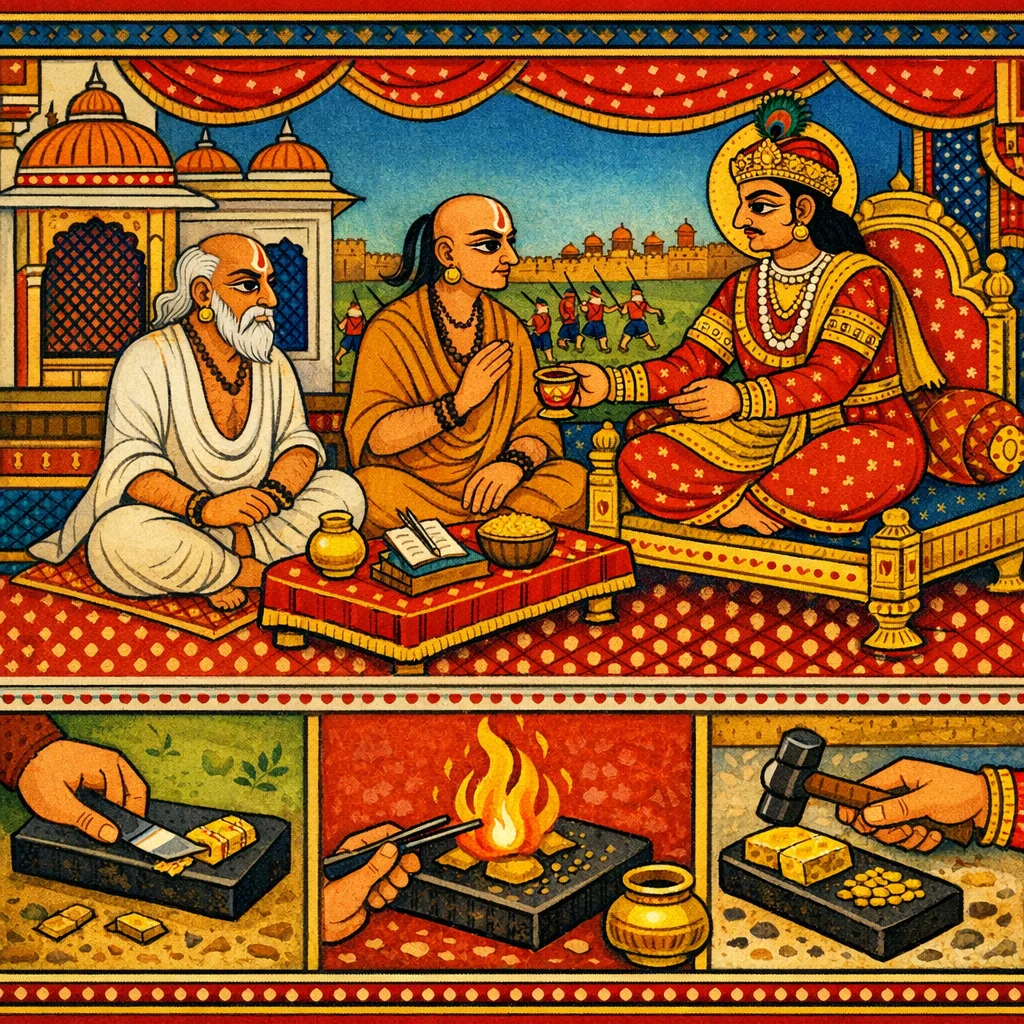
यथा चतुर्भिः कनकं परीक्ष्यते निघर्षणच्छेदनतापताडनैः । तथा चतुर्भिः पुरुषः परीक्ष्यते त्यागेन शीलेन गुणेन कर्मणा ॥
Gold is tested in four ways—rubbing, cutting, heating, and striking; likewise a person is tested in four ways—generosity (renunciation), conduct, qualities, and deeds.
Verse 3
तावद्भयेषु भेतव्यं यावद्भयमनागतम् । आगतं तु भयं वीक्ष्य प्रहर्तव्यमशङ्कया ॥
Fear only while the danger has not yet arrived; once the danger is before your eyes, strike back decisively, without hesitation.
Verse 4
एकोदरसमुद्भूता एकनक्षत्रजातकाः । न भवन्ति समाः शीले यथा बदरकण्टकाः ॥
Though born of the same womb and under the same star, people are not equal in character—like the uneven thorns of the badara tree.
Verse 5
निःस्पृहो नाधिकारी स्यान् नाकामो मण्डनप्रियः । नाविदग्धः प्रियं ब्रूयात्स्पष्टवक्ता न वञ्चकः ॥
One without desire is unfit for office; one without aims loves no adornment; one without shrewdness speaks no pleasing words; one who speaks plainly is no deceiver.
Verse 6
मूर्खाणां पण्डिता द्वेष्या अधनानां महाधनाः । परांगना कुलस्त्रीणां सुभगानां च दुर्भगाः ॥
Fools dislike the learned; the poor dislike the very rich; women of the household resent another man’s woman; and the unfortunate resent the fortunate.
Verse 7
आलस्योपगता विद्या परहस्तगतं धनम् । अल्पबीजं हतं क्षेत्रं हतं सैन्यमनायकम् ॥
Learning overtaken by idleness becomes useless; wealth in another’s hands is insecure; a field with scant seed is ruined; an army without a leader is lost.
Verse 8
अभ्यासाद्धार्यते विद्या कुलं शीलेन धार्यते । गुणेन ज्ञायते त्वार्यः कोपो नेत्रेण गम्यते ॥
Knowledge is sustained by practice; a family line is sustained by conduct. The noble are known by virtue; anger is read in the eyes.
Verse 9
वित्तेन रक्ष्यते धर्मो विद्या योगेन रक्ष्यते । मृदुना रक्ष्यते भूपः सत्स्त्रिया रक्ष्यते गृहम् ॥
Dharma is safeguarded by wealth; learning is safeguarded by disciplined practice (yoga). A king is safeguarded by gentleness; a household is safeguarded by a virtuous woman.
Verse 10
अन्यथा वेदशास्त्राणि ज्ञानपाण्डित्यमन्यथा । अन्यथा तत्पदं शान्तं लोकाः क्लिश्यन्ति चाह्न्यथा ॥
The teachings of the Vedas and śāstras are one thing; knowledge and scholarship are another. The tranquil state is something else again; yet people are afflicted in still another way.
Verse 11
दारिद्र्यनाशनं दानं शीलं दुर्गतिनाशनम् । अज्ञाननाशिनी प्रज्ञा भावना भयनाशिनी ॥
Giving (dāna) removes poverty; good conduct (śīla) removes misfortune. Wisdom (prajñā) removes ignorance; cultivated contemplation (bhāvanā) removes fear.
Verse 12
नास्ति कामसमो व्याधिर्नास्ति मोहसमो रिपुः । नास्ति कोपसमो वह्निर्नास्ति ज्ञानात्परं सुखम् ॥
There is no disease like desire; no enemy like delusion. There is no fire like anger; no happiness beyond knowledge.
Verse 13
जन्ममृत्यू हि यात्येको भुनक्त्येकः शुभाशुभम् । नरकेषु पतत्येक एको याति परां गतिम् ॥
Alone one passes through birth and death; alone one experiences the fruits of good and evil. Alone one falls into hells; alone one attains the highest state.
Verse 14
तृणं ब्रह्मविदः स्वर्गस्तृणं शूरस्य जीवितम् । जिताशस्य तृणं नारी निःस्पृहस्य तृणं जगत् ॥
For the knower of Brahman, heaven is but grass; for the hero, life is but grass; for one who has conquered hope and desire, a woman is but grass; for the cravingless, the world is but grass.
Verse 15
विद्या मित्रं प्रवासे च भार्या मित्रं गृहेषु च । व्याधितस्यौषधं मित्रं धर्मो मित्रं मृतस्य च ॥
On the road, learning is a friend; at home, a wife is a friend; for the sick, medicine is a friend; for the dead, dharma is a friend.
Verse 16
वृथा वृष्टिः समुद्रेषु वृथा तृप्तस्य भोजनम् । वृथा दानं समर्थस्य वृथा दीपो दिवापि च ॥
Rain upon the ocean is futile; food for one already full is futile; a gift to one already self-sufficient is futile; and a lamp, even in daytime, is futile.
Verse 17
नास्ति मेघसमं तोयं नास्ति चात्मसमं बलम् । नास्ति चक्षुःसमं तेजो नास्ति धान्यसमं प्रियम् ॥
No water equals that from the clouds (rain); no strength equals one’s own; no radiance equals the eye; nothing is as dear as grain (food).
Verse 18
अधना धनमिच्छन्ति वाचं चैव चतुष्पदाः । मानवाः स्वर्गमिच्छन्ति मोक्षमिच्छन्ति देवताः ॥
The poor seek wealth; four-footed creatures seek speech; humans seek heaven; and the gods seek liberation (moksha).
Verse 19
सत्येन धार्यते पृथ्वी सत्येन तपते रविः । सत्येन वाति वायुश्च सर्वं सत्ये प्रतिष्ठितम् ॥
By truth the earth is upheld; by truth the sun shines; by truth the wind blows; everything is established upon truth.
Verse 20
चला लक्ष्मीश्चलाः प्राणाश्चले जीवितमन्दिरे । चलाचले च संसारे धर्म एको हि निश्चलः ॥
Prosperity is fickle, breath is fickle, and the body—the house of life—is fickle. In this wavering world, dharma alone is steadfast.
Verse 21
नराणां नापितो धूर्तः पक्षिणां चैव वायसः । चतुष्पादं शृगालस्तु स्त्रीणां धूर्ता च मालिनी ॥
Among men, the barber is deemed crafty; among birds, the crow; among four-footed beasts, the jackal; and among women, the garland-maker is deemed crafty.
Verse 22
जनिता चोपनेता च यस्तु विद्यां प्रयच्छति । अन्नदाता भयत्राता पञ्चैते पितरः स्मृताः ॥
The begetter, the one who conducts the upanayana, the giver of learning, the giver of food, and the protector from fear—these five are remembered as ‘fathers’.
Verse 23
राजपत्नी गुरोः पत्नी मित्रपत्नी तथैव च । पत्नीमाता स्वमाता च पञ्चैता मातरः स्मृताः ॥
The king’s wife, the teacher’s wife, a friend’s wife, one’s wife’s mother, and one’s own mother—these five women are remembered as ‘mothers’.
Frequently Asked Questions
The text recurrently frames satya (truth) and dharma as foundational supports of order: truth is described as sustaining the earth and cosmic functions, while dharma is depicted as the sole stable element in a changing world of wealth, life, and fortune. This presents a historical Nīti view in which moral order is both social and cosmological.
Relationships are organized through ranked roles and functional obligations: multiple forms of “guru” are listed (teacher, husband in relation to women, guest), and kinship is expanded via enumerations of “five fathers” (including giver of knowledge, giver of food, protector from fear) and “five mothers” (including mother, wife, and wives of respected figures). Friendship is categorized instrumentally by context (learning in travel, spouse in the home, medicine in illness, dharma after death).
The aphorisms align with broader Sanskrit strategic and didactic corpora (e.g., Arthashastra-associated pragmatism and Panchatantra-style social observation) by combining character assessment, preparedness against danger, and governance ideals with moral claims about truth and dharma. Rather than systematic statecraft, the chapter offers portable heuristics and social classifications useful for comparative study of classical Indian political-ethical reasoning.