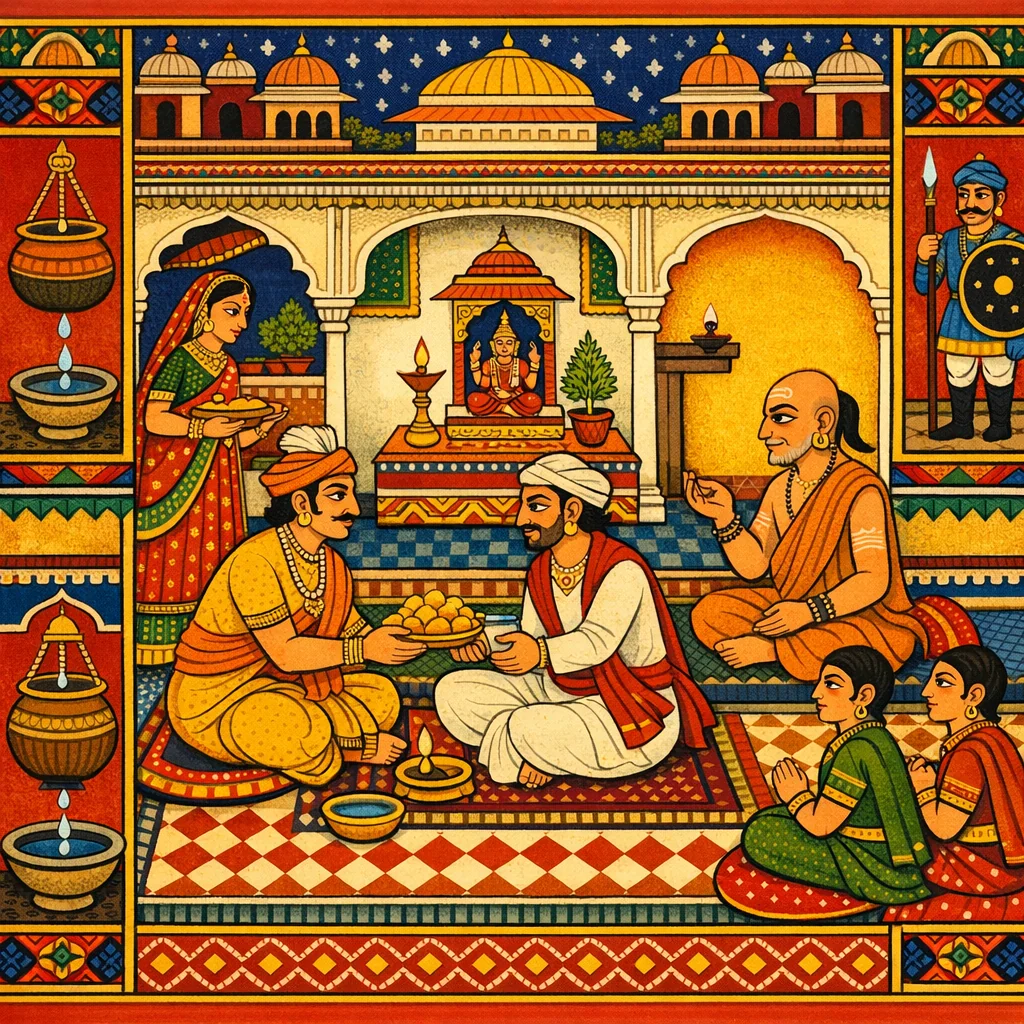
Chapter 12: Adhyaya 12 — Household Virtue, Association, and Moral Discernment
अध्याय १२
Balancing Material Prosperity with Moral Duty
Adhyaya 12 presents a clustered set of subhāṣita-style aphorisms that map social life through the lenses of household prosperity, moral reputation, and the strategic value of association. The chapter opens by portraying the gṛhastha-āśrama as “fortunate” when marked by domestic harmony, hospitality, daily worship, and the company of virtuous persons, situating ethics within everyday institutional life. Several verses frame dāna (especially to learned Brahmins) as socially expansive, while other passages emphasize discernment: differentiated conduct toward kin, outsiders, the virtuous, and the malicious is described as a practical “skill” sustaining public order. The text also uses satirical invective to criticize ritual and learning absent from a household, and it deploys karmic determinism to explain perceived misfortune as prior inscription. A recurring sociological motif is satsaṅga: contact with the good is said to transform the bad more readily than the reverse. The chapter closes with concise maxims on impermanence, ethical accumulation (dharma-saṅgraha), typologies of friends, pragmatic learning, and the persistence of character.
Key Concepts
Key Principles
Strategic Themes
Shlokas in Chapter 12
Verse 1
सानन्दं सदनं सुतास्तु सुधियः कान्ता प्रियालापिनी इच्छापूर्तिधनं स्वयोषिति रतिः स्वाज्ञापराः सेवकाः । आतिथ्यं शिवपूजनं प्रतिदिनं मिष्टान्नपानं गृहे साधोः संगमुपासते च सततं धन्यो गृहस्थाश्रमः ॥
Fortunate is the householder’s stage: a joyful home, wise children, a spouse who speaks lovingly; wealth that fulfills wishes, intimacy with one’s own wife, obedient servants; hospitality, daily worship of Śiva, sweet food and drink at home, and constant company of the virtuous (sādhu).
Verse 2
आर्तेषु विप्रेषु दयान्वितश्च यच्छ्रद्धया स्वल्पमुपैति दानम् । अनन्तपारमुपैति राजन् यद्दीयते तन्न लभेद्द्विजेभ्यः ॥
O king, even a small gift, given with faith and compassion to afflicted Brahmins, yields immeasurable fruit; what is given is not fully regained from the twice-born.
Verse 3
दाक्षिण्यं स्वजने दया परजने शाठ्यं सदा दुर्जने प्रीतिः साधुजने स्मयः खलजने विद्वज्जने चार्जवम् । शौर्यं शत्रुजने क्षमा गुरुजने नारीजने धूर्तता इत्थं ये पुरुषा कलासु कुशलास्तेष्वेव लोकस्थितिः ॥
Be gracious to your own, compassionate to others, and ever crafty with the wicked; be affectionate to the virtuous, contemptuous to the base, and straightforward with the learned; show valor to enemies, forbearance to teachers, and shrewdness in dealing with women. On men skilled in these arts of conduct rests the order of the world.
Verse 4
हस्तौ दानविवर्जितौ श्रुतिपुटौ सारस्वतद्रोहिणौ नेत्रे साधुविलोकनेन रहिते पादौ न तीर्थं गतौ । अन्यायार्जितवित्तपूर्णमुदरं गर्वेण तुङ्गं शिरो रे रे जम्बुक मुञ्च मुञ्च सहसा नीचं सुनिन्द्यं वपुः ॥
Hands without charity, ears hostile to learning, eyes that do not behold the good, feet that never go on pilgrimage. A belly stuffed with unjust wealth, a head held high in pride—hey jackal, cast off at once this base, contemptible body!
Verse 5
येषां श्रीमद्यशोदासुतपदकमले नास्ति भक्तिर्नराणां येषामाभीरकन्याप्रियगुणकथने नानुरक्ता रसज्ञा । येषां श्रीकृष्णलीलाललितरसकथासादरौ नैव कर्णौ धिक् तान् धिक् तान् धिगेतान् कथयति सततं कीर्तनस्थो मृदंगः ॥
Those who lack devotion to the lotus-feet of Yaśodā’s son (Kṛṣṇa); those connoisseurs of rasa who are not drawn to the tales of the cowherd maidens’ beloved virtues; and those whose ears do not reverently hear the refined stories of Kṛṣṇa’s līlās—the mṛdaṅga in kīrtana keeps saying again and again: “Shame! Shame!”
Verse 6
पत्रं नैव यदा करीलविटपे दोषो वसन्तस्य किं नोलूकोऽप्यवलोकते यदि दिवा सूर्यस्य किं दूषणम् । वर्षा नैव पतन्ति चातकमुखे मेघस्य किं दूषणं यत्पूर्वं विधिना ललाटलिखितं तन्मार्जितुं कः क्षमः ॥
If leaves do not grow on the karīla tree, what fault is spring’s? If an owl cannot see by day, what defect is in the sun? If rain does not fall into the cātaka’s beak, what blame is the cloud’s? What destiny once wrote upon the forehead—who can erase it?
Verse 7
सत्सङ्गाद्भवति हि साधुना खलानां साधूनां न हि खलसंगतः खलत्वम् । आमोदं कुसुमभवं मृदेव धत्ते मृद्गन्धं नहि कुसुमानि धारयन्ति ॥
By the company of the virtuous, even the wicked become good; but the virtuous do not become wicked by the company of the wicked. Earth takes on the fragrance of flowers; flowers do not take on the smell of earth.
Verse 8
साधूनां दर्शनं पुण्यं तीर्थभूता हि साधवः । कालेन फलते तीर्थं सद्यः साधुसमागमः ॥
To behold the virtuous is merit, for the virtuous themselves are a tīrtha, a holy ford. A pilgrimage-site bears fruit in time; meeting the virtuous bears fruit at once.
Verse 9
विप्रास्मिन्नगरे महान्कथय कस्तालद्रुमाणां गणः को दाता रजको ददाति वसनं प्रातर्गृहीत्वा निशि । को दक्षः परवित्तदारहरणे सर्वोऽपि दक्षो जनः कस्माज्जीवसि हे सखे विषकृमिन्यायेन जीवाम्यहम् ॥
In this city, O brāhmaṇa—who is “great”? Only a clump of palmyra trees. Who is a “giver”? The washerman, who takes clothes in the morning and returns them by night. Who is “skilled”? Everyone is skilled at seizing another’s wealth and wife. Tell me, friend, why do you live? I live by the rule of the “poison-worm”: I survive by leaning on poison.
Verse 10
न विप्रपादोदककर्दमाणि न वेदशास्त्रध्वनिगर्जितानि । स्वाहास्वधाकारविवर्जितानि श्मशानतुल्यानि गृहाणि तानि ॥
Houses where there is no ritual water from a brāhmaṇa’s feet, no resounding recitation of Veda and śāstra, and no utterance of “svāhā” and “svadhā”—such houses are like a cremation-ground.
Verse 11
सत्यं माता पिता ज्ञानं धर्मो भ्राता दया सखा । शान्तिः पत्नी क्षमा पुत्रः षडेते मम बान्धवाः ॥
Truth is my mother, knowledge my father, dharma my brother, compassion my friend; peace my wife, forgiveness my son—these six are my kin.
Verse 12
अनित्यानि शरीराणि विभवो नैव शाश्वतः । नित्यं संनिहितो मृत्युः कर्तव्यो धर्मसङ्ग्रहः ॥
Bodies are impermanent, and prosperity is not lasting. Death is ever near at hand—therefore one should gather and preserve dharma.
Verse 13
निमन्त्रोत्सवा विप्रा गावो नवतृणोत्सवाः । पत्युत्साहयुता भार्या अहं कृष्णचरणोत्सवः ॥
Brahmins rejoice in invitations; cows rejoice in fresh grass; a wife rejoices in heartening her husband; and I rejoice in devotion to the feet of Kṛṣṇa.
Verse 14
मातृवत्परदारेषु परद्रव्येषु लोष्ट्रवत् । आत्मवत्सर्वभूतेषु यः पश्यति स पण्डितः ॥
A learned person is one who regards another’s spouse as a mother, another’s wealth as a clod of earth, and all beings as one’s own self.
Verse 15
धर्मे तत्परता मुखे मधुरता दाने समुत्साहता मित्रेऽवञ्चकता गुरौ विनयता चित्तेऽतिमभीरता । आचारे शुचिता गुणे रसिकता शास्त्रेषु विज्ञानता रूपे सुन्दरता शिवे भजनता त्वय्यस्ति भो राघव ॥
Devoted to dharma, sweet in speech, eager in giving; honest with friends, humble before teachers, and deeply serious in mind; pure in conduct, refined in relish for virtue, learned in the śāstras; fair in form and devoted in worship of Śiva—O Rāghava, these qualities are found in you.
Verse 16
काष्ठं कल्पतरुः सुमेरुचलश्चिन्तामणिः प्रस्तरः सूर्यास्तीव्रकरः शशी क्षयकरः क्षारो हि वारां निधिः । कामो नष्टतनुर्वलिर्दितिसुतो नित्यं पशुः कामगौ- र्नैतांस्ते तुलयामि भो रघुपते कस्योपमा दीयते ॥
The wishing-tree is but wood, Sumeru but a hill, the cintāmaṇi but a stone; the sun is harsh-rayed, the moon brings waning, the ocean is only salt. Kāma is bodiless, Bali an asura, and the wish-cow ever an animal—O Raghupati, I cannot measure you by these; what simile could be given?
Verse 17
विद्या मित्रं प्रवासे च भार्या मित्रं गृहेषु च । व्याधितस्यौषधं मित्रं धर्मो मित्रं मृतस्य च ॥
On a journey, learning is a friend; at home, a wife is a friend; for the sick, medicine is a friend; for the dead, dharma is a friend.
Verse 18
विनयं राजपुत्रेभ्यः पण्डितेभ्यः सुभाषितम् । अनृतं द्यूतकारेभ्यः स्त्रीभ्यः शिक्षेत कैतवम् ॥
Learn humility from princes, fine speech from the learned; learn falsehood from gamblers, and deception from women.
Verse 19
अनालोक्य व्ययं कर्ता अनाथः कलहप्रियः । आतुरः सर्वक्षेत्रेषु नरः शीघ्रं विनश्यति ॥
One who spends without forethought, lacks support, loves quarrel, and is restless in every undertaking perishes quickly.
Verse 20
नाहारं चिन्तयेत्प्राज्ञो धर्ममेकं हि चिन्तयेत् । आहारो हि मनुष्याणां जन्मना सह जायते ॥
The wise do not dwell on food; they reflect on dharma alone. A human’s sustenance is said to arise together with birth.
Verse 21
धनधान्यप्रयोगेषु विद्यासङ्ग्रहणे तथा । आहारे व्यवहारे च त्यक्तलज्जः सुखी भवेत् ॥
In using wealth and grain, in gathering learning, and in food and daily dealings, one who sets aside inhibiting shame becomes content and prosperous.
Verse 22
जलबिन्दुनिपातेन क्रमशः पूर्यते घटः । स हेतुः सर्वविद्यानां धर्मस्य च धनस्य च ॥
By the fall of water-drops a pot is filled little by little; this is the principle by which all learning, and likewise dharma and wealth, are accumulated.
Verse 23
वयसः परिणामेऽपि यः खलः खल एव सः । सम्पक्वमपि माधुर्यं नोपयातीन्द्रवारुणम् ॥
Even as age matures, the wicked remain wicked; the indravāruṇa gourd, though fully ripe and sweet, does not become a noble fruit.
Frequently Asked Questions
The chapter repeatedly frames “nīti” as situational discernment within social life: ethical value is indexed to association (satsaṅga), calibrated conduct toward different persons (kin, outsiders, virtuous, hostile), and the accumulation of dharma under conditions of impermanence. It also incorporates a karmic-determinist explanation for outcomes, presented as a traditional interpretive frame.
The text distinguishes relational categories such as one’s own people versus others, virtuous persons (sādhu) versus malicious persons (khala/durjana), teachers (guru), enemies (śatru), and household roles (wife, servants). It also offers a functional typology of “friends” (vidyā in travel, wife at home, medicine in illness, dharma after death), treating relationships as context-dependent supports.
As a subhāṣita cluster, the chapter parallels larger niti traditions (e.g., Arthashastra’s emphasis on calibrated policy and social management, and Panchatantra’s focus on association and character). Its strategic dimension appears less as statecraft technique and more as moral sociology: governance and stability are implied to rest on household order, reputational capital, patronage/charity networks, and the transformative or contaminating effects of social contact.