Adhyaya 40
Śrī Kāmākṣī–Mahātripurasundarī: Immanence of Śakti and Cosmic Administration (Lalitopākhyāna)
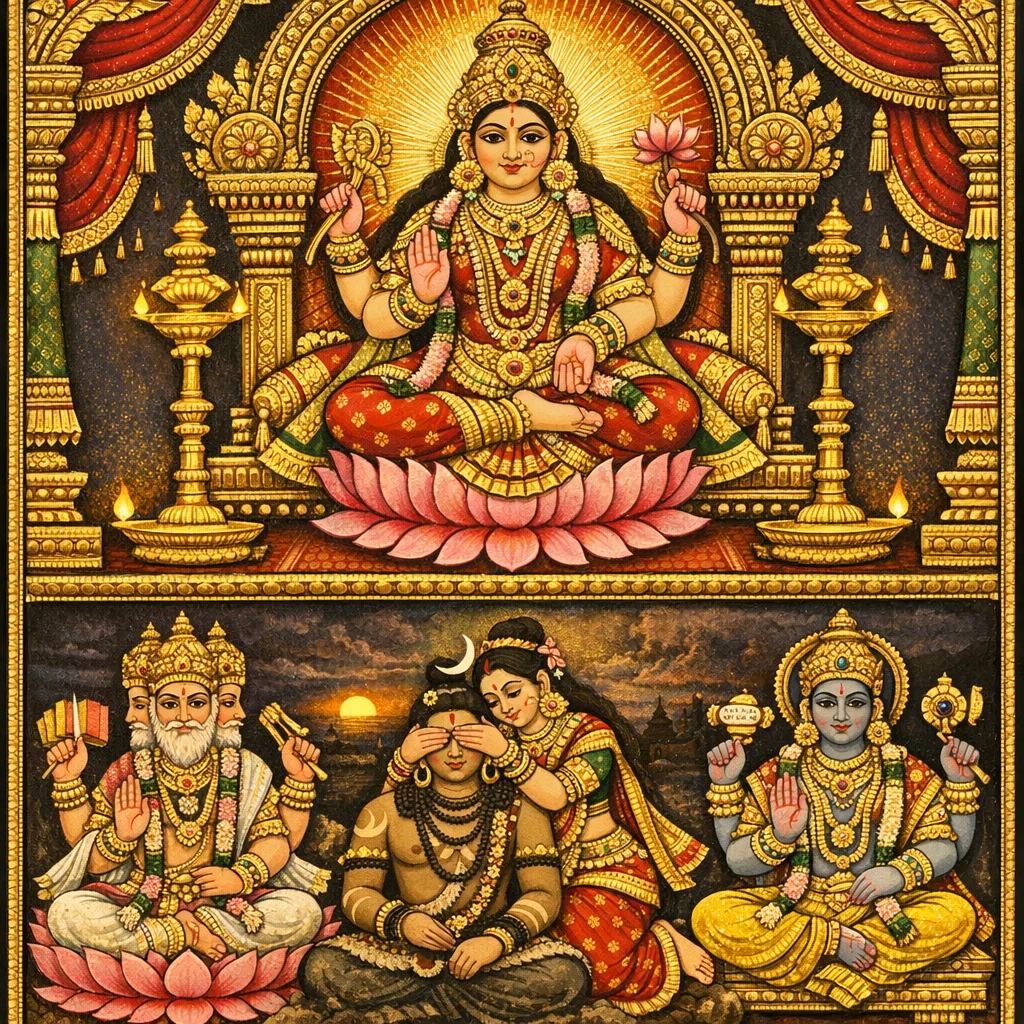
Adhyāya 40 of the Lalitopākhyāna is framed as a dialogue between Hayagrīva and Agastya. Agastya asks how Mahātripurasundarī, famed as Śrī Kāmākṣī, though present on the earthly plane (bhūmaṇḍala), rules as the supreme sovereign. Hayagrīva explains her immanence: even while “here,” she dwells in the hearts of all beings and grants results exactly according to karma. The chapter then turns to cosmic administration: Tripurā and other śaktis are her manifestations, and she is identified with Mahālakṣmī who earlier produced the “three eggs” (aṇḍa-traya), revealing a multi-tiered cosmos. From these arise paired principles (Ambikā–Puruṣottama), and the Goddess arranges functional pairings—Indirā with Mukunda, Pārvatī with Parameśāna, Sarasvatī with Pitāmaha—then assigns Brahmā to creation, Vāsudeva to protection, and Trilocana (Śiva) to dissolution. A mythic exemplum follows: Pārvatī playfully covers Maheśa’s eyes; since sun and moon are linked to his eyes, the worlds fall into darkness, Vedic rites lapse, and Rudra prescribes expiatory tapas in Kāśī. Thus the chapter teaches a cosmology of light, ritual order, and divine responsibility in sustaining dharma.
Shlokas
Verse 1
इति श्रीब्रह्माण्डे महापुराणे उत्तरभागे हयग्रीवागस्त्यसंवादे ललितोपाख्याने एकोनचत्वारिंशो ऽध्यायः अगस्त्य उवाच श्रीकामकोष्ठपीठस्था महात्रिपुरसुन्दरी / कङ्कं विलासमकरोत्कामाक्षीत्यभिविश्रुता
Thus, in the Śrī Brahmāṇḍa Mahāpurāṇa, in the Uttara section, in the dialogue of Hayagrīva and Agastya, in the Lalitopākhyāna, the thirty-ninth chapter. Agastya said: Mahātripurasundarī, abiding on the pīṭha of Śrī Kāmakoṣṭha, famed as Kāmākṣī, performed a playful līlā with the kanka bird.
Verse 2
श्रीकामाक्षीति सा देवी महात्रिपुरसुंदरी / भूमण्डलस्थिता देवी किं करोति महेश्वरी / एतस्याश्चरितं दिव्यं वद मे वदतां वर
That Goddess, Mahātripurasundarī, is known as Śrī Kāmākṣī. The Maheśvarī who abides upon the earth—what does she do? Tell me her divine and wondrous deeds, O best among speakers.
Verse 3
हयग्रीव उवाच अत्र स्थितापि सर्वेषां हृदयस्था घटोद्भव / तत्तत्कर्मानुरूपं सा प्रदत्ते देहिनां फलम्
Hayagrīva said: O Ghaṭodbhava (Agastya), though she abides here, she dwells in the hearts of all. In accord with each one’s deeds, she bestows upon embodied beings their due fruit.
Verse 4
यत्किञ्चिद्वर्तते लोके सर्वमस्या विचेष्टितम् / किञ्चिच्चिन्तयते कश्चित्स्वच्छन्दं विदधात्यसौ
Whatever occurs in the world—everything is her own play of līlā. If anyone so much as thinks of something, she, in her sovereign freedom, brings it to fulfillment.
Verse 5
तस्या एवावतारास्तु त्रिपुराद्याश्च शक्तयः / इयमेव महालक्ष्मीः ससर्जाण्डत्रयं पुरा
Her very incarnations are the Śaktis such as Tripurā and the rest. She herself is Mahālakṣmī, who in ancient times created the three cosmic eggs (aṇḍa-traya).
Verse 6
परत्रयाणामावासं शक्तीनां तिसृणामपि / एकस्मादण्डतो जातावंबिकापुरुषोत्तमौ
It is the abode of the divine triad and likewise the dwelling of the three Śaktis; from a single cosmic egg (aṇḍa) were born together Ambikā and Puruṣottama.
Verse 7
श्रीविरिञ्चौ ततो ऽन्यस्मादन्य स्माच्च गिराशिवौ / इन्दिरां योजयामास मुकुन्देन महेश्वरी / पार्वत्या परमेशानं सरस्वत्या पितामहम्
Then from another cosmic egg arose the glorious Viriñca (Brahmā), and from yet another were born Girā (Sarasvatī) and Śiva. Mahēśvarī joined Indirā (Lakṣmī) with Mukunda (Viṣṇu); through Pārvatī she joined Parameśāna (Śiva), and through Sarasvatī she joined Pitāmaha (Brahmā).
Verse 8
ब्रह्माणं सर्व लोकानां सृष्टिकार्ये न्ययुङ्क्त सा / वासुदेवं परित्राणे संहारे च त्रिलोचनम्
She appointed Brahmā to the work of creating all the worlds, Vāsudeva to the work of protection, and Trilocana (Śiva) to the work of dissolution (saṃhāra).
Verse 9
ते सर्वे ऽपि महालक्ष्मीं ध्यायन्तः शर्मदां सदा / ब्रह्मलोके च वैकुण्ठे कैलासे च वसंत्यमी
All of them, ever meditating on Mahālakṣmī who bestows peace, dwell in Brahmaloka, in Vaikuṇṭha, and on Kailāsa.
Verse 10
कदाचित्पार्वती देवी कैलासशिखरे शुभे / विहरन्ती महेशस्य पिधानं नेत्रयोर्व्यधात्
Once, upon the auspicious peak of Kailāsa, the goddess Pārvatī, sporting with Maheśvara, covered the Lord’s two eyes.
Verse 11
चन्द्रसूर्यौं यतस्तस्य नेत्रात्तस्माज्जगत्त्रयम् / अन्धकारावृतमभूदतेजस्कं समन्ततः
For from His eyes arise the moon and the sun; therefore, when those eyes were covered, the three worlds were shrouded in darkness, bereft of radiance on every side.
Verse 12
ततश्च सकला लोका स्त्यक्तदेवपितृक्तियाः / इति कर्त्तव्यतामूढा न प्रजानन्त किञ्चन
Then all the worlds forsook the rites to the gods and the ancestral Fathers; bewildered about what must be done, they knew nothing at all.
Verse 13
तद्दृष्ट्वा भगवान्रुद्रः पार्वतीमिदमब्रवीत् / त्वया पापं कृतं देवि मम नेत्रपिधानतः
Seeing this, the Blessed Rudra said to Pārvatī: “O Devī, you have committed a sin by covering My eyes.”
Verse 14
ऋषयस्त्यक्ततपसो हतसन्ध्याश्च वैदिकाः / सर्वं च वैदिकं कर्म त्वया नाशितमंबिके
“O Ambikā, the ṛṣis have abandoned their tapas; the Vedic folk have lost the Sandhyā rites; and all Vedic observances have been ruined by you.”
Verse 15
तस्मात्पापस्य शान्त्यर्थं तपः कुरु सुदुष्करम् / गत्वा काशीं व्रतं तत्र किञ्चित्कालं समाचर
Therefore, to bring peace to your sin, perform austerity most difficult. Go to Kāśī and observe a sacred vow there for some time.
Verse 16
पश्चात्काञ्चीपुरं गत्वा कामाक्षीं तत्र द्रक्ष्यसि / आराधयैतां नित्यां त्वं सर्वपापहरीं शिवाम्
Then go to Kāñcīpura; there you shall behold Kāmākṣī. Worship her daily—the auspicious Śivā who removes all sins.
Verse 17
तुलसीमग्रतः कृत्त्वा कम्पाकूले तपः कुरु / इत्यादिश्य महादेवस्तत्रैवान्तरधीयत
Place tulasī before you and perform austerity on the bank of the Kampā. Having thus instructed, Mahādeva vanished there itself.
Verse 18
तथा कृतवतीशानी भर्तुराज्ञानुवर्तिनी / चिरेण तपसा क्लिष्टामनन्यहृदयां शिवाम्
So did Īśānī, obedient to her husband’s command. Long afflicted by austerity, she remained single-hearted, unwavering in Śiva.
Verse 19
अग्रतः कृतसांनिध्या कामाक्षी वाक्यमब्रवीत् / वत्से तपोभिरत्युग्रैरलं प्रीतास्मि सुव्रते
Kāmākṣī, appearing before her, spoke: “Child, these exceedingly fierce austerities are enough; O keeper of a noble vow, I am well pleased with you.”
Verse 20
उन्मील्य नयने पश्चात्पार्वती स्वपुरः स्थिताम् / बालार्कायुतसंकाशां सर्वाभरणभूषिताम्
Then, opening her eyes, Pārvatī beheld Her standing before her—radiant like thousands of young suns, adorned with every ornament.
Verse 21
किरीटहारकेयूरकटकाद्यैरलङ्कृताम् / पाशाङ्कुशेक्षुकोदण्डपञ्चबाणलसत्कराम्
She was adorned with crown, necklace, armlets, bracelets and the like; her shining hands bore the noose (pāśa), the goad (aṅkuśa), the sugarcane bow, and five arrows.
Verse 22
किरीटमुकुटोल्लासिचन्द्ररेखाविभूषणाम् / विधातृहरिरुद्रेशसदाशिवपदप्रदाम्
Upon her crown and diadem shone the ornament of the crescent moon; she is the giver of the exalted station of Vidhātṛ (Brahmā), Hari (Viṣṇu), Rudra, and Sadāśiva.
Verse 23
सगुणं ब्रह्मतामाहुरनुत्तरपदाभिधाम् / प्रपञ्चद्वयनिर्माणकारिणीं तां परांबिकाम्
They declare her to be Brahman with attributes, known as the unsurpassed Supreme State—she, the Supreme Mother (Parāmbikā), who fashions the universe in its twofold manifestation.
Verse 24
तां दृष्ट्वाथ महाराज्ञीं महा नन्दपरिप्लुता / पुलकाचितसर्वाङ्गी हर्षेणोत्फुल्ललोचना
Seeing that Great Queen, she was flooded with immense bliss; her whole body thrilled with gooseflesh, and her eyes blossomed wide with joy.
Verse 25
चण्डिकामङ्गलाद्यैश्च सहसा स्वसखीजनैः / प्रणिपत्य च साष्टाङ्गं कृत्वा चैव प्रदक्षिणाम्
At once, together with her own circle of maiden friends and with Caṇḍikā, Maṅgalā and the rest, she bowed down in the eight-limbed prostration and then performed pradakṣiṇā, reverently circling.
Verse 26
बद्धाञ्जलिपुटा भूयः प्रणता स्वैक्यरूपिणी / तामाह कृपया वीक्ष्य महात्रिपुरसुंदरी
With palms joined in añjali, she bowed again—she who was of one essence with Her; Mahātripurasundarī, gazing with compassion, spoke to her.
Verse 27
बाहुभ्यां संपरिष्वज्य सस्नेहमिदमब्रवीत् / वत्से लभस्व भर्तारं रुद्रं स्वमनसेप्सितम्
Embracing her with both arms, She spoke with affection: “Child, obtain as your lord Rudra, the one your heart has long desired.”
Verse 28
लोके त्वमपि रक्षार्थं ममाज्ञाम नुवर्तय / अहं त्वमिति को भेदस्त्वमेवाहं न संशयः
In the world, for the sake of protection, you too shall follow My command. What difference is there between ‘I’ and ‘you’? You are truly I—of this there is no doubt.
Verse 29
किं पापं तव कल्याणि त्वं हि पापनिकृन्तनी / आमनन्ति हि योगीन्द्रास्त्वामेव ब्रह्मरूपिणीम्
O auspicious one, what sin could ever be yours? You are the cutter of sin itself. The lords among yogins declare that you alone are Brahman in embodied form.
Verse 30
लीलामात्रमिदं वत्से परलोकविडंबनम् / इत्यूचिषीं महाराज्ञीमबिकां सर्वमङ्गला / भक्त्या प्रणम्य पश्यन्ती परां प्रीतिमुपाययौ
“Dear child, this is but līlā alone, a semblance that mimics the other world.” Thus Sarvamaṅgalā Abikā spoke to the great queen. Bowing in bhakti and gazing on, she attained supreme delight.
Verse 31
स्तुवत्यामेव पार्वत्यां तदानीमेव सापरा / प्रविष्टा हृदयं तस्याः प्रहृष्टाया महामुने
O great sage, as Pārvatī was praising, at that very moment the Supreme One entered her heart, as she rejoiced exceedingly.
Verse 32
अथ विस्मयमापन्ना चिन्तयन्ती मुहुर्मुहुः / स्वप्नः किमेष दृष्टो वा मया किमथ वा भ्रमः
Then, struck with wonder, she pondered again and again: “Is this a dream? Or have I truly seen it? Or is it but delusion?”
Verse 33
इत्थं विमृश्य परितः प्रेरयामास लोचने / जयां च विजयां पश्चात्सख्यावालोक्य सस्मिते / प्रसन्नवदना सा तु प्रणते वदति स्म सा
Thus reflecting, she cast her eyes about on every side. Then, smiling, she looked upon her companions Jayā and Vijayā. With a serene and joyful face, she spoke to them as they bowed in reverence.
Verse 34
एतावन्तमलं कालं कुत्र याते युवां प्रिये / मया दृष्टां तु कामाक्षीं युवां चेत्किमपश्यतम्
“My dear ones, where have you two gone for so long? I have beheld Kāmākṣī—why did you not see her?”
Verse 35
सख्यौ तु तद्वचः श्रुत्वा प्रहर्षोत्फुल्ललोचने / पुष्पाणि पूजनार्हाणि निधायाग्रे समूचतुः
Hearing those words, the two friends, their eyes blossoming with delight, placed before them flowers worthy of worship and spoke together.
Verse 36
सत्यमेवाधुना दृष्टा ह्यावाभ्यामपि सा परा / न स्वप्नो न भ्रमो वापि साक्षात्ते हृदयं गता / इत्युक्त्वा पार्श्वयोस्तस्या निषण्णे विनयानते
“Truly, just now that Supreme One has been seen by us both; it is neither dream nor delusion—she has entered your heart directly.” Saying so, they sat at her sides, bowed in humble reverence.
Verse 37
एकाम्रमूले भगवान्भवानीविरहार्तिमान् / गौरीसंप्राप्तये दध्यौ कामाक्षीं नियतेन्द्रियः
At the root of a mango tree, the Blessed Lord Śiva, pained by separation from Bhavānī, meditated on Kāmākṣī with senses restrained, to attain Gaurī once more.
Verse 38
तत्रापि कृतसांनिध्या श्रीविद्यादेवता परा / अचष्ट कृपया तुष्टा ध्यायन्तं निश्चलं शिवम्
There too, the supreme deity of Śrīvidyā drew near in presence; pleased and compassionate, she addressed Śiva as he meditated, unmoving.
Verse 39
अलं ध्यानेन कन्दर्पदर्पघ्न त्वं ममाज्ञया / अङ्गीकुरुष्व कन्दर्पं भूयो मच्छासने स्थितम्
“Enough of meditation, O slayer of Kandarpa’s pride. By my command, accept Kandarpa again, who once more stands under my ordinance.”
Verse 40
एकाम्रसंज्ञे मत्पीठे त्विहैव निवसन्सदा / त्वमेवागत्य मत्प्रीत्यै संनिधौ मम सुव्रत / गौरीमनुगृहाण त्वं कंपानीरनिवासिनीम्
On my pīṭha known as Ekāmra, dwell here always. O you of noble vow, come yourself for my delight, in my very presence; and bestow your grace upon Gaurī, who abides by the waters of Kampā.
Verse 41
तापद्वयं जहीह्याशु योगजं तद्वियोगजम् / इत्युक्त्वान्तर्दधे तस्य हृदये परमा रमा
“Cast off at once the twofold burning sorrow—born of yoga, and born of separation.” Having spoken thus, the Supreme Rāmā vanished into his heart.
Verse 42
शिवो व्युत्थाय सहसा धीरः संहृष्टमानसः / तस्या अनुग्रहं लब्ध्वा सर्वदेवनिषेवितः
Śiva rose at once—steadfast, his heart filled with delight. Having received her favor, he is the One whom all the Devas attend and revere.
Verse 43
हृदिध्यायंश्च तामेव महात्रिपुरसुन्दरीम् / यद्विलासात्समुत्पन्नं लयं याति च यत्र वै
And within his heart he meditated on her alone—Mahātripurasundarī—from whose divine līlā all arises, and in whom indeed all returns to dissolution.
Verse 44
जगच्चराचरं चैतत्प्रपञ्चद्वितयात्मकम् / भूषयन्तीं शिवां कम्पामनुकंपार्द्रमानसाम्
Kampā—Śivā—her heart tender and moist with compassion, adorned this universe, both moving and unmoving, this manifold display of twofold nature.
Verse 45
अङ्गीकृत्य तदा गौरी वैवाहिकविधानतः / आदाय वृषमारुह्य कैलासशिखरं ययौ
Then, having accepted Gaurī according to the sacred rites of marriage, he took her with him; mounting the bull Nandī, he went to the summit of Kailāsa.
Verse 46
पुनरन्यं महप्राज्ञं समाकर्णय कुम्भज / आदिलक्ष्म्याः प्रभावं तु कथयामि तवानघ
Hear again, O Kumbhaja, great in wisdom; to you, O blameless one, I shall recount the majesty of Ādi-Lakṣmī.
Verse 47
सभायां ब्रह्मणो गत्वा समासेदुस्त्रिमुर्त्तयः / दिक्पालाश्च सुराः सर्वे सनकाद्याश्च योगिनः
Going to Brahmā’s assembly hall, the Trimūrti took their seats; the guardians of the directions, all the Devas, and the Yogins led by Sanaka also gathered there.
Verse 48
देवर्षयो नारदाद्या वशिष्ठाद्याश्च तापसाः / ते सर्वे सहितास्तत्र ब्रह्मणश्च कपर्दिनः / द्वयोः पञ्चमुखत्वेन भेदं न विविदुस्तदा
Devarṣis such as Nārada and others, and ascetics such as Vasiṣṭha and others—all of them assembled there with Brahmā and Kapardin (Śiva). Then, since both bore five faces, they could not discern any difference between the two.
Verse 49
अन्योन्यं पृष्टवन्तस्ते ब्रह्मा कः कश्चशङ्करः / तेषां संवदतां मध्ये क्षिप्रमन्तर्हितः शिवः
They questioned one another: “Who is Brahmā, and who is Śaṅkara?” As they spoke among themselves, Śiva swiftly vanished from sight.
Verse 50
तदा पञ्चमुखो ब्रह्मा सितो नारायणस्तयोः / उभयोरपि संवादस्त्वहं ब्रह्मेत्यजायत
Then five-faced Brahmā and radiant, white-hued Nārāyaṇa stood before each other; and in the discourse of the two arose the claim, “I am Brahmā.”
Verse 51
अ५मन्नाभिकमलाज्जातस्त्वं यन्ममात्मजः / सृष्टिकर्ता त्वहं ब्रह्मा नामसाधर्म्यतस्तथा / त्वं च रुद्रश्च मे पुत्रौ सृष्टिकर्तुरुभौ युवाम्
“You, born from the lotus at my navel, are truly my son. You are a creator; and I too am Brahmā, a creator, by kinship of name. You and Rudra are my sons—both of you are makers of creation.”
Verse 52
इति मायामोहितयोरुभयोरन्तरे तदा / तयोश्च स्वस्य माहात्म्यमहं ब्रह्मेति दर्शयन् / प्रादुरासीन्महाज्योतिस्तंभरूपो महेश्वरः
Thus, while both were deluded by māyā, between them Maheśvara appeared—revealing his own majesty as though declaring “I am Brahmā”—as a vast radiance in the form of a pillar.
Verse 53
ज्ञात्वैवैनं महेशानं विष्णुस्तूष्णीं ततः स्थितः / पञ्चवक्त्रस्ततो ब्रह्मा ह्यवमत्यैवमास्थितः / ब्रह्मणः शिरसामूर्ध्वं ज्योतिश्चक्रमभूत्पुरः
Recognizing him as Maheśāna, Viṣṇu then stood in silence. But five-faced Brahmā, still disdainful, persisted in that stance. Above Brahmā’s heads, a wheel of light appeared before him.
Verse 54
तन्मध्ये संस्थितो देवः प्रादुरासोमया सह / ऊर्ध्वमैक्षथ भूयस्तमवमत्य वचो ऽब्रवीत्
In the midst of it, the Deva manifested together with Umā. Brahmā looked upward once more, still in contempt, and spoke words.
Verse 55
तन्निशम्य भृशं क्रोधमवाप त्रिपुरान्तकः / विष्णुमेवं तदालोक्य क्रोधेनैव विकारतः
Hearing this, Tripurāntaka (Śiva) was seized by fierce wrath; and beholding Viṣṇu thus, he was transformed and agitated by that very anger.
Verse 56
तयोरेव समुत्पन्नो भैरवः क्रोधसंयुतः / मूर्धानमेकं चिच्छेद नखेनैव तदा विधेः / हाहेति तत्र सर्वे ऽपि क्रन्दन्तश्च पलायिताः
From those two arose Bhairava, charged with wrath; then, with his nail alone, he severed one head of Vidhe (Brahmā). All there cried “Hā! Hā!”, weeping as they fled.
Verse 57
अथ ब्रह्मकपालं तु नखलग्नं स भैरवः / भूयोभूयो धुनोति स्म तथापि न मुमोच तम्
Then Brahmā’s skull clung fast to Bhairava’s nail; again and again he shook it, yet he could not cast it off.
Verse 58
तद्ब्रह्महत्यामुक्त्यर्थं चचार धरणीतले / पुण्यक्षेत्राणि सर्वाणि गङ्गाद्याश्च महानदीः
To be freed from the sin of brahmahatyā, he wandered upon the earth, visiting every holy kṣetra and the great rivers, Gaṅgā and the rest.
Verse 59
न च ताभिर्विमुक्तो ऽभूत्कपाली ब्रह्महत्यया / विषण्णवदनो दीनो निःश्रीक इव लक्षितः / चिरेण प्राप्तवान्काञ्चीं ब्रह्मणा पूर्वमोषिताम्
Yet Kapālī was not released from the sin of brahmahatyā by those holy places. Downcast in face, wretched and forlorn, as though bereft of splendor, after a long time he reached Kāñcī, once inhabited by Brahmā.
Verse 60
तत्र भिक्षामटन्नित्यं सेवमानः परा श्रियम् / पञ्चतीर्थे प्रतिदिनं स्नात्वा भूलक्षणाङ्किते
There he ever wandered on alms, serving the supreme Śrī; and each day he bathed at the Pañcatīrtha, the ground marked with sacred signs.
Verse 61
कञ्चित्कालमुवासाथ प्रभ्रान्त इव बिल्वलः / काञ्चीक्षेत्रनिवासेन क्रमेण प्रयताशयः
For some time he dwelt there, as though wandering astray about the bilva tree; yet by living in the Kāñcī kṣetra, his heart became, step by step, purified and composed.
Verse 62
निर्धूतनिखिलातङ्कः श्रीदेवीं मनसा वान् / उत्तरे सेवितुं लक्ष्म्या वासुदेवेन दक्षिणे
With every distress dispelled, he held Śrīdevī within his mind; in the north he served Lakṣmī, and in the south Vāsudeva.
Verse 63
श्रीकामकोष्ठमागत्य पुरस्तात्तस्य संस्थितः / आदिलक्ष्मीपदध्यानमाततान यतात्मवान्
Having come to the Śrīkāmakōṣṭha, he stood before that shrine; self-restrained, he spread forth meditation upon the feet of Ādilakṣmī.
Verse 64
यथा दीपो निवातस्थो निस्तरङ्गो यथांबुधिः / तथान्तर्वायुरोधेन न चचाला चलेश्वरः
As a lamp in a windless place, as the ocean without waves; so, by restraining the inner breath, Caleśvara did not stir at all.
Verse 65
तैलधारावदच्छिन्नामनवच्छिन्नभैरवः / वितेने शैलतनयानाथश्रीध्यानसन्ततिम् / न ब्रह्मा नैव विष्णुर्वा न सिद्धः कपिलो ऽपि वा
Bhairava, unbroken like a stream of oil that never snaps, unfolded the continuous succession of sacred Śrī-meditation upon the Lady, the Mountain’s Daughter (Pārvatī). Neither Brahmā nor Viṣṇu, nor any siddha—nor even Kapila—could do so.
Verse 66
नान्ये च सनकाद्या ये मुनयो वा शुकादयः / तया समाधिनिष्ठायां न समर्थाः कथञ्चन
Nor could any others—Sanaka and the rest, or the sages such as Śuka—ever, in any way, abide with firmness in that samādhi.
Verse 67
अथ श्रीभावयोगेन श्रीभावं प्राप्तवाञ्शिवः / ततः प्रसन्ना श्रीदेवी प्रभामण्डलवर्तिनी / अर्धरात्रे पुरः स्थित्वा वाचं प्रोवाच वाङ्मयी
Then Śiva, through the yoga of śrī-bhāva, attained the state of śrī-bhāva. Thereupon Śrī Devī, abiding within a circle of radiance, became gracious; at midnight she stood before him and, as the very embodiment of sacred speech, spoke these words.
Verse 68
श्रीकण्ठ सर्वपापघ्न किं पापं तव विद्यते / मद्रूपस्त्वं कथं देहः सेयं लोकविडम्बना
O Śrīkaṇṭha, destroyer of all sin—what sin could ever be in you? You are of my very form; how, then, is there this body? This is but a worldly delusion, a divine play that confounds the world.
Verse 69
श्वोभूते ब्रह्महत्यायाः क्षणान्मुक्तो भविष्यसि / इत्युक्त्वान्तर्दधे तत्र महासिंहासनेश्वरी
“Tomorrow you shall be freed, in a single moment, from the sin of brahmahatyā,” said the Sovereign Lady of the great lion-throne; and having spoken thus, she vanished there.
Verse 70
भैरवो ऽपि प्रहृष्टात्मा कृतार्थः श्रीविलोकनात् / विनीय तं निशाशेषं श्रीध्यानैकपरायणः
Even Bhairava, his heart exultant, felt his purpose fulfilled upon beholding Śrī. Having settled her to rest through the whole night, he remained devoted solely to meditation on Śrī.
Verse 71
प्रातः पञ्चमहातीर्थे स्नात्वा सन्ध्यामुपास्य च / पुनः पुनर्धूनुते स्म करलग्नं कपालकम्
At dawn he bathed at the Pañca-mahā-tīrtha and performed the Sandhyā worship; then, again and again, he shook the kapālaka—the skull-bowl—clinging to his hand.
Verse 72
तथापि तत्तु नास्रंसत्स निर्वेदं परं गतः / स्वप्नः किमेष माया वा मानसभ्रान्तिरेव वा
Yet it did not come loose; he sank into the utmost dispassion. “Is this a dream? Or māyā? Or merely a delusion of the mind?”
Verse 73
मुहुरेवं विचिन्त्येशः शोकव्याकुलमानसः / स्वयमेव निगृह्याथ शोकं धीराग्रणीः शिवः
Thus pondering again and again, the Lord’s mind was shaken by grief. Yet Śiva, foremost among the steadfast, restrained that sorrow by his own power.
Verse 74
तुलसीमण्डलं नत्वा पूजयित्वा पुरः स्थितः / निगृहीतेन्द्रियग्रामः समाधिस्थो ऽभवत्पुनः
Bowing to the tulasī maṇḍala and worshipping it before him, he restrained the host of senses and once more entered samādhi.
Verse 75
याममात्रे गते देवी पुनः सांनिध्यमागता / अलं समाधिना शम्भो निमज्जात्र सरोवरे
When a single yāma had passed, the Goddess returned to his presence. “Enough of samādhi, O Śambhu; plunge into this lake,” she said.
Verse 76
इत्या दिश्य तिरो ऽधत्त सो ऽपि चिन्तामुपागमत् / इयं च माया स्वप्नो वा किं कर्त्तव्यं मयाथ वा
Having spoken thus, she vanished from sight, and he fell into anxious thought: “Is this māyā, or is it a dream? What then should I do?”
Verse 77
श्वोभूते ब्रह्महत्यायाः क्षणान्मुक्तो भविष्यसि / इत्युक्तं श्रीपरादेव्या यामातीतमिदं दिनम्
“Tomorrow you shall be freed from the sin of brahmahatyā in but a moment,” thus spoke Śrī Parādevī; and that day passed by a yāma.
Verse 78
एवं सर्वं च मिथ्यैवेत्यधिकं चिन्तयावृतः / भगवान्व्यो मवाण्या तु निमज्जाप्स्विति गर्जितम्
Enshrouded in the thought, “All this is but falsehood,” he pondered all the more. Yet the Blessed Lord’s voice thundered: “Plunge into the waters!”
Verse 79
श्रुत्वा शङ्कां समुत्सृज्य तत्त्वं निश्चित्य शङ्करः / निममज्ज सरस्यां तु गङ्गायां पुनरुत्थितः
Hearing this, Śaṅkara cast aside doubt and discerned the truth. He plunged into the pool, and rose again in the river Gaṅgā.
Verse 80
तत्र काशीं समालोक्य किमेतदिति चिन्तयन् / स मुहुर्तं स्थितस्तूष्णीं नखलीनकपालकः
There, beholding Kāśī, he pondered, “What is this?” For a moment he stood in silence, the kapāla—skull-bowl—caught upon the tip of his nail.
Verse 81
ललाटन्त पमुद्वीक्ष्य तरणिं तरुणोन्दुभृत् / भिक्षार्थं नगरीमेनां प्रविवेश वशी शिवः
Lifting his gaze, with sun and youthful moon upon his brow, Śiva—self-mastered—entered this city to seek sacred alms (bhikṣā).
Verse 82
गृहाणि कानिचिद्गत्वा प्रतोल्यां पर्यटन्भवः / सो ऽपश्यदग्रतः काञ्चित्काञ्चीं श्रीदेवताकृतिम्
Bhava (Śiva) went to certain houses and wandered through the lanes; then before him he beheld a woman of Kāñcī, as though the very form of Goddess Śrī.
Verse 83
भिक्षां ज्योतिर्मयीं तस्मै दत्त्वा क्षिप्रं तिरोदधे / क्षणाद्ब्रह्मकपालं तत्प्रच्युतं तन्नखाग्रतः
She gave him alms made of radiance, and swiftly vanished. In that very instant, Brahmā’s kapāla slipped free and fell from the tip of his nail.
Verse 84
तद्दृष्ट्वाद्भुतमीशानः कामाक्षी शीलमुत्तमम् / प्रसन्नवदनांभोजो बहु मेने मुहुः परम्
Seeing that marvel, Īśāna (Śiva) praised the supreme virtue of Kāmākṣī. His lotus-face bright with joy, he again and again deemed it wondrous beyond measure.
Verse 85
पुरी काञ्ची पुरी पुण्या नदी कंपा नदी परा / देवता सैव कामाक्षीत्यासीत्संभावना पुरः
Kāñchī is a holy city, and the Kampā is a supreme river. The Deity there is Kāmākṣī herself, whose glory stands foremost.
Verse 86
इत्थं देवीप्रभावेण विमुक्तः संकटाद्धरः / स्वस्थः स्वस्थानमगमच्छ्लाघमानः परां श्रियम्
Thus, by the Goddess’s power, Dara was freed from distress. Restored and at ease, he returned to his own abode, praising the highest splendor.
Verse 87
पुनरन्यत्प्रवक्ष्यामि विलासं शृणु कुम्भज / प्रभावं श्रीमहादेव्याः कामदं शृण्वतां सदा
Again I shall proclaim another līlā; listen, O Kumbhaja. Hear the power of Śrī Mahādevī, ever wish-fulfilling for those who listen.
Verse 88
अयोध्याधिपतिः श्रीमान्नाम्ना दशरथो नृपः / सन्तानरहितो ऽतिष्ठद्बहुकालं शुचाकुलः
The illustrious lord of Ayodhyā, the king named Daśaratha, was radiant in majesty. Yet childless, he long remained overwhelmed by sorrow.
Verse 89
रहस्याहूय मतिमान्वशिष्ठं स्वपुरोहितम् / उवाचाचारसंशुद्धः सर्वशास्त्रार्थवेदिनम्
Summoning in secret Vasiṣṭha, his own purohita, the wise king spoke to him—pure in conduct and versed in the meaning of all the śāstras.
Verse 90
श्रीनाथ बहवो ऽतीताः कालानाधिगतः सुतः / संततेर्मम संतापः संततं वर्धतेतराम् / किं कुर्वे यदि संतानसंपत्स्यात्तन्निवेदय
O Śrīnātha, Lord of auspicious glory! Many ages have passed, yet no son has been granted. My anguish for the continuance of my line ever increases. What shall I do? If the blessing of offspring may be attained, then declare it to me.
Verse 91
वशिष्ठ उवाच मम वंश महाराज रहस्यं कथयामि ते / अयोध्या मथुरा माया काशी काञ्ची ह्यवन्तिका / एता पुण्यतमाः प्रोक्ताः पुरीणामुत्तमोत्तमाः
Vasiṣṭha said: O great king, I shall tell you the secret of my lineage. Ayodhyā, Mathurā, Māyā, Kāśī, Kāñcī, and Avantikā—these are declared the most holy, the most excellent among cities.
Verse 92
अस्याः सांनिध्यमात्रेण महात्रिपुरसुन्दरीम् / अर्चयन्ति ह्ययोध्यायां मनुष्या अधिदेवताम्
By mere proximity to this city, the people in Ayodhyā worship Mahātripurasundarī as the presiding tutelary Deity (adhidevatā).
Verse 93
नैतस्याः सदृशी काचिद्देवता विद्यते परा / एनामेवर्चयन्त्यन्ये सर्वे श्रीदेवतां नृप
O king, no other Deity exists who is her equal. Therefore all the other gods worship her alone as Śrīdevatā, the Goddess of auspicious fortune.
Verse 94
ब्रह्मविष्णुमहेशाद्याः सस्त्रीकाः सर्वदा सदा / नारिकेलफलालीभिः पनसैः कदलीफलैः
Brahmā, Viṣṇu, Maheśa, and the other gods—together with their consorts—ever and always (make offerings) with coconuts, jackfruit, and bananas.
Verse 95
मध्वाज्यशर्कराप्राज्यैर्महापायसराशिभिः / सिद्धद्रव्यविशेषैश्च पूजयेत्त्रिपुरांबिकाम् / अभीष्टमचिरेणैव संप्रदास्यति सैव नः
With abundant honey, ghee, and sugar, with great heaps of pāyasa, and with special perfected offerings, one should worship Mother Tripurāmbikā; she herself will soon bestow upon us what is desired.
Verse 96
इत्युक्तवन्तमभ्यर्च्य गुरुमिष्टैरुपायनैः / स्वाङ्गजप्राप्तये भूयो विससर्ज विशांपतिः
Having honored and worshiped the guru who spoke thus with pleasing gifts, the lord of the people then sent him forth again, seeking to regain his own son.
Verse 97
ततो गुरूक्तरीत्यैव ललितां परमेश्वरीम् / अर्चयामास राजेन्द्रो भक्त्या परमया युतः
Then, following exactly the rite taught by the guru, the king of kings worshiped Lalitā, the Supreme Goddess Parameśvarī, endowed with the highest devotion.
Verse 98
एवं प्रतिदिनं पूजां विधाय प्रीतमानसः / अयोध्यादेवताधामामशिषत्तत्र सङ्गतः
Thus, performing worship each day with a gladdened heart, he stayed there in Ayodhyā, the abode of the gods, gathered in that holy place.
Verse 99
अर्धरात्रे व्यतीते तु निभृतोल्लासदीपिके / किञ्चिन्निद्रालसस्यास्य पुरतस्त्रिपुरांबिका
When half the night had passed, by the softly gleaming lamp in the stillness, as he lay slightly drowsy, Mother Tripurāmbikā appeared before him.
Verse 100
पाशाङ्कुशधनुर्बाणपरिष्कृतचतुर्भुजा / सर्वशृङ्गारवेषाढ्या सर्वाभरणभूषिता / स्थित्वा वाचमुवाचेमां मन्दमिन्दुमतीसुतम्
The Goddess, four-armed and equipped with noose and goad, bow and arrows, resplendent in every adornment and arrayed with all ornaments, stood and spoke to me gently—me, the son of Indumatī.
Verse 101
अस्ति पङ्क्तिरथ श्रीमन्पुत्रभाग्यं तवानघ / विश्वासघातकर्माणि संति पूर्वकृतानि ते
O illustrious and blameless one, there is indeed a share of fortune for you—the blessing of a son. Yet there are also deeds that betray trust, karmas you performed in former times.
Verse 102
तादृशां कर्मणां शान्त्यै गत्वा काञ्चीपुरं वरम् / स्नात्वा कम्पासरस्यां च तत्र मां पश्य पावनीम्
To pacify such karmas, go to the excellent city of Kāñcīpura. Bathe in the Kampā tank, and there behold me—the Pure One who sanctifies.
Verse 103
मध्ये काञ्चीपुरस्य त्वं कन्दराकाशमध्यगम् / कामकोष्ठं विपाप्मापि सप्तद्वारबिलान्वितम्
In the midst of Kāñcīpura you will see the Kāmakōṣṭha, set between cavern and open sky; even for the sinless, it is a cave endowed with seven gates.
Verse 104
साम्राज्यसूचकं पुंसां त्रयाणामपि सिद्धिदम् / प्राङ्मुखी तत्र वर्ते ऽहं महासिंहासनेश्वरी
It is a sign of sovereignty for men and bestows attainment upon the three as well. There I abide facing east, the Lady enthroned upon the great lion-seat.
Verse 105
महालक्ष्मीस्वरूपेण द्विभुजा पद्मधारिणी / चक्रेश्वरी महाराज्ञी ह्यदृश्या स्थूलचक्षुषाम्
In the form of Mahālakṣmī, two-armed and bearing the lotus; the Sovereign of the Cakra, the Great Queen, unseen by coarse eyes.
Verse 106
ममाक्षिजा महागौरी वर्तते मम दक्षिणे / सौन्दर्यसारसीमा सा सर्वाभरणभूषिता
Mahāgaurī, born of my eyes, abides at my right; she is the utmost bound of beauty’s very essence, adorned with every ornament.
Verse 107
मया च कल्पिताऽवासा द्विभुजा पद्मधारिणी / महालक्ष्मीस्वरूपेण किं वा कृत्यात्मना स्थिता
I too have appointed her dwelling—two-armed, bearing the lotus; in the form of Mahālakṣmī, by what sacred task, as her very nature of action, does she stand there?
Verse 108
आपीठमौलिपर्यन्तं पश्य तस्तां ममांशजाम् / पातकान्याशु नश्यन्ति किं पुनस्तूपपातकम्
Behold my own emanation, from her feet up to her crown; sins swiftly perish—how much more, then, even the gravest sin?
Verse 109
कुवासना कुबुद्धिश्च कुतर्कनिचयश्च यः / कुदेहश्च कुभावश्च नास्तिकत्वं लयं व्रजेत्
Evil inclinations, perverted understanding, and heaps of crooked arguments; a tainted body and a tainted nature—unbelief shall dissolve away.
Verse 110
कुरुष्व मे महापूजां सितामध्वाज्यपायसैः / विविधैर्भक्ष्यभोज्यैश्च पदार्थैः षड्रसान्वितैः
Perform for me a great pūjā, with sugar, honey, ghee, and payasa, and with various foods and delicacies endowed with the six tastes.
Verse 111
तत्रैव सुप्रसन्नाहं पूरयिष्यामि ते वरम् / उपदिश्येति सम्राज्ञी दिव्यमूर्तिस्तिरोदधे
There itself, well pleased, I shall fulfill your boon. Saying, “Thus I instruct you,” the queen’s divine form vanished from sight.
Verse 112
राजापि सहसोत्थाय किमेतदिति विस्मितः / देवीमुद्बोध्य कौसल्यां शुभलक्षणलक्षिताम्
The king too sprang up at once, astonished: “What is this?” and awakened the goddess Kausalyā, marked with auspicious signs.
Verse 113
तस्यै तद्रात्रिवृत्तान्तं कथयामास सादरम् / तत्समा कर्ण्य सा देवी सन्तोषमभजत्तदा
He respectfully recounted to her all that had occurred that night. Hearing it, the queen was then filled with contentment.
Verse 114
प्राप्तहर्षो नृपः प्रातस्तया दयितया सह / अनीकसचिवोपेतः काञ्चीपुरमुपागमत्
In the morning, the king, filled with joy, set out with his beloved queen, accompanied by his army and ministers, and went to Kāñcīpura.
Verse 115
स्नात्वा कंपातरङ्गिण्यां दृष्ट्वा देवीं च पावनीम् / पञ्चतीर्थे ततः स्नात्वा देव्या कौसल्यया नृपः
The king bathed in the river Kampātaraṅgiṇī and beheld the purifying Goddess Pāvanī. Then, bathing at Pañcatīrtha, he bathed again together with the Goddess Kausalyā.
Verse 116
गोभूवस्त्र हिरण्याद्यैस्तत्तीर्थक्षेत्रवासिनः / प्रीणयित्वा सपत्नीकस्तथा तद्भक्तिपूजकान्
With gifts of cows, land, garments, gold, and the like, the king—together with his queen—gladdened the residents of that tīrtha and sacred kṣetra, and likewise honored those devotees who worshipped there in bhakti.
Verse 117
अथालयं समाविश्य महाभक्त्या नृपोत्तमः / प्रदक्षिणत्रयं कृत्वा विनयेन समन्वितः
Then the foremost of kings entered the shrine with great devotion; having performed three pradakṣiṇā, he was filled with humility and reverence.
Verse 118
ततः संनिधिमागत्य देव्या कौसल्यया सह / श्रीकामकोष्ठनिलयं महात्रिपुरसुन्दरीम्
Then, drawing near to the divine Presence together with the Goddess Kausalyā, he beheld Mahātripurasundarī, who abides in Śrīkāmakoṣṭhanilaya.
Verse 119
त्रिमूर्तिजननीमंबां दृष्ट्वा श्रीचक्ररूपिणीम् / प्रणिपत्य तु साष्टाङ्गं भार्यया सह भक्तिमान्
Filled with devotion, the king beheld Mother Ambā, the begetter of the Trimūrti, manifested in the form of the Śrīcakra; and, together with his wife, he bowed down in sāsṭāṅga prostration.
Verse 120
स्वपुरे त्रैपुरे धाम्नि पुरेक्ष्वाकुप्रवर्तिते / दुर्वासा सशिष्येण पूजार्थं पूर्वकल्पिते
In his own city, in the sacred abode of Traipura—founded by the line of Ikṣvāku—sage Durvāsā, with his disciple, arrived for worship ordained from a former kalpa.
Verse 121
दासीदासध्वजारोहगृहोत्सवसमन्विते / तत्र स्वगुरुणोक्तं च कृत्वा स्वात्मार्घपूजनम्
There, amid maidservants and servants, raised banners and household festivities, he followed his guru’s word and performed the arghya-offering, worshipping his own ātman.
Verse 122
रात्रौ स्वप्ने तु यद्रूपं दृष्टवान्स्वपुरे महः / तदेवात्रापि संदध्यौ सन्निधौ राजसत्तमः
At night, in a dream, the great one beheld a certain form in his own city; that very form the best of kings also here composed within his mind, in the very presence.
Verse 123
चिरं ध्यात्वा महाराजः सुवासांसि बहूनि च / दिव्यान्यायतनान्यस्यै दत्त्वा स्तोत्रं चकार ह
Having meditated for a long while, the great king bestowed many fine garments and divine seats and appurtenances upon her; then he composed and chanted a hymn of praise.
Verse 124
पादाग्रलंबिपरमाभरणाभिरामेमञ्जीररत्नरुचिमञ्जुलपादपद्मे / पीतांबरस्फुरितपेशलहेमकाञ्चि केयूरकङ्कणपरिष्कृतबाहुवल्लि
Her lotus-feet are lovely with the radiance of jeweled mañjīra anklets, adorned with supreme ornaments that hang down to the very tips of her toes; she shines in a yellow garment, girded with a graceful golden belt, and her vine-like arms are embellished with keyūra armlets and bracelets.
Verse 125
पुण्ड्रेक्षुचापविलसन्मृदुवामपाणे रत्नोर्मिकासुमशराञ्चितदक्षहस्ते / वक्षोजमण्डलविलासिवलक्षहारि पाशाङ्कुशाङ्गदलसद्भुजशोभिताङ्गि
O Divine Mother, in Your tender left hand shines the sugarcane bow; in Your right, adorned with jeweled rings, You hold flower-arrows. Your breast is graced by a charming white necklace, and Your form is beautified by arms bearing the pāśa (noose) and aṅkuśa (goad).
Verse 126
वक्त्रश्रिया विजितशारदचन्द्रबिंबे ताटङ्करत्नकरमण्डितगण्डभागे / वामे करे सरसिजं सुबिसं दधाने कारुण्यनिर्झरदपाङ्गयुते महेशि
O Maheśī, the beauty of Your face surpasses the autumn moon; Your cheeks are adorned with jeweled earrings. In Your left hand You hold a lotus with its fibers, and in Your sidelong glance pours a waterfall of compassion.
Verse 127
माणिक्यसूत्रमणिभासुरकंबुकण्ठि भालस्थचन्द्रशकलोज्जवलितालकाढ्ये / मन्दस्मितस्फुरणशालिनि मञ्जुनासे नेत्रश्रिया विजितनीलसरोजपत्रे
Your conch-like neck shines with strands of ruby gems; Your dark, abundant hair is illumined by the crescent moon upon Your brow. A gentle flicker of smile plays upon Your lovely nose, and the beauty of Your eyes surpasses the petals of the blue lotus.
Verse 128
सुभ्रूलते सुवदने सुललाटचित्रे योगीन्द्रमानससरोजनिवासहंसि / रत्नानुबद्धतपनीयमहाकिरीटे सर्वाङ्गसुन्दरि समस्तसुरेन्द्रवन्द्ये
O You with vine-like brows, a lovely face, and a finely adorned forehead; O Haṃsī dwelling in the lotus-lake of the Yogīndras’ minds. You wear a great golden crown set with gems; beautiful in every limb, You are revered by all the lords of the gods.
Verse 129
काङ्क्षानुरूपवरदे करुणार्द्रचित्ते साम्राज्यसम्पदभिमानिनि चक्रनाथे / इन्द्रादिदेवपरिसेवितपादपद्मे सिंहासनेश्वरी परे मयि संनिदध्याः
O Bestower of boons according to one’s longing, whose heart is softened with compassion; O Cakranāthā, Mistress of imperial splendor. The lotus of Your feet is attended by Indra and the gods; O Sovereign of the lion-throne, Supreme One, abide within me.
Verse 130
इति स्तत्वा स भूपालो बहिर्निर्गत्य भक्तितः / तस्यास्तु दक्षिणे भागे महागौरीं ददर्श ह
Thus having offered praise, the king rose and, in devotion, went outside; on the right side there he beheld Mahāgaurī.
Verse 131
प्रणम्य दण्डवद्भूमौ कृत्वा चास्याः स्तुतिं पुनः / दत्त्वा चास्यै महार्हाणि वासांसि विविधानि च
Prostrating himself on the ground like a staff, he again sang her praise; and he offered her garments of great worth, of many kinds.
Verse 132
अमुल्यानि महार्हाणि भूषणानि महान्ति च / ततः प्रदक्षिणीकृत्य निर्गत्य सह भार्यया
He offered great ornaments too—priceless and most precious; then, having made pradakṣiṇā, he departed with his queen.
Verse 133
स्वगुरूक्तविधानेन महापूजां विधाय च / तामेव चिन्तयंस्तत्र सप्तरात्रमुवास सः
By the rite taught by his own guru, he performed the great Mahāpūjā; and there he stayed for seven nights, meditating on her alone.
Verse 134
अष्टमे दिवसे देवीं नत्वा भक्त्या विलोकयन् / अम्बाभीष्टं प्रदेहीति प्रार्थयामास चेतसा
On the eighth day, bowing to the Goddess in devotion and gazing upon her, he prayed within his heart: “O Mother, grant me what I desire.”
Verse 135
सुप्रसन्ना च कामाक्षी सांतरिक्षगिरावदत् / भविष्यन्ति मदंशास्ते चत्वारस्तनया नृप
Then Kāmākṣī, greatly pleased, spoke with a voice from the sky: “O king, four sons shall be born—each a portion of My own being.”
Verse 136
इत्युदीरितमाकर्ण्य प्रमोदविकसन्मुखः / श्रियं प्रणम्य साष्टाङ्गमननन्यशरणः पराम्
Hearing these words, his face blossomed with joy; he bowed to the supreme Śrī in eight-limbed prostration, taking refuge in Her alone.
Verse 137
आमन्त्र्य मनसैवांबां सस्त्रीकः सह मन्त्रिभिः / अयोध्यां नगरीं प्रापदिन्दुमत्यास्तु नन्दनः
Bidding farewell in his heart to Mother Ambā, and accompanied by his queen and ministers, Indumatī’s son reached the city of Ayodhyā.
Verse 138
एवं प्रभावा कामाक्षी सर्वलोकहितैषिणी / सर्वेषामपि भक्तानां काङ्क्षितं पूरयत्यलम्
Such is the majesty of Kāmākṣī, who seeks the welfare of all worlds: she abundantly fulfills the desires of all devotees.
Verse 139
एनां लोकेषु बहवः कामाक्षीं परदेवताम् / उपास्य विधिवद्भक्त्या प्राप्ताः कामानशेषतः
In the worlds, many have worshiped Kāmākṣī, the supreme Goddess, with devotion according to sacred rite, and have attained every desire without remainder.
Verse 140
अद्यापि प्राप्नुवन्त्येव भक्तिमन्तः फलं मुने / अनेके च भविष्यन्ति कामाक्ष्याः करुणादृशः
Even today, O sage, the devoted indeed attain the fruit; and in times to come, many shall receive the compassionate gaze of Kāmākṣī.
Verse 141
माहात्म्यमस्याः श्रीदेव्याः को वा वर्णयितुं क्षमः / नाहं न शम्भुर्न ब्रह्मा न विष्णुः किमुतापरे
Who could possibly describe the greatness of this holy Śrī Devī? Not I, not Śambhu (Śiva), not Brahmā, not Viṣṇu—how much less anyone else.
Verse 142
इति ते कथितं किञ्चित्कामाक्ष्याः शीलमुज्ज्वलम् / शृण्वतां पठतां चापि सर्वपापहरं स्मृतम्
Thus have I told you a little of Kāmākṣī’s radiant virtue. It is remembered that for those who hear it and those who recite it, it removes all sins.
Frequently Asked Questions
It asserts dual-location theology: the Goddess is locally worshippable (tīrtha/seat on earth) while simultaneously immanent as the inner regulator who distributes karma-phala, making cosmology and ethics operate through the same śakti-principle.
By explicitly assigning Brahmā to sṛṣṭi, Vāsudeva to protection, and Śiva (Trilocana) to saṃhāra, while presenting Mahālakṣmī/Śakti as the sovereign power that authorizes and coordinates these offices.
Śiva’s eyes are linked to the sun and moon; covering them collapses cosmic illumination, which in turn disrupts ritual timekeeping and Vedic observance. The episode frames dharma as dependent on cosmic light and prescribes restoration through tapas and a Kāśī-vrata as corrective alignment.