Chapter 1: Arjuna Vishada Yoga
अर्जुनविषादयोग
The Yoga of Arjuna's Despondency
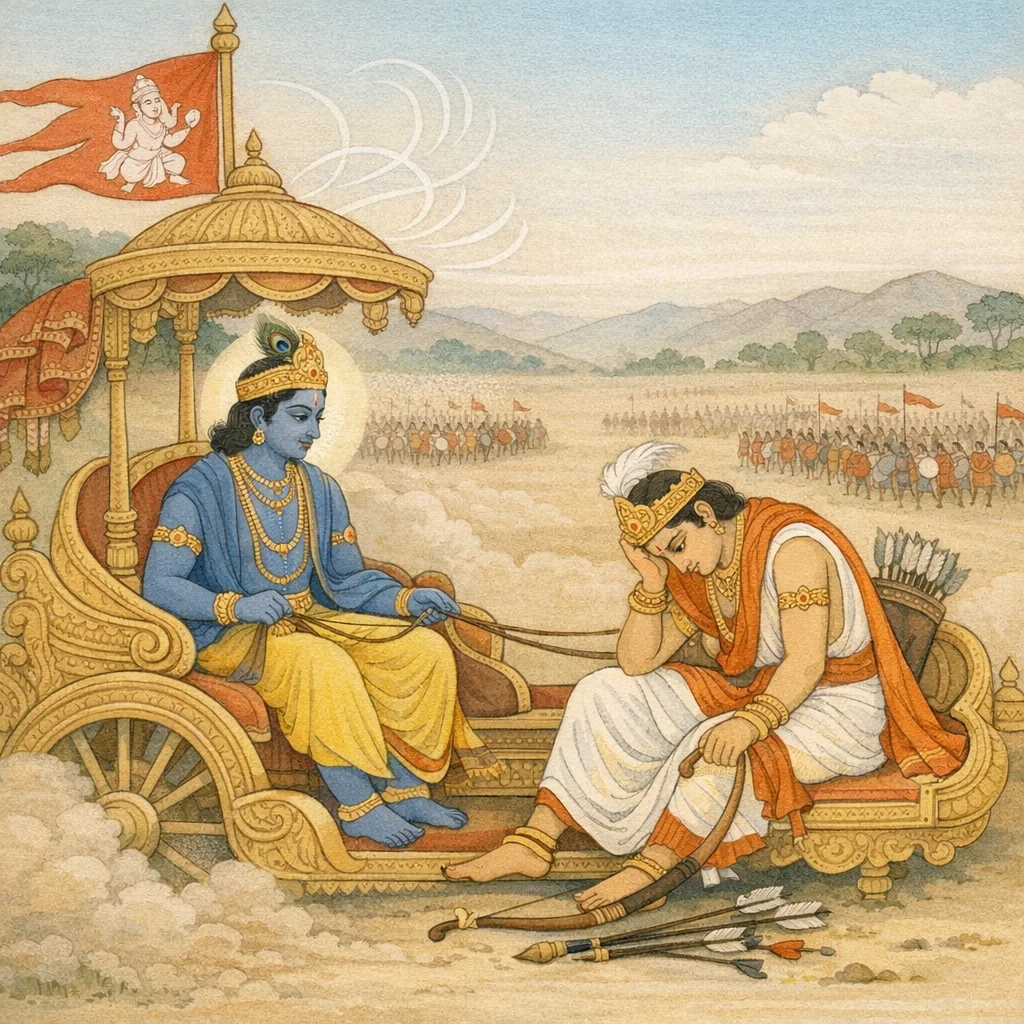
Chapter 1 sets the Bhagavad Gita as a profound dialogue on the dharma-field of Kurukshetra, where outward duty and inward conscience collide. Dhritarashtra’s question, conveyed through Sanjaya’s vision, heightens the moral tension of the “field of action,” while the conches, banners, and ordered battle arrays stand as solemn signs of resolve, obligation, and the weight of choice. Placed between the two armies, Arjuna asks to behold those assembled and swiftly moves from warriorly readiness to inner collapse. Overcome by attachment and compassion, and fearing the ruin of family order and sacred tradition, he doubts the value of victory when it demands the destruction of kin and inherited duties. Thus the chapter presents the central crisis Yoga must heal: the fall of agency under moha, where discernment is eclipsed by emotion. Arjuna’s despondent pause, akin to surrender, prepares the ground for Krishna’s forthcoming teaching on disciplined insight, right action, and steadfast dharma.
Speakers
Key Concepts
Philosophical Constructs
Shlokas in Chapter 1
Verse 1
धृतराष्ट्र उवाच । धर्मक्षेत्रे कुरुक्षेत्रे समवेता युयुत्सवः मामकाः पाण्डवाश्चैव किमकुर्वत सञ्जय ॥
Dhṛtarāṣṭra said: O Sañjaya, gathered on the field of Dharma—Kurukṣetra—desiring to fight, what did my sons and the sons of Pāṇḍu do?
Verse 2
सञ्जय उवाच । दृष्ट्वा तु पाण्डवानीकं व्यूढं दुर्योधनस्तदा आचार्यमुपसङ्गम्य राजा वचनमब्रवीत् ॥
Sañjaya said: Then, seeing the Pāṇḍava army drawn up in battle-array, King Duryodhana approached his teacher and spoke these words.
Verse 3
पश्यैतां पाण्डुपुत्राणामाचार्य महतीं चमूम् । व्यूढां द्रुपदपुत्रेण तव शिष्येण धीमता ॥
Behold, O teacher, this mighty host of the sons of Pāṇḍu, arrayed in formation by the son of Drupada—your wise disciple.
Verse 4
अत्र शूरा महेष्वासा भीमार्जुनसमा युधि । युयुधानो विराटश्च द्रुपदश्च महारथः ॥
Here are heroes, great bowmen, equal in battle to Bhīma and Arjuna: Yuyudhāna, and Virāṭa, and Drupada—the great chariot-warrior.
Verse 5
धृष्टकेतुश्चेकितानः काशिराजश्च वीर्यवान् । पुरुजित्कुन्तिभोजश्च शैब्यश्च नरपुङ्गवः ॥
Dhṛṣṭaketu and Cekitāna, and the valiant king of Kāśī; and Purujit and Kuntibhoja, and Śaibya—the best among men.
Verse 6
युधामन्युश्च विक्रान्त उत्तमौजाश्च वीर्यवान् । सौभद्रो द्रौपदेयाश्च सर्व एव महारथाः ॥
Yudhāmanyu the valiant, Uttamaujā the mighty, the son of Subhadrā, and the sons of Draupadī—all indeed are great chariot-warriors.
Verse 7
अस्माकं तु विशिष्टा ये तान्निबोध द्विजोत्तम । नायका मम सैन्यस्य संज्ञार्थं तान्ब्रवीमि ते ॥
But, O best of the twice-born, know also those distinguished on our side—the leaders of my army; for your understanding I shall name them to you.
Verse 8
भवान्भीष्मश्च कर्णश्च कृपश्च समितिंजयः । अश्वत्थामा विकर्णश्च सौमदत्तिस्तथैव च ॥
You yourself, Bhīṣma, Karṇa, and Kṛpa—the conqueror in battle; Aśvatthāmā, Vikarṇa, and also the son of Somadatta.
Verse 9
अन्ये च बहवः शूरा मदर्थे त्यक्तजीविताः । नानाशस्त्रप्रहरणाः सर्वे युद्धविशारदाः ॥
And many other heroes too, for my sake resolved to lay down their lives—wielding diverse weapons and skilled in the art of war.
Verse 10
अपर्याप्तं तदस्माकं बलं भीष्माभिरक्षितम् । पर्याप्तं त्विदमेतेषां बलं भीमाभिरक्षितम् ॥
That army of ours, guarded by Bhīṣma, is indeed insufficient; but this army of theirs, guarded by Bhīma, is sufficient.
Verse 11
अयनेषु च सर्वेषु यथाभागमवस्थिताः । भीष्ममेवाभिरक्षन्तु भवन्तः सर्व एव हि ॥ १.११ ॥
Therefore, stationed in all the battle-formations, each in his allotted place, all of you indeed protect Bhīṣma alone on every side.
Verse 12
तस्य सञ्जनयन्हर्षं कुरुवृद्धः पितामहः । सिंहनादं विनद्योच्चैः शङ्खं दध्मौ प्रतापवान् ॥ १.१२ ॥
Then, to kindle his joy, the aged grandsire of the Kurus, the mighty Bhīṣma, roared like a lion and blew his conch aloud.
Verse 13
ततः शङ्खाश्च भेर्यश्च पणवानकगोमुखाः । सहसैवाभ्यहन्यन्त स शब्दस्तुमुलोऽभवत् ॥ १.१३ ॥
Thereafter, conches and kettledrums, tabors and drums, and horns were sounded all at once; that uproar became tremendous.
Verse 14
ततः श्वेतैर्हयैर्युक्ते महति स्यन्दने स्थितौ । माधवः पाण्डवश्चैव दिव्यौ शङ्खौ प्रदध्मतुः ॥ १.१४ ॥
Then, stationed on the great chariot yoked with white horses, Mādhava and the son of Pāṇḍu blew their divine conches.
Verse 15
पाञ्चजन्यं हृषीकेशो देवदत्तं धनञ्जयः । पौण्ड्रं दध्मौ महाशङ्खं भीमकर्मा वृकोदरः ॥ १.१५ ॥
Hṛṣīkeśa blew the Pāñcajanya; Dhanañjaya blew the Devadatta; and Vṛkodara, of mighty deeds, blew the great conch named Pauṇḍra.
Verse 16
अनन्तविजयं राजा कुन्तीपुत्रो युधिष्ठिरः । नकुलः सहदेवश्च सुघोषमणिपुष्पकौ ॥ १.१६ ॥
King Yudhiṣṭhira, son of Kuntī, blew the conch named Anantavijaya; and Nakula and Sahadeva blew the conches named Sughoṣa and Maṇipuṣpaka.
Verse 17
काश्यश्च परमेष्वासः शिखण्डी च महारथः । धृष्टद्युम्नो विराटश्च सात्यकिश्चापराजितः ॥ १.१७ ॥
And the supreme archer, the king of Kāśī; and Śikhaṇḍī, the great chariot-warrior; Dhṛṣṭadyumna and Virāṭa; and Sātyaki, the unconquered—
Verse 18
द्रुपदो द्रौपदेयाश्च सर्वशः पृथिवीपते । सौभद्रश्च महाबाहुः शङ्खान्दध्मुः पृथक्पृथक् ॥ १.१८ ॥
O lord of the earth! Drupada, the sons of Draupadī, and the mighty-armed son of Subhadrā (Abhimanyu)—all of them, each in his own way, blew their conches separately.
Verse 19
स घोषो धार्तराष्ट्राणां हृदयानि व्यदारयत् । नभश्च पृथिवीं चैव तुमुलोऽभ्यनुनादयन् ॥ १.१९ ॥
That tumultuous sound tore through the hearts of Dhṛtarāṣṭra’s sons, and resounded through the sky and the earth alike.
Verse 20
अथ व्यवस्थितान्दृष्ट्वा धार्तराष्ट्रान्कपिध्वजः प्रवृत्ते शस्त्रसम्पाते धनुरुद्यम्य पाण्डवः हृषीके...
Then Arjuna, the son of Pāṇḍu, whose banner bore the emblem of Hanumān, seeing Dhṛtarāṣṭra’s sons drawn up in battle array, and as the clash of weapons was about to begin, lifted his bow and spoke these words to Hṛṣīkeśa (Śrī Kṛṣṇa).
Verse 21
हृषीकेशं तदा वाक्यमिदमाह महीपते । अर्जुन उवाच । सेनयोरुभयोर्मध्ये रथं स्थापय मेऽच्युत ॥ १.२१ ॥
Arjuna said: O Acyuta, place my chariot between the two armies.
Verse 22
यावदेतान्निरीक्षेऽहं योद्धुकामानवस्थितान् । कैर्मया सह योद्धव्यमस्मिन् रणसमुद्यमे ॥ १.२२ ॥
So that I may observe those standing here, eager to fight, and know with whom I must contend in this enterprise of war.
Verse 23
योत्स्यमानानवेक्षेऽहं य एतेऽत्र समागताः । धार्तराष्ट्रस्य दुर्बुद्धेर्युद्धे प्रियचिकीर्षवः ॥ १.२३ ॥
I desire to behold those who have assembled here to fight, wishing to do what is pleasing in battle to the misguided son of Dhṛtarāṣṭra.
Verse 24
सञ्जय उवाच । एवमुक्तो हृषीकेशो गुडाकेशेन भारत सेनयोरुभयोर्मध्ये स्थापयित्वा रथोत्तमम् ॥ १.२४ ॥
Sañjaya said: Thus addressed by Guḍākeśa, O Bhārata, Hṛṣīkeśa placed the excellent chariot between the two armies.
Verse 25
भीष्मद्रोणप्रमुखतः सर्वेषां च महीक्षिताम् । उवाच पार्थ पश्यैतान्समवेतान्कुरूनिति ॥ १.२५ ॥
In front of Bhīṣma and Droṇa, and of all the rulers, he said: O Pārtha, behold these Kurus assembled here.
Verse 26
तत्रापश्यत्स्थितान्पार्थः पितॄनथ पितामहान् । आचार्यान्मातुलान्भ्रातॄन्पुत्रान्पौत्रान्सखींस्तथा ॥ १.२६ ॥
There Pārtha beheld, standing arrayed, fathers and grandfathers, teachers, maternal uncles, brothers, sons, grandsons, and friends as well.
Verse 27
श्वशुरान्सुहृदश्चैव सेनयोरुभयोरपि । तान्समीक्ष्य स कौन्तेयः सर्वान्बन्धूनवस्थितान् ॥ १.२७ ॥
And fathers-in-law and well-wishers too, in both armies. Beholding all those kinsmen standing there, the son of Kuntī (Arjuna)…
Verse 28
कृपया परयाविष्टो विषीदन्निदमब्रवीत् । अर्जुन उवाच । दृष्ट्वेमं स्वजनं कृष्ण युयुत्सुं समुपस्थितम् ॥ १.२८ ॥
Overwhelmed by supreme compassion, grieving, he spoke thus. Arjuna said: O Kṛṣṇa, seeing this my own people assembled, eager to fight…
Verse 29
वेपथुश्च शरीरे मे रोमहर्षश्च जायते । गाण्डीवं स्रंसते हस्तात्त्वक्चैव परिदह्यते ॥ १.२९ ॥
My limbs tremble, and my hair stands on end; the Gāṇḍīva slips from my hand, and my skin burns all over.
Verse 30
गाण्डीवं स्रंसते हस्तात्त्वक्चैव परिदह्यते । न च शक्नोम्यवस्थातुं भ्रमतीव च मे मनः ॥ १.३० ॥
The Gāṇḍīva slips from my hand, and my skin burns; I am unable to stand, and my mind seems to reel.
Verse 31
न च श्रेयोऽनुपश्यामि हत्वा स्वजनमाहवे । न काङ्क्षे विजयं कृष्ण न च राज्यं सुखानि च ॥ १.३१ ॥
I do not perceive any true good in slaying my own kinsmen in battle. O Kṛṣṇa, I desire neither victory, nor kingdom, nor pleasures.
Verse 32
किं नो राज्येन गोविन्द किं भोगैर्जीवितेन वा । येषामर्थे काङ्क्षितं नो राज्यं भोगाः सुखानि च ॥ १.३२ ॥
O Govinda, what use is a kingdom to us, or enjoyments, or even life itself? Those for whose sake we longed for kingdom, enjoyments, and pleasures—
Verse 33
येषामर्थे काङ्क्षितं नो राज्यं भोगा: सुखानि च | त इमेऽवस्थिता युद्धे प्राणांस्त्यक्त्वा धनानि च ॥ १.३३ ॥
—those for whose sake we desired kingdom, enjoyments, and pleasures, those very persons stand here in battle, having renounced life and wealth.
Verse 34
आचार्या: पितर: पुत्रास्तथैव च पितामहा: | मातुला: श्वशुरा: पौत्रा: श्याला: सम्बन्धिनस्तथा॥ १.३४ ॥
Teachers, fathers, sons, and likewise grandfathers; maternal uncles, fathers-in-law, grandsons, brothers-in-law, and other relatives—(all are here).
Verse 35
एतान्न हन्तुमिच्छामि घ्नतोऽपि मधुसूदन | अपि त्रैलोक्यराज्यस्य हेतो: किं नु महीकृते ॥ १.३५ ॥
O Madhusūdana, I do not wish to slay these—even if they slay us—not even for the sake of sovereignty over the three worlds; how much less for the earth alone.
Verse 36
पापमेवाश्रयेदस्मान्हत्वैतानाततायिनः । तस्मान्नार्हा वयं हन्तुं धार्तराष्ट्रान्सबान्धवान् । स्वजनं हि कथं हत्वा सुखिनः स्याम माधव ॥ १.३६ ॥
Sin alone would come upon us by slaying these aggressors; therefore we are not fit to kill the sons of Dhṛtarāṣṭra along with their kinsmen. For how, O Mādhava, could we be happy after killing our own people?
Verse 37
यद्यप्येते न पश्यन्ति लोभोपहतचेतसः । कुलक्षयकृतं दोषं मित्रद्रोहे च पातकम् ॥ १.३७ ॥
Though these people, their minds overpowered by greed, do not see the fault that arises from the destruction of the family, nor the sin in betraying friends…
Verse 38
कथं न ज्ञेयमस्माभिः पापादस्मान्निवर्तितुम् । कुलक्षयकृतं दोषं प्रपश्यद्भिर्जनार्दन ॥ १.३८ ॥
How could it not be known by us to turn away from sin, O Janārdana—we who clearly perceive the fault arising from the destruction of the family?
Verse 39
कुलक्षये प्रणश्यन्ति कुलधर्माः सनातनाः । धर्मे नष्टे कुलं कृत्स्नमधर्मोऽभिभवत्युत ॥ १.३९ ॥
With the destruction of the family, the eternal duties of the family perish; when dharma is destroyed, adharma indeed overwhelms the entire family.
Verse 40
अधर्माभिभवात्कृष्ण प्रदुष्यन्ति कुलस्त्रियः । स्त्रीषु दुष्टासु वार्ष्णेय जायते वर्णसङ्करः ॥ १.४० ॥
When adharma prevails, O Kṛṣṇa, the women of the family become corrupted; when women are corrupted, O Vārṣṇeya, varṇa-saṅkara (confusion of social order) arises.
Verse 41
सङ्करो नरकायैव कुलघ्नानां कुलस्य च । पतन्ति पितरो ह्येषां लुप्तपिण्डोदकक्रियाः ॥ १.४१ ॥
Verse 42
दोषैरेतैः कुलघ्नानां वर्णसङ्करकारकैः । उत्साद्यन्ते जातिधर्माः कुलधर्माश्च शाश्वताः ॥ १.४२ ॥
Verse 43
उत्सन्नकुलधर्माणां मनुष्याणां जनार्दन । नरकेऽनियतं वासो भवतीत्यनुशुश्रुम ॥ १.४३ ॥
Verse 44
अहो बत महत्पापं कर्तुं व्यवसिता वयम् । यद्राज्यसुखलोभेन हन्तुं स्वजनमुद्यताः ॥ १.४४ ॥
Verse 45
यदि मामप्रतीकारमशस्त्रं शस्त्रपाणयः । धार्तराष्ट्रा रणे हन्युस्तन्मे क्षेमतरं भवेत् ॥ १.४५ ॥
Verse 46
सञ्जय उवाच । एवमुक्त्वार्जुनः संख्ये रथोपस्थ उपाविशत् विसृज्य सशरं चापं शोकसंविग्नमानसः ॥ १.४६ ॥
Sanjaya said: Having spoken thus on the battlefield, Arjuna, his mind overwhelmed with sorrow, sat down on the seat of the chariot, casting aside his bow along with the arrows.
Frequently Asked Questions
Chapter 1 maps how acute stress can collapse discernment: Arjuna’s attention shifts from purpose to personal attachment, producing somatic anxiety, cognitive doubt, and withdrawal from agency. The takeaway is diagnostic—recognizing Vishada and Moha as conditions that require disciplined clarity rather than impulsive avoidance.
This chapter primarily prepares the metaphysical inquiry rather than completing it: it shows that identity grounded only in relational roles and outcomes destabilizes decision-making. The deeper teaching about the Self (Atman) is not yet stated explicitly, but the need for a stable inner basis beyond changing social ties is clearly established.
It does not resolve the dilemma directly; it formalizes it. By placing Arjuna between both sides and having him articulate ethical, social, and spiritual concerns, the text establishes the precise problem Yoga must solve—how to act in alignment with dharma when emotions and attachments obscure judgment.
Use Chapter 1 as a leadership and mental-clarity template: (1) pause before major decisions to name the real conflict (values vs. attachment), (2) separate role-duty from fear of social fallout, (3) notice stress signals as data, not directives, and (4) seek principled guidance and a stable framework before acting—especially in high-stakes professional or family contexts.