
Shloka 46
Arjuna Vishada Yoga — The Yoga of Arjuna's Despondency
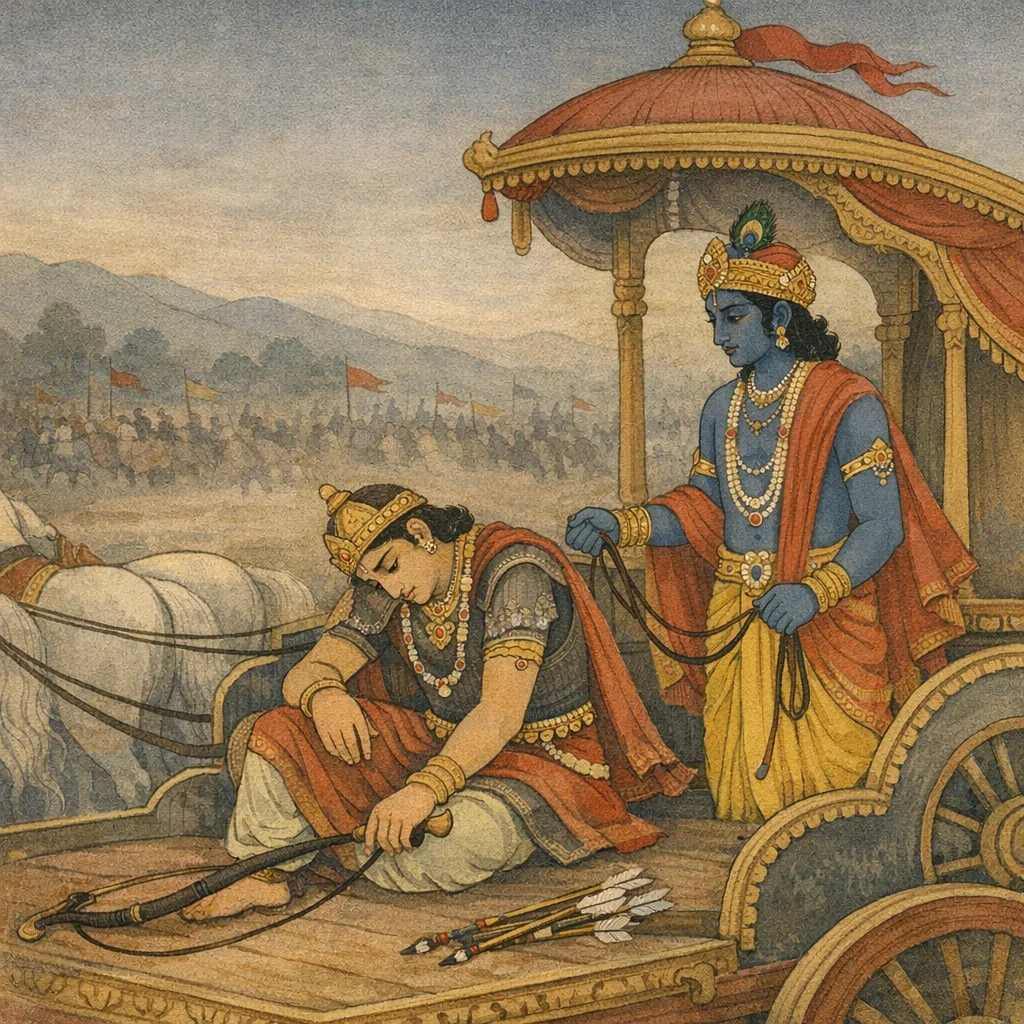
सञ्जय उवाच । एवमुक्त्वार्जुनः संख्ये रथोपस्थ उपाविशत् विसृज्य सशरं चापं शोकसंविग्नमानसः ॥ १.४६ ॥
sañjaya uvāca | evam uktvā arjunaḥ saṅkhye rathopastha upāviśat | visṛjya saśaraṃ cāpaṃ śokasaṃvignamānasaḥ || 1.46 ||

Sanjaya said: Having spoken thus on the battlefield, Arjuna, his mind overwhelmed with sorrow, sat down on the seat of the chariot, casting aside his bow along with the arrows.
संजय बोले—ऐसा कहकर शोक से व्याकुल मन वाला अर्जुन रणभूमि में रथ के आसन पर बैठ गया और बाण सहित धनुष को छोड़ दिया।
Sañjaya said: Having spoken thus, Arjuna, his mind shaken by grief, sat down on the chariot-seat in the midst of the battlefield, casting aside his bow along with its arrows.
Most translations agree closely. Academically, the gesture of laying down the bow is often read as a symbolic collapse of agency—an embodied sign of existential and ethical crisis.
FAQs
The physical act of sitting down and releasing the bow externalizes inner collapse: grief overwhelms decision-making capacity.
Indirect: the scene prepares for teachings on the self, action, and discernment by showing the limits of ordinary coping in moral crisis.
This verse closes Chapter 1, formally establishing Arjuna’s despondency as the condition that prompts Krishna’s instruction.
It mirrors moments when stress leads to shutdown; the text suggests that clarity may require counsel, reflection, and a re-framing of values.