
Shloka 20
Arjuna Vishada Yoga — The Yoga of Arjuna's Despondency
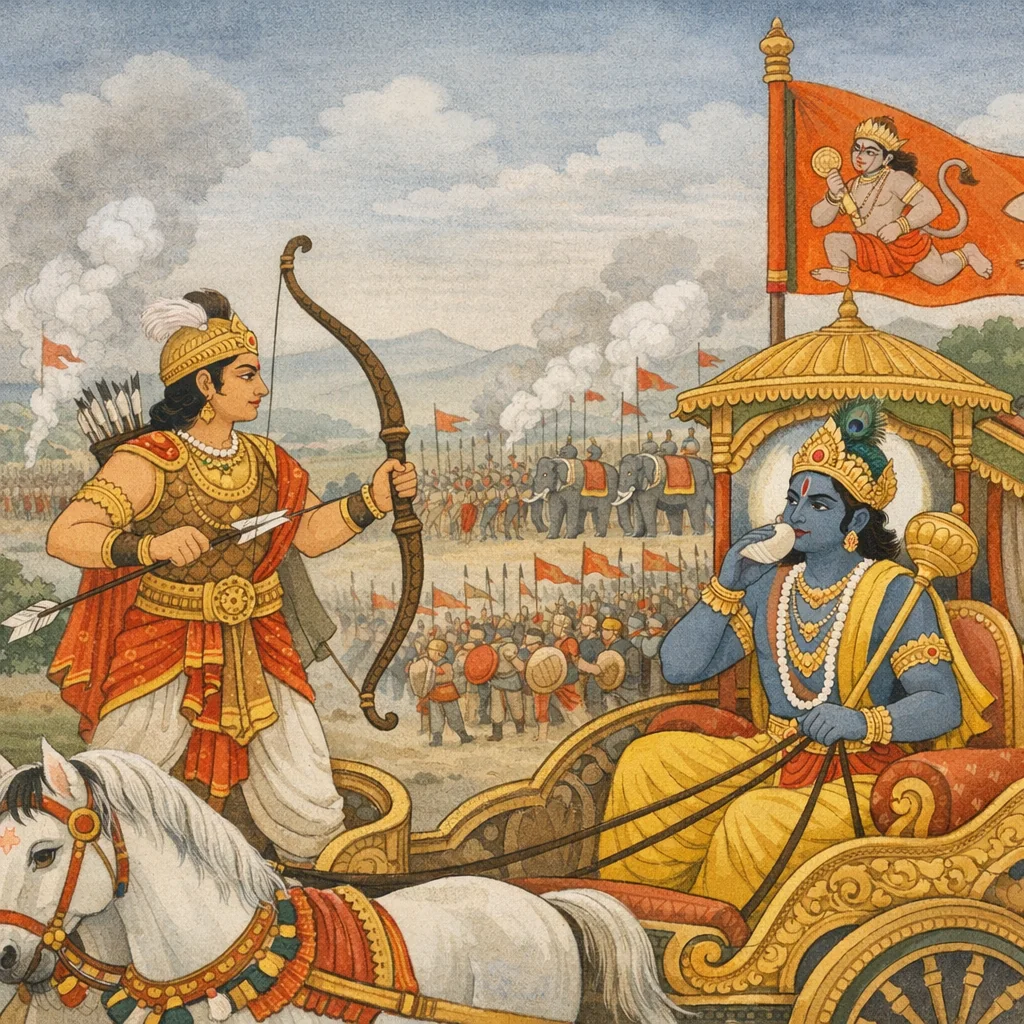
अथ व्यवस्थितान्दृष्ट्वा धार्तराष्ट्रान्कपिध्वजः प्रवृत्ते शस्त्रसम्पाते धनुरुद्यम्य पाण्डवः हृषीके...
atha vyavasthitān dṛṣṭvā dhārtarāṣṭrān kapi-dhvajaḥ pravṛtte śastra-sampāte dhanur udyamya pāṇḍavaḥ hṛṣīke...

Then Arjuna, the son of Pāṇḍu, whose banner bore the emblem of Hanumān, seeing Dhṛtarāṣṭra’s sons drawn up in battle array, and as the clash of weapons was about to begin, lifted his bow and spoke these words to Hṛṣīkeśa (Śrī Kṛṣṇa).
पाठ अपूर्ण है। पूर्ण श्लोक (1.20) में अर्जुन (कपिध्वज) द्वारा सामने व्यवस्थित धृतराष्ट्र-पक्ष को देखकर, औपचारिक आरम्भ के क्षण में धनुष उठाने और फिर कृष्ण (हृषीकेश) से संबोधित होकर आगे संवाद आरम्भ होने का वर्णन आता है।
Input text is truncated. In the complete verse (1.20), Arjuna—bannered with Hanumān—seeing the Dhārtarāṣṭras arrayed and as the formal engagement is about to commence, raises his bow and addresses Hṛṣīkeśa, initiating the request that leads into the teaching context.
विश्लेषण सीमित है क्योंकि श्लोक का अंतिम भाग उपलब्ध नहीं है। कृपया 1.20 का पूर्ण देवनागरी पाठ दें ताकि शब्दार्थ, अनुवाद और संभावित पाठांतर (यदि कोई) ठीक से दर्ज किए जा सकें।
FAQs
The verse signals a transition from external readiness to inward appraisal: Arjuna’s attention shifts from the scene to reflection, setting up the coming emotional and ethical struggle.
As the dialogue begins, the narrative prepares for philosophical inquiry—how to act rightly amid competing obligations—though 1.20 itself is primarily transitional.
This is the hinge where the epic tableau gives way to the pedagogical frame: Arjuna turns to Kṛṣṇa, prompting the discourse that becomes the Gītā’s core.
Represents the moment before decisive action when one pauses to seek guidance—an ethically significant step in high-stakes decisions.