
Shloka 41
Arjuna Vishada Yoga — The Yoga of Arjuna's Despondency
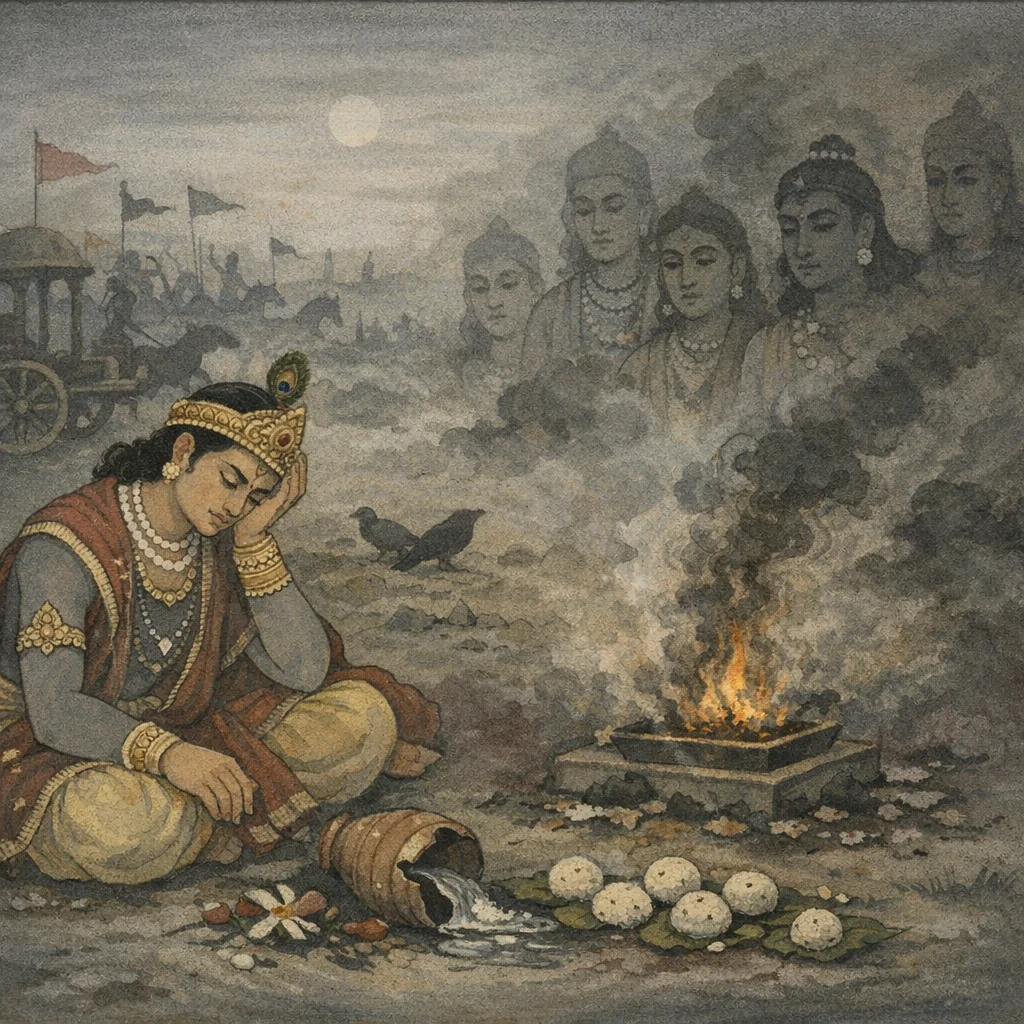
सङ्करो नरकायैव कुलघ्नानां कुलस्य च । पतन्ति पितरो ह्येषां लुप्तपिण्डोदकक्रियाः ॥ १.४१ ॥
saṅkaro narakāyaiva kulaghnānāṃ kulasya ca | patanti pitaro hyeṣāṃ luptapiṇḍodakakriyāḥ || 1.41 ||

वर्ण-संकर से कुलघातियों और कुल का पतन होता है; पिण्ड-जल आदि श्राद्ध-क्रियाएँ लुप्त होने से उनके पितर (पूर्वज) भी पतित हो जाते हैं।
Social intermixture (saṅkara) leads to a hellish condition for both the destroyers of the family-line and the family itself; for their ancestors fall when the rites of offering (piṇḍa) and water-libations are discontinued.
Most traditional readings emphasize ritual discontinuity (piṇḍa-udaka) as causing ancestral ‘fall’; academic renderings often treat this as a reflection of dharmaśāstra social-ritual ideology rather than a metaphysical claim requiring assent. No major variant is commonly noted for this pāda in standard recensions, but CE confirmation is recommended.
FAQs
Arjuna’s reasoning shows anticipatory guilt and catastrophic forecasting: he imagines broad social and familial collapse as a consequence of his participation in the conflict.
The verse frames ritual continuity and ancestral well-being as linked; philosophically, it illustrates a dharma-based worldview where individual action is embedded in transgenerational obligations.
It continues Arjuna’s argument that the breakdown of family structures undermines inherited duties and rites, strengthening his reluctance to act.
Read non-literally, it can be taken as a warning that abrupt social rupture can erode shared practices that hold communities together, calling for careful ethical reflection before drastic action.