
Shloka 4
Arjuna Vishada Yoga — The Yoga of Arjuna's Despondency
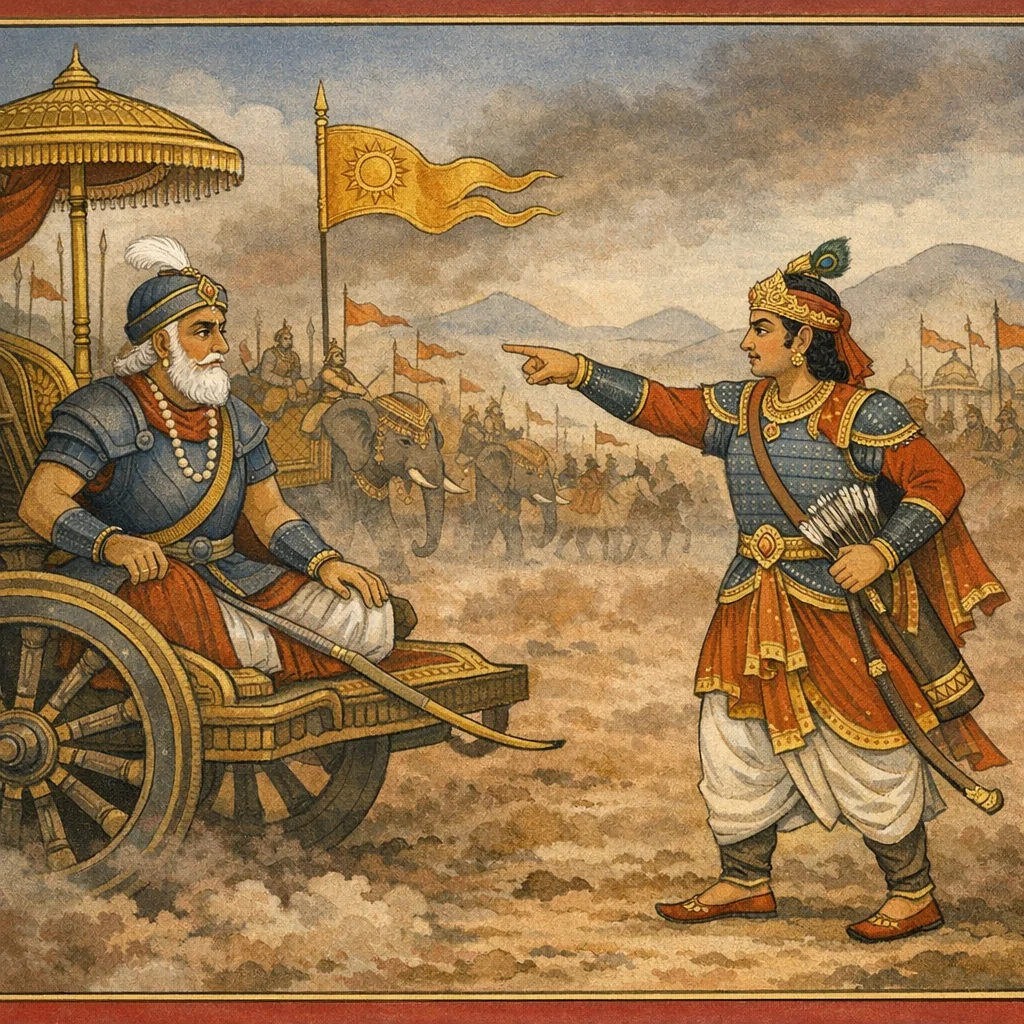
अत्र शूरा महेष्वासा भीमार्जुनसमा युधि । युयुधानो विराटश्च द्रुपदश्च महारथः ॥
atra śūrā maheṣvāsā bhīmārjunasamā yudhi | yuyudhāno virāṭaś ca drupadaś ca mahārathaḥ ||

Here are heroes, great bowmen, equal in battle to Bhīma and Arjuna: Yuyudhāna, and Virāṭa, and Drupada—the great chariot-warrior.
Here are heroes, mighty archers, equal in battle to Bhīma and Arjuna: Yuyudhāna, Virāṭa, and Drupada, the great chariot-warrior.
Here are brave men, great bowmen, comparable in combat to Bhīma and Arjuna: Yuyudhāna, Virāṭa, and Drupada, a great chariot-fighter.
‘mahāratha’ is a traditional military epithet; translations vary (‘great charioteer’, ‘great warrior’). The verse is a formal enumeration rather than a narrative of violence.
FAQs
Listing notable figures functions as cognitive mapping: naming strengths and comparing them to known standards (Bhīma/Arjuna) organizes fear and strategy.
The verse can be read as a reminder that human qualities (guṇas) manifest in diverse forms; excellence itself is ethically neutral and must be guided by discernment.
It continues Duryodhana’s description of the opposing leadership, emphasizing that the Pāṇḍava side has multiple capable allies.
In nonviolent competition (academia, careers), people often benchmark opponents. The verse suggests doing so soberly—without panic—so planning remains realistic.