
Shloka 23
Arjuna Vishada Yoga — The Yoga of Arjuna's Despondency
योत्स्यमानानवेक्षेऽहं य एतेऽत्र समागताः । धार्तराष्ट्रस्य दुर्बुद्धेर्युद्धे प्रियचिकीर्षवः ॥ १.२३ ॥
yotsyamānān avekṣe 'haṁ ya ete 'tra samāgatāḥ | dhārtarāṣṭrasya durbuddher yuddhe priya-cikīrṣavaḥ || 1.23 ||

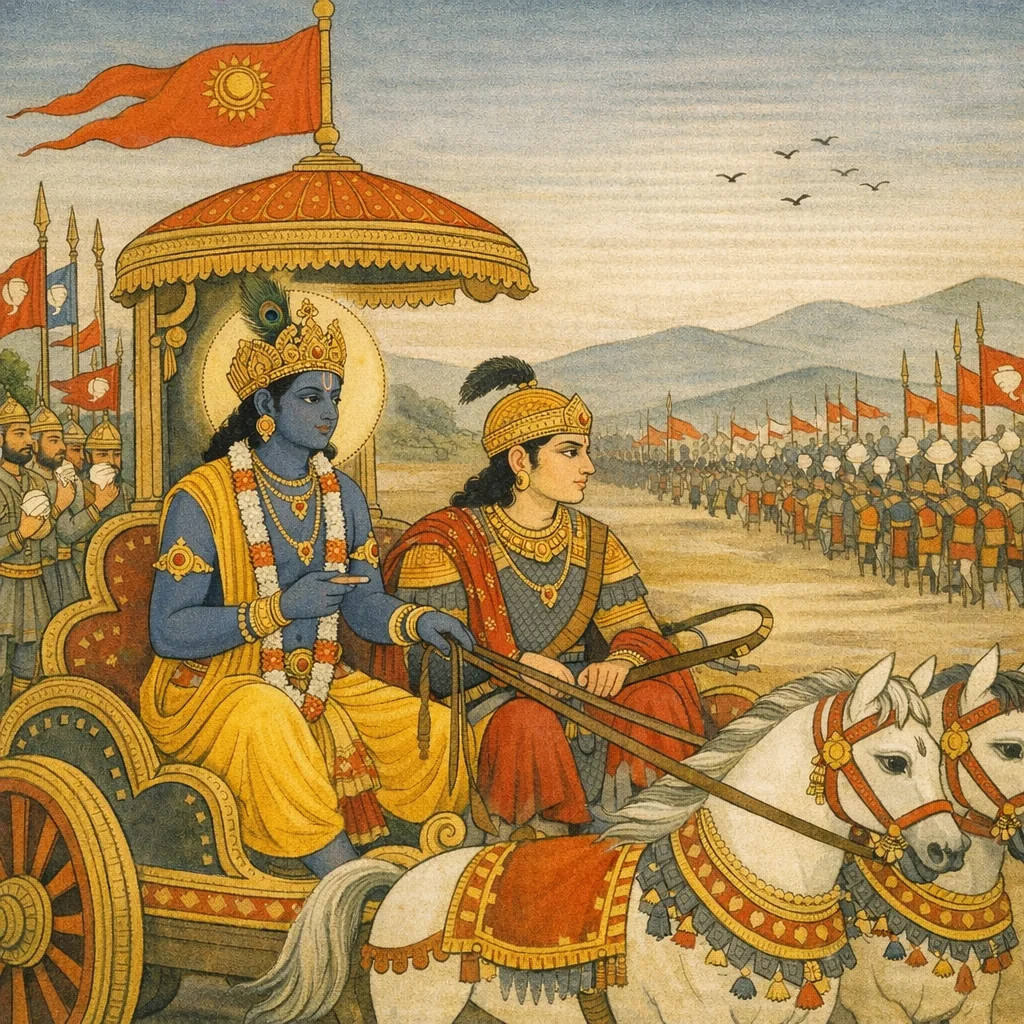
I desire to behold those who have assembled here to fight, wishing to do what is pleasing in battle to the misguided son of Dhṛtarāṣṭra.
I wish to look upon those gathered here intent on contest, who seek to do what is pleasing to the misguided son of Dhṛtarāṣṭra.
“I will observe those who are about to engage, who have assembled here, wishing to do what is dear to the ill-judging Dhārtarāṣṭra (Duryodhana).”
Some traditional renderings explicitly identify ‘Dhārtarāṣṭra’ as Duryodhana; academically, it is an epithet that contextually points to him. ‘Durbuddhi’ is evaluative (‘poor judgment’), reflecting Arjuna’s stance.
FAQs
Arjuna frames the opposing side’s motivation as pleasing a leader; this highlights how allegiance and group identity can shape ethical perception.
It can be read as a critique of actions driven by ‘pleasing’ impulses (priya) rather than truth-aligned discernment—an inner dynamic of desire-led action.
The verse sharpens the narrative polarity: Arjuna interprets the gathering not merely as opponents, but as participants in a value-laden cause.
Examine whether one’s actions serve principled ends or merely satisfy authority, approval-seeking, or group pressure.