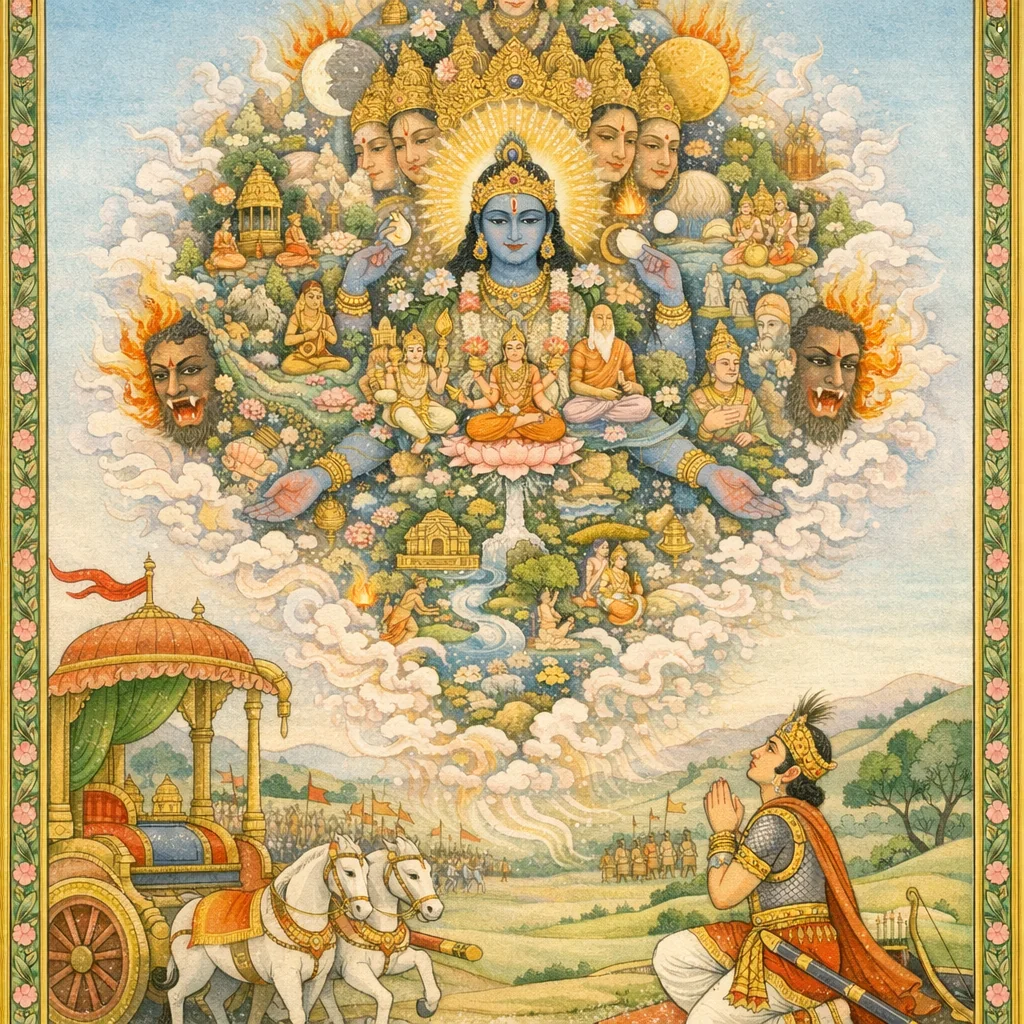
Chapter 11: Vishwarupa Darshana Yoga
विश्वरूपदर्शनयोग
The Yoga of the Cosmic Vision
Chapter 11 advances the Gita’s soteriological arc by transforming Arjuna’s intellectual assent into direct contemplative certainty through a revelatory vision. Having received esoteric instruction, Arjuna requests experiential verification of Krishna’s sovereign reality (aiśvarya). Krishna grants a “divine eye,” establishing that transcendent truth is not merely an object of ordinary perception but requires a transformed mode of knowing. The ensuing vision presents the cosmos as a single integrated field within the Divine, dissolving the seeker’s fragmented view of agency, time, and consequence. Arjuna’s mental state moves through wonder, reverence, and existential trembling into clarified devotion and ethical readiness. The chapter reframes the duty-based dilemma on the field of action: Arjuna is to act without egoic appropriation, recognizing a larger metaphysical order where outcomes are gathered by Time and the individual becomes an instrument of dharma. The foundational yoga emphasized is bhakti-informed surrender aligned with insight.
Speakers
Key Concepts
Philosophical Constructs
Shlokas in Chapter 11
Verse 1
अर्जुन उवाच । मदनुग्रहाय परमं गुह्यमध्यात्मसंज्ञितम् यत्त्वयोक्तं वचस्तेन मोहोऽयं विगतो मम ॥ ११.१ ॥
Arjuna said: By that supreme, most secret teaching of the Self (adhyātma) spoken by You for my grace, this delusion of mine has been dispelled.
Verse 2
भवाप्ययौ हि भूतानां श्रुतौ विस्तरशो मया । त्वत्तः कमलपत्राक्ष माहात्म्यमपि चाव्ययम् ॥ ११.२ ॥
O lotus-eyed One! I have heard from You in detail the arising and dissolution of beings, and also Your imperishable greatness.
Verse 3
एवमेतद्यथात्थ त्वमात्मानं परमेश्वर । द्रष्टुमिच्छामि ते रूपमैश्वरं पुरुषोत्तम ॥ ११.३ ॥
Thus indeed it is, just as You have spoken of Yourself, O Supreme Lord. O Purushottama, I desire to behold Your sovereign, divine form.
Verse 4
मन्यसे यदि तच्छक्यं मया द्रष्टुमिति प्रभो । योगेश्वर ततो मे त्वं दर्शयात्मानमव्ययम् ॥ ११.४ ॥
If You deem it possible for me to behold that, O Lord—O Yogeshvara—then reveal to me Your imperishable Self.
Verse 5
श्रीभगवानुवाच । पश्य मे पार्थ रूपाणि शतशोऽथ सहस्रशः नानाविधानि दिव्यानि नानावर्णाकृतीनि च ॥ ११.५ ॥
The Blessed Lord said: Behold, O Partha, My forms—by the hundreds and by the thousands—manifold, divine, of various kinds, and of diverse colors and shapes.
Verse 6
पश्यादित्यान्वसून्रुद्रानश्विनौ मरुतस्तथा । बहून्यदृष्टपूर्वाणि पश्याश्चर्याणि भारत ॥ ११.६ ॥
Behold the Adityas, the Vasus, the Rudras, the two Ashvins, and the Maruts. Behold, O Bharata, many wonders never seen before.
Verse 7
इहैकस्थं जगत्कृत्स्नं पश्याद्य सचराचरम् । मम देहे गुडाकेश यच्चान्यद् द्रष्टुमिच्छसि ॥ ११.७ ॥
Behold here, O Gudakesha, in My body, the entire universe—moving and unmoving—gathered in one place; and whatever else you desire to see, behold that too.
Verse 8
न तु मां शक्यसे द्रष्टुमनेनैव स्वचक्षुषा । दिव्यं ददामि ते चक्षुः पश्य मे योगमैश्वरम् ॥ ११.८ ॥
But you are not able to behold Me with these very eyes of yours. Therefore I grant you divine sight; behold My sovereign Yoga—My divine majesty.
Verse 9
संजय उवाच । एवमुक्त्वा ततो राजन्महायोगेश्वरो हरिः दर्शयामास पार्थाय परमं रूपमैश्वरम् ॥ ११.९ ॥
Sanjaya said: O King, having thus spoken, then the great Lord of Yoga, Hari, revealed to Partha His supreme, majestic form.
Verse 10
अनेकवक्त्रनयनमनेकाद्भुतदर्शनम् । अनेकदिव्याभरणं दिव्यानेकोद्यतायुधम् ॥ ११.१० ॥
It had many mouths and eyes, many wondrous visions; it bore many divine ornaments and held aloft many divine weapons.
Verse 11
दिव्यमाल्याम्बरधरं दिव्यगन्धानुलेपनम् । सर्वाश्चर्यमयं देवमनन्तं विश्वतोमुखम् ॥ ११.११ ॥
Wearing divine garlands and garments, anointed with divine fragrances, it was the God filled with every wonder—endless, with faces on all sides.
Verse 12
दिवि सूर्यसहस्रस्य भवेद्युगपदुत्थिता । यदि भाः सदृशी सा स्याद्भासस्तस्य महात्मनः ॥ ११.१२ ॥
If, in the sky, the radiance of a thousand suns were to rise all at once, that splendor might resemble the splendor of that Great Soul.
Verse 13
तत्रैकस्थं जगत्कृत्स्नं प्रविभक्तमनेकधा । अपश्यद्देवदेवस्य शरीरे पाण्डवस्तदा ॥ ११.१३ ॥
There, then, the son of Pāṇḍu beheld, in the body of the God of gods, the entire universe—though divided in many ways—gathered and established in one single place.
Verse 14
ततः स विस्मयाविष्टो हृष्टरोमा धनंजयः । प्रणम्य शिरसा देवं कृताञ्जलिरभाषत ॥ ११.१४ ॥
Then Dhanañjaya, overwhelmed with wonder and thrilled with joy, bowed his head in reverence to the Lord, and with folded palms spoke.
Verse 15
अर्जुन उवाच । पश्यामि देवांस्तव देव देहे सर्वांस्तथा भूतविशेषसंघान् । ब्रह्माणमीशं कमलासनस्थ- मृ...
Arjuna said: O Lord, I behold in Your body all the gods, and likewise the multitudes of diverse beings; Brahmā, the Lord, seated upon the lotus, and all the sages and the celestial serpents as well.
Verse 16
अनेकबाहूदरवक्त्रनेत्रं पश्यामि त्वां सर्वतोऽनन्तरूपम् । नान्तं न मध्यं न पुनस्तवादिं पश्यामि विश्...
I behold You with many arms, bellies, mouths, and eyes—an infinite form on every side. I see neither Your end, nor Your middle, nor again Your beginning, O Lord of the universe, O Form of all.
Verse 17
किरीटिनं गदिनं चक्रिणं च तेजोराशिं सर्वतो दीप्तिमन्तम् । पश्यामि त्वां दुर्निरीक्ष्यं समन्ताद्द्दीप्तानलार्कद्युतिमप्रमेयम् ॥
I behold You crowned, bearing a mace and a discus—an immense mass of splendor, radiant on every side; from all directions You are hard to gaze upon, blazing like fire and the sun, immeasurable.
Verse 18
त्वमक्षरं परमं वेदितव्यं त्वमस्य विश्वस्य परं निधानम् । त्वमव्ययः शाश्वतधर्मगोप्ता सनातनस्त्वं पुरुषो मतो मे ॥
You are the Imperishable, the supreme Reality to be known; You are the highest refuge and foundation of this entire universe. You are the unchanging guardian of the eternal Dharma; You are the Sanātana Puruṣa—such is my firm conviction.
Verse 19
अनादिमध्यान्तमनन्तवीर्यं अनन्तबाहुं शशिसूर्यनेत्रम् । पश्यामि त्वां दीप्तहुताशवक्त्रं स्वतेजसा विश्वमिदं तपन्तम् ॥
I behold You without beginning, middle, or end; of infinite might; with innumerable arms; with the moon and the sun as Your eyes; with a mouth like blazing fire—by Your own radiance You illumine and heat this entire universe.
Verse 20
द्यावापृथिव्योरिदमन्तरं हि व्याप्तं त्वयैकेन दिशश्च सर्वाः । दृष्ट्वाद्भुतं रूपमुग्रं तवेदं लोकत्रयं प्रव्यथितं महात्मन् ॥
The space between heaven and earth is pervaded by You alone, and so too all the directions. Beholding this wondrous and terrible form of Yours, O Mahātmā, the three worlds are shaken with awe.
Verse 21
अमी हि त्वां सुरसंघा विशन्ति केचिद्भीताः प्राञ्जलयो गृणन्ति । स्वस्तीत्युक्त्वा महर्षिसिद्धसंघाः स्तुवन्ति त्वां स्तुतिभिः पुष्कलाभिः ॥
These hosts of devas enter into You; some, struck with fear, sing Your praise with palms joined. Saying “svasti” (auspicious well-being), the assemblies of great ṛṣis and siddhas extol You with abundant hymns.
Verse 22
रुद्रादित्या वसवो ये च साध्या विश्वेऽश्विनौ मरुतश्चोष्मपाश्च । गन्धर्वयक्षासुरसिद्धसंघा वीक्षन्ते त्वां विस्मिताश्चैव सर्वे ॥
Rudras, Ādityas, Vasus, Sādhyas, the Viśvedevas, the Aśvins, Maruts, and the hosts of the Pitṛs, along with Gandharvas, Yakṣas, Asuras, and Siddhas—all of them gaze upon You, utterly amazed.
Verse 23
रूपं महत्ते बहुवक्त्रनेत्रं महाबाहो बहुबाहूरुपादम् । बहूदरं बहुदंष्ट्राकरालं दृष्ट्वा लोकाः प्रव्यथितास्तथाहम् ॥
O mighty-armed one, beholding Your vast form with many mouths and eyes, with many arms, thighs, and feet—many bellies and terrible fangs—people are greatly shaken; and so am I.
Verse 24
नभःस्पृशं दीप्तमनेकवर्णं व्यात्ताननं दीप्तविशालनेत्रम् । दृष्ट्वा हि त्वां प्रव्यथितान्तरात्मा धृतिं न विन्दामि शमं च विष्णो ॥
Seeing You touching the sky—radiant, of many hues—with gaping mouth and blazing, wide eyes, my inmost self is shaken; I find neither steadiness nor peace, O Viṣṇu.
Verse 25
दंष्ट्राकरालानि च ते मुखानि दृष्ट्वैव कालानलसन्निभानि । दिशो न जाने न लभे च शर्म प्रसीद देवेश जगन्निवास ॥
Seeing Your mouths with terrible fangs, like the fire of Time, I lose my sense of direction and find no refuge or comfort. Be gracious, O Lord of the gods, abode of the universe.
Verse 26
अमी च त्वां धृतराष्ट्रस्य पुत्राः सर्वे सहैवावनिपालसंघैः । भीष्मो द्रोणः सूतपुत्रस्तथासौ सहास्मदीयैरपि योधमुख्यैः ॥
And these sons of Dhṛtarāṣṭra—all of them—together with the hosts of kings; Bhīṣma, Droṇa, and Karṇa, the charioteer’s son; along with our own foremost warriors—(are here before You).
Verse 27
वक्त्राणि ते त्वरमाणा विशन्ति दंष्ट्राकरालानि भयानकानि । केचिद्विलग्ना दशनान्तरेषु संदृश्यन्ते चूर्णितैरुत्तमाङ्गैः ॥
They, in great haste, enter into Your fearful mouths with terrible fangs; some are seen caught between the teeth, with their heads crushed to powder.
Verse 28
यथा नदीनां बहवोऽम्बुवेगाः समुद्रमेवाभिमुखा द्रवन्ति । तथा तवामी नरलोकवीरा विशन्ति वक्त्राण्यभिविज्वलन्ति ॥
As the many torrents of rivers rush, facing the ocean alone, so do these heroes of the human world enter into Your mouths, blazing on every side.
Verse 29
यथा प्रदीप्तं ज्वलनं पतङ्गा विशन्ति नाशाय समृद्धवेगाः । तथैव नाशाय विशन्ति लोका- स्तवापि वक्त्राणि समृद्धवेगाः ॥
As moths, with great speed, enter a blazing fire for their own destruction, so too do these worlds, with great speed, enter Your mouths for destruction.
Verse 30
लेलिह्यसे ग्रसमानः समन्ताल्लोकान्समग्रान्वदनैर्ज्वलद्भिः । तेजोभिरापूर्य जगत्समग्रं भासस्तवोग्राः प्रतपन्ति विष्णो ॥
You lick, as You devour from every side, all the worlds with Your flaming mouths; filling the entire universe with Your radiance, Your fierce rays scorch it, O Vishnu.
Verse 31
आख्याहि मे को भवानुग्ररूपो नमोऽस्तु ते देववर प्रसीद । विज्ञातुमिच्छामि भवन्तमाद्यं न हि प्रजानामि तव प्रवृत्तिम् ॥
Tell me—who are You in this terrible form? Salutations to You, O best of gods; be gracious. I desire to know You, the primal One, for I do not comprehend Your purpose and activity.
Verse 32
श्रीभगवानुवाच । कालोऽस्मि लोकक्षयकृत्प्रवृद्धो लोकान्समाहर्तुमिह प्रवृत्तः । ऋतेऽपि त्वां न भविष्यन्ति सर्वे येऽवस्थिताः प्रत्यनीकेषु योधाः ॥
The Blessed Lord said: I am Time, grown mighty, the destroyer of worlds, set forth here to annihilate the peoples. Even without you, none of these warriors arrayed in the opposing armies shall remain.
Verse 33
तस्मात्त्वमुत्तिष्ठ यशो लभस्व जित्वा शत्रून् भुङ्क्ष्व राज्यं समृद्धम् । मयैवैते निहताः पूर्वमेव निमित्तमात्रं भव सव्यसाचिन् ॥
Therefore arise; win glory. Conquering the foes, enjoy a prosperous kingdom. By Me indeed have these already been slain; be thou merely an instrument, O Savyasācin.
Verse 34
द्रोणं च भीष्मं च जयद्रथं च कर्णं तथान्यानपि योधवीरान् । मया हतांस्त्वं जहि मा व्यथिष्ठा युध्यस्व जेतासि रणे सपत्नान् ॥
Slay Droṇa and Bhīṣma and Jayadratha and Karṇa, and the other heroic warriors as well. By Me they have already been slain; do not be distressed. Fight—thou shalt conquer the foes in battle.
Verse 35
संजय उवाच । एतच्छ्रुत्वा वचनं केशवस्य कृताञ्जलिर्वेपमानः किरीटी । नमस्कृत्वा भूय एवाह कृष्णं सगद्गदं भीतभीतः प्रणम्य ॥
Sañjaya said: Hearing these words of Keśava, the diademed Arjuna, with palms joined, trembling, again and again bowed to Kṛṣṇa; and, greatly terrified, he spoke with a choked voice, prostrating himself.
Verse 36
अर्जुन उवाच । स्थाने हृषीकेश तव प्रकीर्त्या जगत्प्रहृष्यत्यनुरज्यते च । रक्षांसि भीतानि दिशो द्रवन्ति सर्वे नमस्यन्ति च सिद्धसङ्घाः ॥
Arjuna said: Rightly, O Hṛṣīkeśa, by Thy glory the world rejoices and is drawn to Thee. The Rākṣasas, terrified, flee in all directions, and all the hosts of Siddhas bow down to Thee.
Verse 37
कस्माच्च ते न नमेरन्महात्मन् गरीयसे ब्रह्मणोऽप्यादिकर्त्रे । अनन्त देवेश जगन्निवास त्वमक्षरं सदसत्तत्परं यत् ॥
And why should they not bow to Thee, O great-souled One—Thou who art greater than Brahmā, the primal Creator? O Infinite One, O Lord of gods, O Abode of the universe! Thou art the Imperishable; Thou art the Being and the non-being, and That which is beyond them, the Supreme.
Verse 38
त्वमादिदेवः पुरुषः पुराणस् त्वमस्य विश्वस्य परं निधानम् । वेत्तासि वेद्यं च परं च धाम त्वया ततं विश्वमनन्तरूप ॥
You are the primal Deva, the ancient Puruṣa; You are the supreme refuge and resting-place of this universe. You are the knower and also That which is to be known; You are the highest abode. O One of infinite forms, by You this entire universe is pervaded.
Verse 39
वायुर्यमोऽग्निर्वरुणः शशाङ्कः प्रजापतिस्त्वं प्रपितामहश्च । नमो नमस्तेऽस्तु सहस्रकृत्वः पुनश्च भूयोऽपि नमो नमस्ते ॥
You are Vāyu, Yama, Agni, Varuṇa, the Moon, Prajāpati, and the great-grandfather (Brahmā) as well. Salutations, salutations to You a thousand times; and again, yet again—salutations, salutations to You!
Verse 40
नमः पुरस्तादथ पृष्ठतस्ते नमोऽस्तु ते सर्वत एव सर्व । अनन्तवीर्यामितविक्रमस्त्वं सर्वं समाप्नोषि ततोऽसि सर्वः ॥ ११.४० ॥
Salutations to You from the front and from behind; salutations to You from every side, O All! You are of infinite prowess and immeasurable might; You pervade all—therefore You are all.
Verse 41
सखेति मत्वा प्रसभं यदुक्तं हे कृष्ण हे यादव हे सखेति । अजानता महिमानं तवेदं मया प्रमादात्प्रणयेन ...
Thinking of You as a friend, whatever I have rashly spoken—“O Kṛṣṇa,” “O Yādava,” “O friend”—not knowing this Your greatness, through heedlessness or out of affection…
Verse 42
यच्चावहासार्थमसत्कृतोऽसि विहारशय्यासनभोजनेषु । एकोऽथवाप्यच्युत तत्समक्षं तत्क्षामये त्वामहमप्रमेय ॥
O Acyuta, whatever disrespect I have shown You in jest—while playing, resting, sitting, or at meals—whether alone with You or in the presence of others, for all that, O Immeasurable One, I beg Your forgiveness.
Verse 43
पितासि लोकस्य चराचरस्य त्वमस्य पूज्यश्च गुरुर्गरीयान् । न त्वत्समोऽस्त्यभ्यधिकः कुतोऽन्यो लोकत्रयेऽप्यप्रतिमप्रभाव ॥
You are the Father of this whole world—of the moving and the unmoving. You are its most worshipful One and the Guru, greater than all. None is equal to You; how then could there be anyone superior to You in the three worlds, O One of incomparable power?
Verse 44
तस्मात्प्रणम्य प्रणिधाय कायं प्रसादये त्वामहमीशमीड्यम् । पितेव पुत्रस्य सखेव सख्युः प्रियः प्रियायार्हसि देव सोढुम् ॥
Therefore, bowing down and prostrating my body, I seek to propitiate You, the Lord, worthy of praise. O Deva, as a father bears with a son, as a friend with a friend, as a beloved with the beloved—so should You bear with me.
Verse 45
अदृष्टपूर्वं हृषितोऽस्मि दृष्ट्वा भयेन च प्रव्यथितं मनो मे । तदेव मे दर्शय देव रूपं प्रसीद देवेश ...
Having seen what was never seen before, I rejoice; yet my mind is also greatly shaken with fear. Therefore, O Deva, show me that very form of Yours; be gracious, O Lord of the gods.
Verse 46
किरीटिनं गदिनं चक्रहस्तमिच्छामि त्वां द्रष्टुमहं तथैव । तेनैव रूपेण चतुर्भुजेन सहस्रबाहो भव विश्वमूर्ते ॥
I wish to see You as before—crowned, bearing the mace and the discus—in that same four-armed form. O thousand-armed One, O Lord whose form is the universe, become that (form again).
Verse 47
श्रीभगवानुवाच । मया प्रसन्नेन तवार्जुनेदं रूपं परं दर्शितमात्मयोगात् । तेजोमयं विश्वमनन्तमाद्यं यन्मे त्वदन्येन न दृष्टपूर्वम् ॥ ११.४७ ॥
The Blessed Lord said: Being gracious to you, O Arjuna, I have shown you—by My own Yoga-power—this supreme form: radiant, universal, infinite, primal, which none other than you has ever seen before.
Verse 48
न वेदयज्ञाध्ययनैर्न दानैर्न च क्रियाभिर्न तपोभिरुग्रैः । एवंरूपः शक्य अहं नृलोके द्रष्टुं त्वदन्येन कुरुप्रवीर ॥ ११.४८ ॥
Neither by Vedic study, nor by sacrifices, nor by gifts, nor by rituals, nor by fierce austerities can I be seen in this form in the human world by anyone other than you, O foremost of the Kurus.
Verse 49
मा ते व्यथा मा च विमूढभावो दृष्ट्वा रूपं घोरमीदृङ्ममेदम् । व्यपेतभीः प्रीतमनाः पुनस्त्वं तदेव मे रूपमिदं प्रपश्य ॥ ११.४९ ॥
Let there be no distress in you, nor bewilderment, on seeing this dreadful form of Mine. With fear departed and with a delighted mind, behold again this very form of Mine (as before).
Verse 50
संजय उवाच । इत्यर्जुनं वासुदेवस्तथोक्त्वा स्वकं रूपं दर्शयामास भूयः । आश्वासयामास च भीतमेनं भूत्वा पुनः सौम्यवपुर्महात्मा ॥ ११.५० ॥
Sanjaya said: Having thus spoken to Arjuna, Vasudeva again showed His own form; and, assuming His gentle appearance, the great-souled One consoled that frightened one.
Verse 51
अर्जुन उवाच । दृष्ट्वेदं मानुषं रूपं तव सौम्यं जनार्दन । इदानीमस्मि संवृत्तः सचेताः प्रकृतिं गतः ॥ ११.५१ ॥
Arjuna said: Seeing this gentle human form of Yours, O Janardana, I am now composed, restored to clarity, and returned to my natural state.
Verse 52
श्रीभगवानुवाच । सुदुर्दर्शमिदं रूपं दृष्टवानसि यन्मम । देवा अप्यस्य रूपस्य नित्यं दर्शनकाङ्क्षिणः ॥ ११.५२ ॥
The Blessed Lord said: Very difficult to behold is this form of Mine which you have seen; even the gods ever long to behold this form.
Verse 53
नाहं वेदैर्न तपसा न दानेन न चेज्यया । शक्य एवंविधो द्रष्टुं दृष्टवानसि मां यथा ॥ ११.५३ ॥
Not by the Vedas, nor by austerity, nor by charity, nor by sacrifice can I be seen in this form, as you have seen Me.
Verse 54
भक्त्या त्वनन्यया शक्य अहमेवंविधोऽर्जुन । ज्ञातुं द्रष्टुं च तत्त्वेन प्रवेष्टुं च परंतप ॥ ११.५४ ॥
But by exclusive devotion I can be known, truly seen, and entered into, O Arjuna, as I am.
Verse 55
मत्कर्मकृन्मत्परमो मद्भक्तः सङ्गवर्जितः । निर्वैरः सर्वभूतेषु यः स मामेति पाण्डव ॥ ११.५५ ॥
He who does My work, who holds Me as the supreme goal, who is devoted to Me, free from attachment, and free from hostility toward all beings—he comes to Me, O Pandava.
Frequently Asked Questions
The chapter maps a progression from conceptual belief to stabilizing certainty: awe and trembling are not treated as failure but as transitional responses when the ego confronts a larger order. The mature outcome is steadiness—acting with reduced self-importance, clearer priorities, and devotion-informed composure on the field of action.
Reality is disclosed as an integrated whole within the Divine: the many are not independent from the One. Krishna’s identification with kāla (Time) underscores that cosmic processes exceed individual control, while the Universal Form communicates unity-in-diversity as a lived metaphysical insight rather than a mere doctrine.
Arjuna’s hesitation is reframed: he is not asked to manufacture outcomes but to align his role with dharma without egoic appropriation. Recognizing a higher order that gathers results, he can act responsibly while relinquishing anxiety about control, thereby converting paralysis into ethically grounded readiness.
Use Chapter 11 as a leadership and stress-management framework: (1) clarify what is yours to do (duty), (2) release obsession over what you cannot control (outcomes/time), (3) cultivate devotion or value-centered surrender to reduce ego strain, and (4) return from overwhelming complexity to a workable, humane focus—steady action with humility.