
Bhagavad Gita — Vishwarupa Darshana Yoga, Shloka 3
Vishwarupa Darshana Yoga
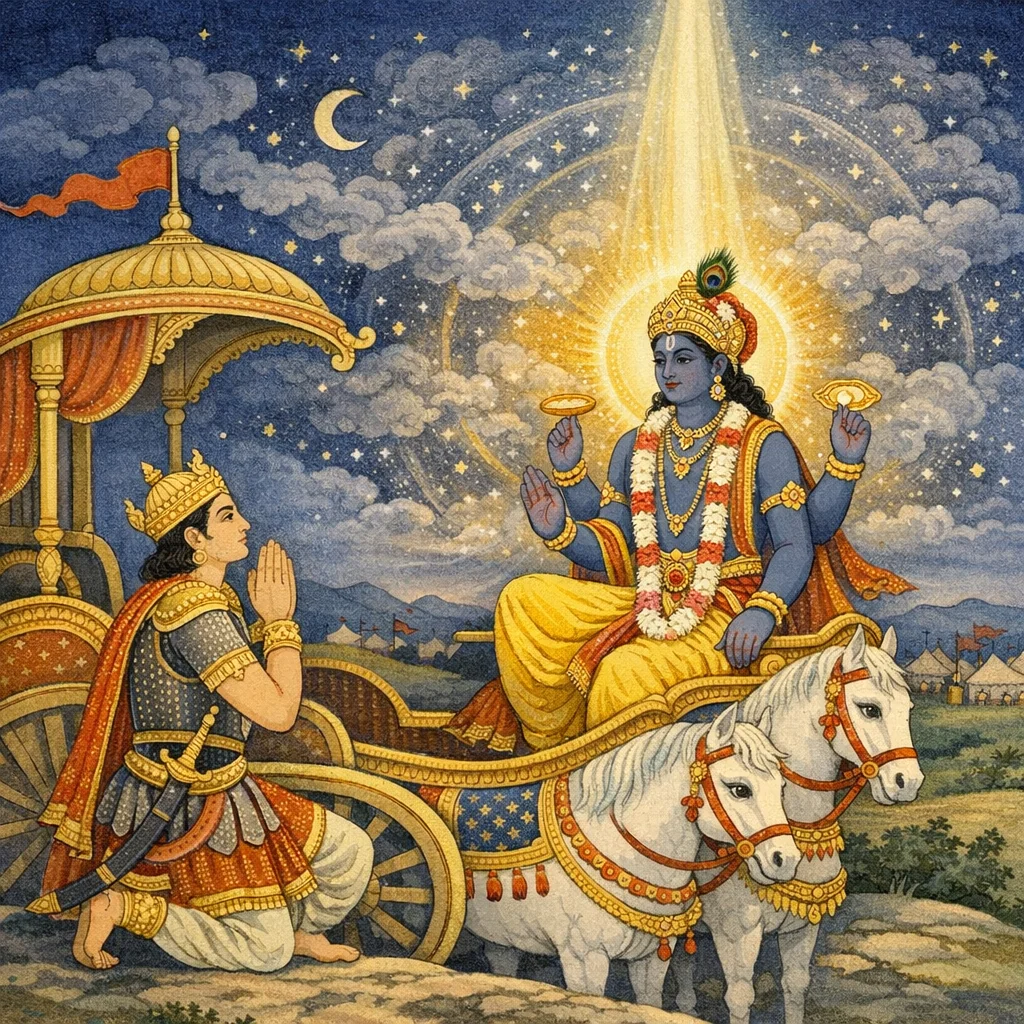
एवमेतद्यथात्थ त्वमात्मानं परमेश्वर । द्रष्टुमिच्छामि ते रूपमैश्वरं पुरुषोत्तम ॥ ११.३ ॥
evam etad yathāttha tvam ātmānaṁ parameśvara | draṣṭum icchāmi te rūpam aiśvaraṁ puruṣottama || 11.3 ||

Thus indeed it is, just as You have spoken of Yourself, O Supreme Lord. O Purushottama, I desire to behold Your sovereign, divine form.
हे परमेश्वर! आपने अपने विषय में जैसा कहा है, यह ऐसा ही है। हे पुरुषोत्तम! मैं आपका ऐश्वर्ययुक्त रूप देखना चाहता हूँ।
So it is, as you have described yourself, O supreme Lord. I wish to see your sovereign (aiśvara) form, O highest person.
‘Aiśvara rūpa’ is variously translated as divine, majestic, or lordly form. Philosophically, it indicates a theophany: a form expressing sovereignty over the cosmos, not merely a personal or iconic image.
FAQs
It expresses a common progression: intellectual assent leads to a desire for experiential confirmation, deepening commitment and understanding.
Arjuna seeks apprehension of the divine as cosmic sovereignty—an encounter with ultimate reality as encompassing and ordering the whole.
This is the pivotal request that triggers Krishna’s revelation of the universal form in chapter 11.
It can be read as valuing evidence and experience alongside theory—seeking direct insight rather than relying only on second-hand descriptions.