
Bhagavad Gita — Vishwarupa Darshana Yoga, Shloka 43
Vishwarupa Darshana Yoga
पितासि लोकस्य चराचरस्य त्वमस्य पूज्यश्च गुरुर्गरीयान् ।
न त्वत्समोऽस्त्यभ्यधिकः कुतोऽन्यो लोकत्रयेऽप्यप्रतिमप्रभाव ॥
pitāsi lokasya carācarasya tvam asya pūjyaś ca gurur garīyān |
na tvat-samo 'sty abhyadhikaḥ kuto 'nyo loka-traye 'py apratima-prabhāva ||

You are the Father of this whole world—of the moving and the unmoving. You are its most worshipful One and the Guru, greater than all. None is equal to You; how then could there be anyone superior to You in the three worlds, O One of incomparable power?
You are the Father of this entire world of the moving and the unmoving. You are its most venerable one and the supreme teacher. None is equal to You; how then could there be anyone superior to You in the three worlds, O One of incomparable might?
You are the father of the world, of what moves and what does not move; you are worthy of worship and the teacher, weightier (than all). There exists none equal to you—how then another superior?—even in the three worlds, O you of unmatched power/effect.
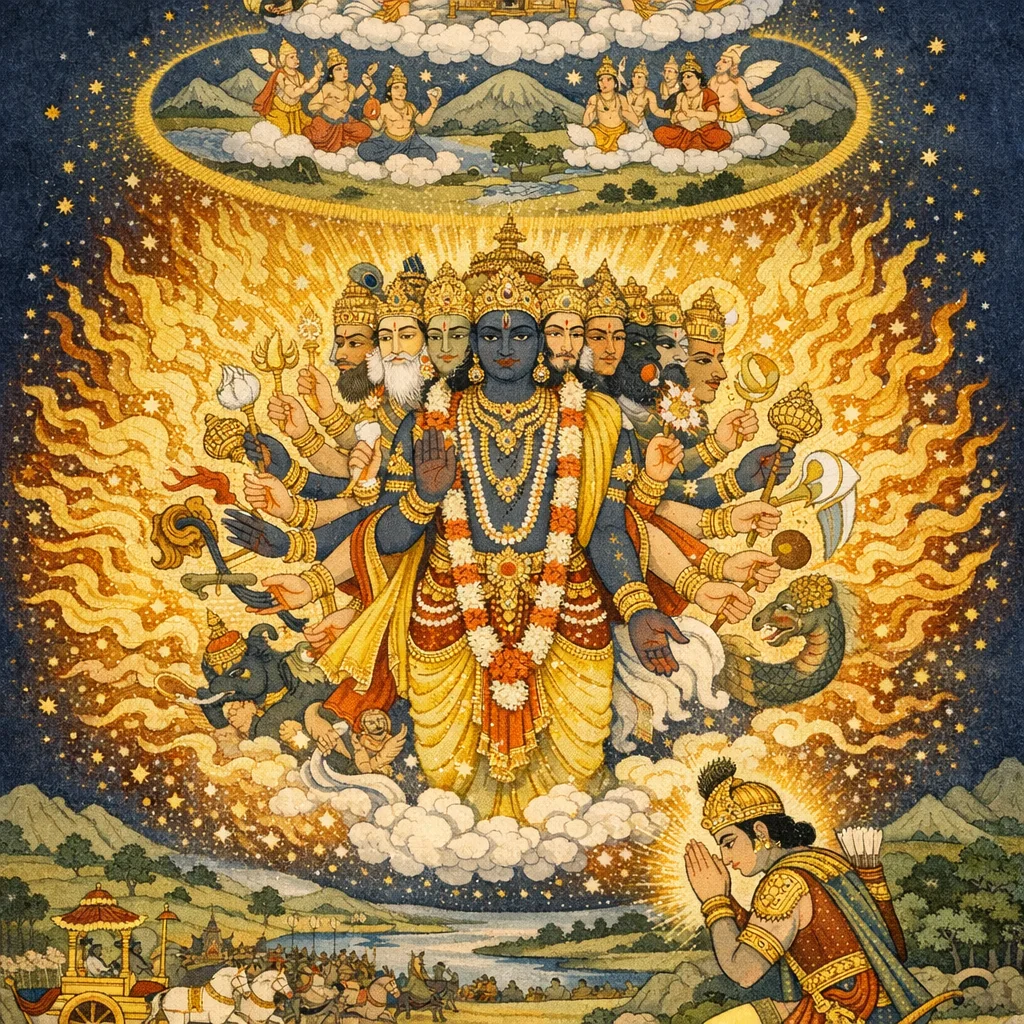
Most recensions read “लोकत्रयेऽप्यप्रतिमप्रभाव” (“even in the three worlds, of unmatched prabhāva”). Translational differences center on prabhāva: devotional renderings often choose “might/majesty,” while academic/literal renderings may prefer “power, efficacy, manifestation.” The verse is a doxological address by Arjuna within the theophany (viśvarūpa) context; no major doctrinal divergence is implied by common minor wording variants.
FAQs
Arjuna’s language reflects a shift from uncertainty to awe and cognitive reorientation: the mind recognizes a single, overarching source behind diverse phenomena (“moving and unmoving”), which can be read as an integration of fragmented perception into a unified meaning-framework.
The verse articulates a hierarchical metaphysics in which the divine is the originating and sustaining principle (“father”), the ultimate object of veneration, and the unsurpassed teacher. It asserts incomparability (no equal or superior) across the “three worlds,” indicating maximal ontological and axiological status.
In Chapter 11, after witnessing the viśvarūpa, Arjuna responds with hymnic praise. This verse summarizes his recognition of the revealed form as the universal ground and the highest authority, reinforcing the chapter’s theme of divine totality rather than a merely local or sectarian deity.
As a non-sectarian ethical and contemplative takeaway, the verse can be used to cultivate humility and gratitude by viewing life as embedded in a larger order, and to value genuine instruction (“guru”) as guidance toward broader understanding beyond personal preference or ego-centered judgment.