
Bhagavad Gita — Vishwarupa Darshana Yoga, Shloka 2
Vishwarupa Darshana Yoga
भवाप्ययौ हि भूतानां श्रुतौ विस्तरशो मया । त्वत्तः कमलपत्राक्ष माहात्म्यमपि चाव्ययम् ॥ ११.२ ॥
bhavāpyayau hi bhūtānāṁ śrutau vistaraśo mayā | tvattaḥ kamala-patrākṣa māhātmyam api cāvyayam || 11.2 ||

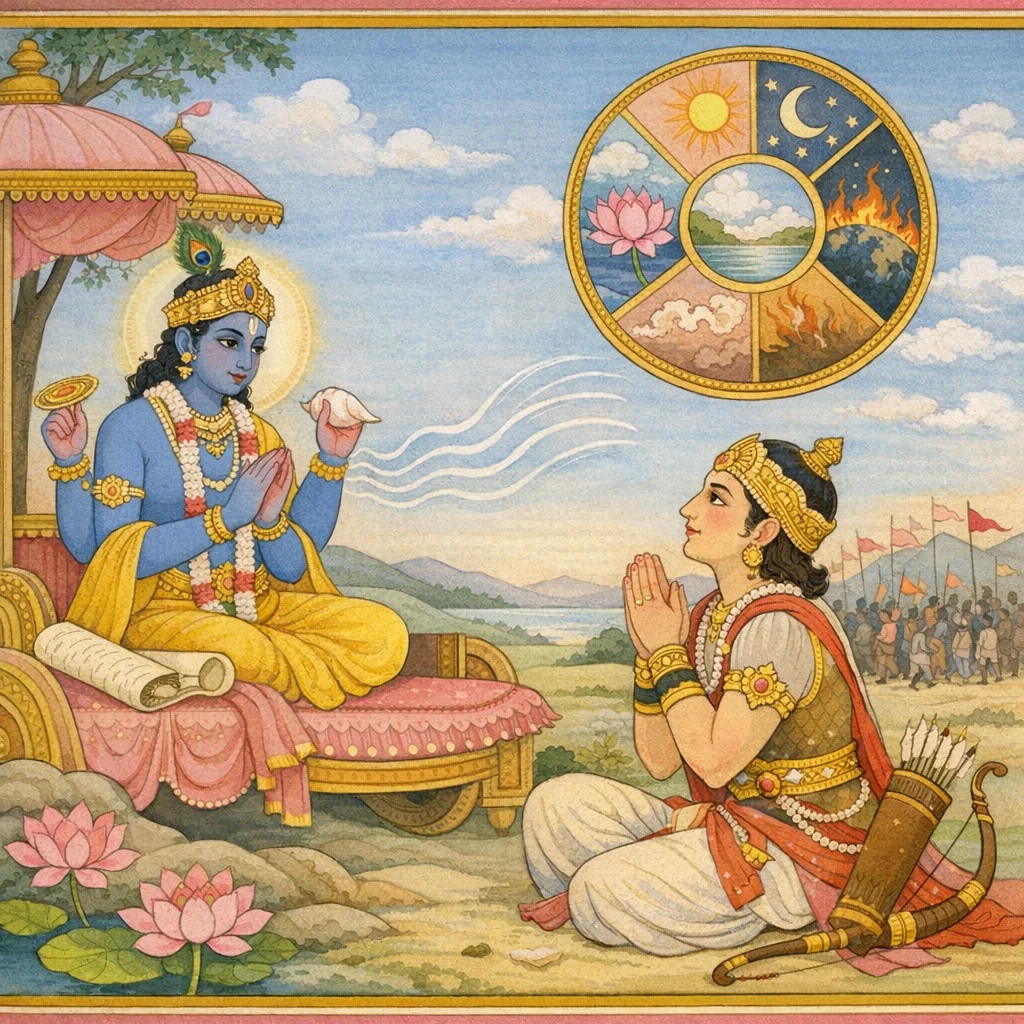
O lotus-eyed One! I have heard from You in detail the arising and dissolution of beings, and also Your imperishable greatness.
हे कमलपत्राक्ष! आपसे मैंने प्राणियों की उत्पत्ति और प्रलय का विस्तार से श्रवण किया है और आपका अव्यय माहात्म्य भी।
For I have heard from you in detail the arising and passing away of beings, O lotus-eyed one, and also your imperishable greatness.
The verse is textually stable. ‘Bhava-apyayau’ is often rendered as creation and dissolution; academically it can be read more generally as origination and cessation within cosmic cycles.
FAQs
Arjuna consolidates learning by summarizing key points—an effective cognitive step before seeking deeper experiential understanding.
It juxtaposes changing phenomena (origination/cessation) with an imperishable divine principle, framing a contrast between conditioned beings and the unconditioned ground.
Arjuna signals that he has understood Krishna’s cosmological teaching, setting up the request to see the divine reality directly.
It models reflective learning: restating what one has understood before asking for demonstrations or experiential validation.