
Bhagavad Gita — Vishwarupa Darshana Yoga, Shloka 46
Vishwarupa Darshana Yoga
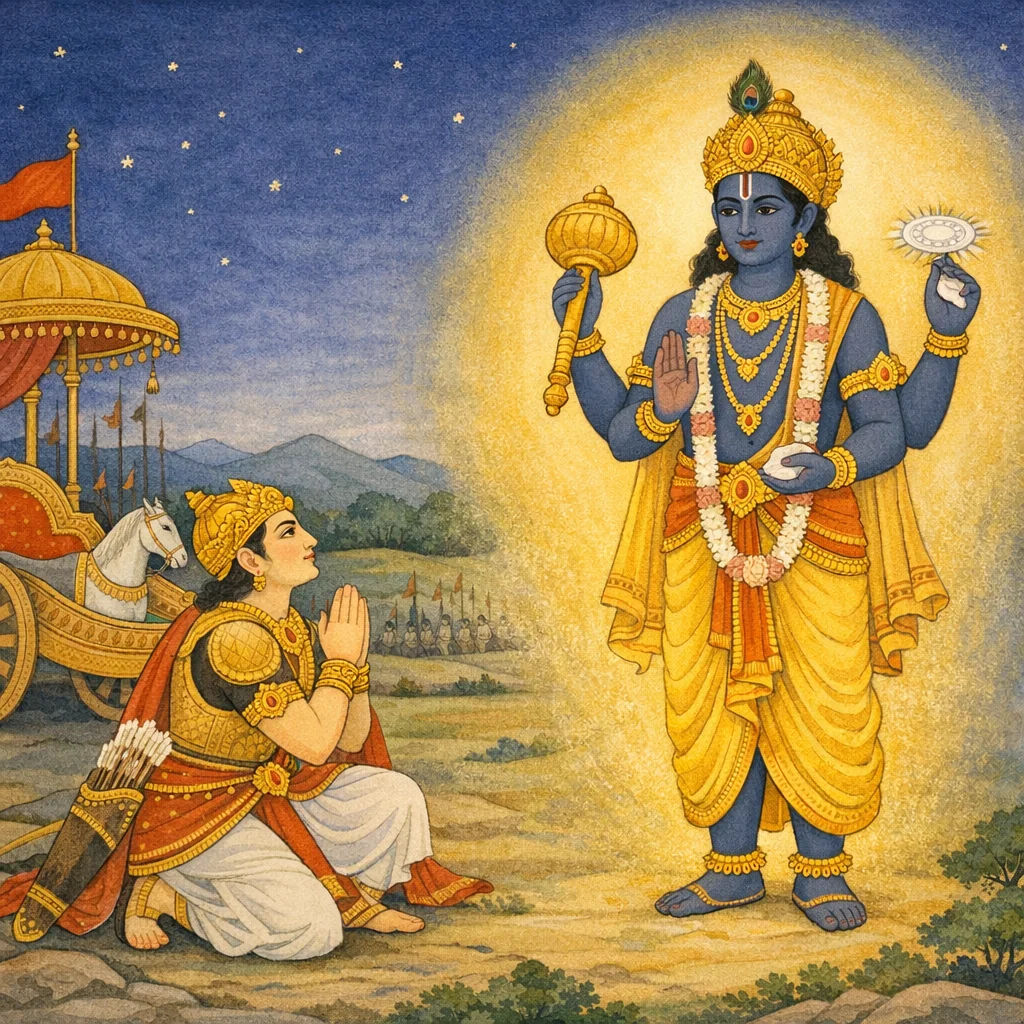
किरीटिनं गदिनं चक्रहस्तमिच्छामि त्वां द्रष्टुमहं तथैव ।
तेनैव रूपेण चतुर्भुजेन सहस्रबाहो भव विश्वमूर्ते ॥
kirīṭinaṃ gadinaṃ cakrahastam icchāmi tvāṃ draṣṭum ahaṃ tathaiva |
tenaiva rūpeṇa caturbhujena sahasrabāho bhava viśvamūrte ||

I wish to see You as before—crowned, bearing the mace and the discus—in that same four-armed form. O thousand-armed One, O Lord whose form is the universe, become that (form again).
I wish to see You as before, wearing the crown, holding the mace and discus, in that same four-armed form. O thousand-armed, O universal-formed Lord, become (again) that form.
I desire to behold you just so: crowned, bearing a mace, with the discus in hand. In that very form—four-armed—be (so), O thousand-armed one, O embodiment of the universe.
Most recensions agree on the request to return from the cosmic (viśvarūpa) manifestation to the familiar four-armed Vaiṣṇava iconography (crown, mace, discus). Minor editorial differences may appear in sandhi/compound division (e.g., cakra-hastam vs cakrahastam) without materially changing meaning.
FAQs
The verse can be read as a shift from cognitive and emotional overload—provoked by an all-encompassing vision of reality—to a request for a more comprehensible and relational focus. It reflects a common human need to integrate intense experiences by returning to a familiar, stable frame of reference.
Philosophically, it contrasts the unbounded cosmic manifestation (viśvarūpa) with a determinate, personal form (caturbhuja). The passage suggests that the same ultimate reality may be approached both as an all-inclusive totality and as a personal Lord, depending on the mode of apprehension and devotion.
After witnessing the universal form, Arjuna expresses reverent fear and seeks reassurance. This verse initiates the narrative return from the extraordinary theophany to the familiar divine form, preparing for the restoration of dialogue under conditions Arjuna can sustain.
As a practical reflection, it can support the idea that profound experiences—spiritual, intellectual, or emotional—benefit from grounding and integration. One may honor expansive insights while also choosing practices and symbols that make meaning accessible in daily life.