
Bhagavad Gita — Vishwarupa Darshana Yoga, Shloka 16
Vishwarupa Darshana Yoga
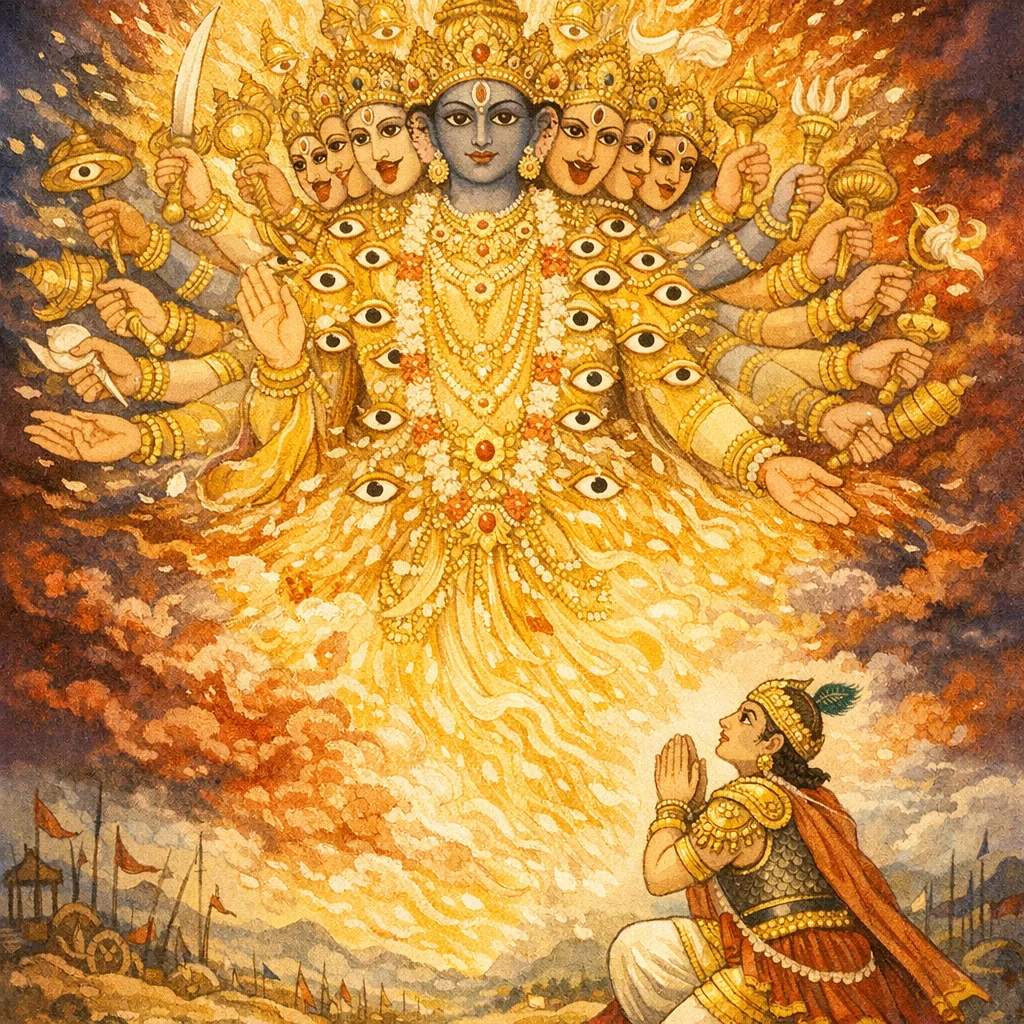
अनेकबाहूदरवक्त्रनेत्रं पश्यामि त्वां सर्वतोऽनन्तरूपम् । नान्तं न मध्यं न पुनस्तवादिं पश्यामि विश्...
aneka-bāhūdara-vaktra-netraṃ paśyāmi tvāṃ sarvato 'nanta-rūpam | nāntaṃ na madhyaṃ na punas tavādiṃ paśyāmi viś...

I behold You with many arms, bellies, mouths, and eyes—an infinite form on every side. I see neither Your end, nor Your middle, nor again Your beginning, O Lord of the universe, O Form of all.
मैं आपको अनेक भुजाओं, उदरों, मुखों और नेत्रों से युक्त, सब ओर अनन्त रूपवाला देखता हूँ; मैं न आपका अन्त देखता हूँ, न मध्य और न आदि ही देखता हूँ ... (आगे)।
I see you with many arms, bellies, faces, and eyes—endless in form on every side; I see neither your end, nor your middle, nor again your beginning ... (continues).
Input is truncated, so renderings are partial. The verse is philosophically important for apophatic pressure: even as the form is seen, it resists being bounded by temporal/spatial markers (beginning/middle/end).
FAQs
The inability to locate “beginning, middle, end” mirrors how the mind reacts to vastness: it cannot frame the experience within ordinary narrative boundaries.
By denying spatial-temporal limits, the verse points to the divine as not merely one entity within the world, but as the condition that exceeds ordinary delimitation.
It deepens Arjuna’s witness-report from cataloging beings (11.15) to articulating the boundlessness of the form itself.
It can support philosophical reflection on the limits of conceptual frameworks when addressing totality—useful in comparative philosophy, theology, and the study of consciousness.