
Bhagavad Gita — Vishwarupa Darshana Yoga, Shloka 6
Vishwarupa Darshana Yoga
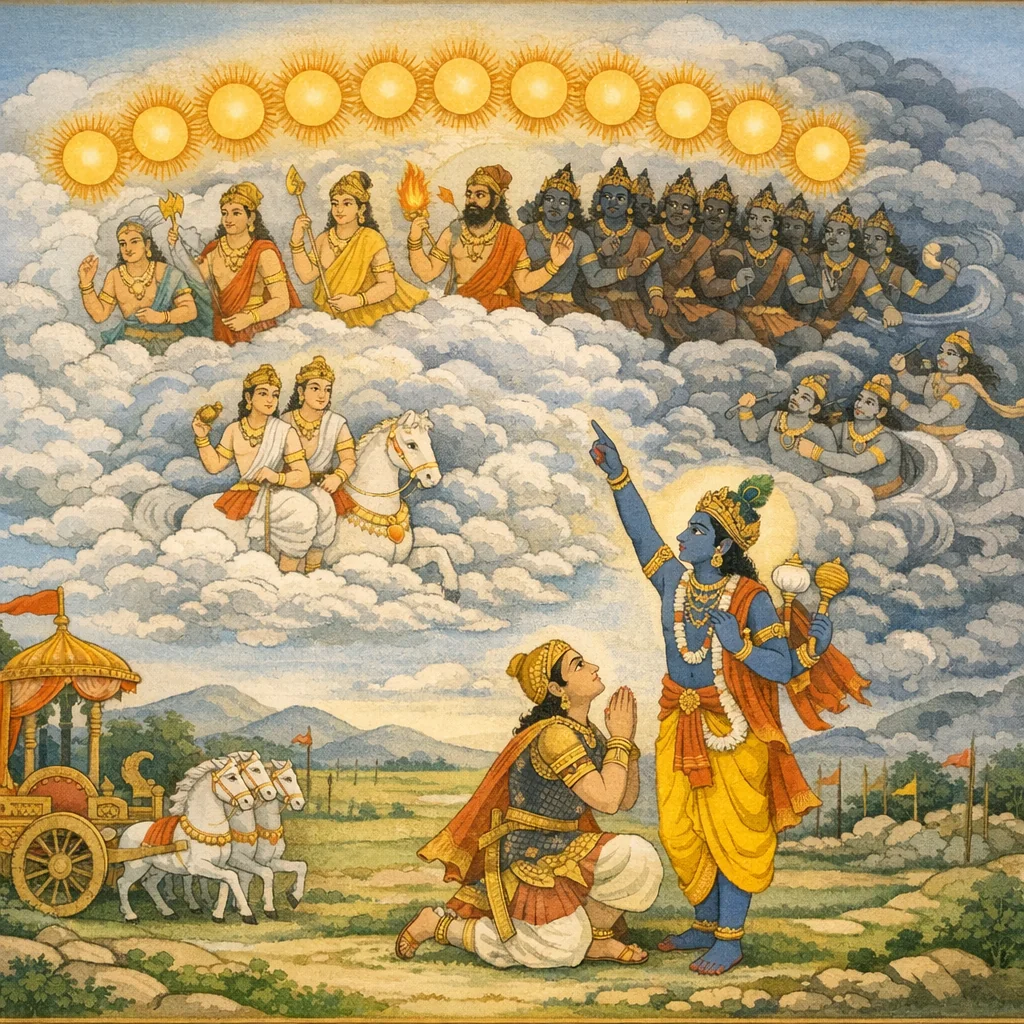
पश्यादित्यान्वसून्रुद्रानश्विनौ मरुतस्तथा । बहून्यदृष्टपूर्वाणि पश्याश्चर्याणि भारत ॥ ११.६ ॥
paśyādityān vasūn rudrān aśvinau marutas tathā | bahūny adṛṣṭa-pūrvāṇi paśyāścaryāṇi bhārata || 11.6 ||

Behold the Adityas, the Vasus, the Rudras, the two Ashvins, and the Maruts. Behold, O Bharata, many wonders never seen before.
हे भारत! आदित्यों, वसुओं, रुद्रों, अश्विनीकुमारों और मरुद्गणों को देखो तथा बहुत से पहले न देखे हुए आश्चर्यों को देखो।
Behold the Ādityas, the Vasus, the Rudras, the Aśvins, and the Maruts. Behold many wonders never seen before, O Bhārata.
The list reflects Vedic-era divine classes (deva-groups). Interpretations vary between literal celestial beings, symbolic cosmic forces, or poetic markers of totality within the vision.
FAQs
The verse depicts an encounter with ‘the vast’ through culturally meaningful symbols, often associated with awe that can reorganize priorities and self-understanding.
By including multiple deva-classes, the vision suggests that diverse cosmic functions and powers are encompassed within the single divine reality being revealed.
Krishna situates the forthcoming universal-form vision within familiar Vedic categories, making the revelation intelligible to Arjuna’s cultural-religious horizon.
It can be read as a reminder that transformative experiences are often interpreted through one’s symbolic vocabulary; studying these symbols helps understand the experience without reducing it to mere fantasy.