
Bhagavad Gita — Vishwarupa Darshana Yoga, Shloka 8
Vishwarupa Darshana Yoga
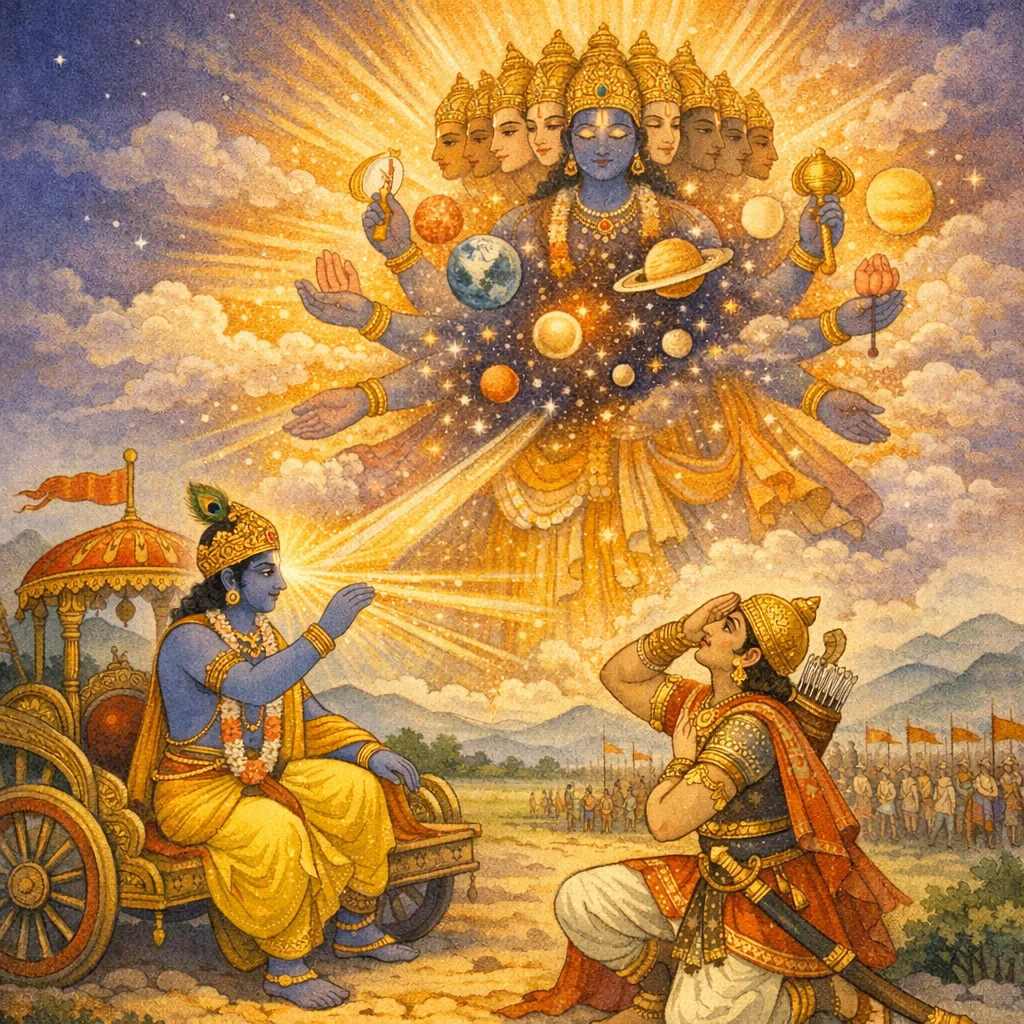
न तु मां शक्यसे द्रष्टुमनेनैव स्वचक्षुषा । दिव्यं ददामि ते चक्षुः पश्य मे योगमैश्वरम् ॥ ११.८ ॥
na tu māṃ śakyase draṣṭum anenaiva svacakṣuṣā | divyaṃ dadāmi te cakṣuḥ paśya me yogam aiśvaram || 11.8 ||

But you are not able to behold Me with these very eyes of yours. Therefore I grant you divine sight; behold My sovereign Yoga—My divine majesty.
परन्तु तू इन अपने नेत्रों से मुझे (इस रूप में) देखने में समर्थ नहीं है; इसलिए मैं तुझे दिव्य नेत्र देता हूँ—मेरे ऐश्वर्ययुक्त योग को देख।
But you are not able to see me with this very (ordinary) eye of yours; I grant you a divine eye—behold my lordly (aiśvara) yoga.
“दिव्यं…चक्षुः” is interpreted either as a literal visionary faculty granted by the deity or as an elevated mode of cognition. “योग” here functions as “extraordinary power/manifestation” rather than a discipline alone.
FAQs
It highlights that certain integrative or awe-inducing insights require a changed standpoint—an altered attentional and interpretive capacity, not merely more sensory data.
The verse implies a hierarchy of cognition: ordinary perception cannot grasp the cosmic totality, while a divinely-enabled mode can apprehend it as a unified manifestation.
This is the formal transition from dialogue to vision: Krishna authorizes the vision by granting the capacity to witness it.
It can be read as encouraging epistemic humility: complex realities (ethical, ecological, social) may require refined methods of understanding beyond everyday assumptions.