
Bhagavad Gita — Vishwarupa Darshana Yoga, Shloka 22
Vishwarupa Darshana Yoga
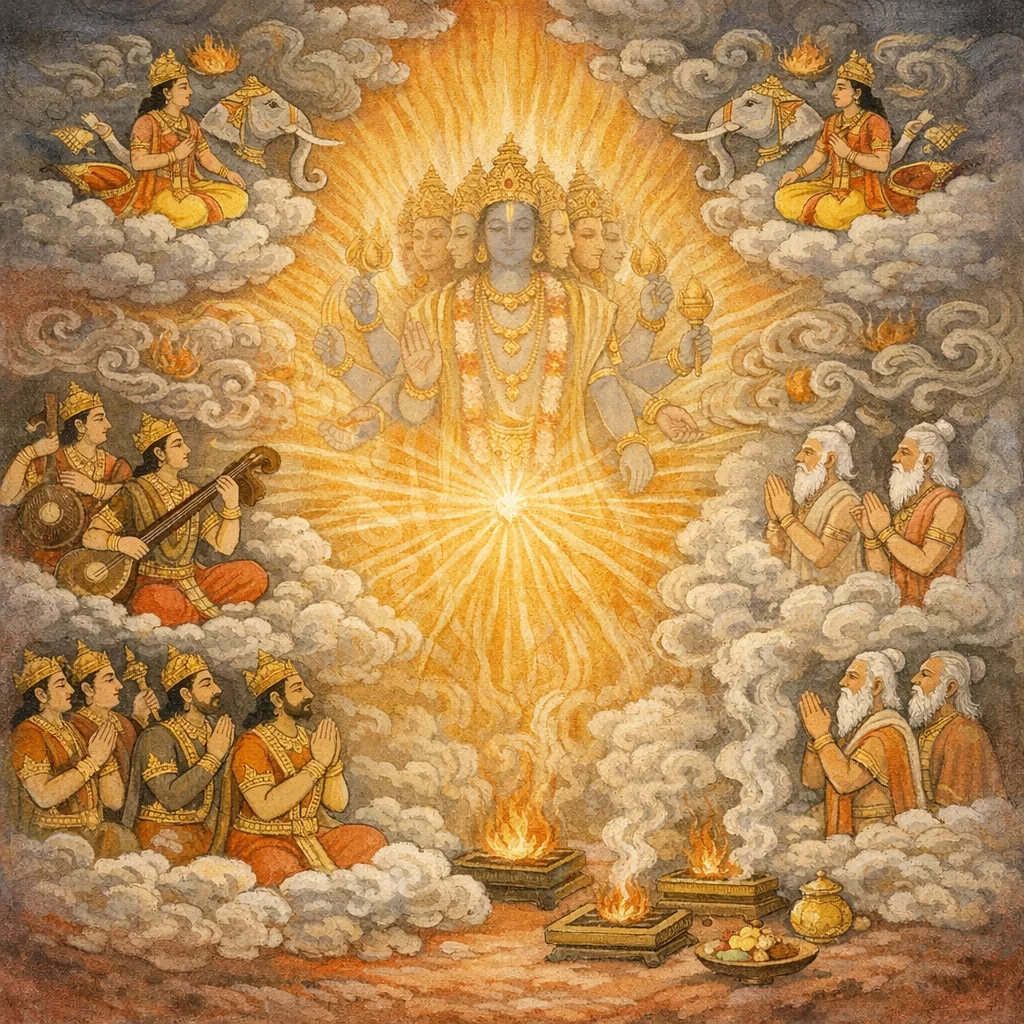
रुद्रादित्या वसवो ये च साध्या विश्वेऽश्विनौ मरुतश्चोष्मपाश्च । गन्धर्वयक्षासुरसिद्धसंघा वीक्षन्ते त्वां विस्मिताश्चैव सर्वे ॥
rudrādityā vasavo ye ca sādhyā viśve 'śvinau marutaś coṣmapāś ca | gandharva-yakṣāsura-siddha-saṅghā vīkṣante tvāṃ vismitāś caiva sarve ||

Rudras, Ādityas, Vasus, Sādhyas, the Viśvedevas, the Aśvins, Maruts, and the hosts of the Pitṛs, along with Gandharvas, Yakṣas, Asuras, and Siddhas—all of them gaze upon You, utterly amazed.
Rudras, Ādityas, Vasus, Sādhyas, Viśvedevas, the Aśvins, Maruts, and the hosts of the ‘warmth-drinkers’ (ancestors), along with Gandharvas, Yakṣas, Asuras, and Siddhas—all gaze upon You in amazement.
Rudras, Ādityas, Vasus, Sādhyas, Viśvedevas, the Aśvins, Maruts, and the Uṣmapas; and the companies of Gandharvas, Yakṣas, Asuras, and Siddhas—every one of them looks on you, astonished.
uṣmapāḥ is variously glossed in commentaries (often connected with pitṛs/ancestors or a class of beings). The list functions as a catalog of cosmological categories, emphasizing universality rather than sectarian taxonomy.
FAQs
Cataloging many classes of beings can be read as the mind’s attempt to ‘map’ an overwhelming experience by naming familiar categories.
The verse implies that no single cosmic tier is ultimate; all are encompassed within a more fundamental reality manifested as the cosmic form.
It expands the scope of the vision to include Vedic and epic-era cosmology, signaling continuity with earlier religious imaginaries.
It can be approached as a reminder to interpret traditions within their symbolic cosmologies, translating ‘orders of beings’ into layers of experience or values when reading today.