
Bhagavad Gita — Vishwarupa Darshana Yoga, Shloka 7
Vishwarupa Darshana Yoga
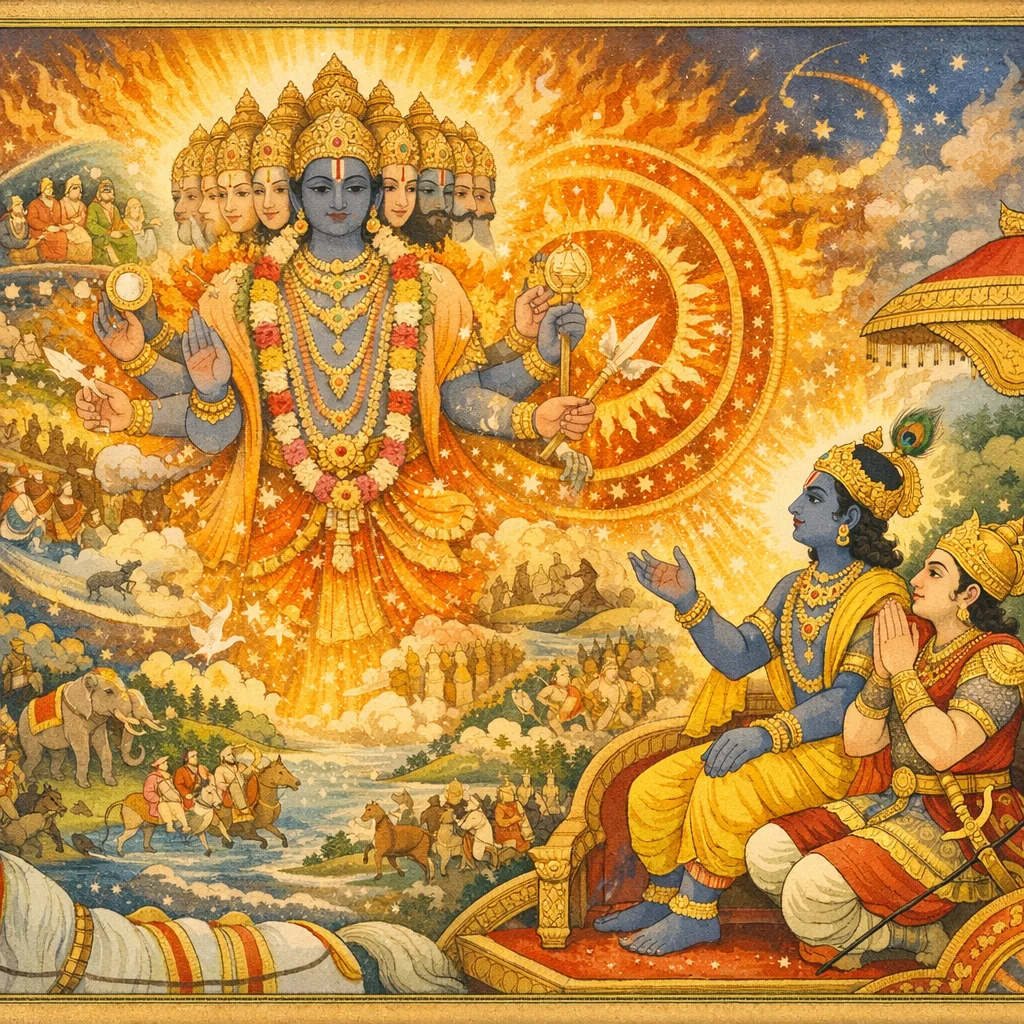
इहैकस्थं जगत्कृत्स्नं पश्याद्य सचराचरम् । मम देहे गुडाकेश यच्चान्यद् द्रष्टुमिच्छसि ॥ ११.७ ॥
ihaikasthaṃ jagat kṛtsnaṃ paśyādya sacarācaram | mama dehe guḍākeśa yac cānyad draṣṭum icchasi || 11.7 ||

Behold here, O Gudakesha, in My body, the entire universe—moving and unmoving—gathered in one place; and whatever else you desire to see, behold that too.
हे गुडाकेश! अब मेरे शरीर में एक ही स्थान पर स्थित सम्पूर्ण जगत् को—चर और अचर सहित—देख; और जो कुछ भी तू और देखना चाहता है, वह भी (यहीं) देख।
Here, today, behold in my body the entire universe gathered in one place—moving and unmoving; and whatever else you wish to see, see that as well (here).
“मम देहे” is often rendered devotionally as “in My divine body,” while a more literal academic rendering keeps “in my body.” “इहैकस्थं” emphasizes simultaneity and condensation of multiplicity into a single locus, a key feature of the theophany.
FAQs
The verse frames a shift from ordinary, fragmented perception to an integrative perception where many experiences are seen as belonging to a single, coherent whole.
It presents a theophany in which the universe is portrayed as grounded in the divine person, suggesting a cosmology where multiplicity depends upon a single underlying reality (Īśvara).
It introduces the climax of Chapter 11: Krishna invites Arjuna to witness the universal form, expanding the narrative from counsel to direct visionary disclosure.
As a reflective practice, it can support seeing diverse roles, events, and beings as interconnected rather than isolated, reducing reactive narrowness in decision-making.