
Bhagavad Gita — Vishwarupa Darshana Yoga, Shloka 48
Vishwarupa Darshana Yoga
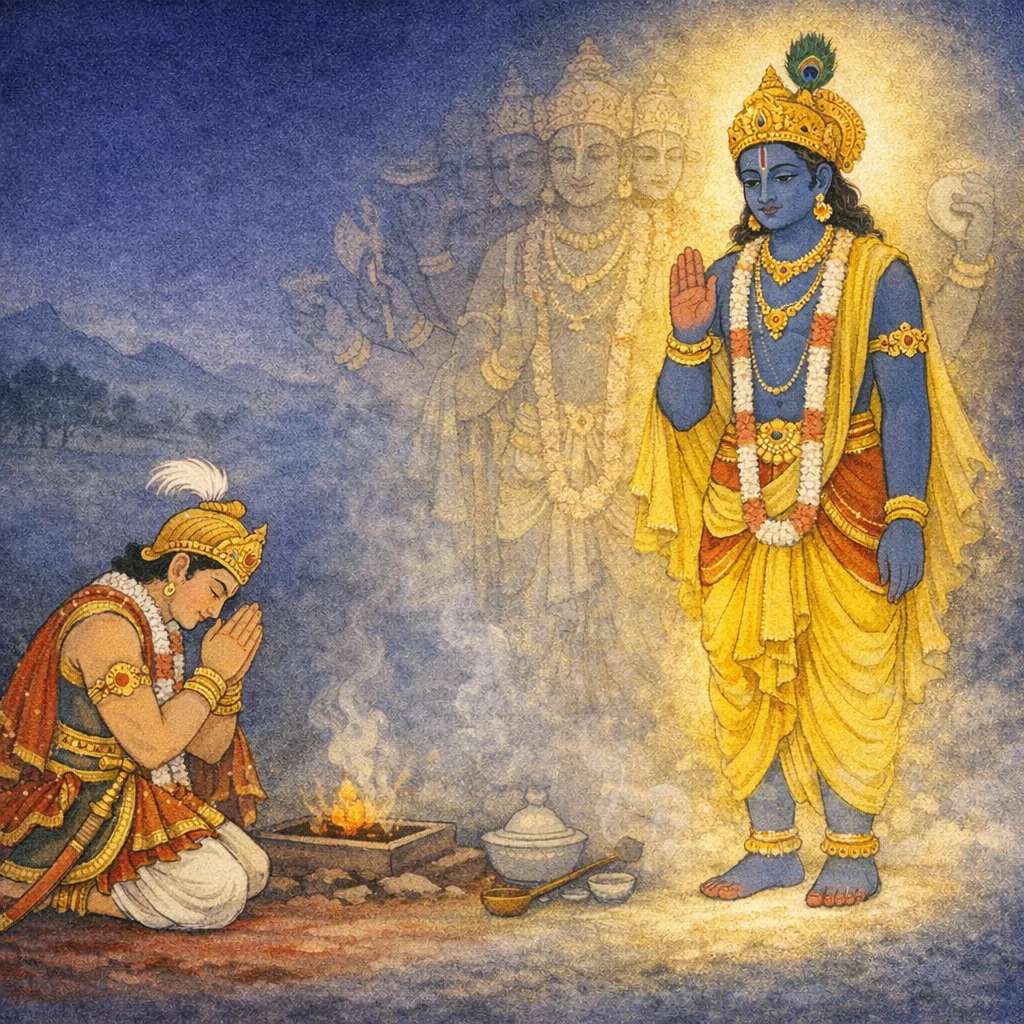
न वेदयज्ञाध्ययनैर्न दानैर्न च क्रियाभिर्न तपोभिरुग्रैः । एवंरूपः शक्य अहं नृलोके द्रष्टुं त्वदन्येन कुरुप्रवीर ॥ ११.४८ ॥
na vedayajñādhyayanair na dānair na ca kriyābhir na tapobhir ugraiḥ | evaṁrūpaḥ śakya ahaṁ nṛloke draṣṭuṁ tvadanyena kurupravīra || 11.48 ||

Neither by Vedic study, nor by sacrifices, nor by gifts, nor by rituals, nor by fierce austerities can I be seen in this form in the human world by anyone other than you, O foremost of the Kurus.
Not by Vedic study, sacrifices, gifts, rituals, nor by severe austerities can I be seen in this form in the human world by anyone other than you, O best of the Kurus.
Not by Veda-and-sacrifice study, nor by gifts, nor by ritual acts, nor by harsh austerities is it possible in the human realm to see me in such a form—by anyone other than you, hero of the Kurus.
Traditional translations often group ‘Veda, sacrifice, study’ as standard religious means; academic renderings highlight the rhetorical negation of multiple soteriological routes, intensifying the claim that the vision is not mechanically produced by merit.
FAQs
The verse challenges the assumption that intense practice guarantees peak experience, emphasizing instead the unpredictability of insight and the need to avoid spiritual overconfidence.
It suggests that the divine in its all-encompassing mode is not an object among objects, and therefore not fully accessible through ordinary means of religious action alone.
Krishna contrasts conventional religious disciplines with the singular nature of Arjuna’s encounter, preparing the shift toward devotion as the privileged means in the next chapter.
A practical reading is to value disciplined practice while recognizing that ethical maturity and inner readiness matter as much as external performance.