
Bhagavad Gita — Vishwarupa Darshana Yoga, Shloka 9
Vishwarupa Darshana Yoga
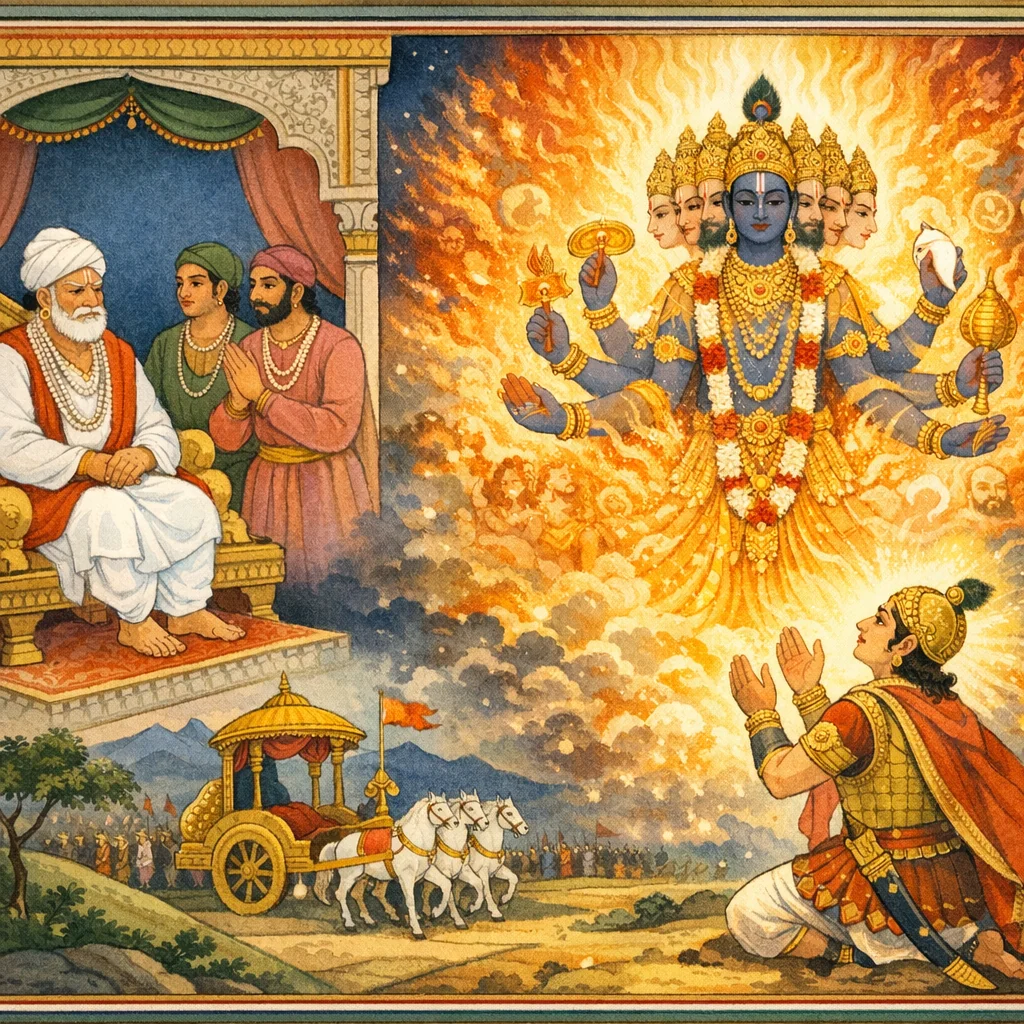
संजय उवाच । एवमुक्त्वा ततो राजन्महायोगेश्वरो हरिः दर्शयामास पार्थाय परमं रूपमैश्वरम् ॥ ११.९ ॥
sañjaya uvāca | evam uktvā tato rājan mahāyogeśvaro hariḥ | darśayām āsa pārthāya paramaṃ rūpam aiśvaram || 11.9 ||

Sanjaya said: O King, having thus spoken, then the great Lord of Yoga, Hari, revealed to Partha His supreme, majestic form.
संजय ने कहा—हे राजन्! ऐसा कहकर तत्पश्चात् महायोगेश्वर हरि ने पार्थ को अपना परम ऐश्वर्ययुक्त रूप दिखलाया।
Sañjaya said: Having spoken thus, O king, Hari, the great lord of yoga, then showed Pārtha the supreme, lordly form.
Narrative framing is foregrounded: Sañjaya reports to Dhṛtarāṣṭra. “महायोगेश्वर” is often read theologically, but academically it can be taken as a title marking Krishna’s mastery over extraordinary manifestation (yoga) in epic idiom.
FAQs
The verse emphasizes mediated experience: profound events are often known through trusted testimony, shaping belief and meaning beyond direct perception.
It frames the universal form as an intentional disclosure, not a random phenomenon—suggesting a reality that can be revealed in accordance with divine agency.
Sañjaya’s voice re-enters to mark the start of the vision proper and to remind the listener (Dhṛtarāṣṭra) of the unfolding battlefield dialogue.
It invites reflection on how narratives and reliable reporting shape our understanding of transformative experiences in history, religion, and psychology.