
Bhagavad Gita — Vishwarupa Darshana Yoga, Shloka 4
Vishwarupa Darshana Yoga
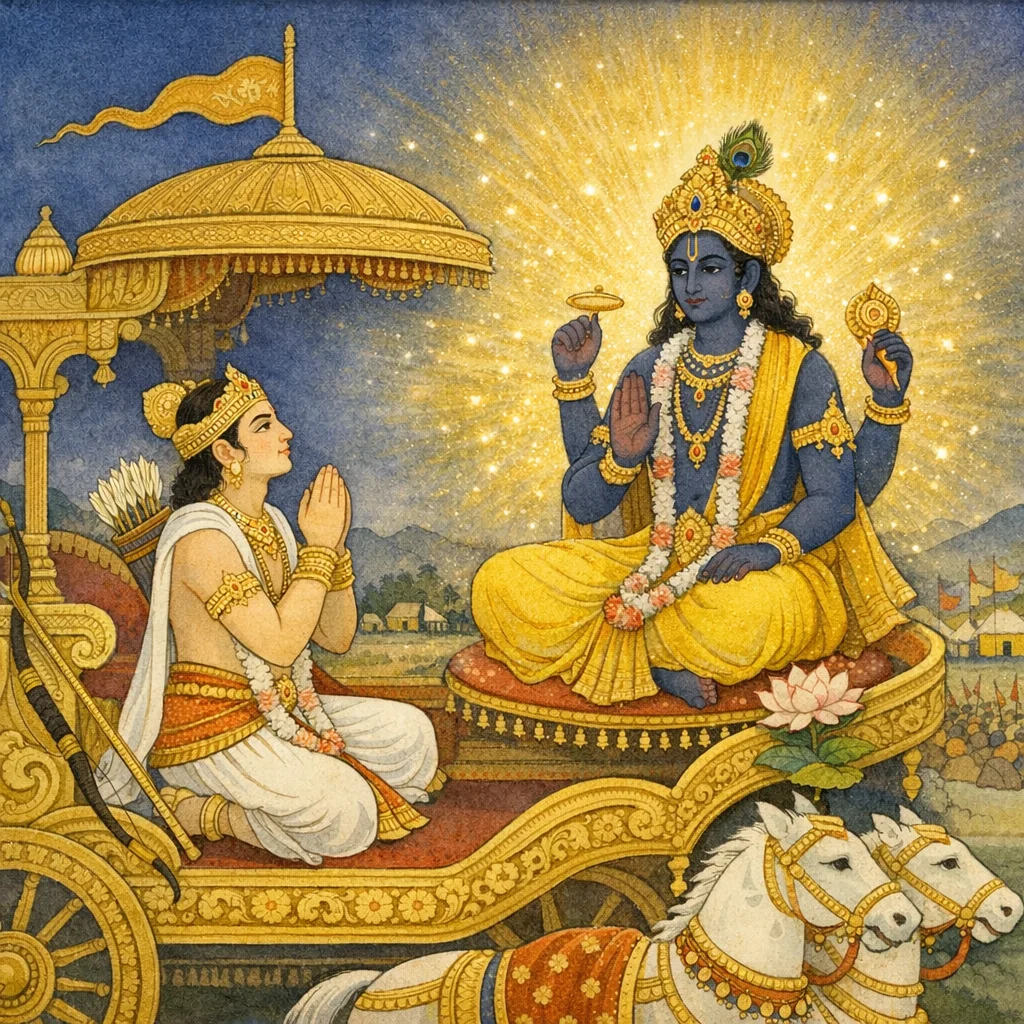
मन्यसे यदि तच्छक्यं मया द्रष्टुमिति प्रभो । योगेश्वर ततो मे त्वं दर्शयात्मानमव्ययम् ॥ ११.४ ॥
manyase yadi tac chakyaṁ mayā draṣṭum iti prabho | yogeśvara tato me tvaṁ darśayātmānam avyayam || 11.4 ||

If You deem it possible for me to behold that, O Lord—O Yogeshvara—then reveal to me Your imperishable Self.
हे प्रभो! यदि आप मानते हैं कि मेरे द्वारा वह रूप देखा जा सकता है, तो हे योगेश्वर! आप मुझे अपना अव्यय स्वरूप दिखाइये।
If you think it possible for me to see it, O Lord—then, O master of yoga, show me your imperishable self.
The verse is stable. ‘Yogeśvara’ underscores Krishna’s mastery of yogic power/discipline; ‘avyayam’ emphasizes that what is to be shown is not subject to decay, even if expressed in a form.
FAQs
Arjuna acknowledges limits and asks for support—an adaptive stance where aspiration is paired with realism and reliance on guidance.
It suggests that perceiving ultimate reality requires more than ordinary perception; it depends on an enabling condition associated with yogic mastery.
This verse intensifies the request and implicitly invites Krishna’s response about special perception (divine sight) that follows shortly.
It can be applied as a model for learning difficult subjects: recognize constraints and seek methods/tools that make deeper understanding possible.