
Bhagavad Gita — Vishwarupa Darshana Yoga, Shloka 5
Vishwarupa Darshana Yoga
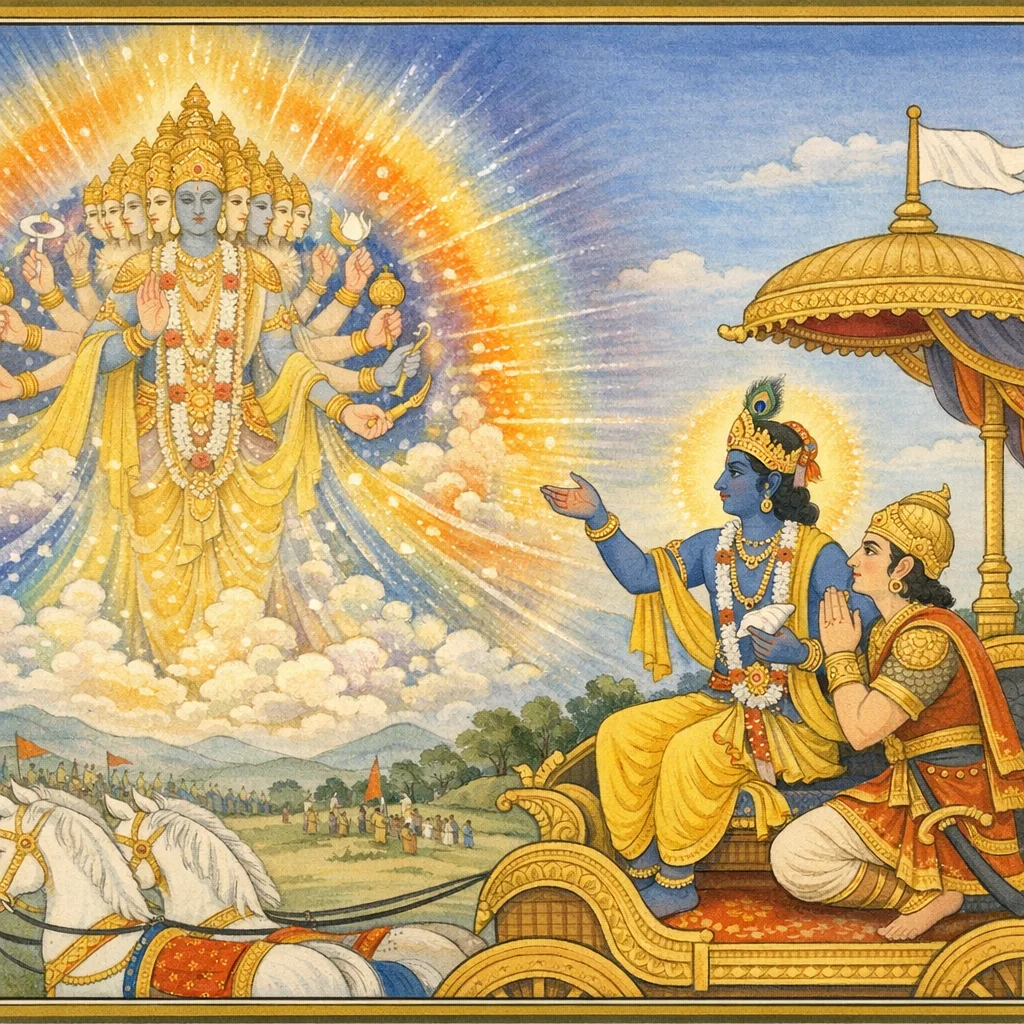
श्रीभगवानुवाच । पश्य मे पार्थ रूपाणि शतशोऽथ सहस्रशः नानाविधानि दिव्यानि नानावर्णाकृतीनि च ॥ ११.५ ॥
śrī-bhagavān uvāca | paśya me pārtha rūpāṇi śataśo 'tha sahasraśaḥ nānā-vidhāni divyāni nānā-varṇākṛtīni ca || 11.5 ||

The Blessed Lord said: Behold, O Partha, My forms—by the hundreds and by the thousands—manifold, divine, of various kinds, and of diverse colors and shapes.
श्रीभगवान् बोले—हे पार्थ! मेरे सैकड़ों-हजारों प्रकार के दिव्य रूपों को देखो, जो नाना प्रकार के और नाना रंग-आकृतियों वाले हैं।
The Blessed Lord said: Behold my forms, O son of Pṛthā—by the hundreds and thousands—diverse, divine, and of many colors and shapes.
The verse is textually stable. Interpretively, “forms” can be read as symbolic modalities of the divine or as a visionary phenomenology describing a theophanic experience.
FAQs
As a phenomenology of awe, the verse portrays an expanded perception in which ordinary categories multiply and intensify, often associated with transformative insight.
It presents the divine as capable of manifesting innumerable forms without losing unity, suggesting a reality that is both one and richly expressive.
Krishna begins the revelation narrative by directing Arjuna’s attention to a vast spectrum of divine appearances.
It can encourage appreciation of diversity—different ‘forms’ of excellence or meaning—while maintaining a sense of underlying coherence.