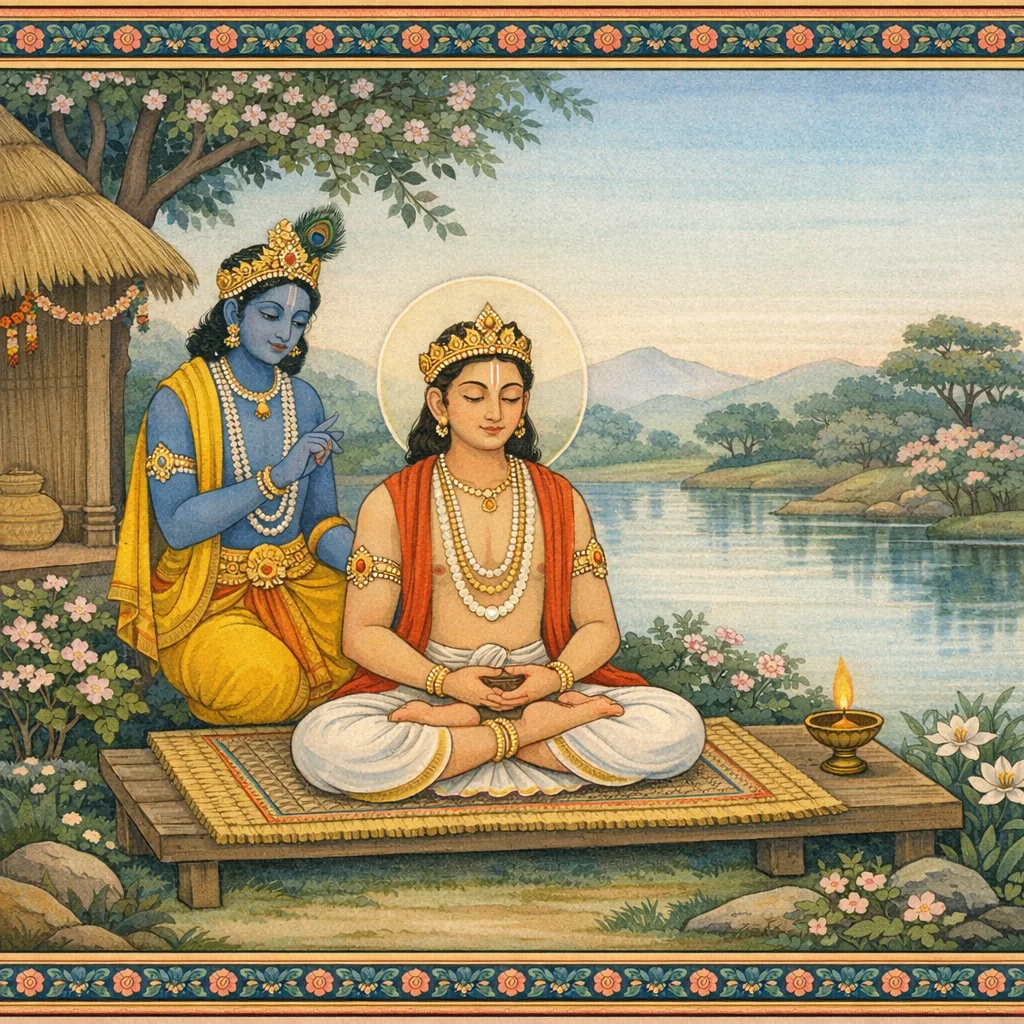
Chapter 6: Atma Samyama Yoga
ध्यानयोग
The Yoga of Meditation
Chapter 6 systematizes Dhyāna Yoga as a disciplined method for stabilizing the mind and realizing the Self, while integrating it with karma performed without attachment. Krishna reframes renunciation as inner relinquishment of egoic intention rather than mere withdrawal from action, establishing that authentic yoga requires the abandonment of self-centered resolve. He outlines a practical contemplative regimen—solitude, moderation, posture, and one-pointed attention—aimed at citta-nirodha (restraint of mental fluctuation). The philosophical arc moves from ethical self-governance (the self as friend or enemy) to experiential samādhi, described as an inward, supra-sensory happiness and unshakable steadiness amid opposites. The yogin’s vision culminates in universal sameness and devotionally grounded union: seeing the Divine everywhere and all beings in the Self. Arjuna’s concern about mental restlessness elicits Krishna’s core psychology: mastery is difficult yet attainable through sustained practice (abhyāsa) and dispassion (vairāgya). The chapter closes with reassurance about spiritual continuity across lives and a hierarchy that esteems the devoted, inwardly absorbed yogin as foremost.
Speakers
Key Concepts
Philosophical Constructs
Shlokas in Chapter 6
Verse 1
श्रीभगवानुवाच । अनाश्रितः कर्मफलं कार्यं कर्म करोति यः स संन्यासी च योगी च न निरग्निर्न चाक्रियः ॥
The Blessed Lord said: He who performs the duty that ought to be done without depending on the fruit of action—he is a sannyāsī and a yogī; not he who merely gives up the sacred fire, nor he who merely abstains from action.
Verse 2
यं संन्यासमिति प्राहुर्योगं तं विद्धि पाण्डव । न ह्यसंन्यस्तसंकल्पो योगी भवति कश्चन ॥ ६.२ ॥
O Pāṇḍava, know that what is called sannyāsa is indeed yoga; for no one becomes a yogī without renouncing sankalpa (self-willed intentions and desires).
Verse 3
आरुरुक्षोर्मुनेर्योगं कर्म कारणमुच्यते । योगारूढस्य तस्यैव शमः कारणमुच्यते ॥ ६.३ ॥
For the sage who seeks to ascend to yoga, action is said to be the means; and for the same one who has ascended to yoga, serenity (śama—quietude of mind) is said to be the means.
Verse 4
यदा हि नेन्द्रियार्थेषु न कर्मस्वनुषज्जते । सर्वसंकल्पसंन्यासी योगारूढस्तदोच्यते ॥ ६.४ ॥
When one is not attached either to sense-objects or to actions, and has wholly renounced all volitional imaginings (saṅkalpas), then one is said to have ascended to Yoga (yogārūḍha).
Verse 5
उद्धरेदात्मनात्मानं नात्मानमवसादयेत् । आत्मैव ह्यात्मनो बन्धुरात्मैव रिपुरात्मनः ॥ ६.५ ॥
Let a person uplift oneself by oneself; let one not degrade oneself. For the Self alone is one’s friend, and the Self alone is one’s enemy.
Verse 6
बन्धुरात्मात्मनस्तस्य येनात्मैवात्मना जितः । अनात्मनस्तु शत्रुत्वे वर्तेतात्मैव शत्रुवत् ॥ ६.६ ॥
For one who has conquered oneself by oneself, the Self is a friend; but for one who has not conquered oneself, the Self remains in enmity, like an enemy.
Verse 7
जितात्मनः प्रशान्तस्य परमात्मा समाहितः । शीतोष्णसुखदुःखेषु तथा मानापमानयोः ॥ ६.७ ॥
For the self-controlled and tranquil one, the Supreme Self is firmly established; one remains even-minded amid cold and heat, pleasure and pain, and honor and dishonor.
Verse 8
ज्ञानविज्ञानतृप्तात्मा कूटस्थो विजितेन्द्रियः । युक्त इत्युच्यते योगी समलोष्टाश्मकाञ्चनः ॥ ६.८ ॥
The yogī whose inner being is satisfied with knowledge and realized wisdom, who is steadfast and free from change, who has conquered the senses—such a one is called united (yukta); to whom a clod of earth, a stone, and gold are the same.
Verse 9
सुहृन्मित्रार्युदासीनमध्यस्थद्वेष्यबन्धुषु । साधुष्वपि च पापेषु समबुद्धिर्विशिष्यते ॥ ६.९ ॥
He excels whose understanding is equal toward the well-wisher, the friend, the foe, the indifferent, the mediator, the hateful, and the kinsman—and likewise toward the righteous and the sinful.
Verse 10
योगी युञ्जीत सततमात्मानं रहसि स्थितः । एकाकी यतचित्तात्मा निराशीरपरिग्रहः ॥ ६.१० ॥
Let the yogin constantly unite the mind with the Self, abiding in solitude; alone, with mind and body disciplined, free from hope and free from possessiveness.
Verse 11
शुचौ देशे प्रतिष्ठाप्य स्थिरमासनमात्मनः । नात्युच्छ्रितं नातिनीचं चैलाजिनकुशोत्तरम् ॥ ६.११ ॥
In a clean place, having established for himself a firm seat—neither too high nor too low—covered with cloth, deerskin, and kuśa grass.
Verse 12
तत्रैकाग्रं मनः कृत्वा यतचित्तेन्द्रियक्रियः । उपविश्यासने युञ्ज्याद्योगमात्मविशुद्धये ॥ ६.१२ ॥
There, seated on the seat, making the mind one-pointed, restraining the activities of mind and senses, let him practice yoga for the purification of the self.
Verse 13
समं कायशिरोग्रीवं धारयन्नचलं स्थिरः । सम्प्रेक्ष्य नासिकाग्रं स्वं दिशश्चानवलोकयन् ॥ ६.१३ ॥
Holding the body, head, and neck erect and steady, unmoving; gazing at the tip of his own nose, not looking around in any direction.
Verse 14
प्रशान्तात्मा विगतभीर्ब्रह्मचारिव्रते स्थितः । मनः संयम्य मच्चित्तो युक्त आसीत मत्परः ॥ ६.१४ ॥
With the inner being pacified, free from fear, established in the vow of brahmacarya, restraining the mind, fixing the consciousness in Me, and regarding Me as the supreme goal—let him sit, united in Yoga, devoted to Me alone.
Verse 15
युञ्जन्नेवं सदात्मानं योगी नियतमानसः । शान्तिं निर्वाणपरमां मत्संस्थामधिगच्छति ॥ ६.१५ ॥
Thus, constantly disciplining himself in Yoga, the yogin of restrained mind attains the supreme peace—nirvāṇa—abiding in Me, reaching Me.
Verse 16
नात्यश्नतस्तु योगोऽस्ति न चैकान्तमनश्नतः । न चाति स्वप्नशीलस्य जाग्रतो नैव चार्जुन ॥ ६.१६ ॥
Yoga is not for one who eats too much, nor for one who does not eat at all; nor, O Arjuna, for one who sleeps excessively, nor for one who is always awake.
Verse 17
युक्ताहारविहारस्य युक्तचेष्टस्य कर्मसु । युक्तस्वप्नावबोधस्य योगो भवति दुःखहा ॥ ६.१७ ॥
For one who is moderate in food and recreation, moderate in effort in actions, and moderate in sleep and wakefulness—Yoga becomes the destroyer of sorrow.
Verse 18
यदा विनियतं चित्तमात्मन्येवावतिष्ठते । निःस्पृहः सर्वकामेभ्यो युक्त इत्युच्यते तदा ॥ ६.१८ ॥
When the well-restrained mind abides in the Self alone, and one becomes free from longing for all desires—then one is said to be united in Yoga.
Verse 19
यथा दीपो निवातस्थो नेङ्गते सोपमा स्मृता । योगिनो यतचित्तस्य युञ्जतो योगमात्मनः ॥ ६.१९ ॥
As a lamp set in a windless place does not flicker—such is the simile remembered for the yogin of restrained mind, who is absorbed in the Yoga of the Self.
Verse 20
यत्रोपरमते चित्तं निरुद्धं योगसेवया । यत्र चैवात्मनात्मानं पश्यन्नात्मनि तुष्यति ॥ ६.२० ॥
Where the mind, restrained by the practice of Yoga, comes to rest; and where, seeing the Self by the self within the Self alone, one is satisfied in the Self.
Verse 21
सुखमात्यन्तिकं यत्तद् बुद्धिग्राह्यमतीन्द्रियम् । वेत्ति यत्र न चैवायं स्थितश्चलति तत्त्वतः ॥ ६.२१ ॥
That supreme bliss which is grasped by the intellect and is beyond the senses—knowing which, one established therein does not swerve from the Reality.
Verse 22
यं लब्ध्वा चापरं लाभं मन्यते नाधिकं ततः । यस्मिन्स्थितो न दुःखेन गुरुणापि विचाल्यते ॥ ६.२२ ॥
Having attained which, one deems no other gain greater than that; and established in which, one is not shaken even by grievous sorrow.
Verse 23
तं विद्यात् दुःखसंयोगवियोगं योगसंज्ञितम् ॥ ६.२३ ॥
Know that to be Yoga—the disunion from the union with sorrow.
Verse 24
स निश्चयेन योक्तव्यो योगोऽनिर्विण्णचेतसा । संकल्पप्रभवान्कामांस्त्यक्त्वा सर्वानशेषतः मनसैवेन्द्रियग्रामं विनियम्य समन्ततः ॥ ६.२४ ॥
This Yoga should be practiced with firm resolve and with a mind that does not grow weary; having completely renounced all desires born of imagination, and restraining the entire host of senses on every side by the mind alone.
Verse 25
शनैः शनैरुपरमेद् बुद्ध्या धृतिगृहीतया । आत्मसंस्थं मनः कृत्वा न किंचिदपि चिन्तयेत् ॥ ६.२५ ॥
Little by little, let him withdraw (the mind) by the intellect held steady through fortitude; having established the mind in the Self, let him not think of anything at all.
Verse 26
यतो यतो निश्चरति मनश्चञ्चलमस्थिरम् । ततस्ततो नियम्यैतदात्मन्येव वशं नयेत् ॥ ६.२६ ॥
Wherever the restless and unsteady mind wanders, from there and there let him restrain it and bring it under control in the Self alone.
Verse 27
प्रशान्तमनसं ह्येनं योगिनं सुखमुत्तमम् । उपैति शान्तरजसं ब्रह्मभूतमकल्मषम् ॥ ६.२७ ॥
Supreme bliss comes to that yogin whose mind is perfectly tranquil—whose rajas has been stilled, who has become Brahman, and who is free from sin.
Verse 28
युञ्जन्नेवं सदात्मानं योगी विगतकल्मषः । सुखेन ब्रह्मसंस्पर्शमत्यन्तं सुखमश्नुते ॥ ६.२८ ॥
Thus, ever disciplining himself, the yogin—freed from impurities—easily attains the boundless bliss that arises from the touch of Brahman.
Verse 29
सर्वभूतस्थमात्मानं सर्वभूतानि चात्मनि । ईक्षते योगयुक्तात्मा सर्वत्र समदर्शनः ॥ ६.२९ ॥
The yogin, whose self is united in yoga, beholds the Self abiding in all beings, and all beings abiding in the Self; he sees with equal vision everywhere.
Verse 30
यो मां पश्यति सर्वत्र सर्वं च मयि पश्यति । तस्याहं न प्रणश्यामि स च मे न प्रणश्यति ॥ ६.३० ॥
He who sees Me everywhere and sees everything in Me—never do I become lost to him, and he is never lost to Me.
Verse 31
सर्वभूतस्थितं यो मां भजत्येकत्वमास्थितः । सर्वथा वर्तमानोऽपि स योगी मयि वर्तते ॥ ६.३१ ॥
He who worships Me as abiding in all beings, established in oneness—though he moves about in every way, that yogin abides in Me.
Verse 32
आत्मौपम्येन सर्वत्र समं पश्यति योऽर्जुन । सुखं वा यदि वा दुःखं स योगी परमो मतः ॥ ६.३२ ॥
O Arjuna, he is held to be the supreme yogin who, by comparing with himself, sees equality everywhere—whether in pleasure or in pain.
Verse 33
अर्जुन उवाच । योऽयं योगस्त्वया प्रोक्तः साम्येन मधुसूदन एतस्याहं न पश्यामि चञ्चलत्वात्स्थितिं स्थि...
Arjuna said: O Madhusūdana, this yoga of equanimity taught by You—I do not see its steady continuance, because of the mind’s restlessness.
Verse 34
चञ्चलं हि मनः कृष्ण प्रमाथि बलवद्दृढम् । तस्याहं निग्रहं मन्ये वायोरिव सुदुष्करम् ॥ ६.३४ ॥
Arjuna said: For the mind, O Kṛṣṇa, is indeed restless, turbulent, strong, and obstinate; I deem its restraint to be exceedingly difficult—like restraining the wind.
Verse 35
श्रीभगवानुवाच । असंशयं महाबाहो मनो दुर्निग्रहं चलम् अभ्यासेन तु कौन्तेय वैराग्येण च गृह्यते ॥ ६.३५...
The Blessed Lord said: Undoubtedly, O mighty-armed one, the mind is restless and hard to restrain; but, O son of Kuntī, it is mastered by practice and by dispassion.
Verse 36
असंयतात्मना योगो दुष्प्राप इति मे मतिः । वश्यात्मना तु यतता शक्योऽवाप्तुमुपायतः ॥ ६.३६ ॥
In My view, yoga is difficult to attain for one whose self is uncontrolled; but for one who is self-controlled and strives, it can be attained by proper means.
Verse 37
अर्जुन उवाच । अयतिः श्रद्धयोपेतो योगाच्चलितमानसः अप्राप्य योगसंसिद्धिं कां गतिं कृष्ण गच्छति ॥ ६.३...
Arjuna said: One who lacks steadfast discipline, yet is endowed with faith, whose mind has strayed from yoga—without attaining perfection in yoga, what end does he reach, O Kṛṣṇa?
Verse 38
कच्चिन्नोभयविभ्रष्टश्छिन्नाभ्रमिव नश्यति । अप्रतिष्ठो महाबाहो विमूढो ब्रह्मणः पथि ॥ ६.३८ ॥
O mighty-armed one, fallen away from both, without support, deluded on the path to Brahman—does he not perish like a cloud torn asunder?
Verse 39
एतन्मे संशयं कृष्ण छेत्तुमर्हस्यशेषतः । त्वदन्यः संशयस्यास्य छेत्ता न ह्युपपद्यते ॥ ६.३९ ॥
O Kṛṣṇa, you alone are worthy to dispel this doubt of mine completely; for none other than You can be the remover of this doubt.
Verse 40
श्रीभगवानुवाच । पार्थ नैवेह नामुत्र विनाशस्तस्य विद्यते । न हि कल्याणकृत्कश्चिद्दुर्गतिं तात गच्छति ॥ ६.४० ॥
The Blessed Lord said: O Pārtha, for him there is no ruin either here or hereafter; for one who does good, dear one, never goes to an evil state.
Verse 41
प्राप्य पुण्यकृतां लोकानुषित्वा शाश्वतीः समाः । शुचीनां श्रीमतां गेहे योगभ्रष्टोऽभिजायते ॥ ६.४१ ॥
Having attained the worlds of the righteous and dwelling there for many years, one who has fallen from yoga is born again in the house of the pure and the prosperous.
Verse 42
अथवा योगिनामेव कुले भवति धीमताम् । एतद्धि दुर्लभतरं लोके जन्म यदीदृशम् ॥ ६.४२ ॥
Or else he is born in the family of wise yogins; indeed, such a birth as this is rarer in this world.
Verse 43
तत्र तं बुद्धिसंयोगं लभते पौर्वदेहिकम् । यतते च ततो भूयः संसिद्धौ कुरुनन्दन ॥ ६.४३ ॥
There he regains the union with that understanding from the former body, and from that point he strives again for perfection, O joy of the Kurus.
Verse 44
पूर्वाभ्यासेन तेनैव ह्रियते ह्यवशोऽपि सः । जिज्ञासुरपि योगस्य शब्दब्रह्मातिवर्तते ॥ ६.४४ ॥
By that very former practice, he is indeed borne onward, even against his will; and even one who merely longs to know Yoga transcends the realm of the Vedic word (ritualistic injunctions).
Verse 45
प्रयत्नाद्यतमानस्तु योगी संशुद्धकिल्बिषः । अनेकजन्मसंसिद्धस्ततो याति परां गतिम् ॥ ६.४५ ॥
But the yogin who strives with earnest effort, his sins purified, perfected through many births—then he attains the supreme Goal.
Verse 46
तपस्विभ्योऽधिको योगी ज्ञानिभ्योऽपि मतोऽधिकः । कर्मिभ्यश्चाधिको योगी तस्माद्योगी भवार्जुन ॥ ६.४६ ॥
The yogin is held to be superior to ascetics, and even superior to the men of knowledge; the yogin is also superior to the men of action. Therefore, O Arjuna, become a yogin.
Verse 47
योगिनामपि सर्वेषां मद्गतेनान्तरात्मना । श्रद्धावान् भजते यो मां स मे युक्ततमो मतः ॥ ६.४७ ॥
And among all yogins, he who worships Me with faith, with his inmost self absorbed in Me—he is deemed by Me to be the most perfectly united.
Frequently Asked Questions
The chapter presents a rigorous psychology of attention: the mind is naturally restless, but it can be trained through repeated practice (abhyāsa) and loosening compulsive craving (vairāgya). Inner stability arises from moderation, self-regulation, and returning attention to the chosen focus whenever it wanders.
It affirms the Self (Ātman) as the locus of abiding fulfillment and depicts realization as an inward, supra-sensory clarity in which one abides unshaken by opposites. This culminates in seeing the Self in all beings and the Divine everywhere, integrating contemplative insight with devotion.
It resolves the tension between action and renunciation by redefining renunciation as non-attachment to outcomes and egoic intention, not mere inactivity. The chapter also answers the fear of failure in yoga by teaching continuity of spiritual progress and providing a concrete method for mind-mastery.
Use the chapter as a focus-and-resilience protocol: keep routines moderate (sleep, food, stimulation), schedule short daily meditation, and practice “returning” attention without self-criticism. Apply non-attachment to results in work—commit to high-quality effort while reducing anxiety-driven fixation on outcomes.