
Bhagavad Gita — Dhyana Yoga, Shloka 8
Atma Samyama Yoga
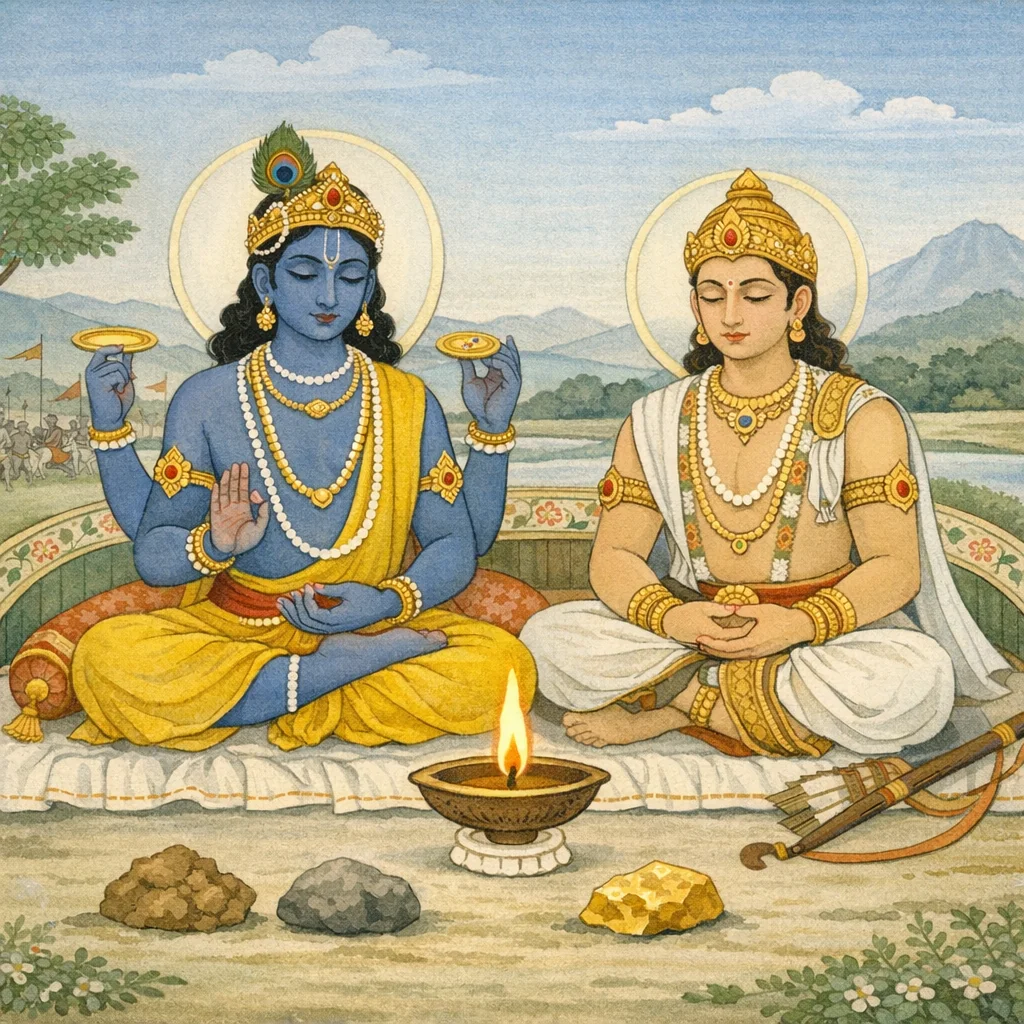
ज्ञानविज्ञानतृप्तात्मा कूटस्थो विजितेन्द्रियः । युक्त इत्युच्यते योगी समलोष्टाश्मकाञ्चनः ॥ ६.८ ॥
jñāna-vijñāna-tṛptātmā kūṭastho vijitendriyaḥ | yukta ity ucyate yogī sama-loṣṭāśma-kāñcanaḥ || 6.8 ||

The yogī whose inner being is satisfied with knowledge and realized wisdom, who is steadfast and free from change, who has conquered the senses—such a one is called united (yukta); to whom a clod of earth, a stone, and gold are the same.
जिसका अन्तःकरण ज्ञान-विज्ञान से तृप्त है, जो विकाररहित (कूटस्थ) है, जिसने इन्द्रियों को जीत लिया है और जिसके लिये मिट्टी, पत्थर और सोना समान हैं—वह योगी युक्त कहा जाता है।
The yogin whose self is satisfied with knowledge and realized understanding, who is unshaken and has conquered the senses, and to whom clod, stone, and gold are equal—he is called ‘integrated’ (yukta).
Most recensions read essentially the same. Interpretive divergence centers on kṣūṭastha/kūṭastha: devotional-traditional readings gloss it as ‘unchanging like an anvil’ or ‘established in the immutable Self,’ while academic-literal renderings keep ‘unshaken/immutable’ without importing later Vedāntic technicalities.
FAQs
The verse describes a stabilized personality: sensory impulses are regulated, and valuation of external objects (e.g., wealth) no longer drives mood and decision-making. This points to reduced reactivity and greater cognitive-emotional balance.
It frames yogic maturity as rooted in both conceptual knowledge (jñāna) and lived realization (vijñāna), culminating in an ‘unshaken’ stance associated with the Self’s constancy rather than changing experiences.
Within Chapter 6’s discussion of meditation, this verse characterizes the successful meditator: inner satisfaction and equanimity are presented as markers that practice has matured beyond technique into transformation.
It can be applied as a guideline for evaluating progress in contemplative practice: are choices less compulsive, and do status/possessions have less power to disturb one’s composure?