
Bhagavad Gita — Dhyana Yoga, Shloka 28
Atma Samyama Yoga
युञ्जन्नेवं सदात्मानं योगी विगतकल्मषः । सुखेन ब्रह्मसंस्पर्शमत्यन्तं सुखमश्नुते ॥ ६.२८ ॥
yuñjann evaṁ sadātmānaṁ yogī vigata-kalmaṣaḥ | sukhena brahma-saṁsparśam atyantaṁ sukham aśnute || 6.28 ||

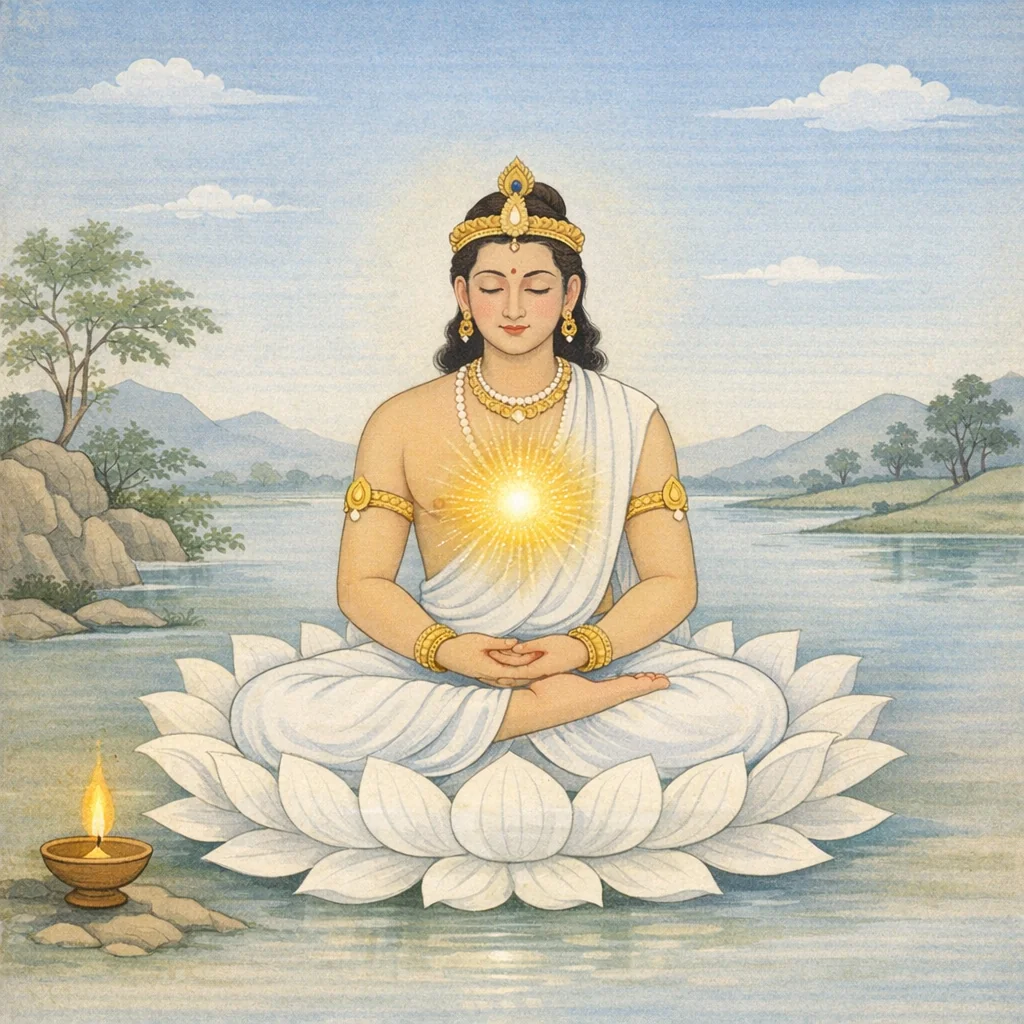
Thus, ever disciplining himself, the yogin—freed from impurities—easily attains the boundless bliss that arises from the touch of Brahman.
Thus constantly disciplining himself, the yogin, freed from impurities, easily attains the supreme bliss that comes from contact with Brahman.
In this way, continually yoking (the mind) to the Self, the yogin—whose defilements are removed—attains, with ease, the highest happiness consisting in the ‘touch’ (immediate experience) of Brahman.
Most traditional renderings read brahma-saṁsparśa as ‘communion/contact with Brahman’ and emphasize blessedness (ānanda). Academic translations often highlight the idiom of ‘touch’ as immediate realization rather than physical contact; no major variant is typically noted for this pāda.
FAQs
The verse frames well-being as a result of sustained mental training: repeated ‘yoking’ of attention to a stable center reduces mental ‘impurities’ (e.g., agitation, compulsive desire), enabling a more effortless, enduring contentment.
‘Brahma-saṁsparśa’ indicates immediate apprehension of ultimate reality (Brahman). The ‘highest happiness’ is not ordinary pleasure but a stable fulfillment associated with realization of the Self’s relation to Brahman.
This continues the chapter’s account of meditation (dhyāna) and inner discipline, describing the culmination of practice as purification and direct realization.
As a practical ethic of attention: regular contemplative practice, combined with moral self-regulation, is presented as a pathway to resilient well-being rather than short-lived gratification.