
Bhagavad Gita — Dhyana Yoga, Shloka 35
Atma Samyama Yoga
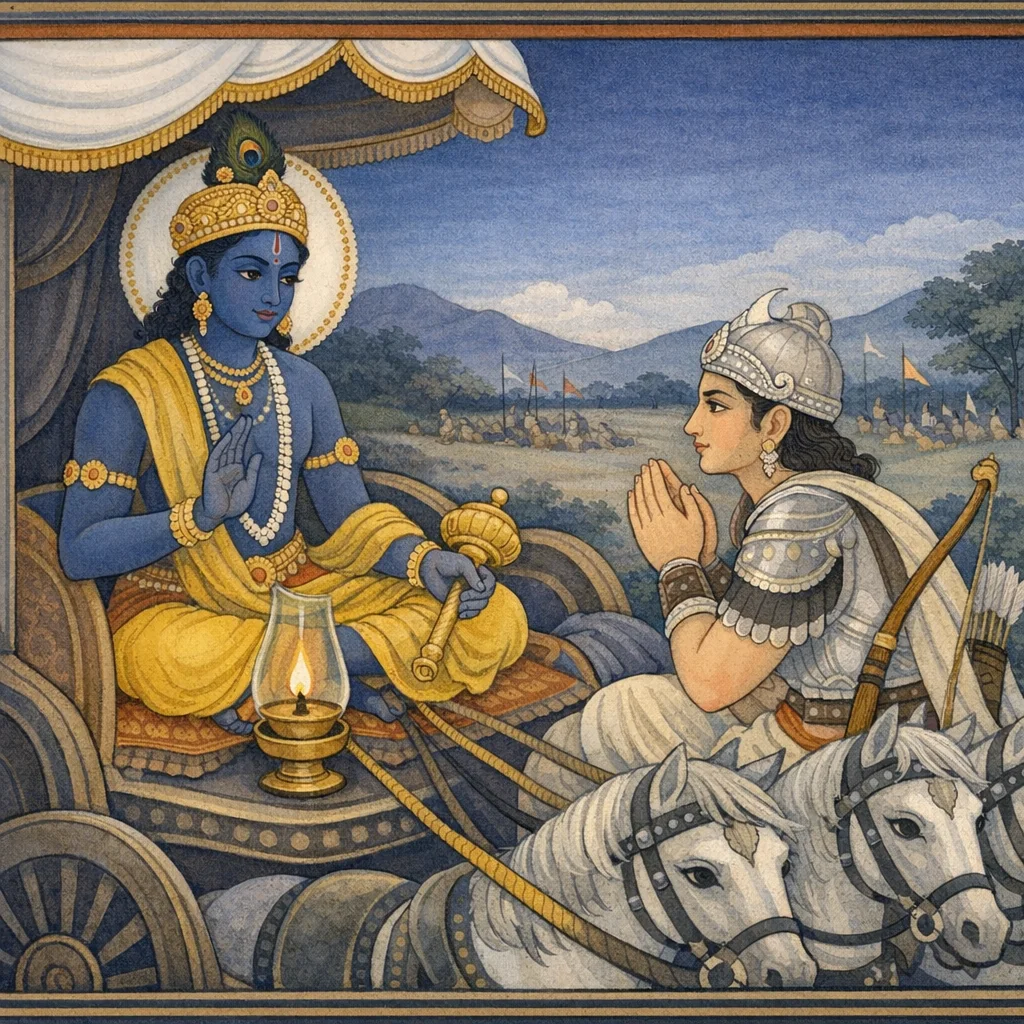
श्रीभगवानुवाच । असंशयं महाबाहो मनो दुर्निग्रहं चलम् अभ्यासेन तु कौन्तेय वैराग्येण च गृह्यते ॥ ६.३५...
śrī-bhagavān uvāca | asaṁśayaṁ mahā-bāho mano durnigrahaṁ calam | abhyāsena tu kaunteya vairāgyeṇa ca gṛhyate || 6.35 ||

The Blessed Lord said: Undoubtedly, O mighty-armed one, the mind is restless and hard to restrain; but, O son of Kuntī, it is mastered by practice and by dispassion.
The Blessed Lord said: Undoubtedly, O mighty-armed, the mind is difficult to restrain and restless; but it is controlled, O son of Kunti, by practice and dispassion.
The Lord said: Without doubt, O strong-armed one, the mind is hard to control and unsteady; yet, O Kaunteya, it is grasped/held by practice and by dispassion.
The input is truncated but the verse is well known and stable. ‘Gṛhyate’ (‘is grasped/held’) is sometimes rendered ‘is controlled’ or ‘is steadied,’ emphasizing training (abhyāsa) plus letting-go (vairāgya) as complementary.
FAQs
The verse proposes a paired strategy: repetition builds stability (skill acquisition), while dispassion reduces craving-based reinforcement that keeps attention scattered.
Methodologically, it implies that realization is not merely conceptual but requires transformation of mental habits; metaphysical insight is supported by disciplined cognition.
This is Krishna’s direct answer to Arjuna’s wind analogy: the difficulty is acknowledged, but a concrete path (practice + dispassion) is given.
It aligns with behavior change models: consistent training plus reducing triggers/attachments (e.g., simplifying inputs, moderating compulsive consumption) supports attention control.