
Bhagavad Gita — Dhyana Yoga, Shloka 4
Atma Samyama Yoga
यदा हि नेन्द्रियार्थेषु न कर्मस्वनुषज्जते । सर्वसंकल्पसंन्यासी योगारूढस्तदोच्यते ॥ ६.४ ॥
yadā hi nendriyārtheṣu na karmasv anuṣajjate | sarva-saṅkalpa-saṁnyāsī yogārūḍhas tadocyate || 6.4 ||

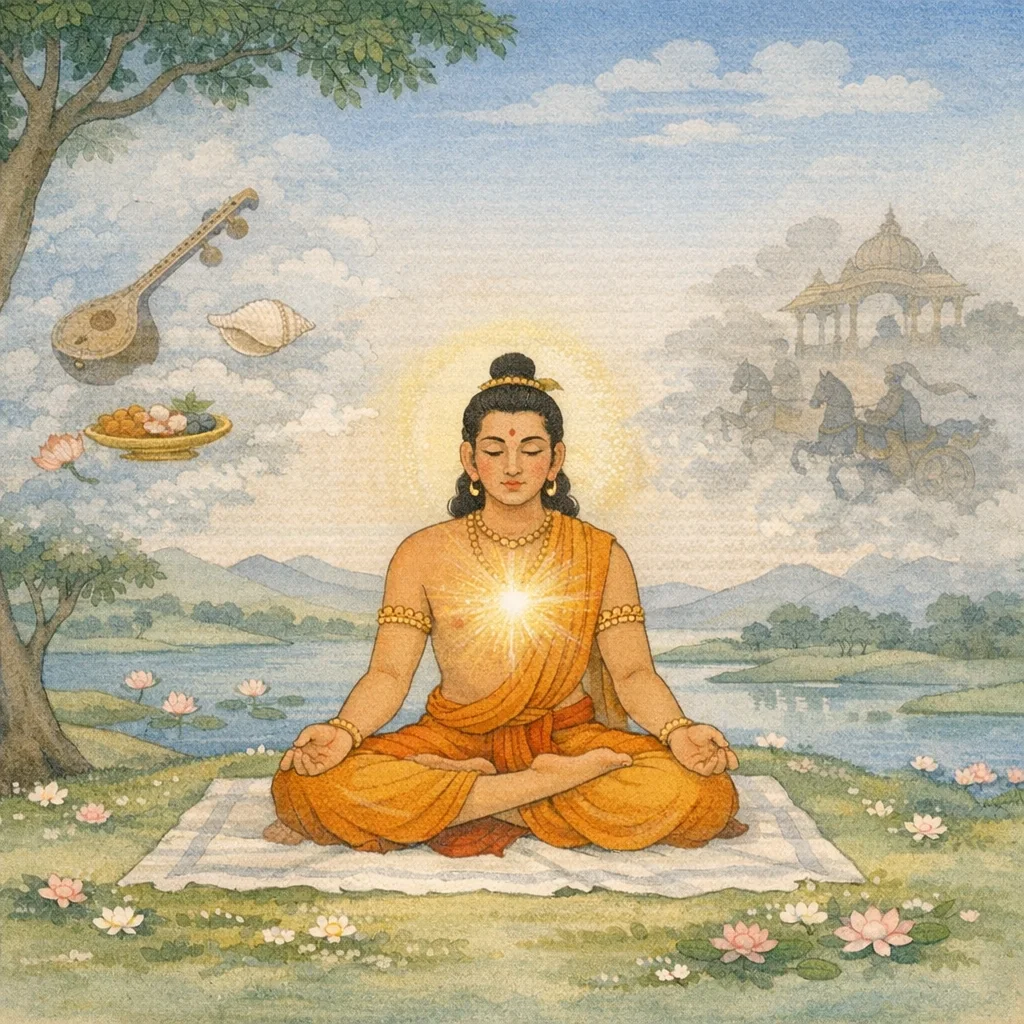
When one is not attached either to sense-objects or to actions, and has wholly renounced all volitional imaginings (saṅkalpas), then one is said to have ascended to Yoga (yogārūḍha).
जब (साधक) न इन्द्रिय-विषयों में और न कर्मों में आसक्त होता है तथा संकल्पों का सर्वथा त्यागी होता है, तब वह योगारूढ़ कहा जाता है।
When one is not attached either to sense-objects or to actions, and has renounced all volitional constructions (saṅkalpas), then one is said to be ‘ascended in yoga’ (yogārūḍha).
Interpretations vary on “not attached to actions”: it typically means absence of clinging and self-serving motivation, not the cessation of responsible activity in all contexts.
FAQs
It describes reduced compulsivity: the person no longer seeks identity or security through stimulation or achievement, indicating stable self-regulation.
Non-attachment is treated as a condition for clearer self-knowledge; when intention is purified of egoic projections, contemplation becomes stable.
It refines the earlier stage model (6.3) by stating the hallmark of being established in yoga: non-clinging to both pleasure-objects and action-identity.
Practice doing tasks without defining self-worth by outcomes; cultivate mindful consumption and reduce dependence on constant sensory input.