
Bhagavad Gita — Dhyana Yoga, Shloka 29
Atma Samyama Yoga
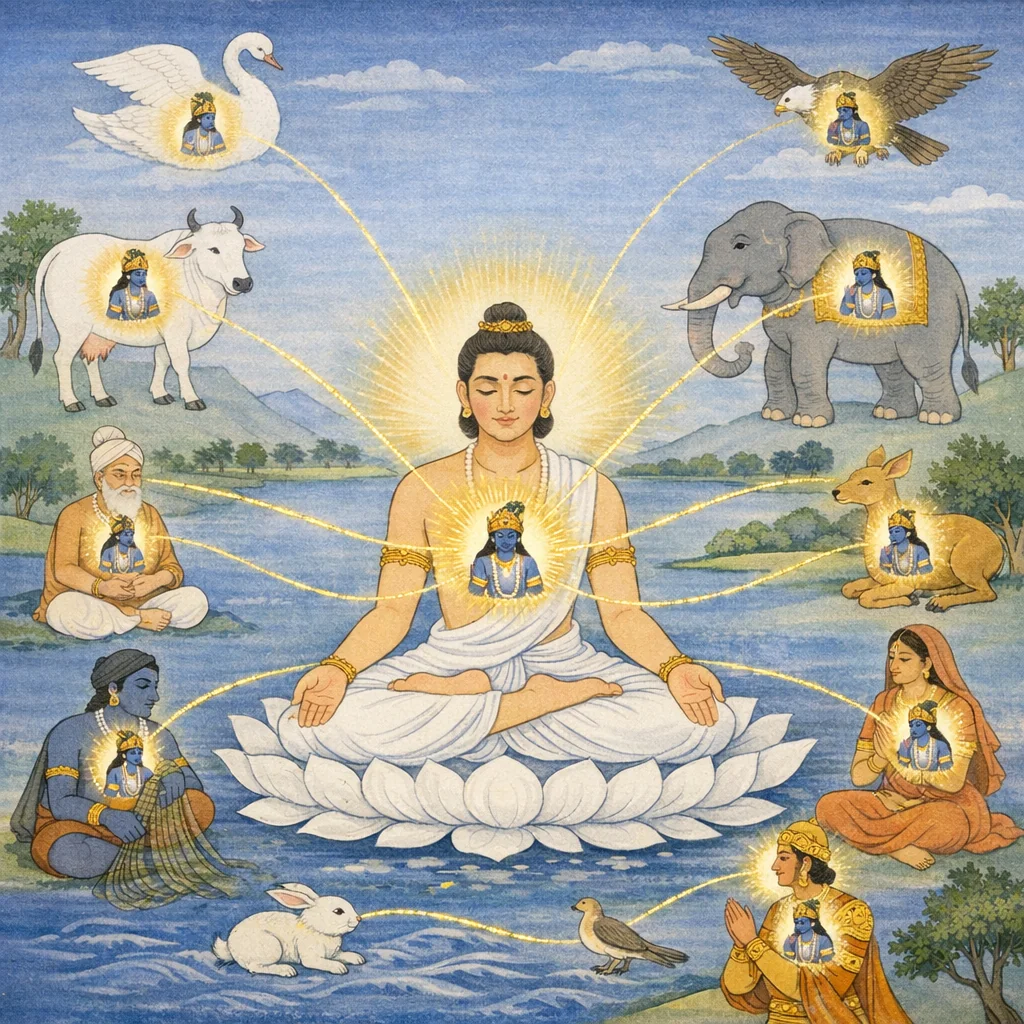
सर्वभूतस्थमात्मानं सर्वभूतानि चात्मनि । ईक्षते योगयुक्तात्मा सर्वत्र समदर्शनः ॥ ६.२९ ॥
sarva-bhūta-stham ātmānaṁ sarva-bhūtāni cātmani | īkṣate yoga-yuktātmā sarvatra sama-darśanaḥ || 6.29 ||

The yogin, whose self is united in yoga, beholds the Self abiding in all beings, and all beings abiding in the Self; he sees with equal vision everywhere.
The yogin, united with yoga, sees the Self abiding in all beings and all beings in the Self; he has equal vision everywhere.
The person whose self is integrated by yoga perceives the Self as present in all beings, and all beings as (present) in the Self—one who sees equally in all situations.
Traditional Vedāntic readings often stress non-dual insight (ātman identical with all). Some theistic commentators interpret the ‘Self in all’ as the Lord’s immanence; the grammar allows both, though the immediate context emphasizes yogic realization and ‘equal vision’ (sama-darśana).
FAQs
‘Equal vision’ can be read as reduced bias and reactivity: the trained mind recognizes commonality across persons and situations, supporting empathy and steadier judgment.
The verse articulates a pan-psychic or non-dual style of insight: the Self is not confined to one body-mind but is realized as universal, with beings understood within that same reality.
After describing meditative absorption and bliss, the text turns to the cognitive-ethical fruit of yoga: a transformed way of seeing self and others.
It supports practices that cultivate impartiality—e.g., mindfulness and compassion training—by grounding ethical regard in a perception of shared being or shared interiority.